The 2026 solar eclipse is the first total solar eclipse in continental Europe since the 21st century began. Basically, the European mainland will be reached only within the Iberian Peninsula, but with respect to it, this eclipse remains the most accessible totality by Europeans since 1999. In 2015, the total solar eclipse missed the continent as its path proceeded between the North Atlantic and the Norwegian Sea, and then through the Arctic Ocean. The only lands where people could experience the totality were the Faroe Islands and Svalbard, not to mention the isolated and uninhabited rock protrusion west of St. Kilda – Rockall, which belongs to the United Kingdom. There was another totality in 2006, which just missed the Greek islands (Crete, Rhodes), leaving them with obscuration of almost 99%, and passed over the Caucasus range, a controversial area in a geological sense, as it is considered part of the Asian mountain range.

Unlike the Great American Eclipse of 2024, this totality isn’t widely discussed as much, probably because the totality doesn’t reach many grounds over its path; however, we can find a couple of interesting links about this event:
https://eclipse2026.is/
https://eclipse262728.es/en/eclipse2026/
https://www.elgraneclipse.com/
And the general websites:
Michael Zeiler’s 2026 eclipse maps and information
Fred Espenak’s interactive 2026 solar eclipse map
Xavier Jubier’s interactive 2026 solar eclipse map
Yuk Tung Liu 2026 solar eclipse map
The longest duration of 2m18s occurs about 40km southwest of the western fiords, where the most extended duration on the ground is 2m13.2s. The eastern Mallorca will experience the shortest duration at the centerline – 1m 35.5s.
This website won’t cover only the section of totality, which has already been widely described in other services on other occasions. It will focus on the totality extension below the horizon within the central Russia and Mediterranean regions, as local people and astronomical institutions should be aware of the occasional, unprecedented, and unrepeatable celestial event!
THE PRIMARY GOAL OF THIS WEBSITE is to make people aware of uncommon observations, which can be performed during the 2026 solar eclipse, and especially its extension within the twilight zone.
SELECT CHAPTER
- GENERAL INFORMATION
- THE ECLIPSE GEOMETRY
- THE MOON’S SHADOW CIRCUMSTANCES
- The isolines oddity
- THE TOTAL PHASE
Iceland Portugal Spain - THE PARTIAL PHASE
- Eclipse event below the horizon
Algeria Tunisia Italy Malta Other countries - ACCOMPANYING OPTICAL EVENTS
- ANTITWILITGHT SKY PROJECTIONS
- ECLIPSE SUNSET CIRCUMSTANCES
- SKY VIEW
- PERSEIDS AND OTHER METEORS
- WEATHER PROSPECTS
- LIGHT POLLUTION
- Observation case studies
a b c d e - Resources
Webcams Casual flights Casual ferries Software - ECLIPSER TERMINUS PROJECT
- OBSERVATION RESULTS
- SUMMARY
- Acknowledgments
1. GENERAL INFORMATION
The solar eclipse of August 12, 2026, belongs to Saros 126 and occurs between the eclipses of August 1, 2008, and August 23, 2044.
The Saros 126 includes a couple of interesting solar eclipses. First of all, from the perspective of my homeland, I would like to mention the total solar eclipse of June 30, 1954, which was the last one visible in Poland. The same eclipse, as well as the other one in the same saros, the total solar eclipse of July 22, 1990, resulted in the first professional publications about its influence on twilight.


The eclipse path begins at the eastern part of the Taymyr Peninsula in Russia. It proceeds over the Arctic Ocean, where it just misses the North Pole, and continues to Greenland, the World’s largest island. Then, the path continues over western Iceland and the North Atlantic towards the Bay of Biscay and the westernmost part of the Cantabrian Sea, where it enters the Iberian Peninsula. After that, the path proceeds across Spain and grazes the Portuguese border. On its further way, it encounters the Balearic Sea and the Balearic Islands. Finally, it finishes at the Mediterranean, west of the island of Sardinia and north of the Algerian Atlas Mountains.
2. THE ECLIPSE GEOMETRY
The maximum width of the eclipse path is 294km, which refers to the point at which the eclipse is visible at maximum height above the horizon. This height is just about 26,5°, which leads to the conclusion that the entire region of eclipse visibility is adjacent to the pole. As far as the first approach to the eclipse visibility is concerned, the 2026 total solar eclipse falls under type V (Meeus, 1997). In this type of solar eclipse, there is no central eclipse at noon (Meeus, 1997). As mentioned in this article, the umbral path can be seen only at one part of the day (morning or afternoon). In 2026, the entire line of the central eclipse should occur in the afternoon hours, which is illustrated in the image below (Pic. 4).
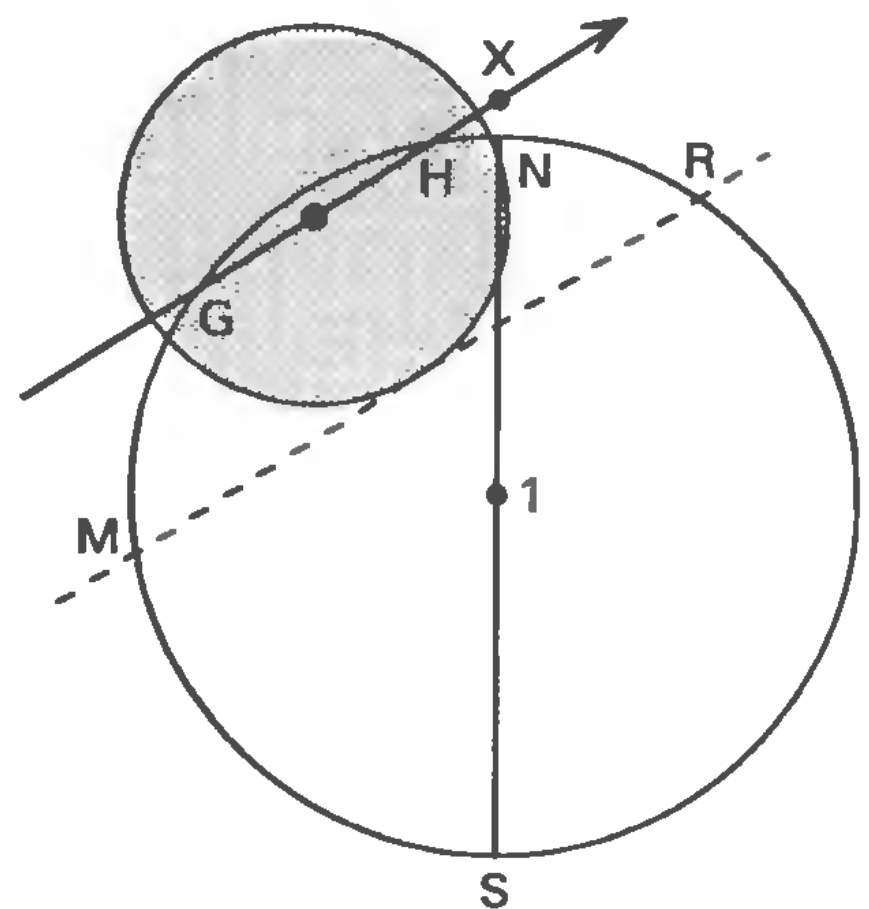
A central solar eclipse can occur only in one part of the day, either in the morning or the afternoon, but never at noon. The segments G-H and N-S don’t intersect. The position of the umbral cone at point X means a deep partial, or at most non-central, eclipse on the Earth. The zone of partial solar eclipse, limited by the segment of M-R, can occur either before or after noon. The configuration such as this can arise in total, annular, or annular-total eclipses. Type V solar eclipse can take place only when the absolute value of γ is between 0.86 and 0.997 (Meeus, 1997). This is the minimum value of γ at which the distance between the solar eclipse and the subsolar point is the closest. For example, on August 12, 2026, the minimum γ value is 0.8977, which, at least in theory, should place the central line of the solar eclipse very close to the moment of noon or midnight, determined by the segment of N-S. However, the 2026 total solar eclipse seems to prove that the absolute value of γ equal to 0.86 is not enough for the type V of solar eclipse occurrence. The best evidence of it can be found in the following illustrations below (Pic. 5 – 7)
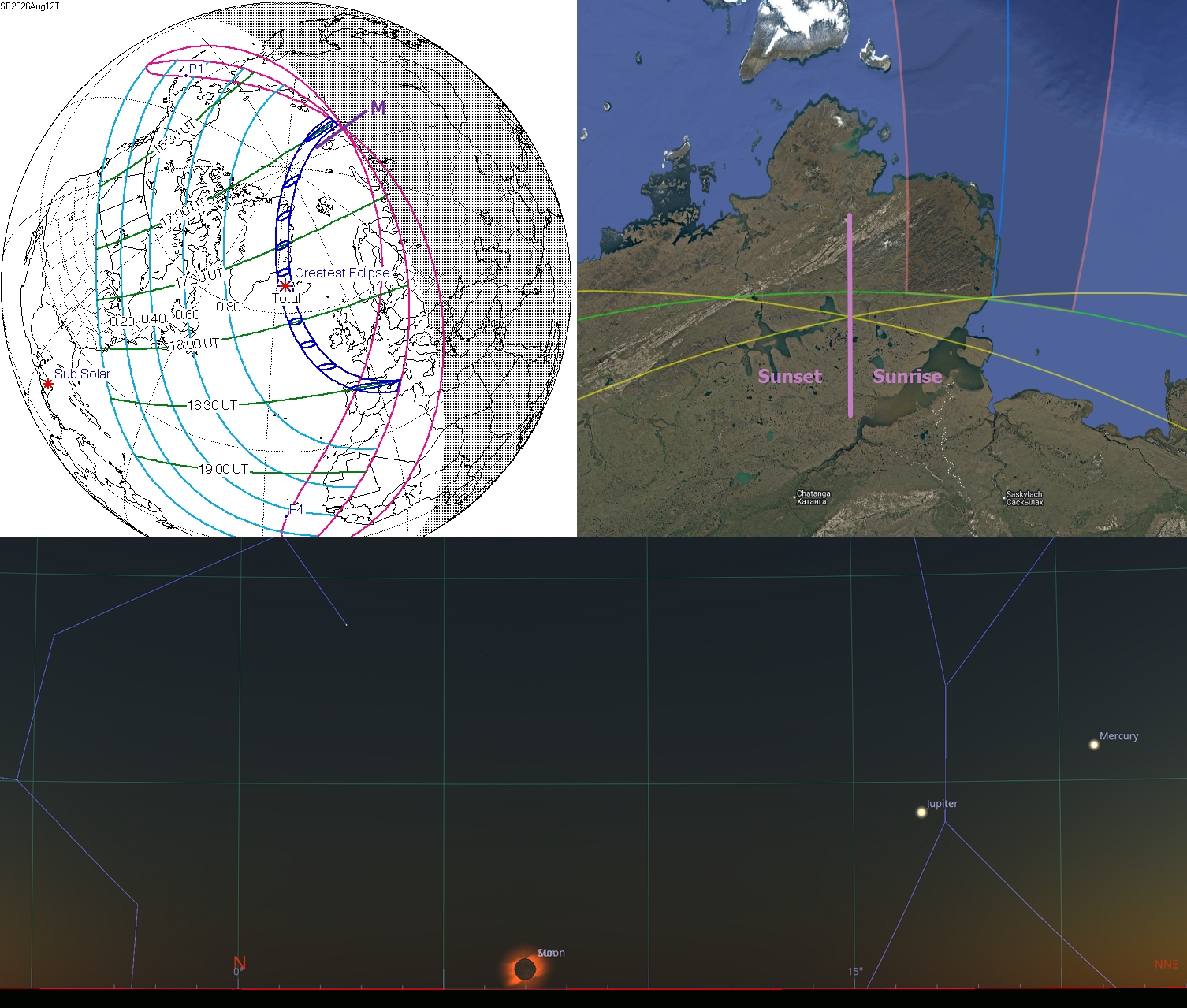
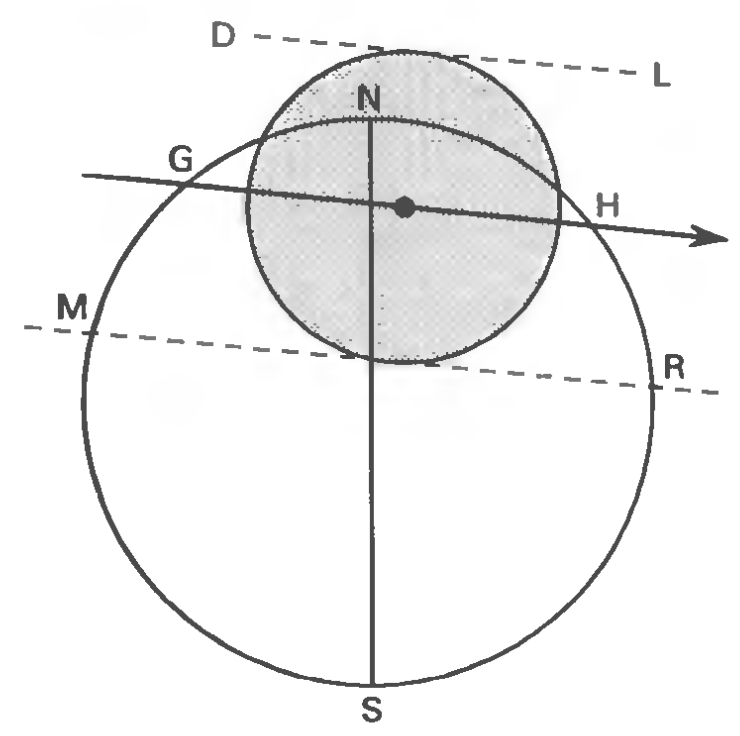
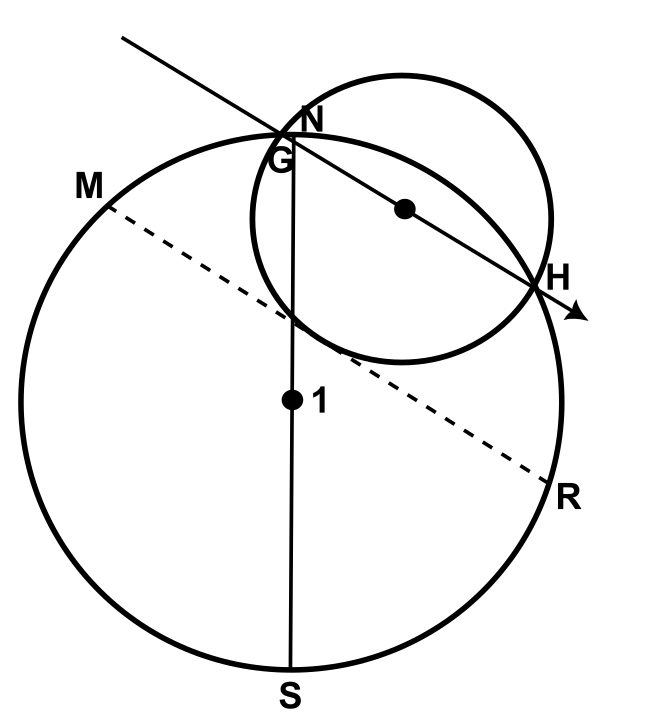
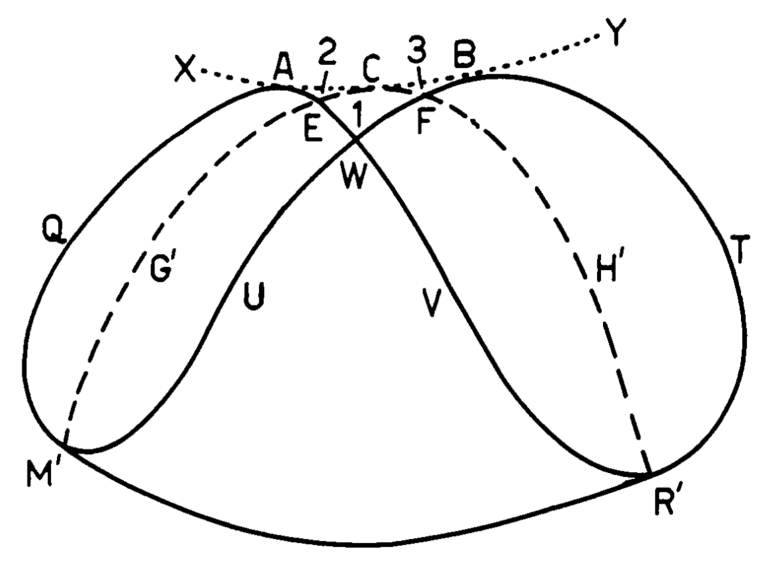
Following a more detailed explanation of « how to read » the eclipse map (Meeus, 1997), three regions near the terminator line are noteworthy. The region 1 bound with ECFW shows the area in which the maximum eclipse is visible. In region 2(AEC), the Sun rises and sets between the maximum eclipse and the last contact. Region 3 (CBF) lies in the area where the Sun rises and sets between first contact and maximum. The lines AEW and AQM mark the last contact at sunset, whereas the arcs WFB and BTR indicate the first contact at sunrise. On the ECF arc, the maximum eclipse occurs at the horizon, around midday or midnight. The other two lines show the most incredible eclipse moment at sunrise (M’G’E) and sunset (FH’R’). The last two lines indicate the last contact at sunrise (M’QAE) and the first contact at sunset (FBTR).
This pattern is understood well, as it applies to the northern hemisphere, where the northernmost section of the terminator line lies south of the pole. For the same circumstances in the southern hemisphere, the illustration should be mirrored. In the case of the 2026 totality, there is another problem: the northernmost limit of the solar eclipse area lies beyond the north pole and is on the other side of the globe. In light of these circumstances, the image below indicates how to interpret the 2026 total solar eclipse map at the very beginning of the path in Russia (Pic. 7), where the central line is marked red and the limits of the path in blue. The path of totality misses out the North Pole slightly.
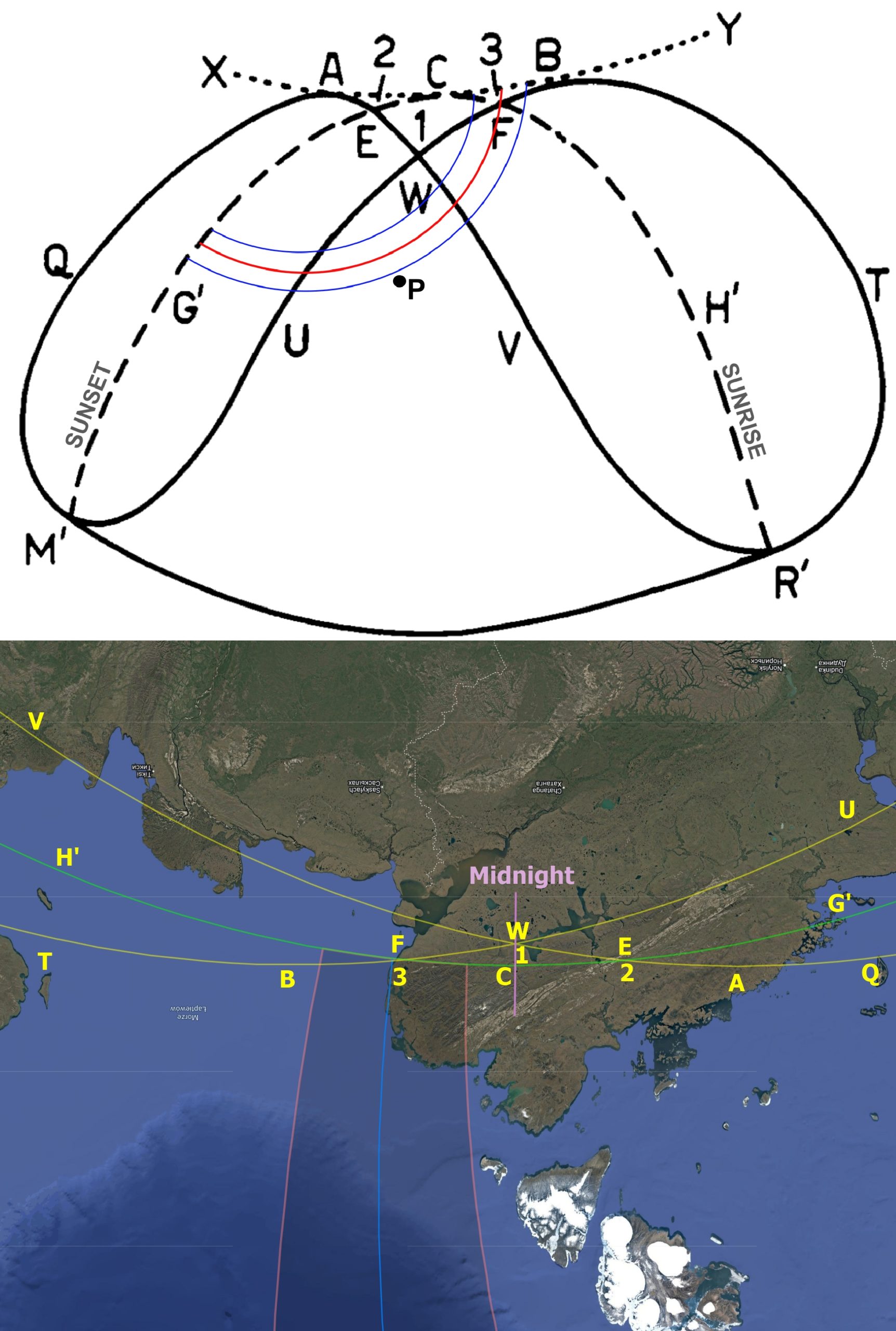
Imagine that you are looking at the beginning of this eclipse from above the North Pole. Now, you can see the real example of the pattern as mentioned earlier, but rotated upside down. This is an intentional illustration as a result of these eclipse circumstances. The geometry of the 2026 total solar eclipse isn’t obvious, as it begins around local midnight. There are three scenarios in which the solar eclipse can be observed at midnight. The 2026 totality applies the second case (Pic. 8), in which the entire path lies between the pole and the terminator on the opposite side of the globe.
As the Earth’s rotational axis is tilted for almost the entire year, the occurrence of a solar eclipse on the other side of the pole is quite plausible in the circumstances, at which the absolute γ value is close to 0.997 and as small as 0.86 (Meeus, 2007). There are nine eclipses such as this in the XXI century. In fact, the last two occurred in 2021, and admittedly, this is another rare situation, which will repeat only in 2712. It’s such a digression about how rare these eclipses are. The same applies to the latitude of the point, where the central eclipse occurs at midnight. In recent times, the lowest latitude was 70°N on June 6, 1891, which was the last central solar eclipse at midnight in the northern hemisphere before 2021. In August 2026, the latitude of this point is 85°N, and it’s the previous occurrence like this in the northern hemisphere before 2079. The next central solar eclipse at midnight will be observed on December 15, 2039, as a part of the same saros as the 2021 total solar eclipse.
The illustrations below clearly explain how the central solar eclipse can be visible at midnight (Pic. 9).
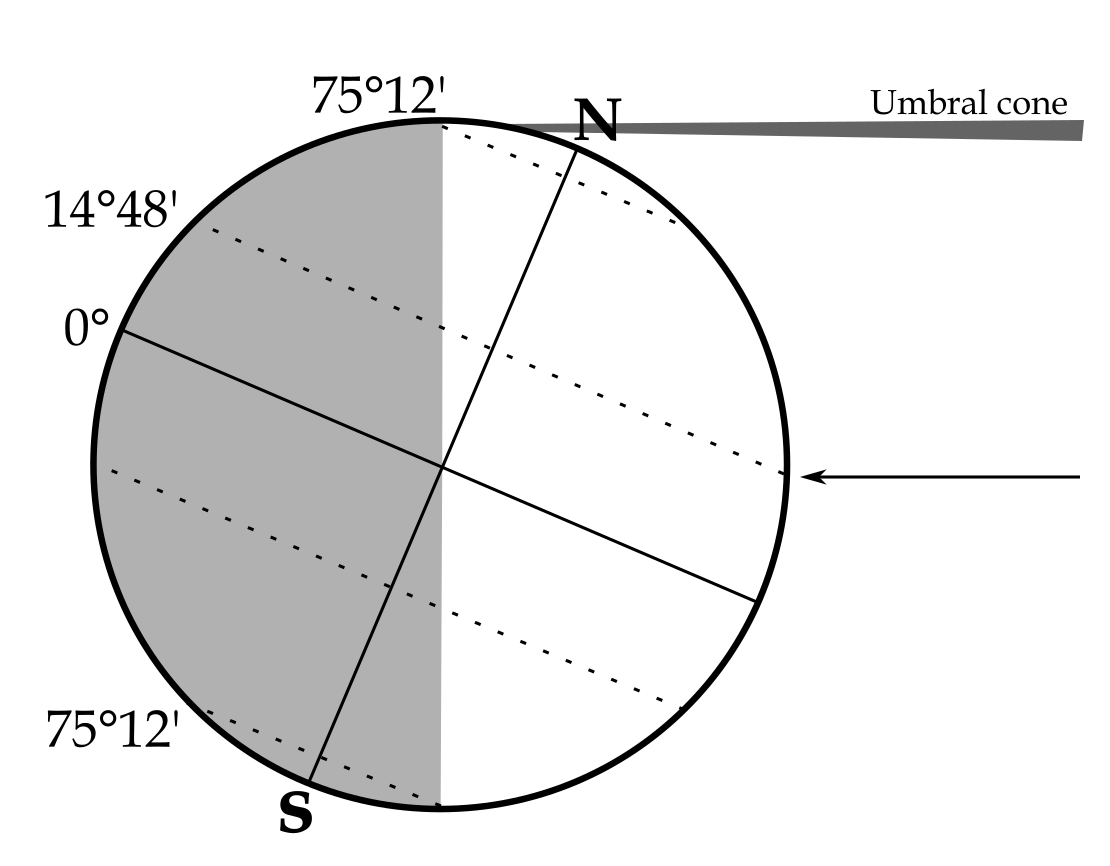
As you can see, the pole’s tilt is the paramount importance. To have a central eclipse at local midnight, the central line must pass between the pole and the nearest limb of the Earth (Pic. 8). It doesn’t happen around equinoxes, when the pole is close to the limb. However, because the 2026 total solar eclipse occurs around mid-August, when the declination of the Sun is +14°48′, the event is technically possible from a latitude higher than 75°12’N (Pic. 9).
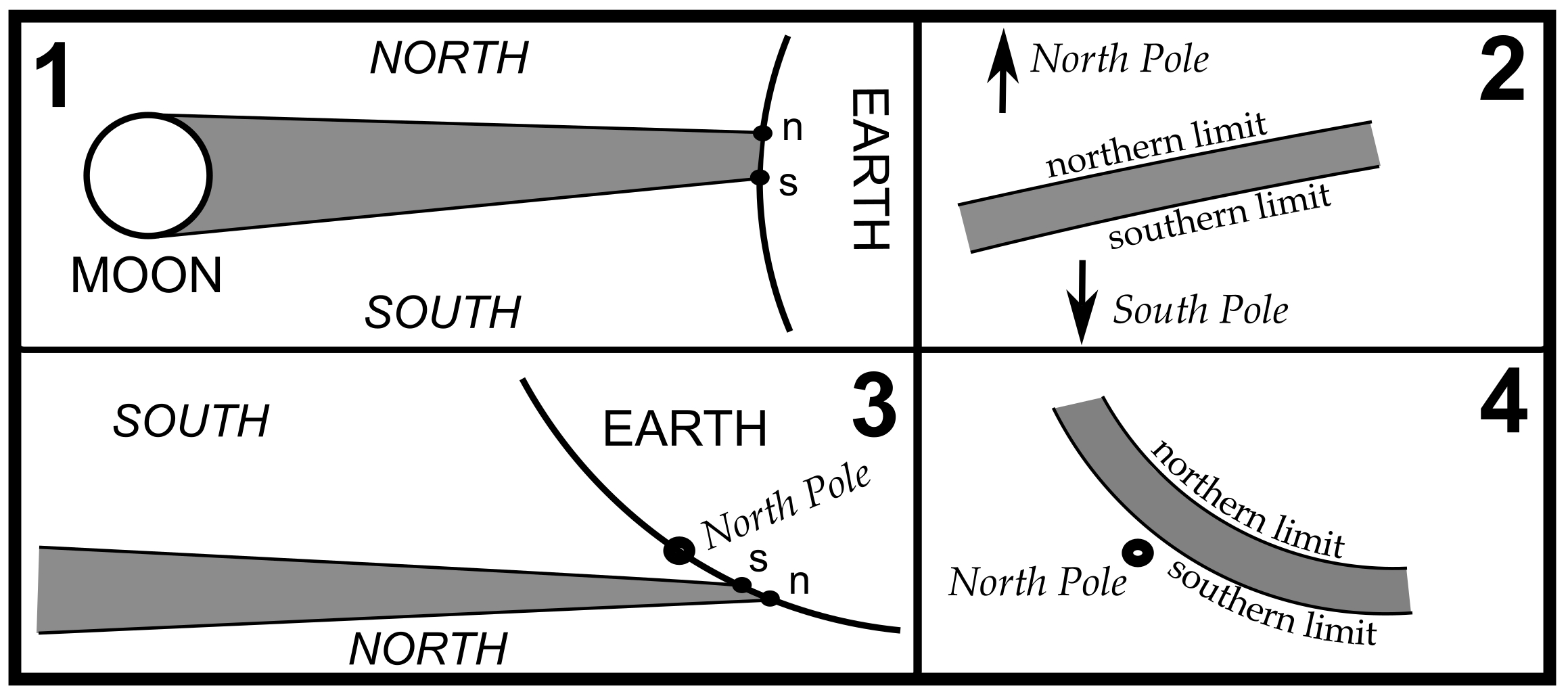
As a basic repercussion of this eclipse, another oddity arises: the reversed umbra limitation. As the umbral cone moves across the Earth’s surface, it traces a long path called the totality (or annularity) zone, which is bounded by two curves: the northern limit (n) and the southern limit (s) of the path (Meeus, 1997). Should we assume that the northern limit corresponds to the north direction in space, thereby the northern side of the plane of the ecliptic, and vice versa. If in some cases the Moon’s shadow happens to fall « above » the north pole, that is, north of it as seen from space. In turn, the southern limit of the umbra is nearer to the pole than the northern limit, and thus lies geographically north of it! This north-south oddity is reflected by the Earth’s illumination zone defined by the aforementioned axial tilt.
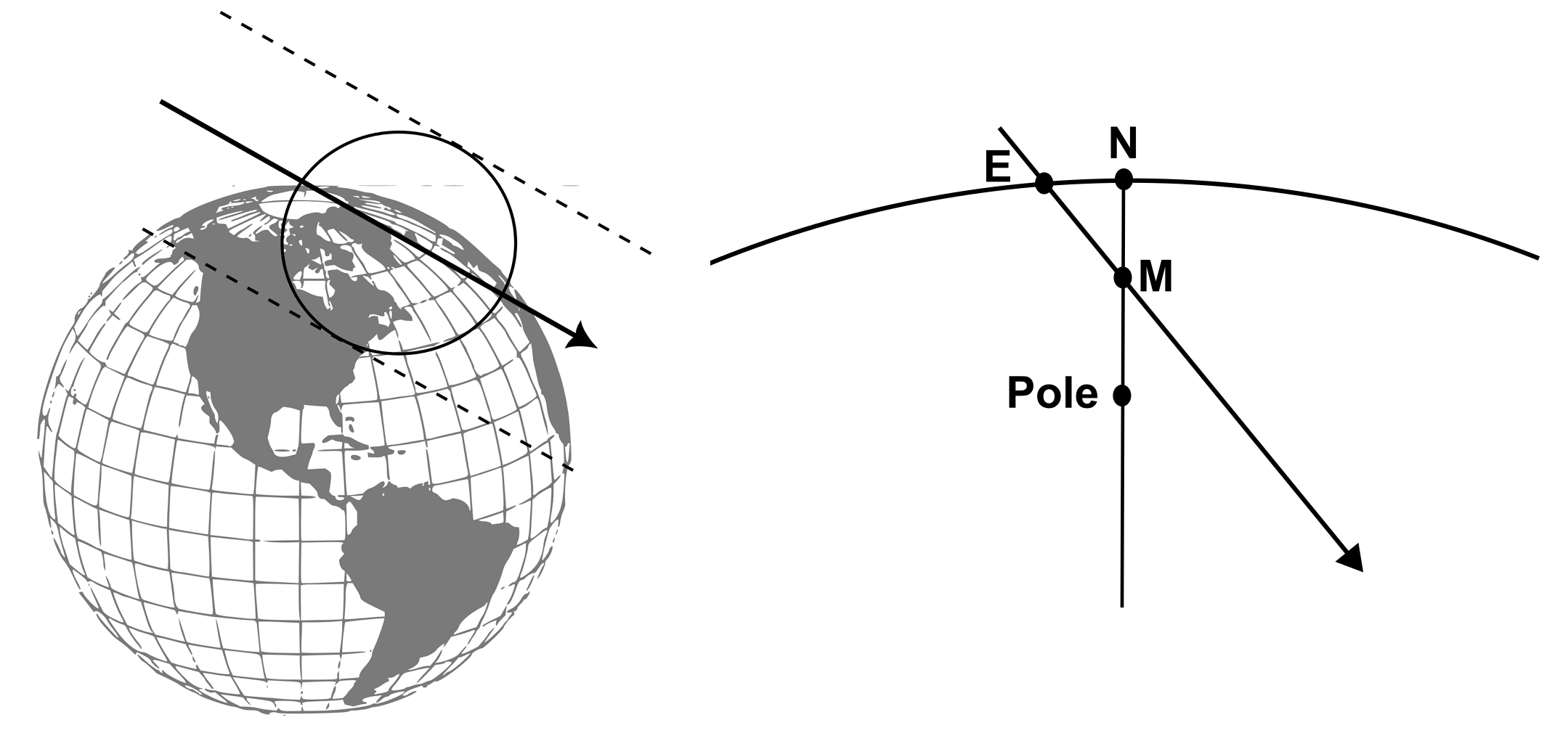
The 2026 total solar eclipse begins at a latitude of approximately 75° north and reaches the maximum northern latitude of 87°53′, although the local midnight, marked as point M, occurs earlier (Pic. 12). The closest approach to the pole doesn’t mean that the eclipse occurs at local midnight and vice versa. The 2026 total solar eclipse is a good example here. Situation changes as the eclipse path proceeds towards the sunset. After reaching the maximum northern latitude, the eclipse path proceeds southwards. Then the north limit of the path is oriented eastwards and south-westwards. At the westernmost longitude of 28° west, the central line changes its orientation again, and from this moment, the North-South oddity doesn’t appear anymore. Finally, the eclipse ends at sunset in the western part of the Mediterranean Sea, at a latitude of 39° north.
3. THE ECLIPSE PATH AND MOON’S SHADOW CIRCUMSTANCES
In definition, for a solar eclipse with the γ value larger than 0, the umbral cone projected on the Earth’s surface is never circular. The Moon’s shadow is always circular when projected onto a flat surface. Because the Earth is a sphere, a situation like this can occur only when the total solar eclipse occurs exactly at the zenith. Moreover, this moment is typical for only the very middle part of the eclipse path, because in other situations the γ value changes. All the γ values provided in all eclipse catalogs represent the moment of the greatest eclipse occurrence elsewhere on Earth, which usually happens halfway between the start and the end of the eclipse path. Usually, but not always, what depends on the position of the subsolar point. For the case of 2026, there is no doubt about it, as the greatest eclipse occurs at an altitude of 26° only. The umbra shape is seriously oval.
The situation, which will occur on August 12, 2026, is illustrated in the image below (Pic. 12).
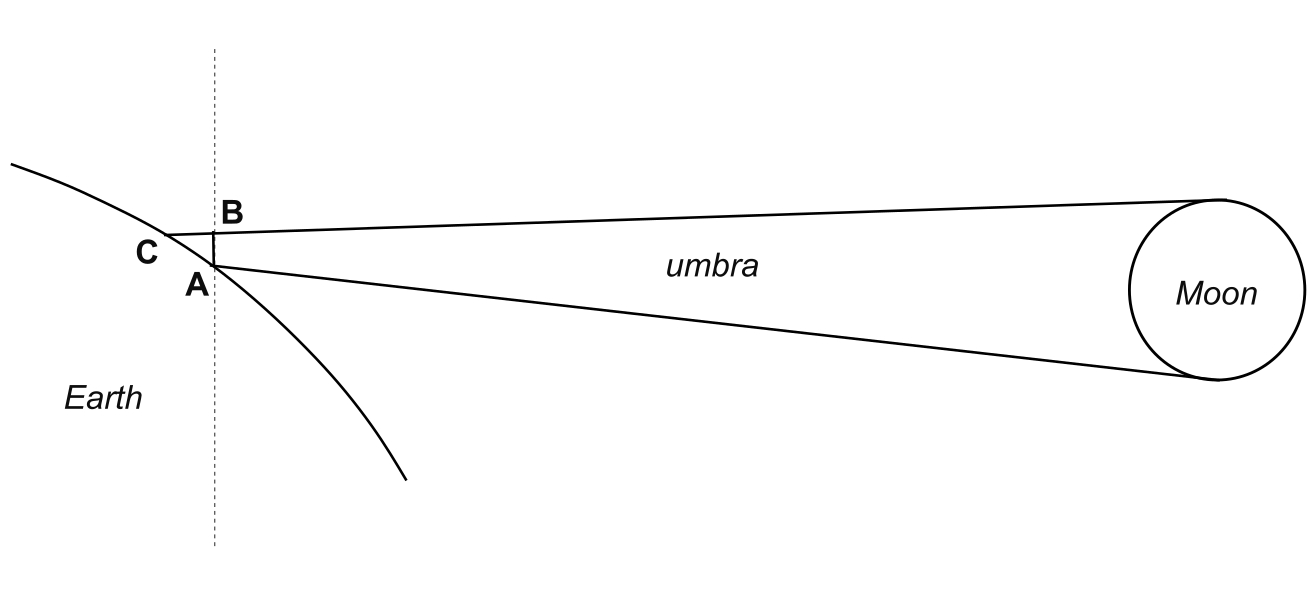
Let the hypothetical fundamental plane act as the dotted line. It goes somewhere beneath the ground, through point A, into the space. Since point A marks the southern limit of totality on the ground, the opposite side of the circular Moon’s shadow is point B, located in space. Due to Earth’s curvature and the low angle at which the umbral cone hits the ground, the true shape of the Moon’s shadow is defined by points A and C. Point C is the northern limit of totality and corresponds to point B on the ground. For better understanding, we can compare the distance A-B, which is the diameter of the umbral cone, with the distance A-C, which is the major axis of the oval umbra visible in reality. This major axis thereby determines the true width of the path of totality on the ground. To have a very wide path of totality, the quantity γ should be larger than about 0.95 in absolute value (Meeus, 2007). In most extreme cases, the width of the path of totality can exceed 800 km. Conversely, the minor axis of the umbra oval will never exceed 270km. However, it’s not the rule that a large γ value means an extremely wide eclipse path. Sometimes, even in these circumstances, the eclipse path can still be narrow. The primary reason is the eclipse’s duration. If it lasts only a second instead of, e.g., 2 or 3 minutes, the path of totality will still be very narrow even for large values of γ.
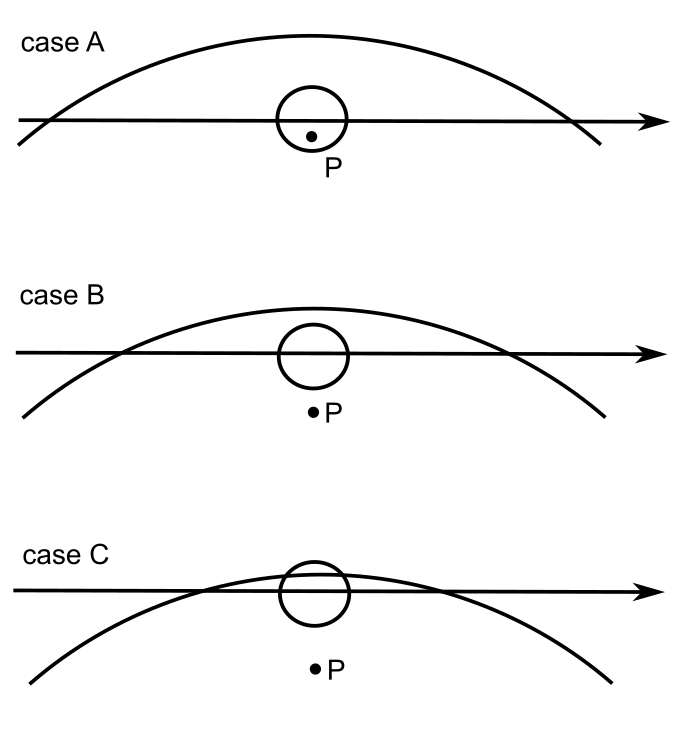
Now, another thing. The image above (Pic. 15) displays the situation around the middle part of the eclipse with the lowest γ value. This situation is represented by the shape C of the umbra in the image below (Pic. 16). What happens if the eclipse occurs earlier or later than this point? The umbra will be elongated. The largest elongation is to be observed near the beginning and the end of the passage of the lunar umbra over the Earth’s surface. The gliding Moon’s shadow during a total solar eclipse constantly changes its shape and orientation as it moves between the northern and southern limits of totality. I will describe it in detail later. Due to these changes, the aforementioned length of the major axis equals the width of the totality path only once, at the greatest eclipse point, which corresponds to instance C on the image below. In other cases will be larger than the eclipse path width.
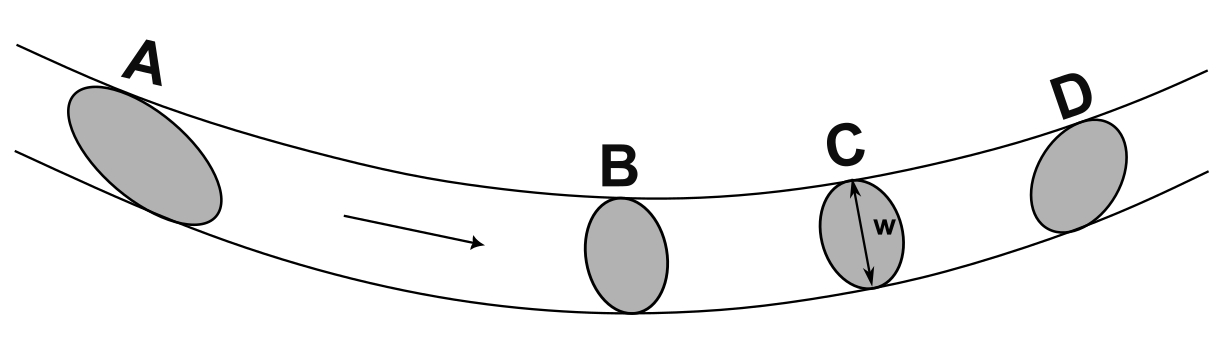
The moment at which the length of the umbra oval major axis defines the width of the totality path is marked with the w symbol in the image above. As you can see, other major axes are longer. Paradoxically, as the width of the umbra oval major axis increases, the width of the totality path decreases simultaneously. This is because of Earth’s curvature. The umbral cone has the smallest diameter at the terminator line, and paradoxically, the length of the major axis of the umbra would be the largest if complete.
The image below shows the comparison between the maximum length of the umbra, the width of the umbra, and the width of the totality path (Pic. 17).
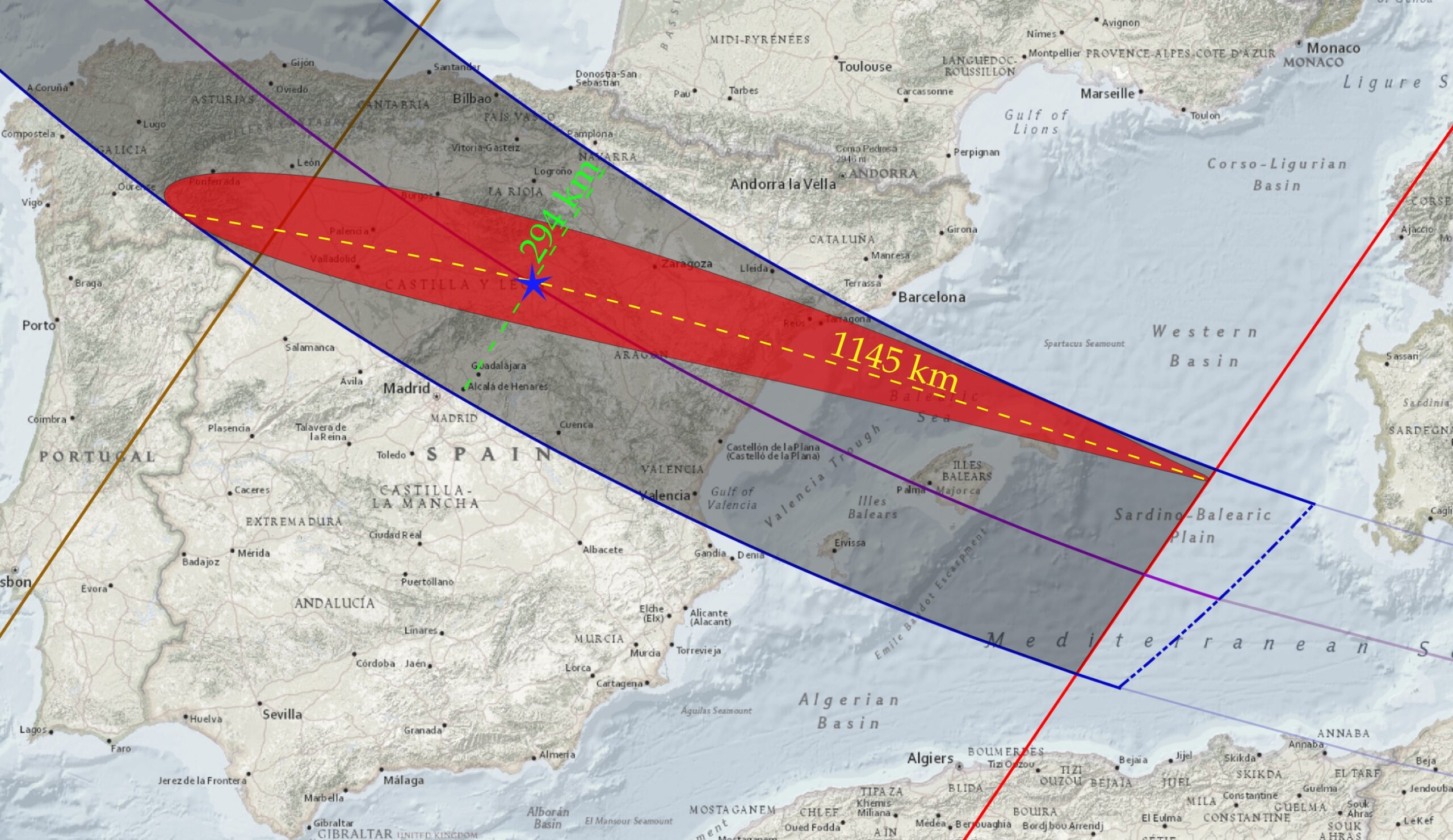
The moment at which the length of the umbra can be considered falls between the moments of U2 and U3, where U2 indicates the full Moon’s shadow appearance on the ground after sunrise, and U3 its last moment of full visibility before sunset. The moments of U1 and U4 correspond to the first and last appearance of the umbra, respectively, but the shadow isn’t visible in its full shape at these stages. The most dynamic changes of umbra shape, size, and appearance occur at the beginning and end of the totality path.
In the table below, you can find how the total length of the umbra changes over the last 10 minutes of totality in Spain (Tab. 1).
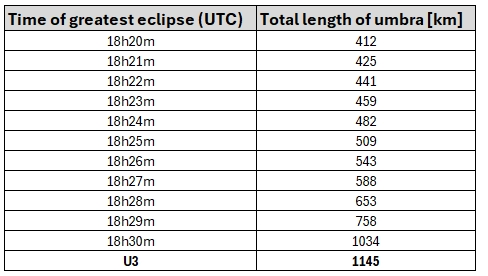
The length of the umbra increases very fast towards the end of the path, and this particular matter will be explained in a separate article in the future. The maximum length of 1145km isn’t something unusual. There are eclipses when the umbra can be longer, reaching up to 1608km on July 16, 2186.
4. THE ISOLINES ODDITY
5. THE TOTAL PHASE
Before analysing the totality of circumstances across all the countries mentioned below, it is important to flag key scientific aspects that can be undertaken during the total solar eclipse. Most people travel only to witness the totality and look mostly towards the Sun. As a result, many optical effects are missed. Before I start to list them out, let’s consider some events or objects visible in the nearest vicinity of the Sun. In many web sources, if you type, for example, « Total solar eclipse – what can I see, » you can find basic, concise information. Amidst a multitude of websites, it’s advisable to read science-based services that deal well with popular science and usually explain everything well enough for novices. For the sake of supplementation, you can read the article about the top 21 things possible to see during a total solar eclipse, which is updated with additional, practical information in the bullet points below.
A. SOLAR CORONA – The valuable information about past solar activity can be found under this link, where we have daily SOHO solar corona information. This data is around 1,5 weeks behind, so eventually you can check what the corona looked like in the near past, but the data gives you a hint of what the coronavirus can look like, i.e., today.
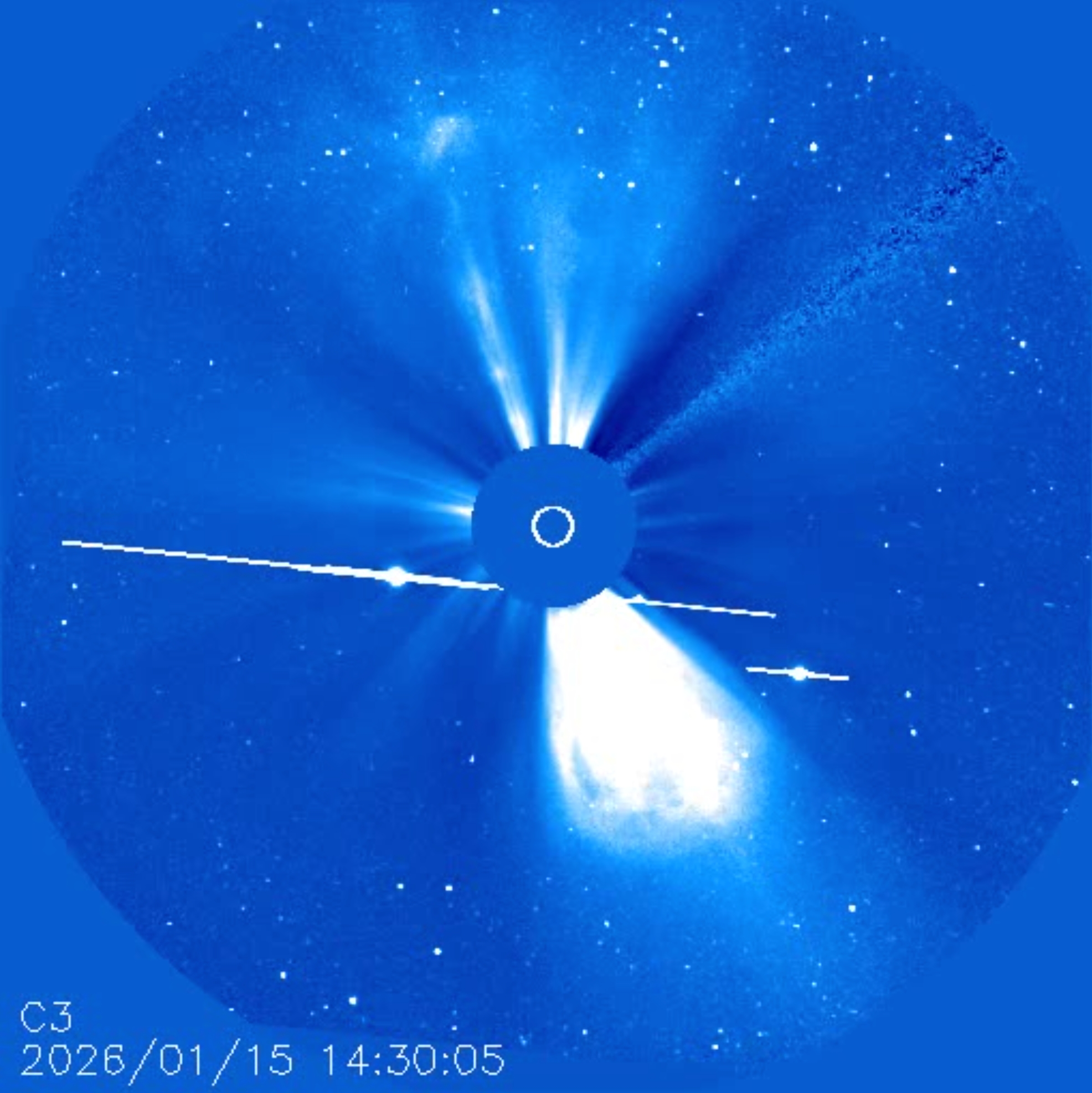
At the moment of production of this text (2.03.2026), the newest SOHO corona images (C2, C3, D2, D3) are dated January 15.
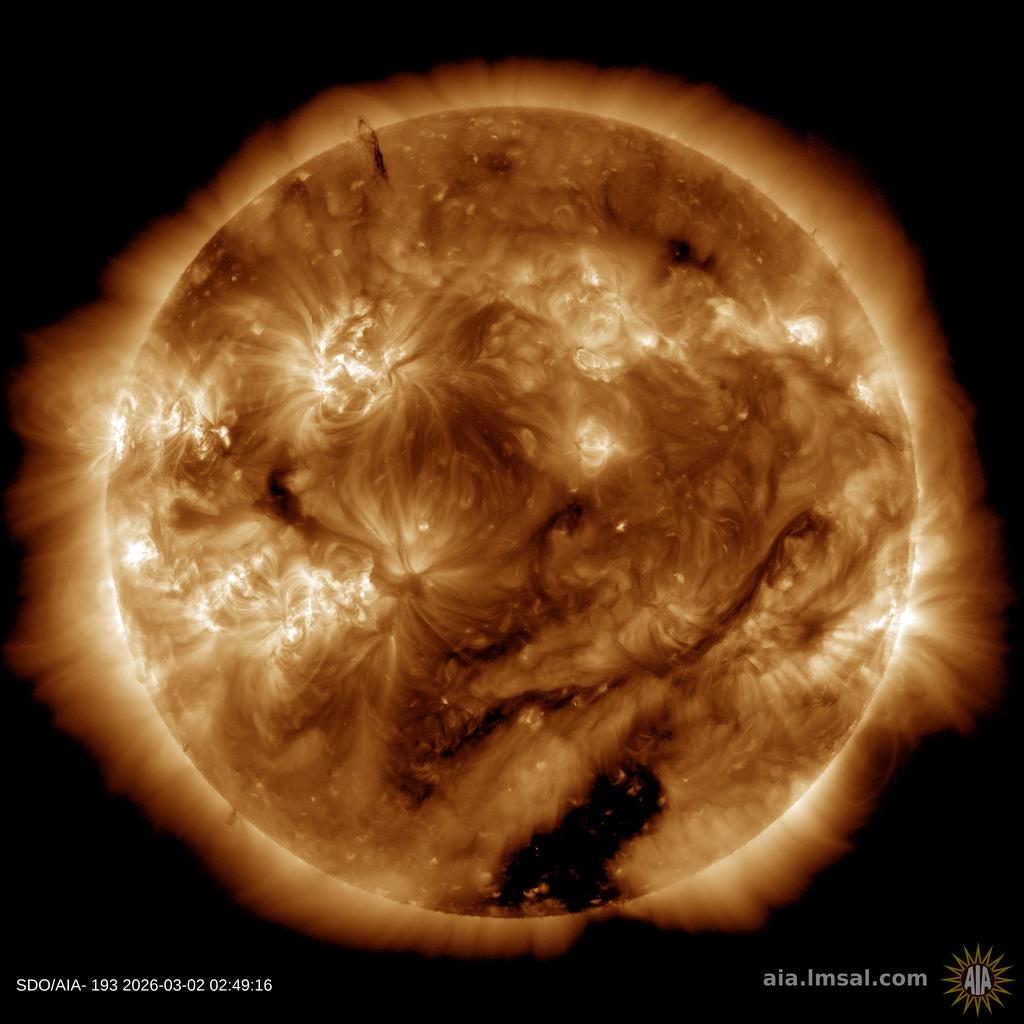
Given the latest solar corona images, we can visit Spaceweather.com, which provides a daily fetch of NASA/SDO coronal holes (Pic. 21).
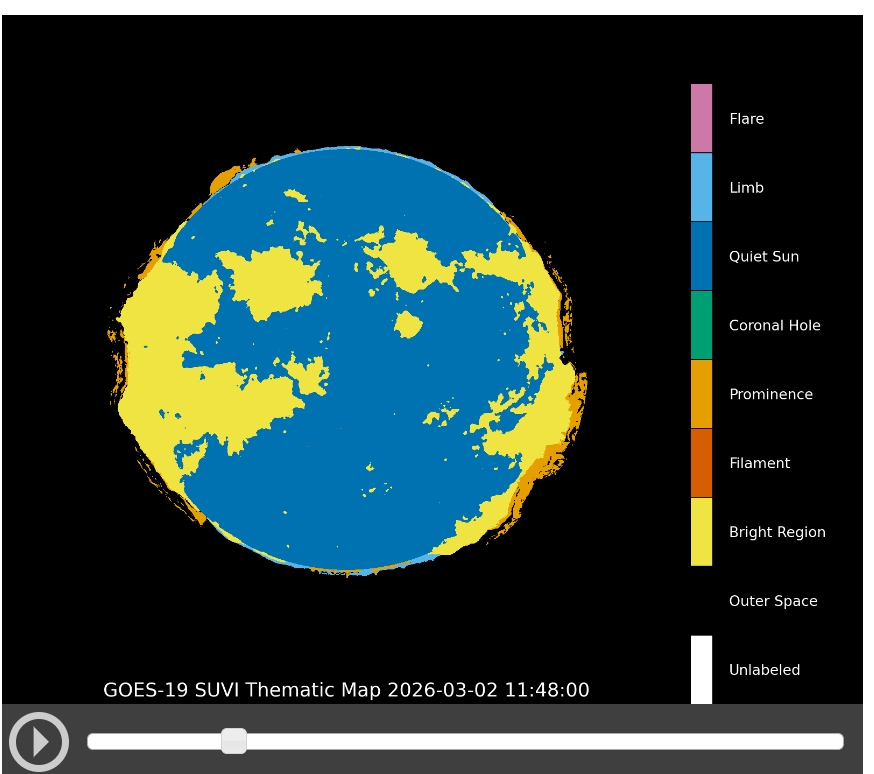
By clicking « More Info » at Spaceweather.com, we are redirected to the GOES Solar Ultraviolet Imager (SUVI), which features daily images of the Sun from a sophisticated extreme ultraviolet telescope. The results of the imagery presented across the several bands are illustrated as a solar thematic map (Pic. 22) on a given day.
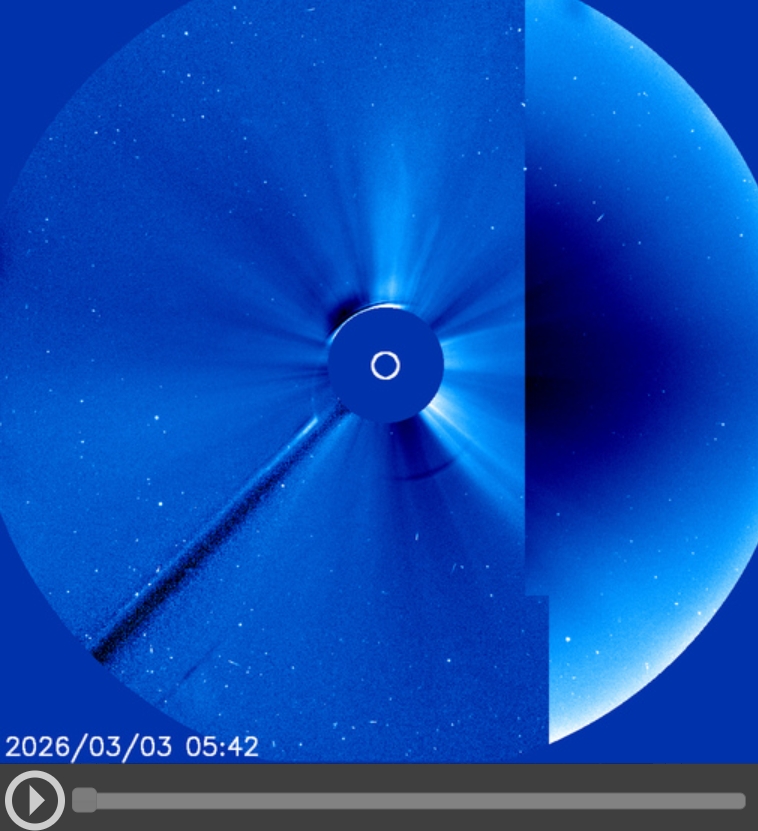
Moreover, in other sections of this website, the actual images of the LASCO C2, C3 coronal mass ejections can be found (Pic. 23).
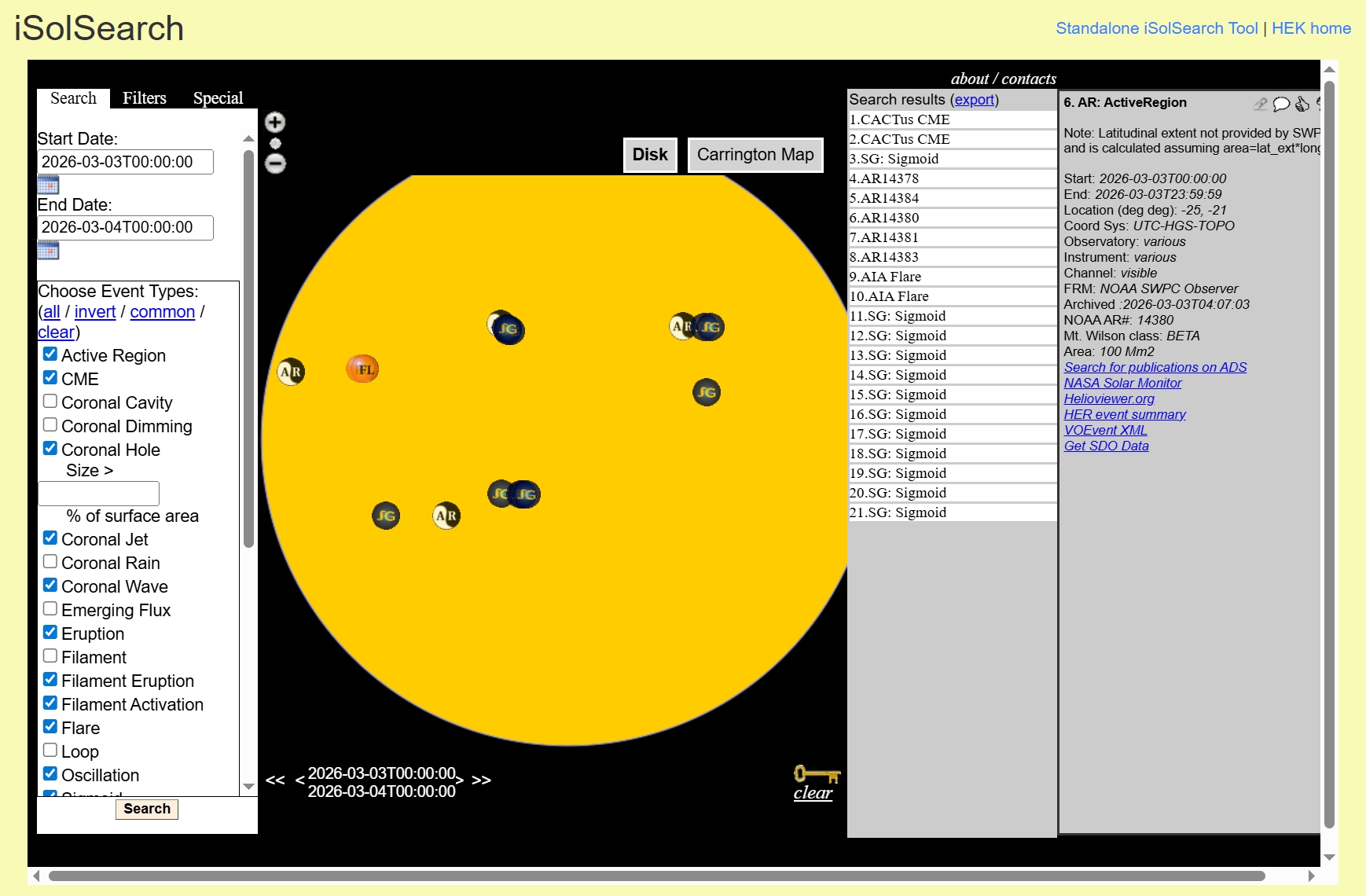
When you need more details about the daily situation on the Sun, it’s vital to visit this website, where you can find more daily images of the Sun and especially the standalone iSolSearch tool dedicated to heliophysics and advanced solar observers (Pic. 24), allowing for identification of solar activity structures in real time.
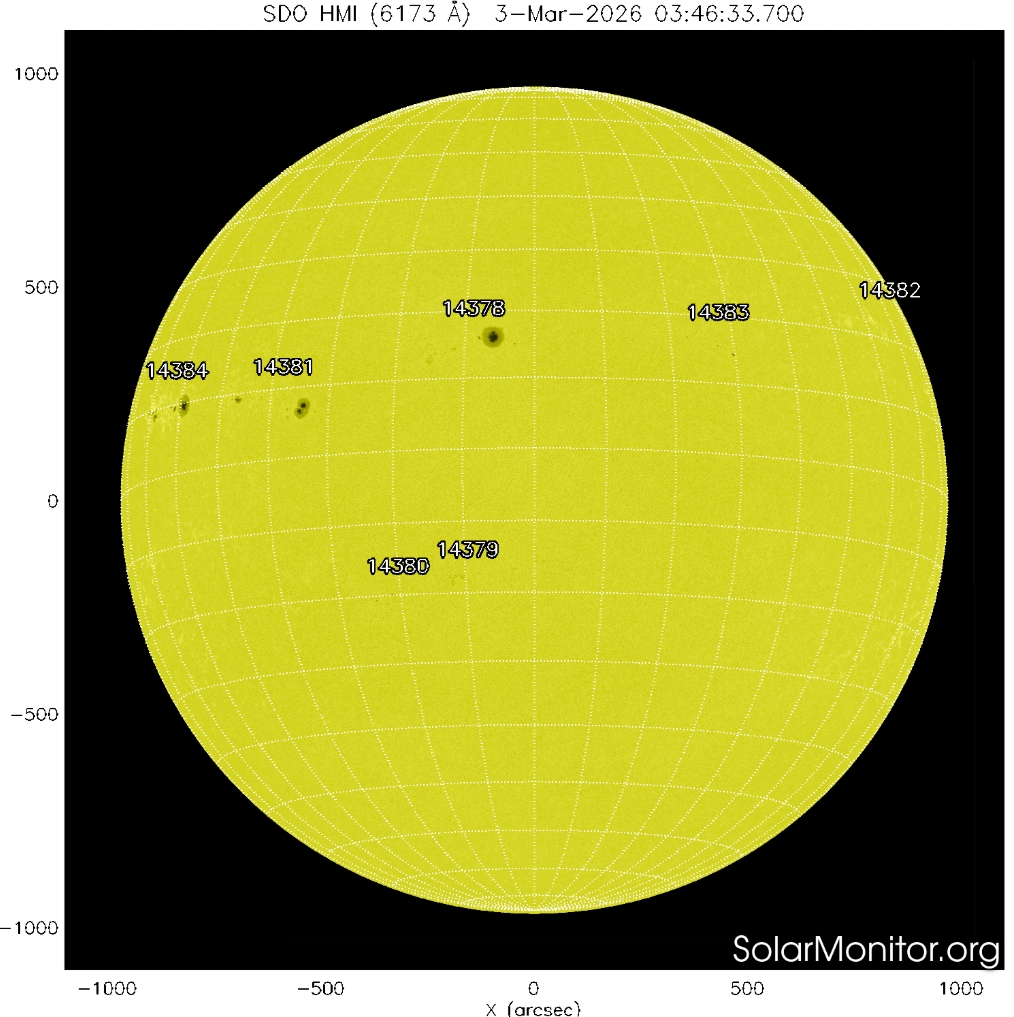
Another detail of the Sun’s behaviour on a daily basis can be obtained from the Solarmonitor.org website. The general daily map of the Sun in the SDO DMI (6173Å) can be interesting for the partial phase of the eclipse because of a clear indication of sunspots (Pic. 25). An observer can see how the lunar limb swallows the sunspots during the eclipse.
There are at least a few other websites where we can get the latest images of the Sun, like for example here.
Last thing to mention here is, finally, the forecast of solar corona visibility. The best forecast can be gotten just a few days ahead. A good example is a solar image obtained by the Interface Region Imaging Spectrograph (IRIS). For long-term forecasts, we can see text data and expert comments. The example of various forecast data can be found on this website. For example, if we consider predicted sunspot numbers and radio flux, we can find a good tabular dataset here.
Getting around this presented data, we can deliberately plan our solar corona observation during a brief moment of totality. For some hints on how to prepare, we can use the old image sequences from a few days ago. A good example of collecting these images during the total solar eclipse observation can be found here.
B. SOLAR PROMINENCES AND THEIR MOVEMENT – Along with the prediction of the solar corona behaviour, we can check what the solar prominences can look like in the near future, directly preceding the eclipse event. Typically, solar prominences become strikingly visible during total solar eclipses. Usually, a total solar eclipse means the Moon’s disk is slightly larger than the Sun’s. Thereby, some of the prominences are visible at the beginning of totality, and others at the end, about which you can read in detail in this article. Among eclipse phenomena, their apparent motion against the lunar disk offers measurable scientific value. Before and after totality, the chromosphere appears briefly as a thin pink rim. Simultaneously, prominences project beyond the lunar edge. Their shifting position along the dark disk reveals the Moon’s steady progression.
Observer location strongly influences perceived prominence motion. Near the centerline of totality, transitions occur rapidly because umbral depth reaches its maximum. Consequently, Baily’s Beads and chromospheric flashes last only seconds. However, near the umbral boundary, geometric alignment prolongs these transitional effects. In that configuration, a major prominence appeared to rise above the lunar surface as the eclipse progressed.
Parallax further modifies the geometry of the third contact. The returning photospheric light emerges from different lunar valleys depending on the observer’s latitude within the umbra. Therefore, the diamond ring effect aligns with distinct prominence groups at separate locations. Comparisons between central-path and southern-limit observations reveal significant differences in prominence alignment relative to lunar topography.
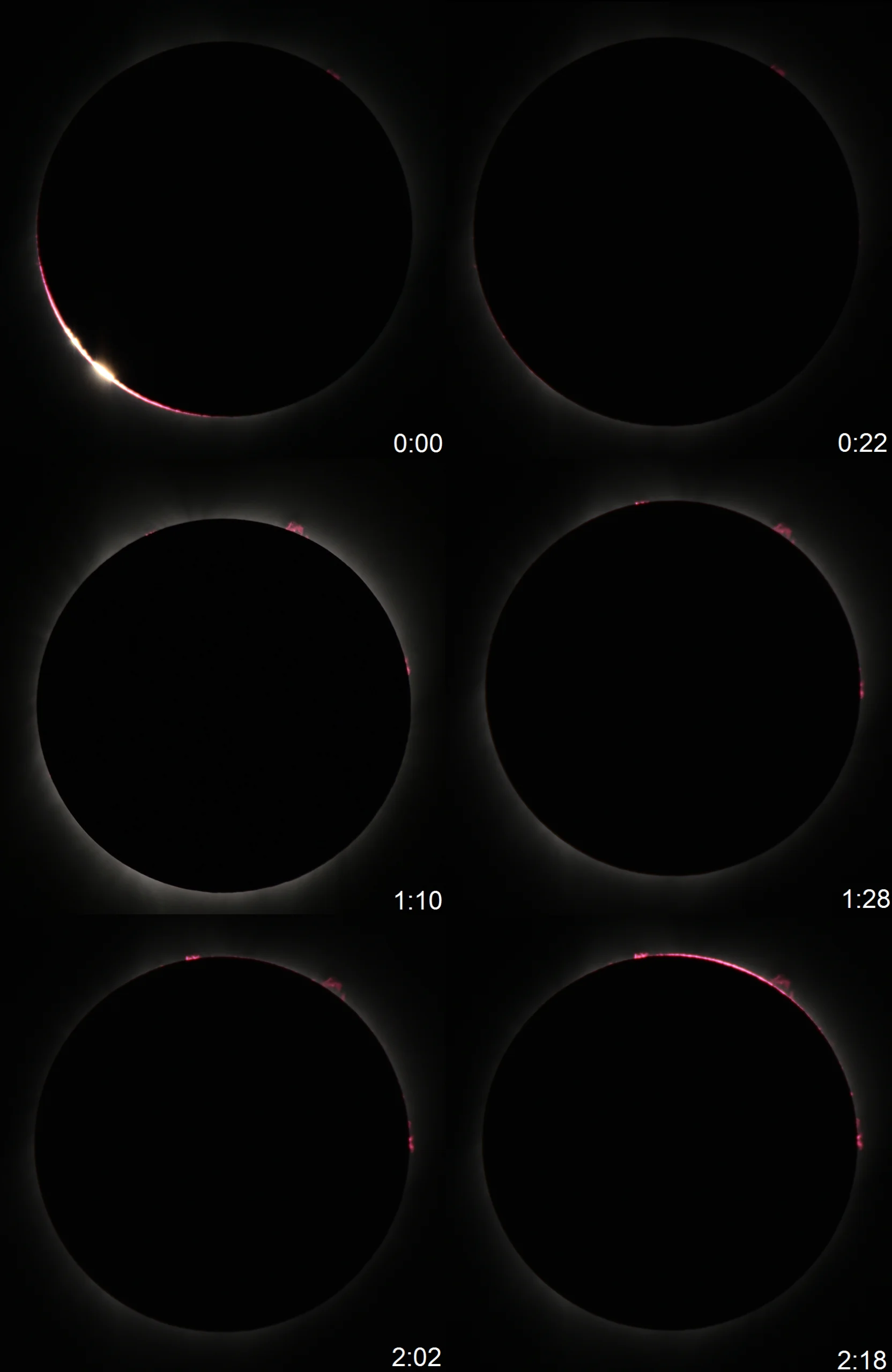
Image sequences from 2017 confirm that prominence morphology evolves rapidly during totality. Even within seconds, brightness and structure change noticeably. Continuous imaging thus provides essential data for analyzing plasma behavior and geometric displacement.
In summary, prominence motion during total eclipses reflects the combined influence of lunar motion and observational geometry.
C. FLASH SPECTRUM – is an array of wavelengths detectable in the emissions from just above the limb of the Sun during the flash periods occurring with the very first and very last light from the solar limb. As the photospheric continuum vanishes through the bottom of the lunar valleys, it’s replaced by an array of wavelengths emitted from the lowermost layers of the solar atmosphere. When the prohosphere is entirely hidden behind the lunar limb, the lowermost layers of the Sun’s atmosphere flash into prominence, and the flash spectrum briefly appears, showing bright lines produced by hot, luminous gas. A flash spectrum provides an opportunity to study the physical state of the solar chromosphere. Normally, we can’t see the chromospheric emission lines because their luminance is much weaker, since they are emitted in all directions. During a total solar eclipse, an observer can see the most dominant hydrogen lines in a Balmer series (bright reddish, aqua, and blue arcs), next calcium H and K, and the single ionized helium (yellow arc), magnesium (bright green arc), and sodium (faint yellow arc). All these spectra determine the chromosphere’s final, purplish-pink hue visible during totality.
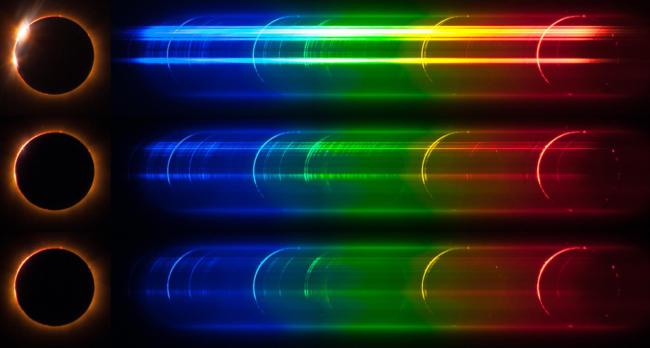
The chromosphere has an angular diameter of only 10″, so from our perspective, we have only a few seconds for capturing this phenomenon. Alternatively, we can position ourselves near the edge of the totality path to slightly elongate this period.
The flash spectra can also be produced artificially by applying slit-less spectroscopy.
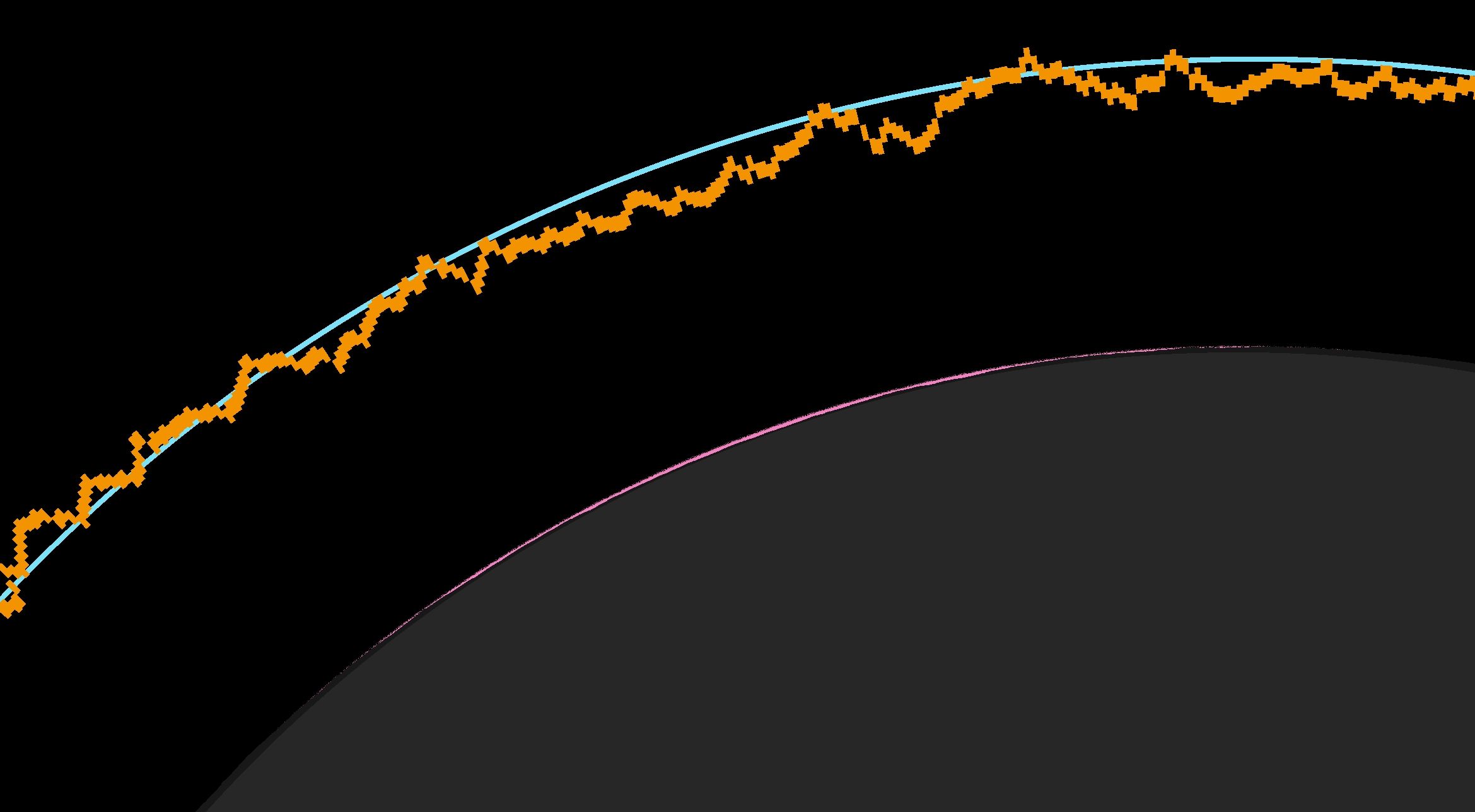
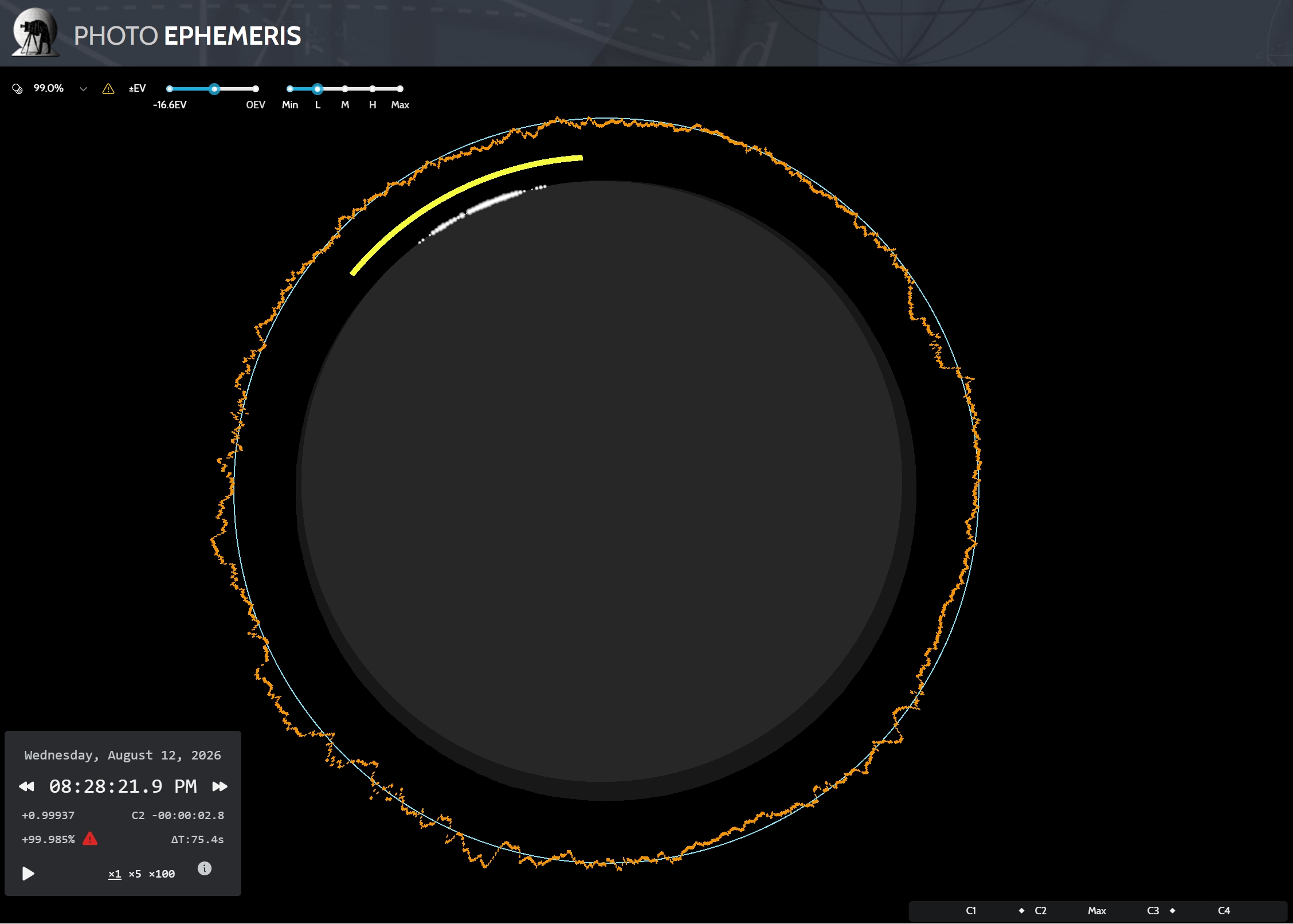
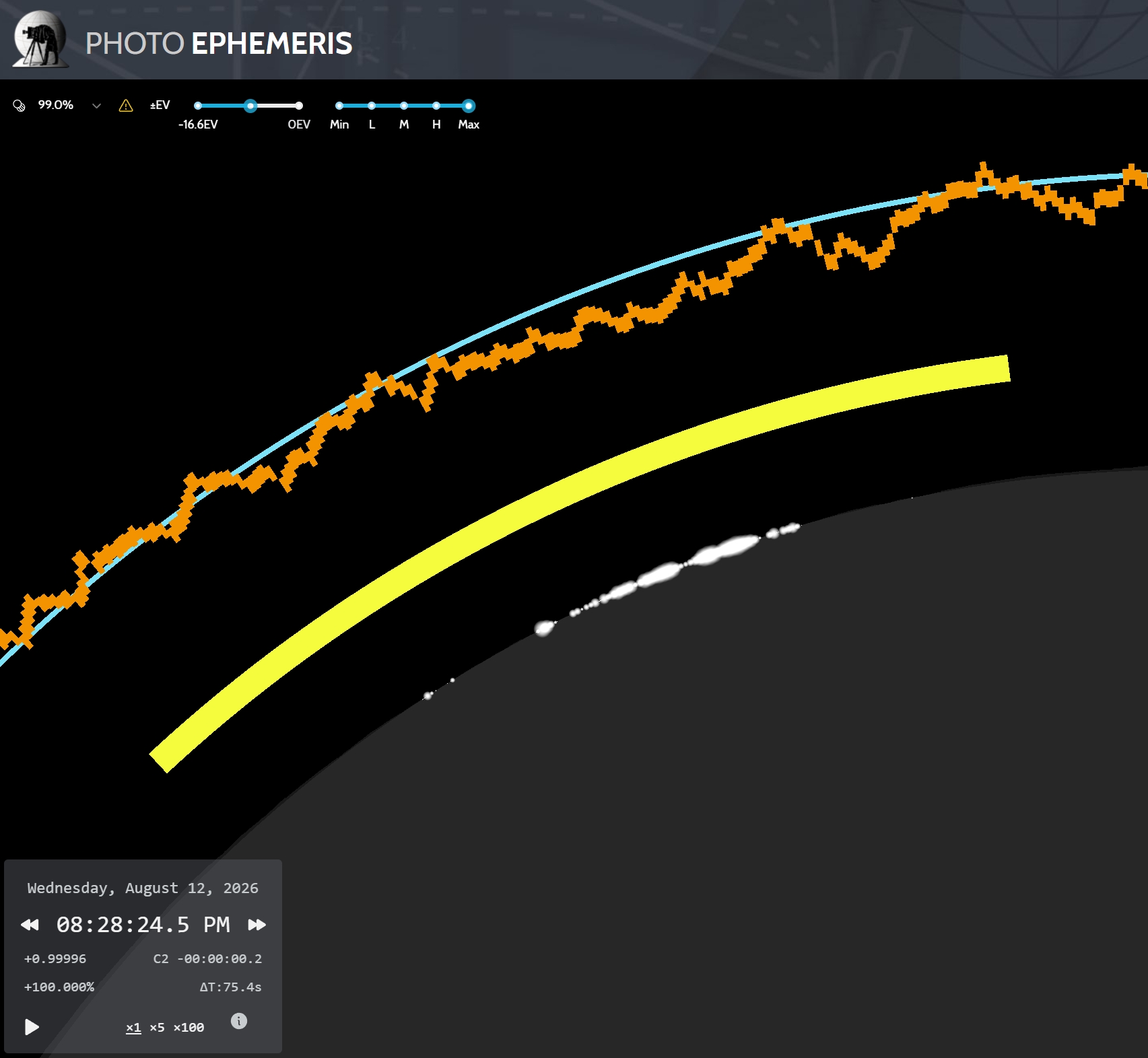
D. BAILY’S BEADS – are caused by rugged lunar topography, which allows the solar rays to shine through the Moon’s valleys. The most effective Bailey’s beds can appear around 22 seconds before totality, when obscuration is greater than 99,5%. You will find a lot of information on the internet about Bailey’s Beads and their reports. Because this thread is dedicated to supplementary stuff, I can share the fantastic tool, a genuine counterpart to Xavier Jubier’s Solar Eclipse Maestro, unfortunately available only for macOS. By purchasing the Pro version of the PhotoEphemeris web-based application, we have access to a modern eclipse simulator that provides Baily’s beads predictions on the same basis as the Solar Eclipse Maestro. As a result, we have the eclipse panel where these events can be visualized under various lightning conditions. The example can be seen below (Pics. 26 and 27), and some circumstances for random eclipse locations are considered, as described in subchapters 5.1, 5.2, and especially 5.3.
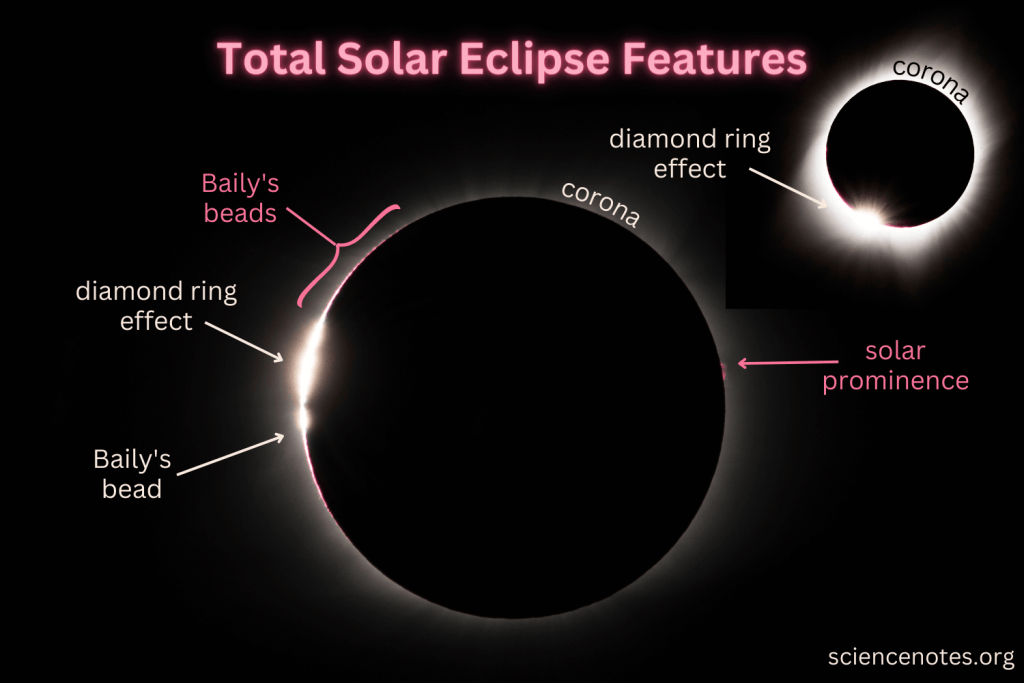
E. DIAMOND RING – this most distinct feature of the eclipsed Sun, which is observed along the Baily’s Beads. This is a glittering diamond (final spot of solar beams) set on a ring (bright solar corona), visible about 10-25s before totality completes (Pic. 28).
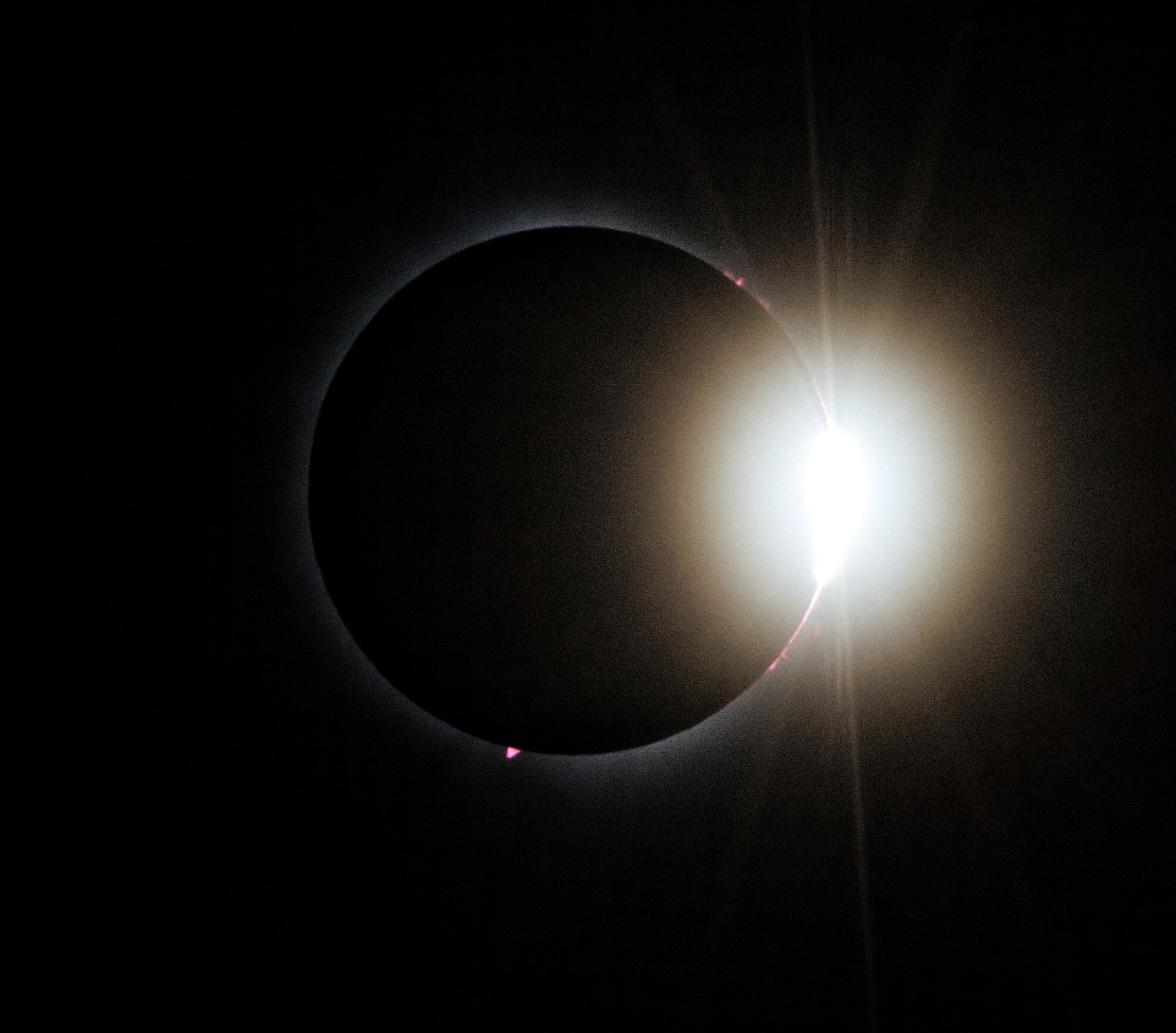
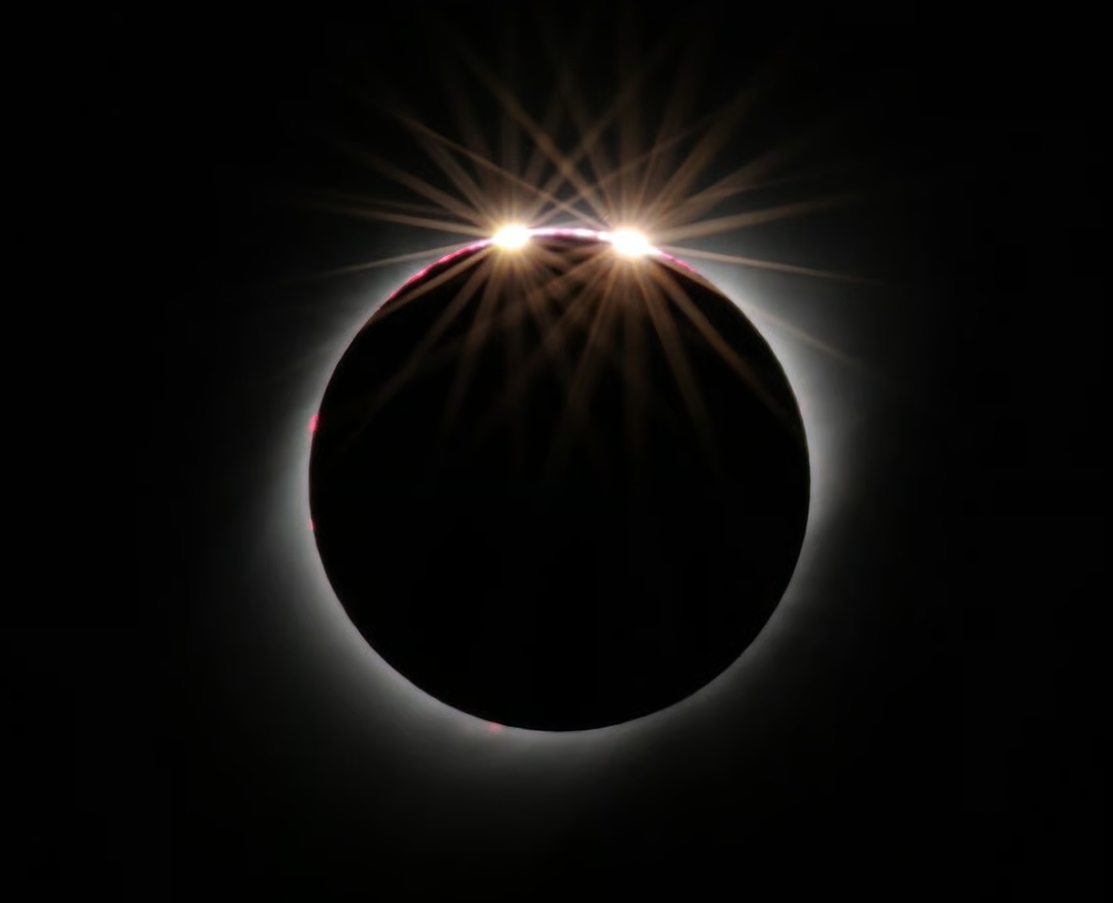
For short-duration totalities or when an observer is placed at the edge of the totality path, the double diamond ring is possible. The key role played by the lunar limb profile on the day of the eclipse.
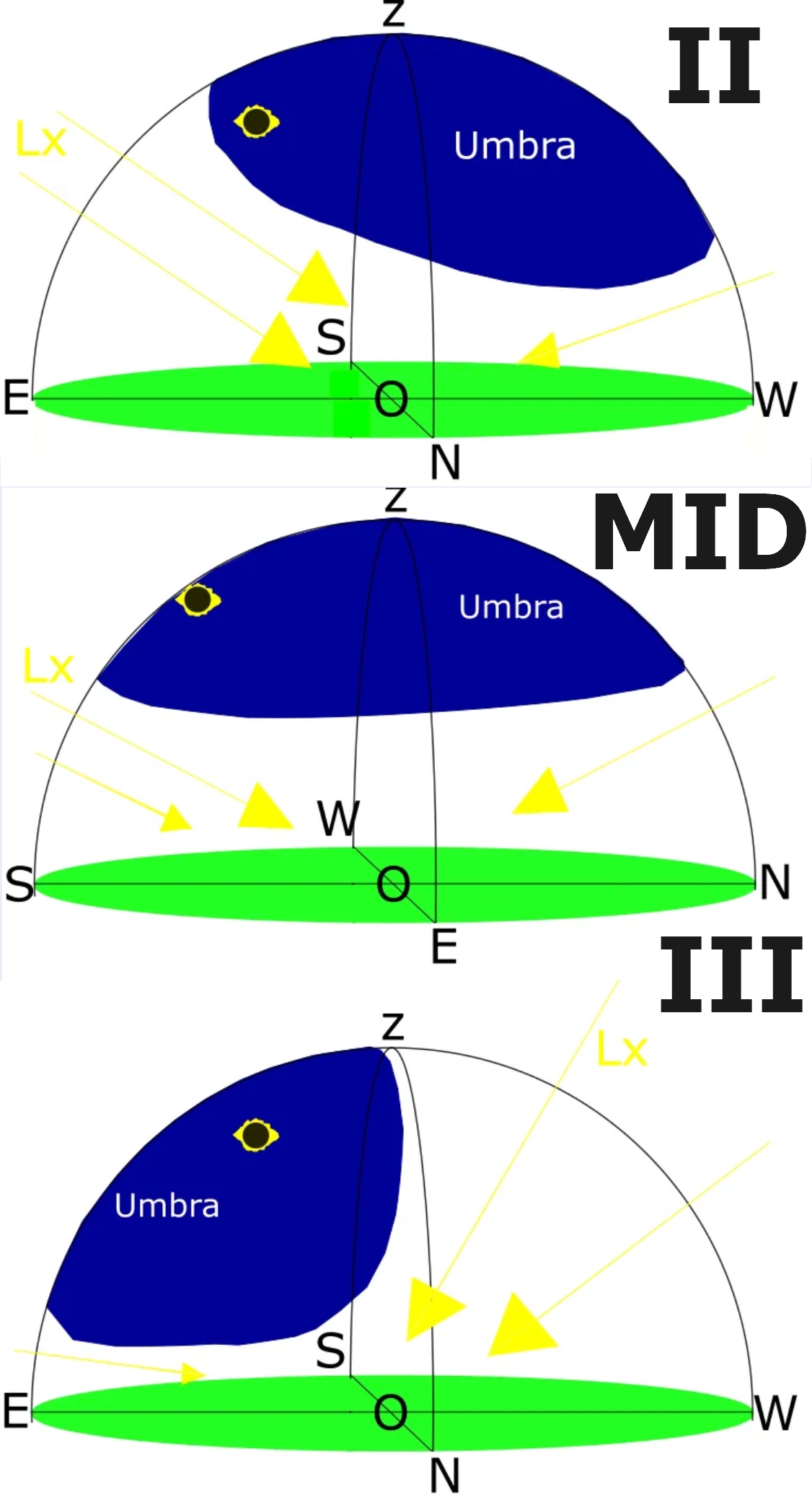
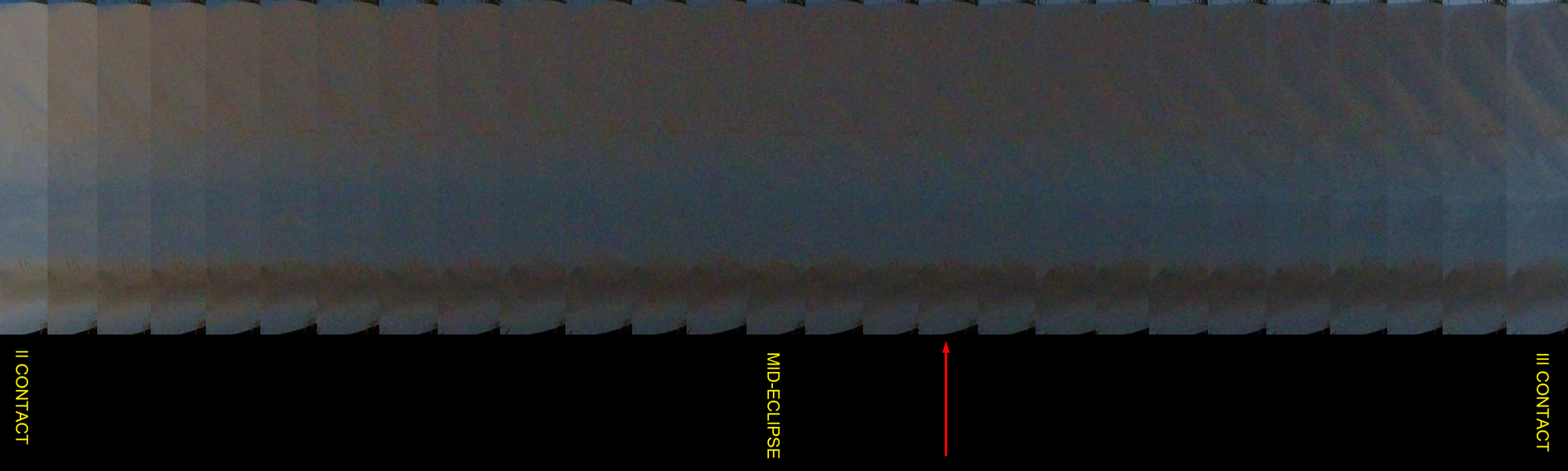
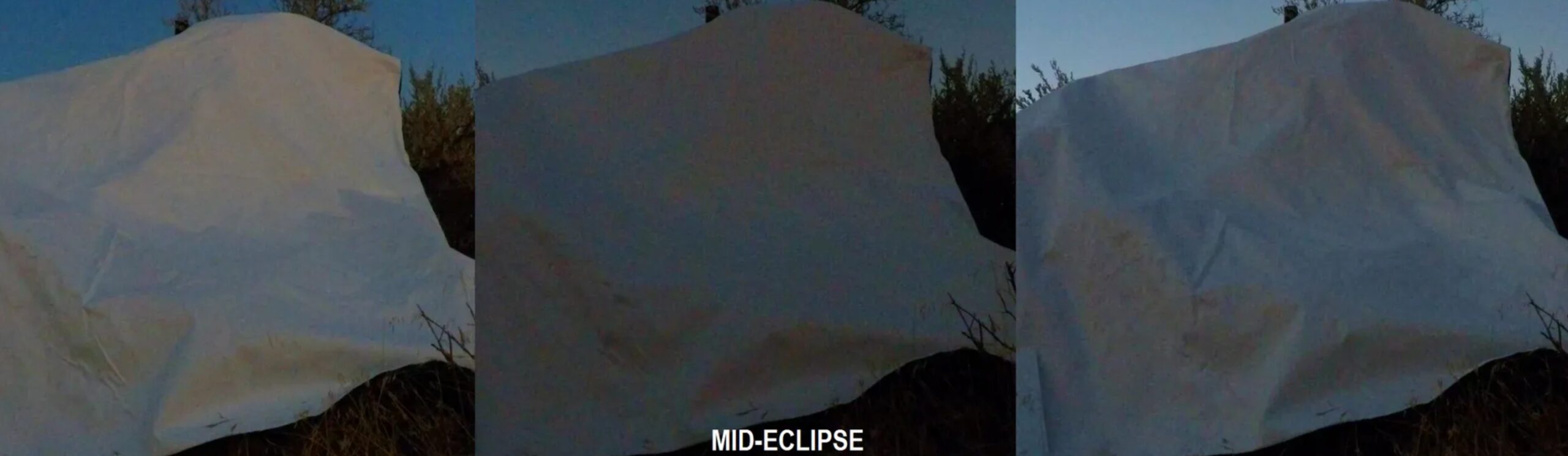
F. SHADE MOVEMENTS AND SURFACE CHANGES – The effect, which can be observed on the occasion of watching shadow bands, has been described in detail here. Since the white plain surface is placed, as it’s usually not flat enough, we can see some shaded areas within. They help to understand that atmospheric light scattering during totality requires analyzing the spatial distribution of illumination around the observer. The phenomenon can be examined at three principal stages: immediately after second contact, near mid-eclipse, and just before third contact.
Just after the second contact, the solar disk became fully obscured, yet the atmosphere outside the umbra remained illuminated. Consequently, the brightest scattered light originated from the shadow-out sector of the sky. If this section occurs in the same part of the sky where the Sun is located, forward scattering takes hold. In turn, the observer sees enhanced brightness in this region due to the relatively small angular separation between the Sun and the adjacent illuminated atmosphere. As a result, the zenith appeared darker than the southeastern horizon during the initial seconds of totality.
5.1 Iceland
In general, all the important information about the 2026 total solar eclipse in Iceland has been presented on the following websites:
– https://eclipse2026.is/ – which is the main portal, where you can find maps (including an interactive map), the view of the sky, and very important practical sections like Where to See, Eye Safety, or the external link to the Rent a Car option. It’s the main and best Iceland solar eclipse website, highly recommended for a practical guideline for everyone. Some additional information about the total solar eclipse in Iceland can also be found on the National Eclipse website. Because my text serves as supplementary content, I can add additional info on eclipse conditions for some case studies.
At first, let’s consider the capital of Iceland – Reykjavik, with the detailed map below (Pic. 34).
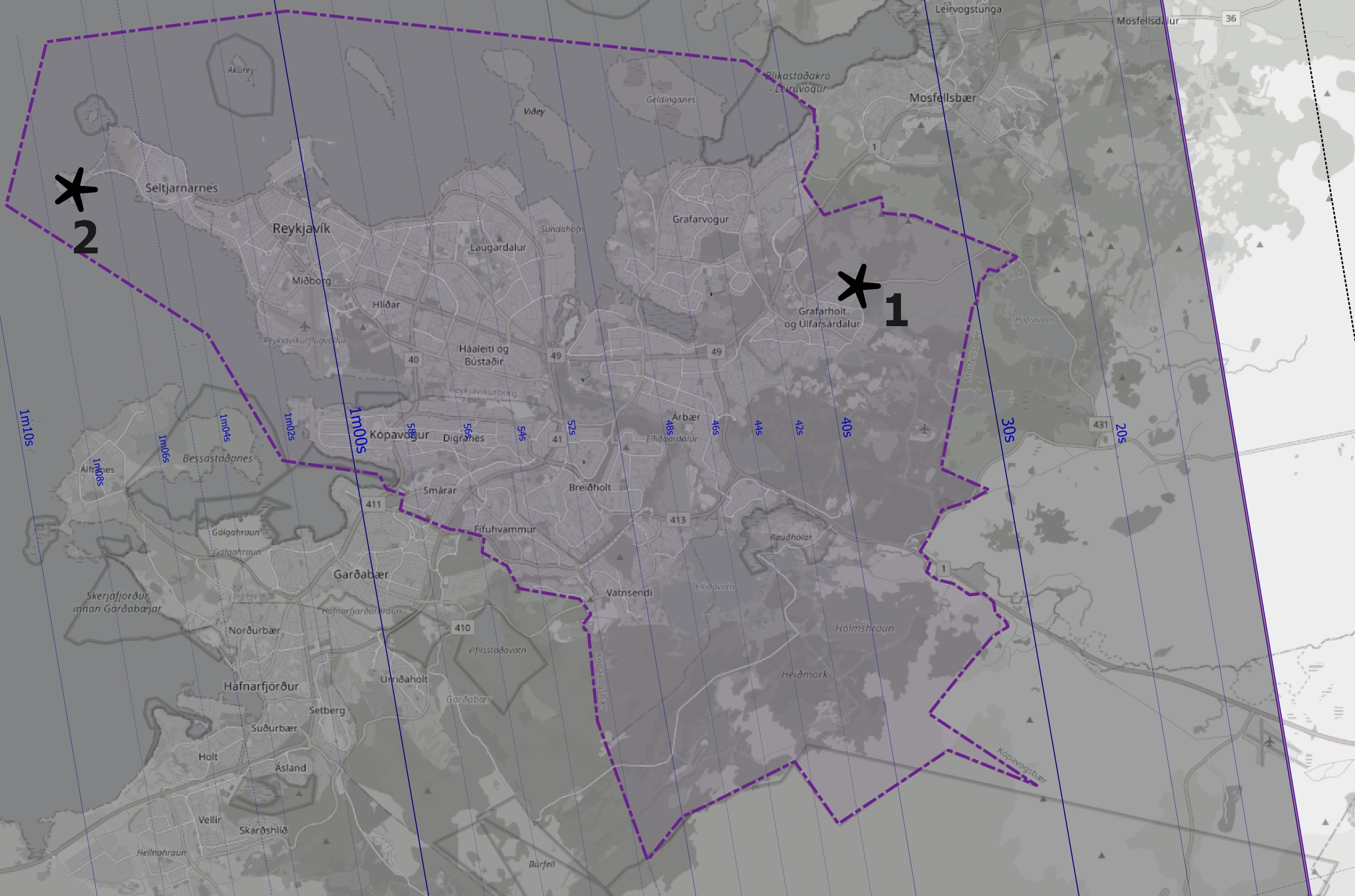
Within the Reykjavik boundary, the duration of totality varies dramatically, from 27s to 1m13s. It must be translated into the umbra position in the sky and into the Baily’s Beads projection, as presented below.
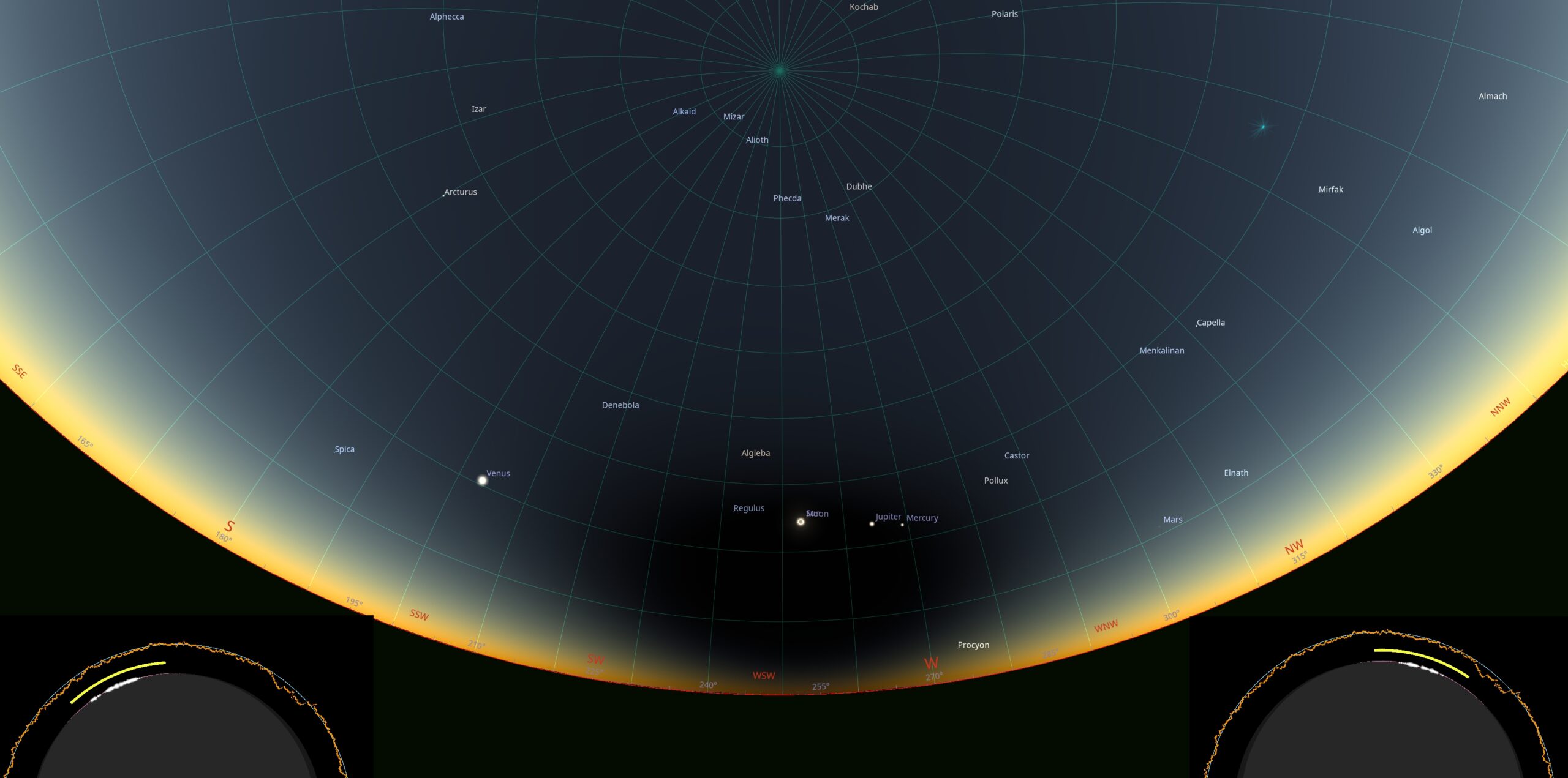
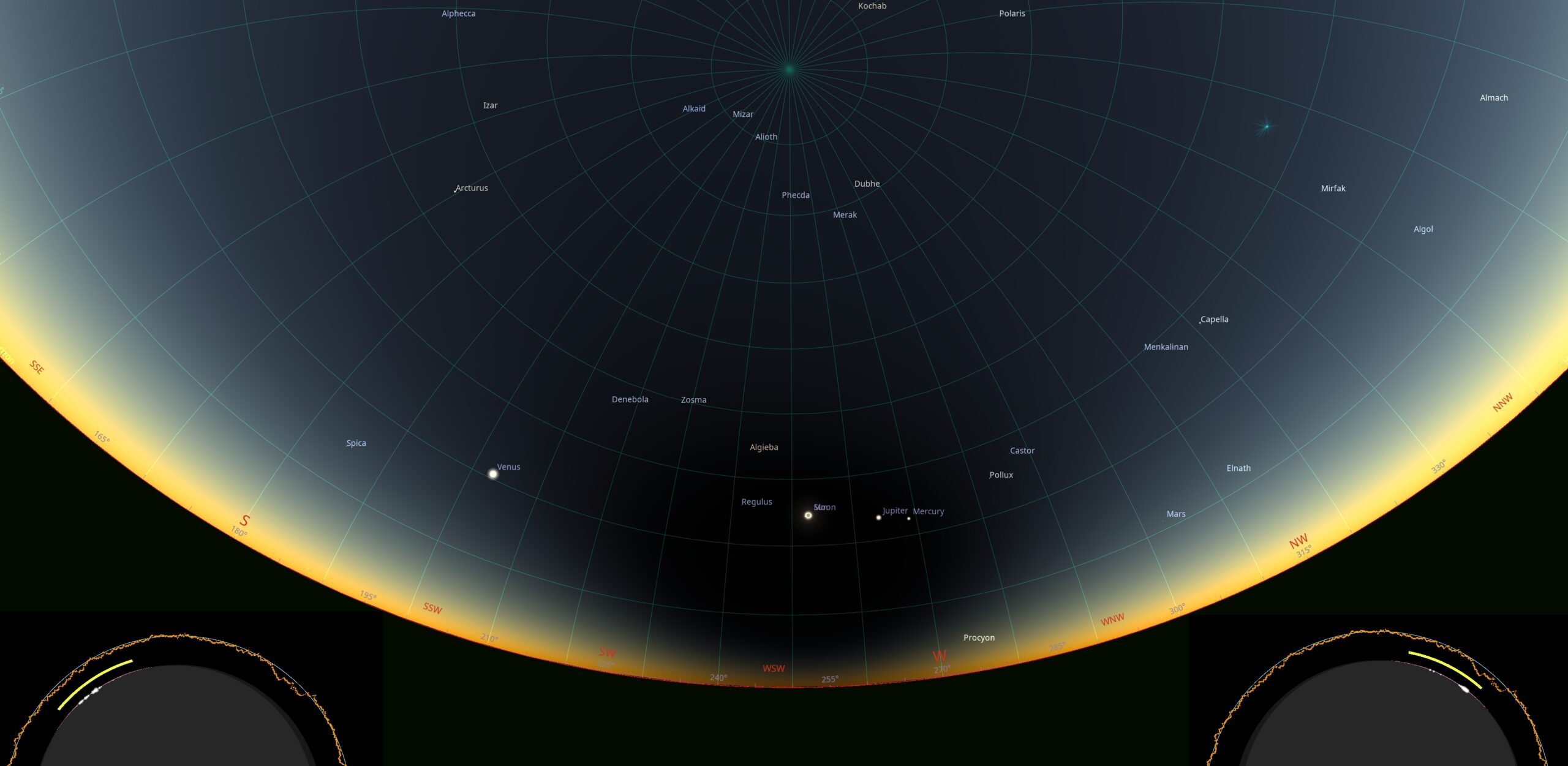
Some additional sky conditions for Iceland were considered in Chapter 10. Regarding the Diamond ring’s appearance, the image below shows what it will look like from Látrabjarg, located closest to the centerline (Pic. 36).
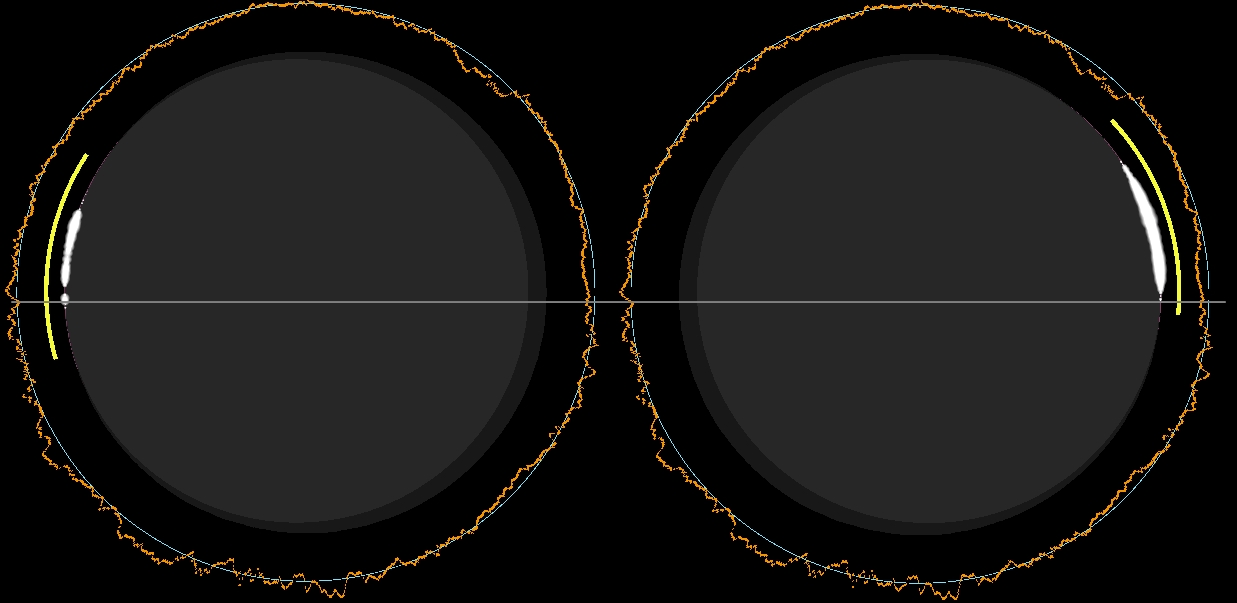
The Látrabjarg point has the best 2026 total solar eclipse location because of the duration (2m13s) and the Sun’s altitude above the horizon, which is almost the highest along the entire path (approximately 26°). Because the place is located just about 40 km from the point where the eclipse reaches maximum altitude over its path and around 35 km to the centerline, the progression of totality is quite typical. The image above shows the diamond ring position at the second and third contacts relative to the gray line, which divides the solar disk in half. As you can see, the position of the diamond ring isn’t aligned ideally with this line, which is the consequence of a distance from the centerline towards the north. Additionally, the umbral depth of this place is about 75% instead of 100%. By analyzing the lunar limb profile, we can adjust our observation place to the size of Baily’s Beads and diamond ring effect! Picking the location with the longest duration isn’t always a good choice, though it depends on what we want to see. It will be explained in further readings.
More detailed maps are presented on the website mentioned above. Unfortunately, what is missing there is the list of potential observation venues where you could set up with a nice view and watch the eclipse. Including the noteworthy optical phenomenon, which is the visual range extension during totality, I would suggest the elevated and « open-horizon » places, which are, in fact, easily accessible and covered by the Google Street View, so we can easily identify the horizon. See the maps with points included and refer to the list below.
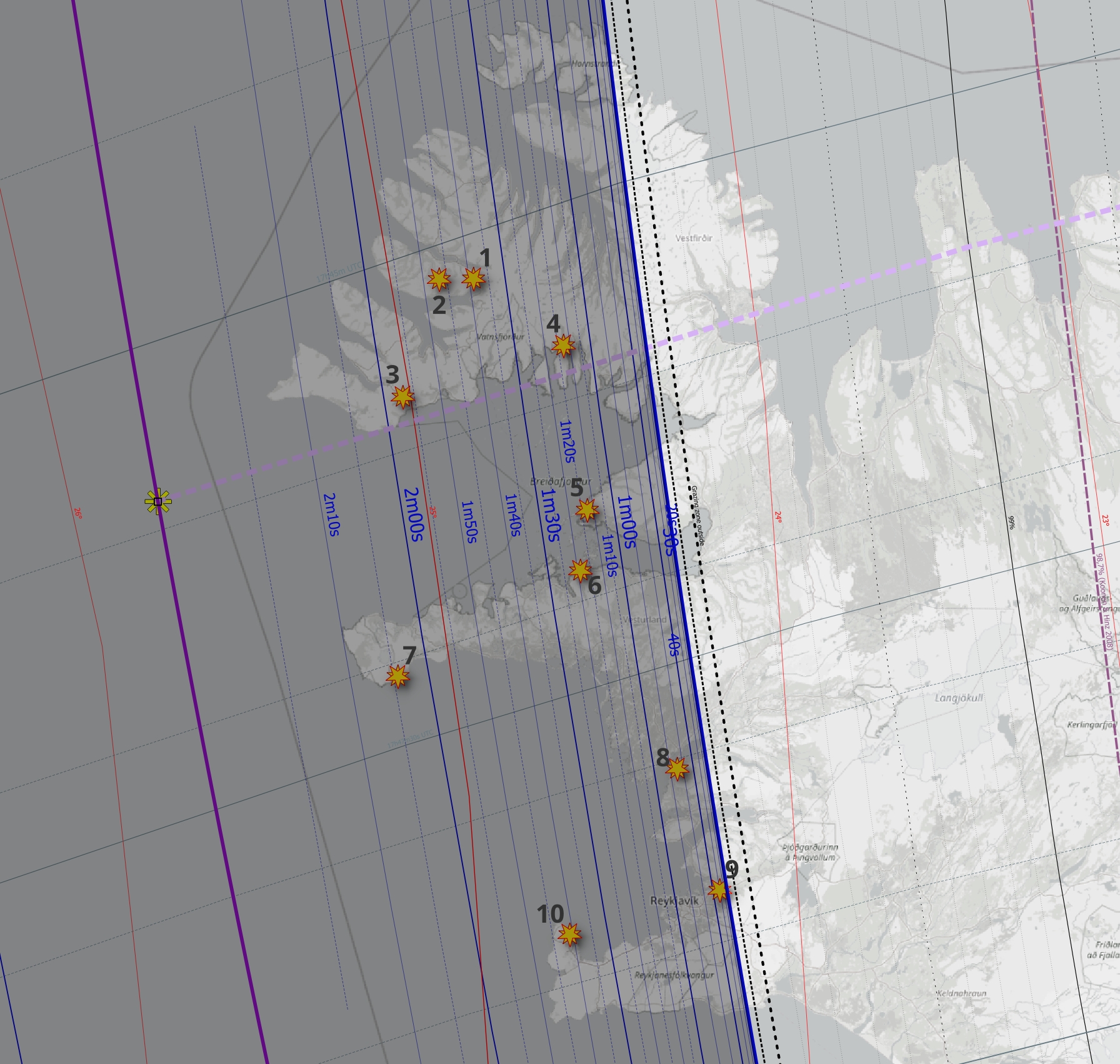
Point 1 – Google Maps – Google Street View – Ulrich Deuschle Panorama – Xjubier Map
Point 2 (Hrafnseyrarheiði mountain pass) – Google Maps – Google Street View – Ulrich Deuschle Panorama – Xjubier Map
Point 3 – Google Maps – Google Street View – Ulrich Deuschle Panorama – Xjubier Map
Point 4 – Google Maps – Google Street View – Ulrich Deuschle Panorama – Xjubier Map
Point 5 (Klofninsvegur) – Google Maps – Google Street View – Ulrich Deuschle Panorama – Xjubier Map
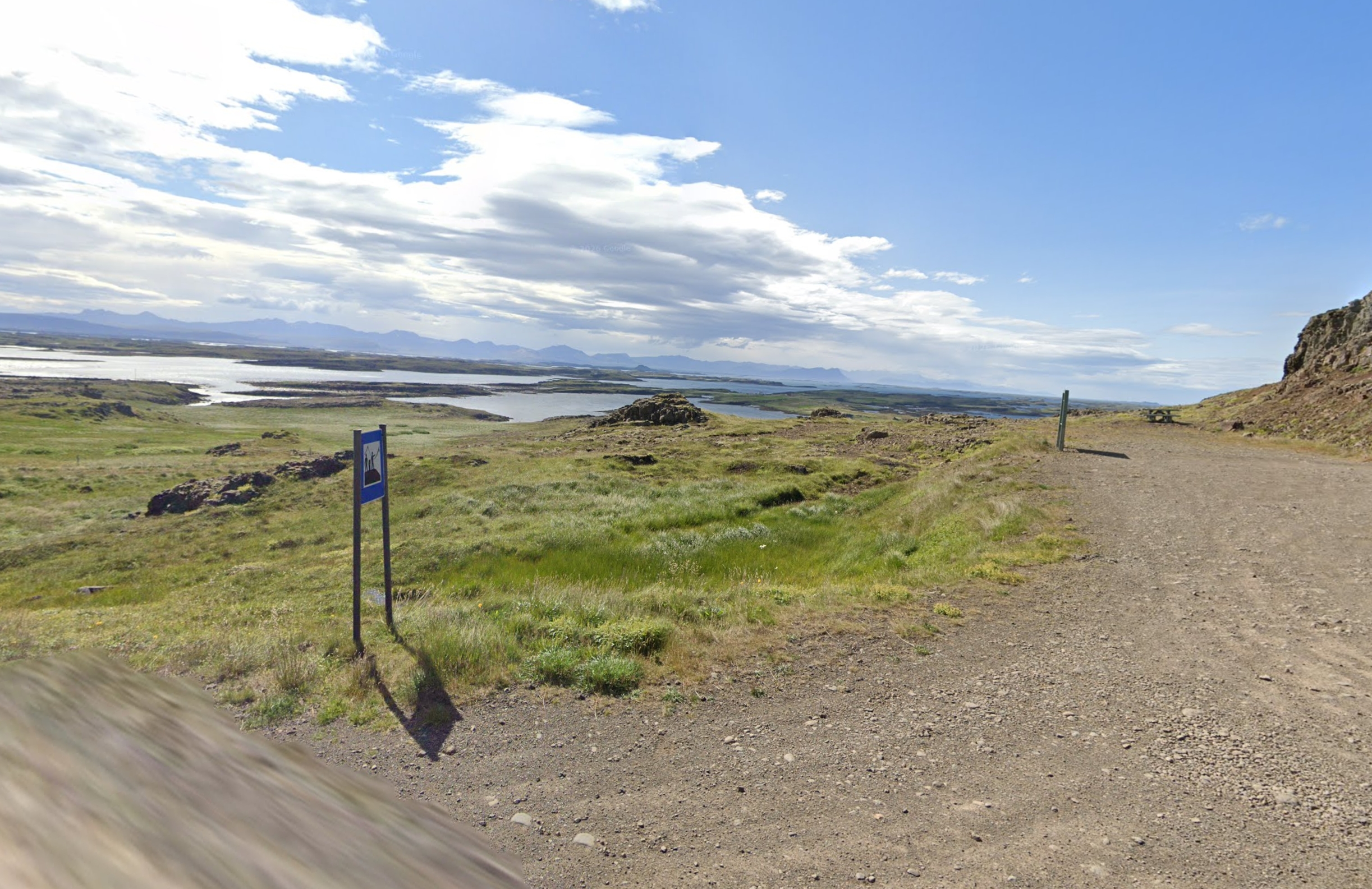
Point 6 – Google Maps – Google Street View – Ulrich Deuschle Panorama – Xjubier Map
Point 7 – Google Maps – Google Street View – Ulrich Deuschle Panorama – Xjubier Map
Point 8 – Google Maps – Google Street View – Ulrich Deuschle Panorama – Xjubier Map
Point 9 – Google Maps – Google Street View – Ulrich Deuschle Panorama – Xjubier Map
Point 10 – Google Maps – Google Street View – Ulrich Deuschle Panorama – Xjubier Map
These are only the top 10 random places. A similar view will probably be around the world too. If you live in Iceland or visit this country quite often, you will probably find more interesting venues. This section just gives you a hint as a supplement to the main page about the Iceland eclipse.
5.2 Spain
The largest portion of totality and the most popular eclipse destination for anyone is Spain. There is quite a lot of specific information available about the 2026 total solar eclipse. I am pleased to list them here and briefly describe their content.
SolarEclipseSpain.com – this website includes basic guidelines on how to prepare, find a place, and watch the eclipse. In the same manner, the SpainSolarEclipse.com and Eclipse26.com websites were created. Other websites have dedicated tabs for the forthcoming eclipse event, like Eclipse-Spain.es. which includes information about all the eclipses in Spain. Not to mention the websites listed at the very beginning of this long text. Despite quite a short time until the eclipse event, there are still some websites in preparation, like SolarEclipse2026Spain.com, where you will find only empty tabs and space for content, which, in the long perspective, might look promising. Similar content is available on the TrioEclipses.es site, launched recently by the Spanish government. Admittedly, I could find at least a few others whose content is pretty much the same, including what to expect on the afternoon of August 12 and how to watch the eclipse safely. The worst thing is that there is no comprehensive website that includes all the necessary information, such as detailed maps, potential observation sites, weather predictions, etc. Everything, of course, we can find, but in general, the information is sparse, which is the primary goal of this section: to gather all of them together.
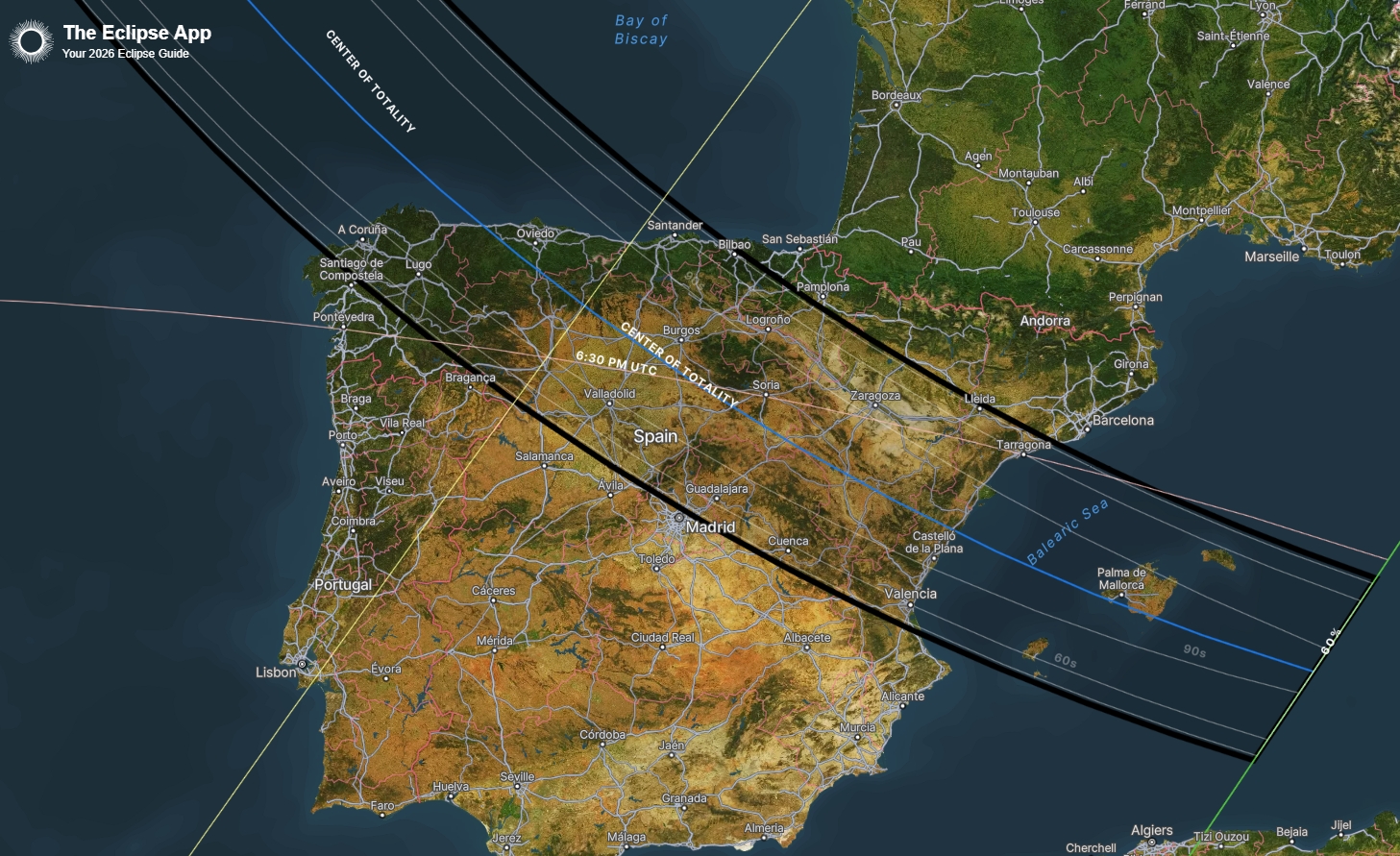
A. MAPS – There are interactive maps of the eclipse available on commonly known websites like NASA Eclipse, Eclipsewise.com, Xavier Jubier 2026 solar eclipse map, or TimeandDate eclipse map. However, they’re not the only ones! In recent times, we have seen the emergence of various interactive maps of varying quality. Amongst them, I would highly recommend TheEclipse.app, which displays the path of totality on satellite imagery (Pic. 35) and includes lines of the same eclipse duration.
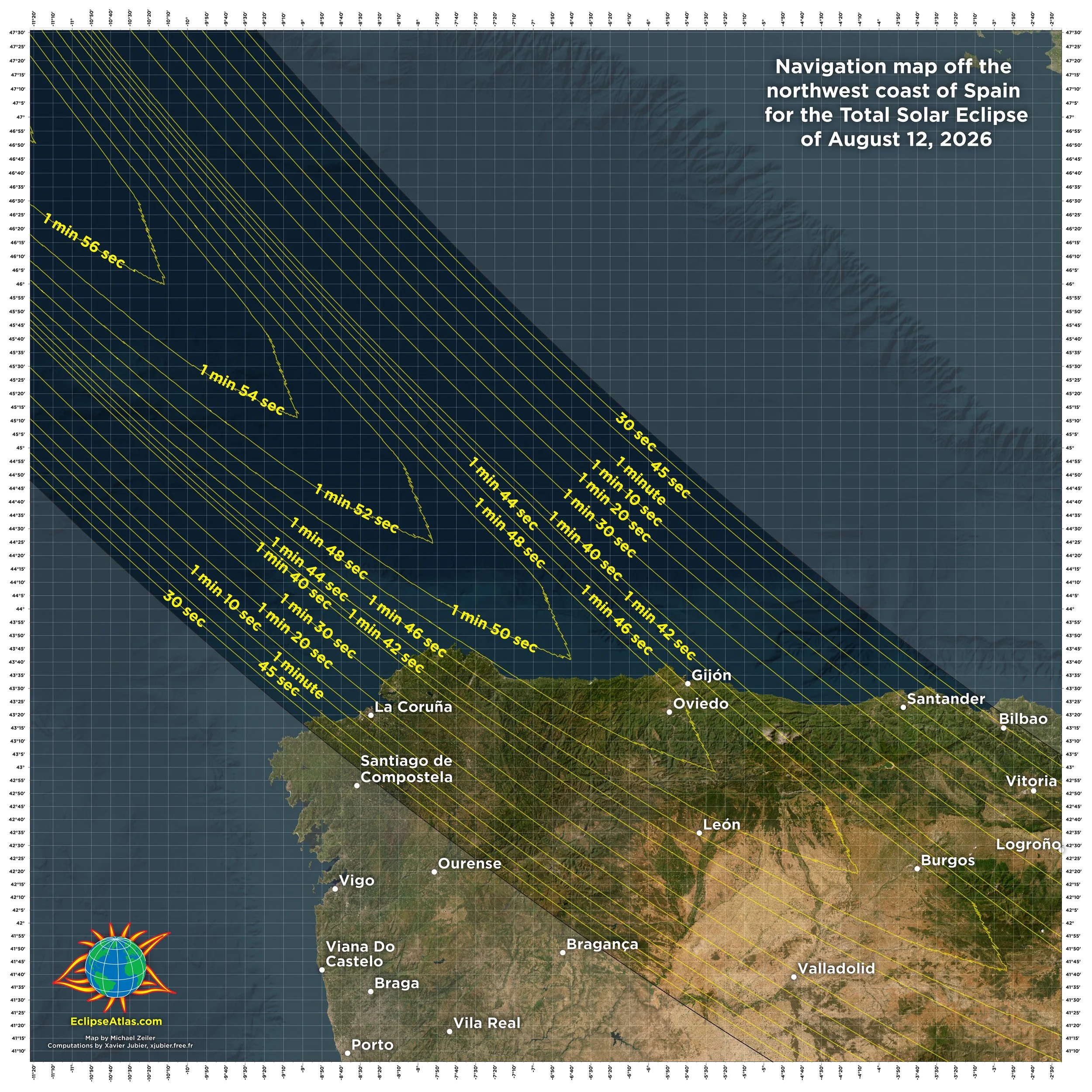
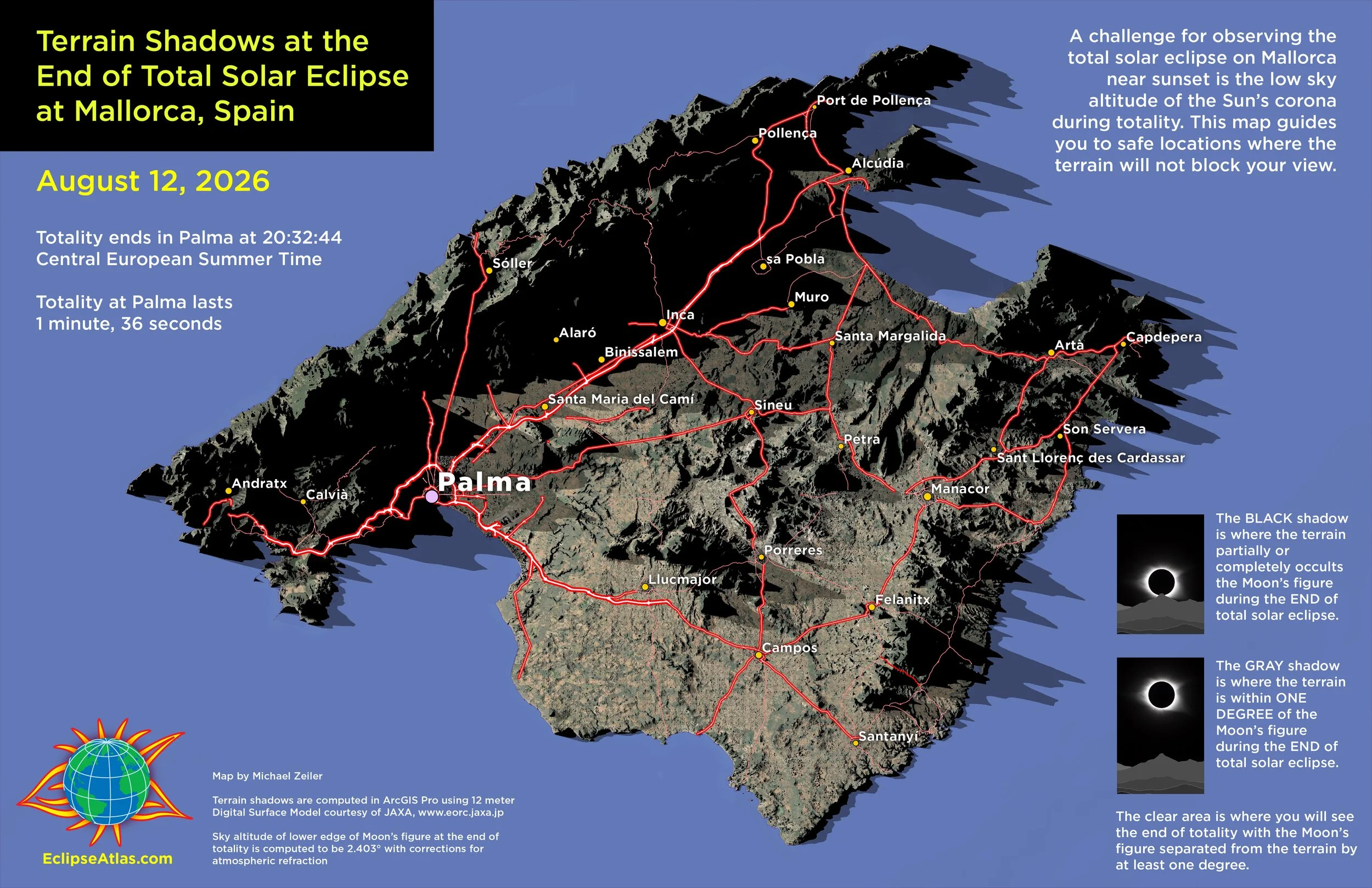
Apart from the interactive versions, it’s always good to have something like a poster map – a static mapping illustration of the event, which is good to look at straight away without clicking for more information. Sadly, this kind of map is missing from all the top eclipse websites for Spain, and anyone has to rely on EclipseAtlas.com, developed by Michael Zeiler, which provides fantastic, high-quality eclipse maps for any single event. One of them is shown below; visit the website for more.
Given the high level of detail in the street plan, you can see the most detailed eclipse maps for the largest cities across Spain (Pic. 37-45).
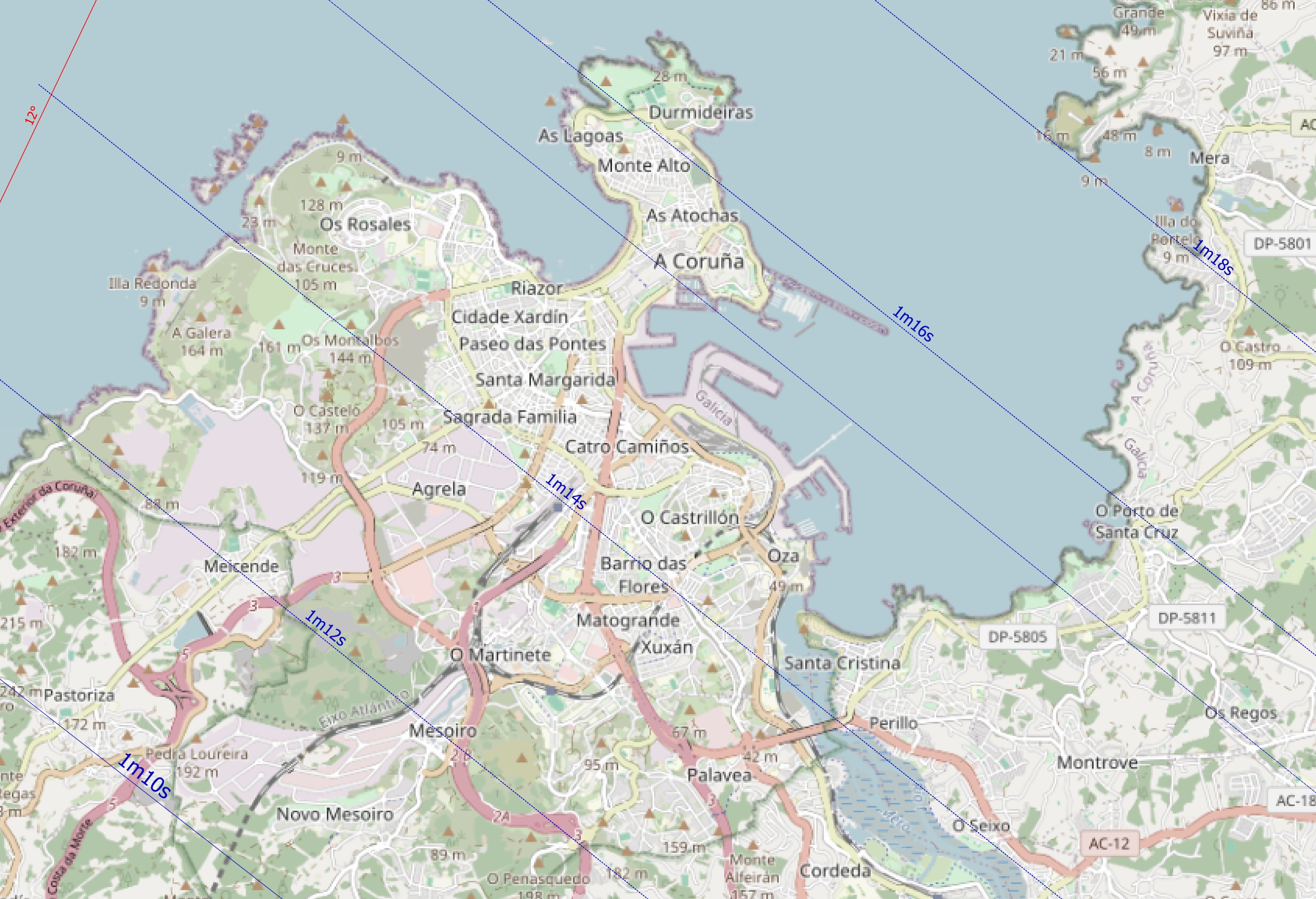
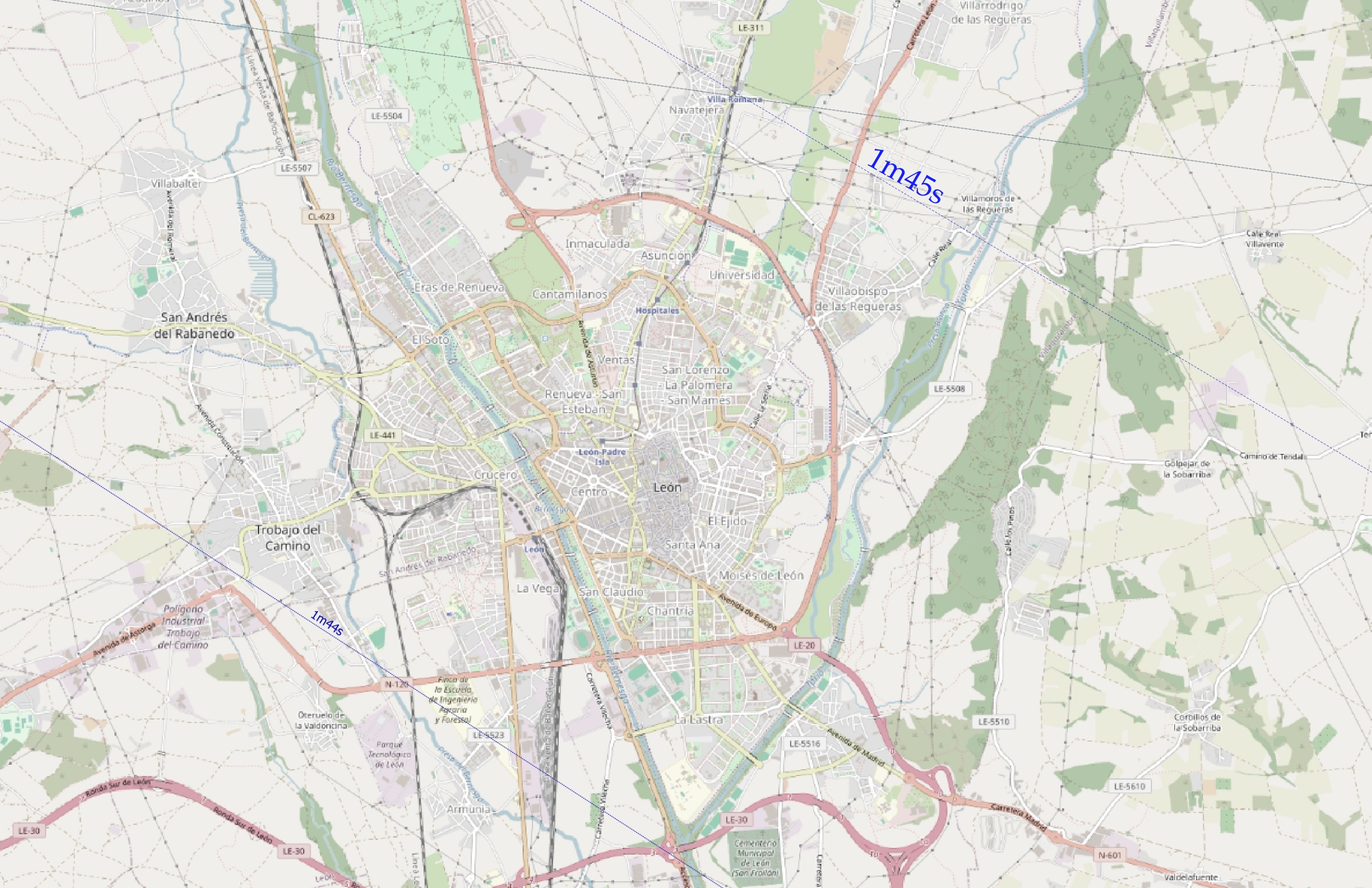
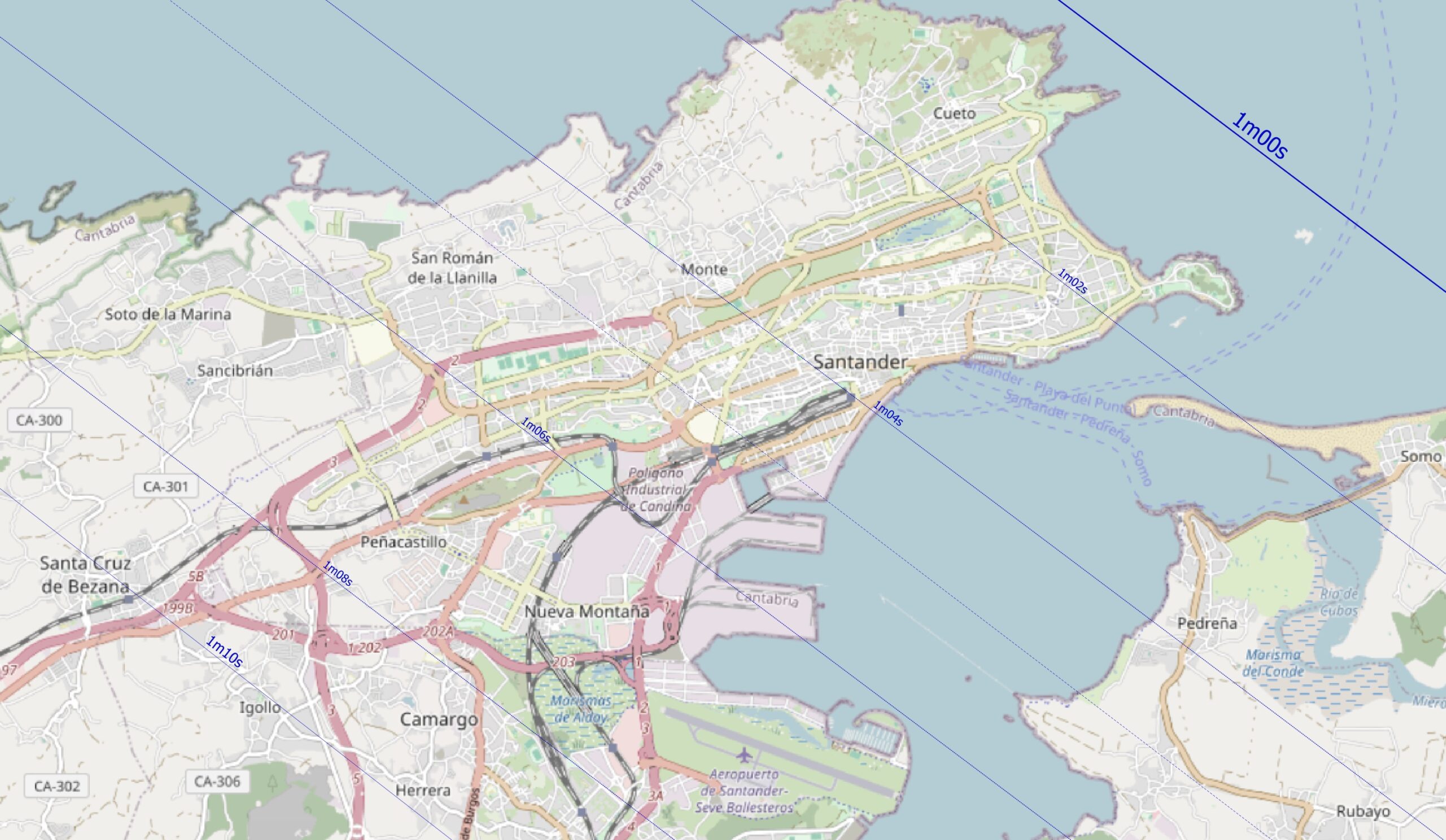
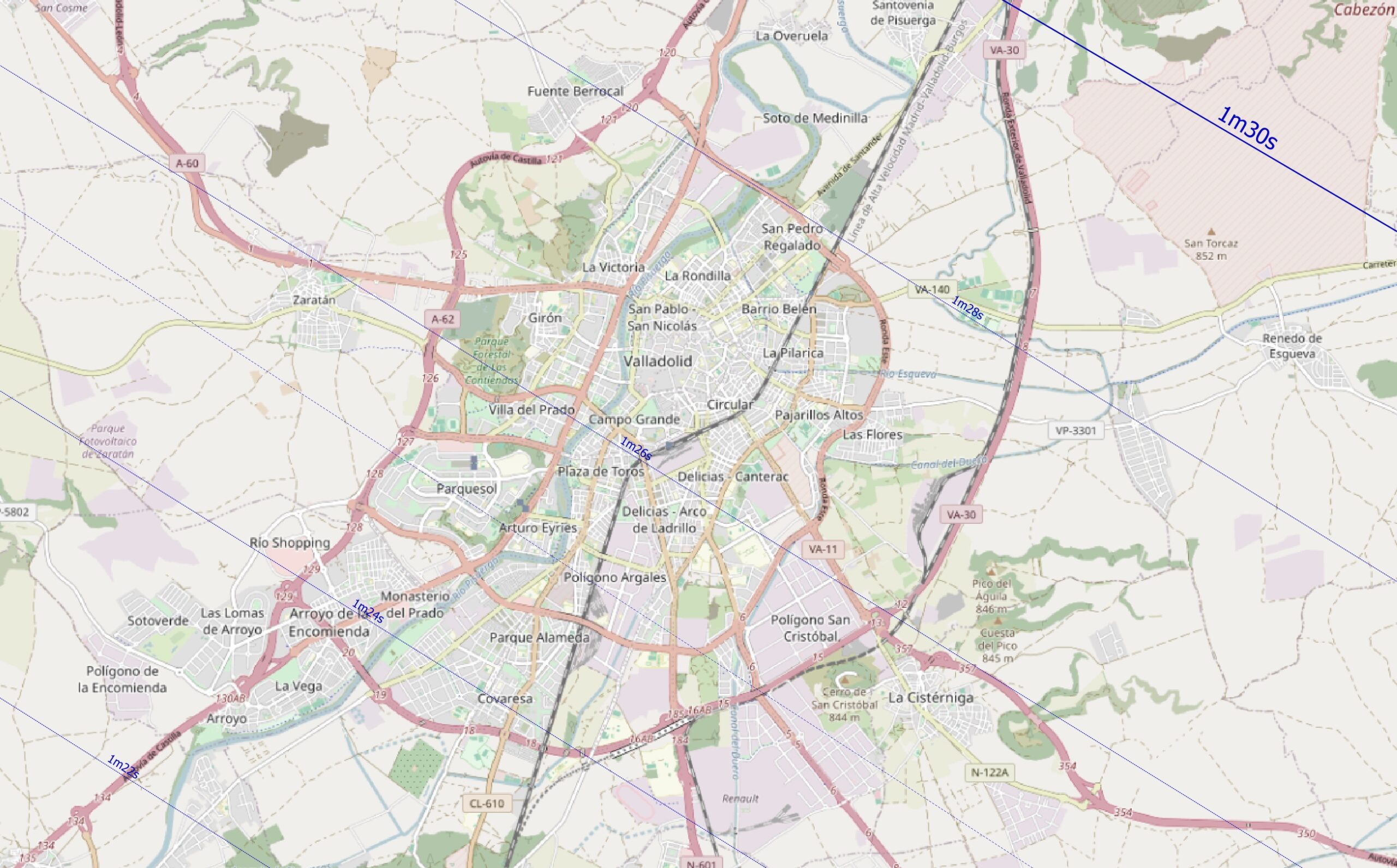
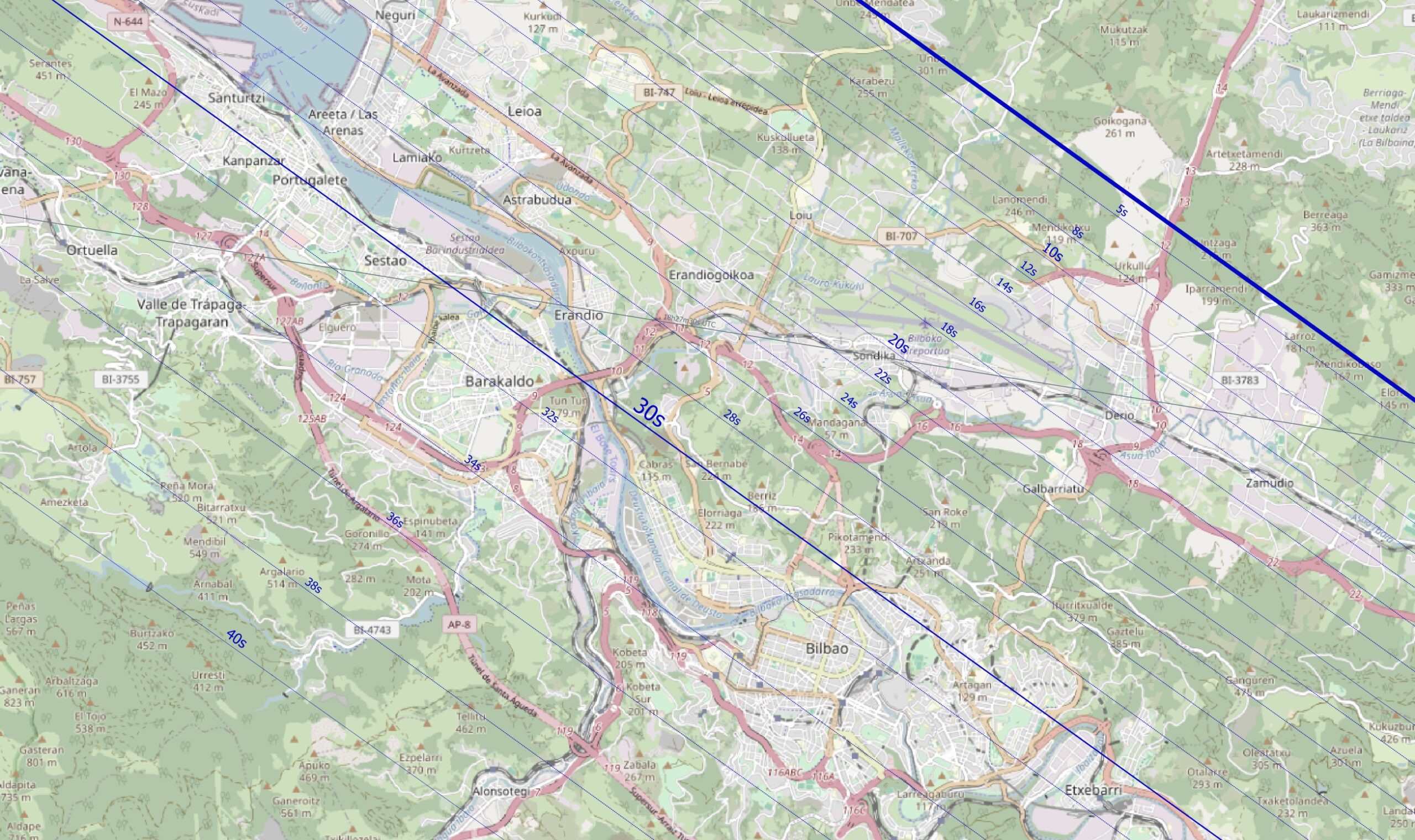
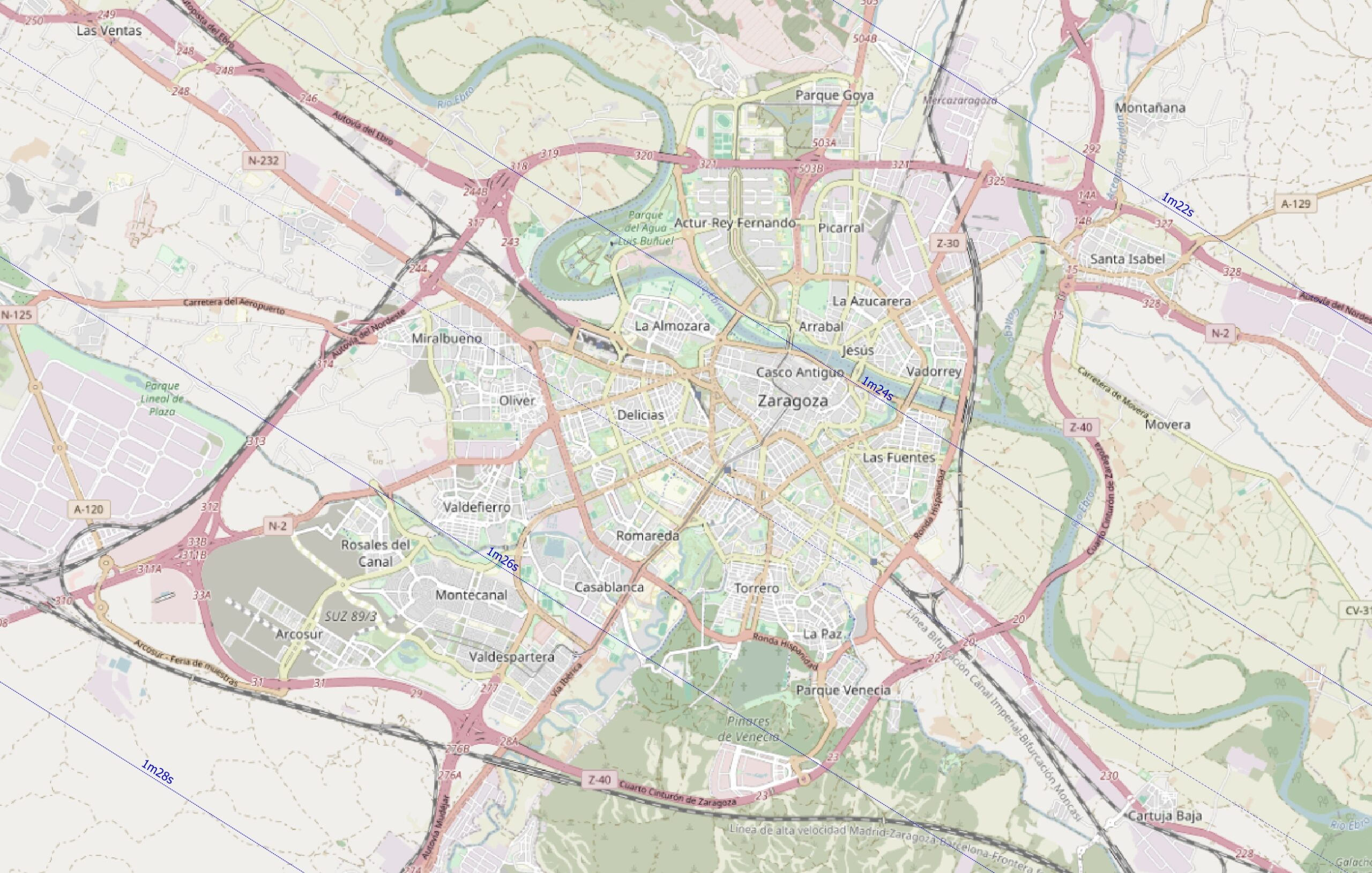
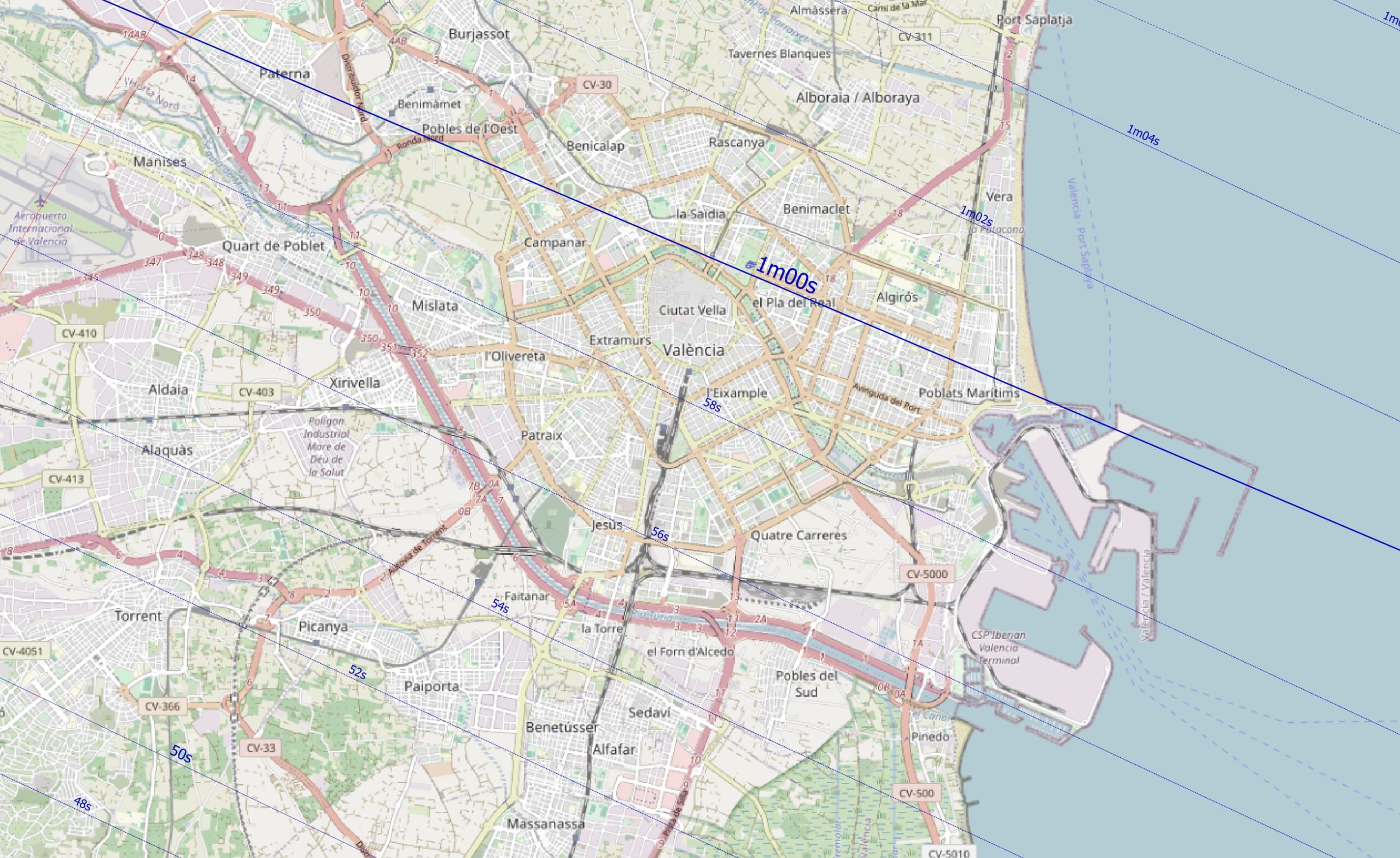
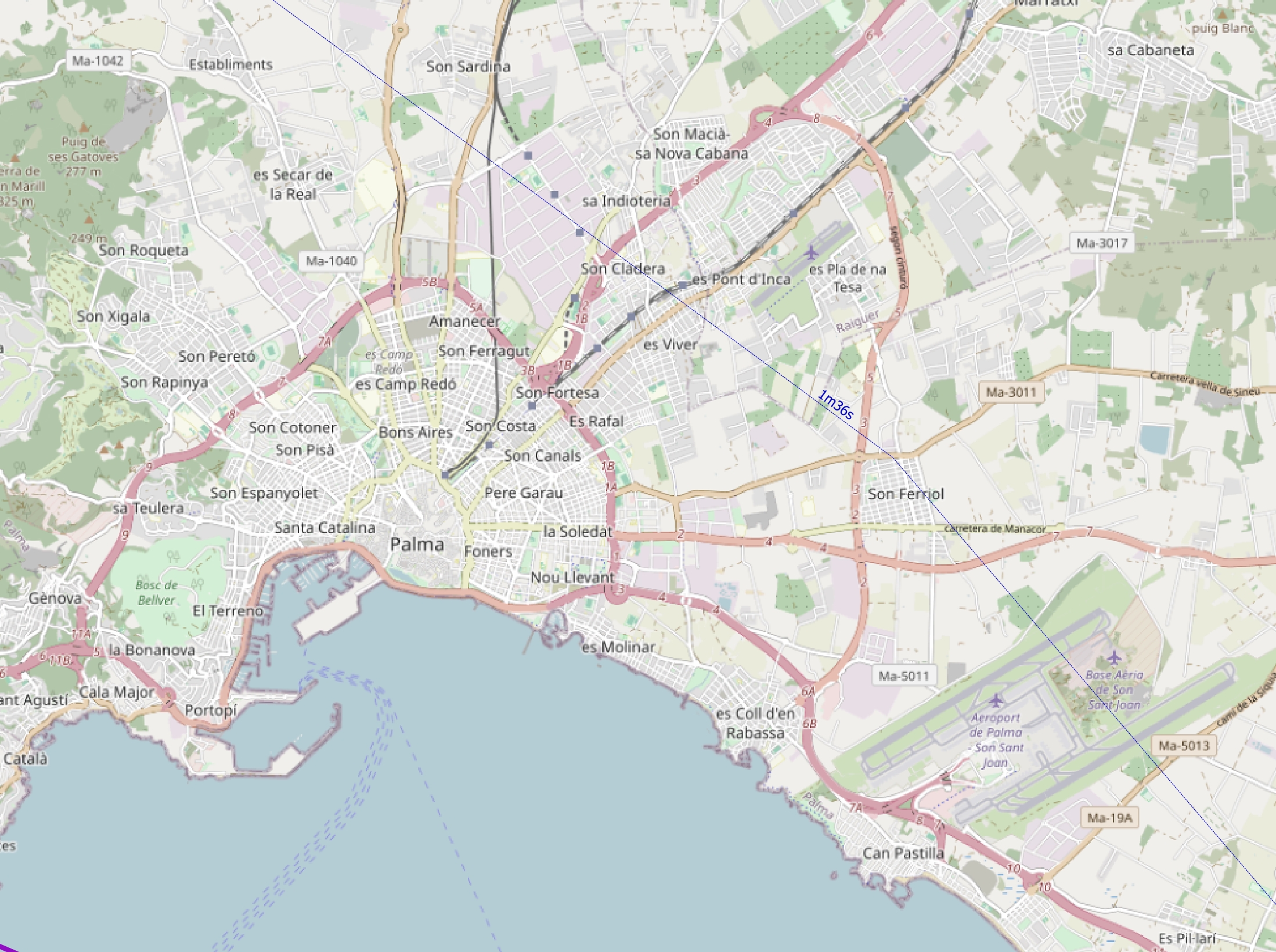
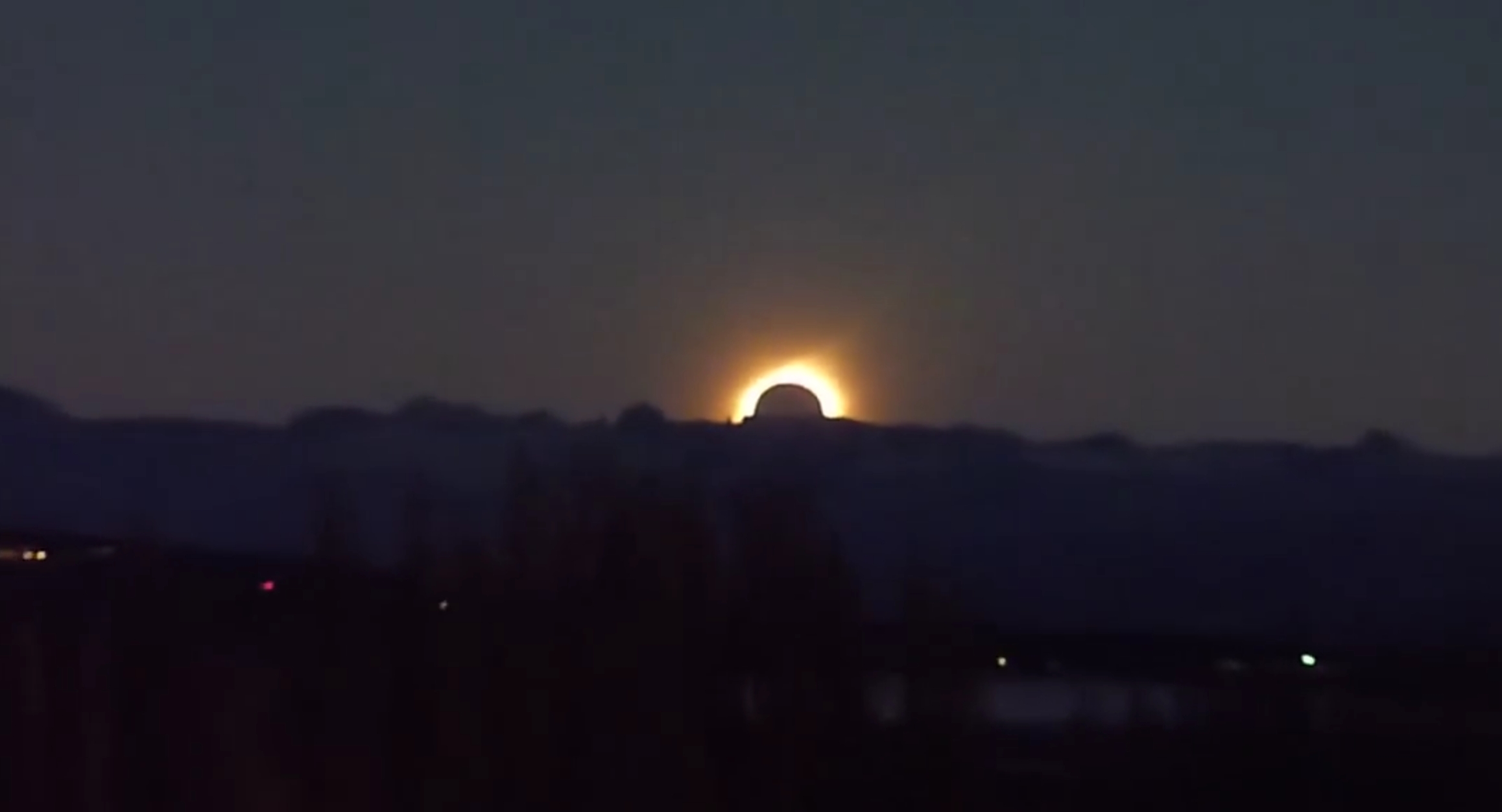
Unfortunately, the last map isn’t valid, as Palma de Mallorca will be completely shaded by the Sierra de Tramuntana, and the eclipsed Sun won’t be visible! With respect to these circumstances, we need to go back to the very important section of the EclipseAtlas.com content, which is the work on 2026 eclipse shadow maps, which are necessary, especially in the eastern part of the Spanish mainland, and specifically on the Balearic Islands, where the Sun will be very low above the horizon. The Terrain Shadows over Spain section includes a detailed map showing how ground features will chase the shadow at the moment of greatest eclipse. At Mallorca, for example, the totality visibility zones are planned to be determined on May 1, when the Sun has a similar declination to that on August 12, so the relevant information, including maps, will be published afterwards. The observations of totality, when the Sun is very low above the horizon, are very risky, as sometimes people might locate themselves on too low grounds and see only the passing shadow instead of the eclipsed Sun. A good example was the observation of totality in El Calafate on July 11, 2010, as shown in the video below.
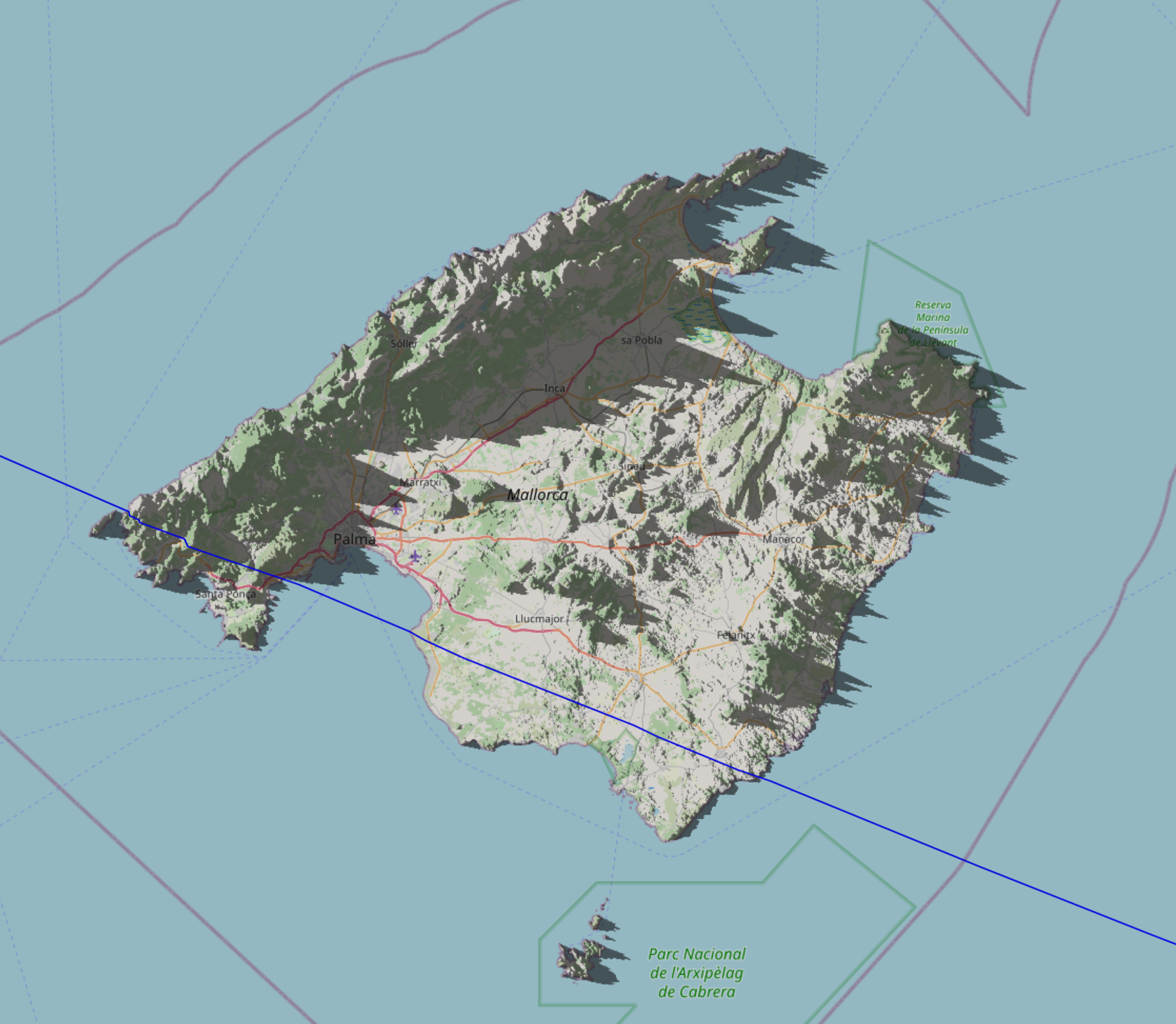
Alternatively, we can use the BesselianElements eclipse map (Pic. 49), which allows you to analyze the shadows cast by local topography at various zoom levels.
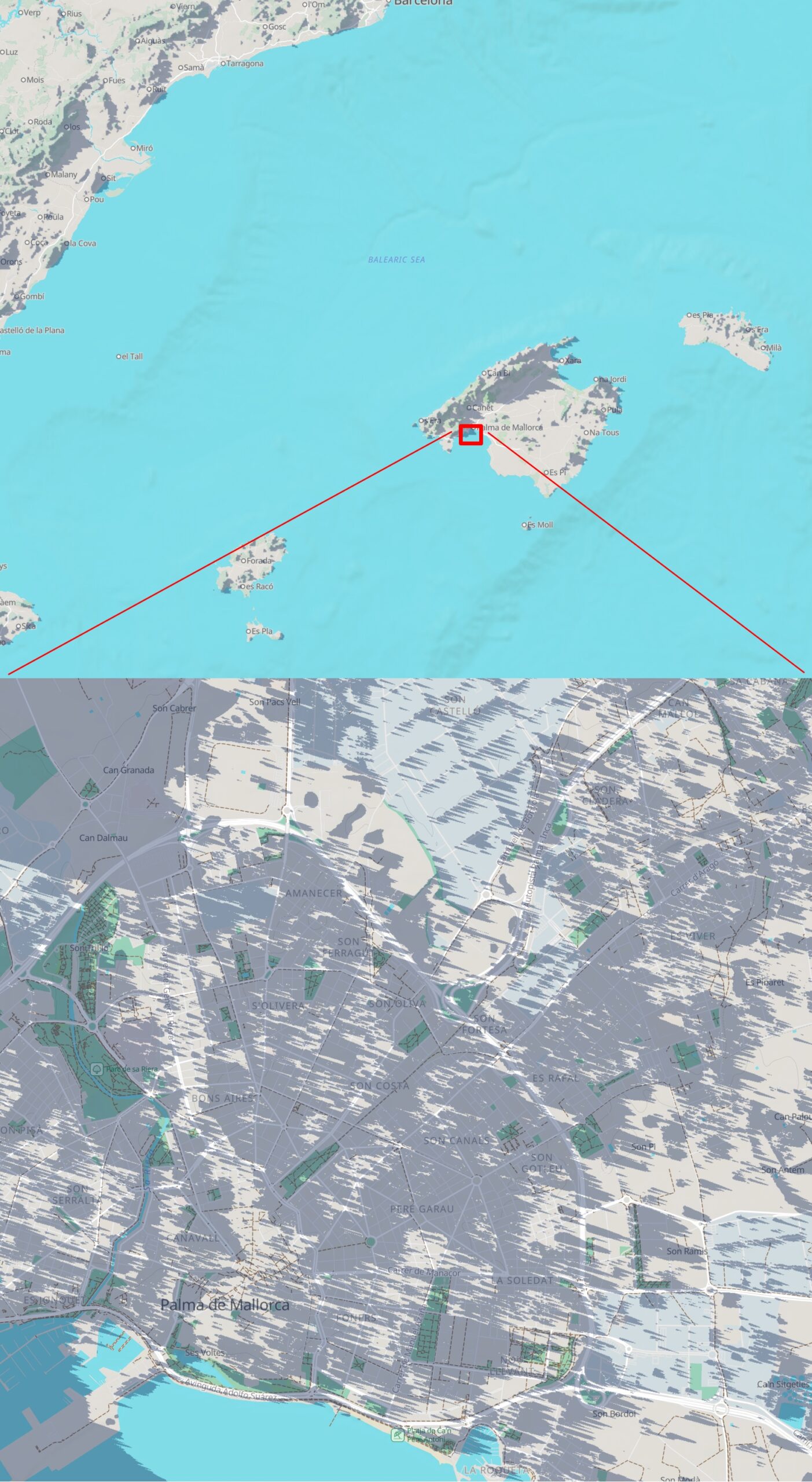
Another website, the Shademap.app, can render detailed shading conditions for us. However, they aren’t as good or elegant as Michael Zeiler’s map and can be used only locally when a large zoom factor is necessary, especially since this application also includes shadows from buildings and other artificial objects.
An alternative source of information about shadows in Mallorca is the Photoephemeris platform, which offers a free example. If you wish, this is a good GitHub tool that can be installed and run for more details based on the SRTM model.
B. PLACES – As the area is enormous, it’s a great choice for planning your eclipse photography with some interesting objects. Some of them, UNESCO-listed, were discussed in this article a while ago.
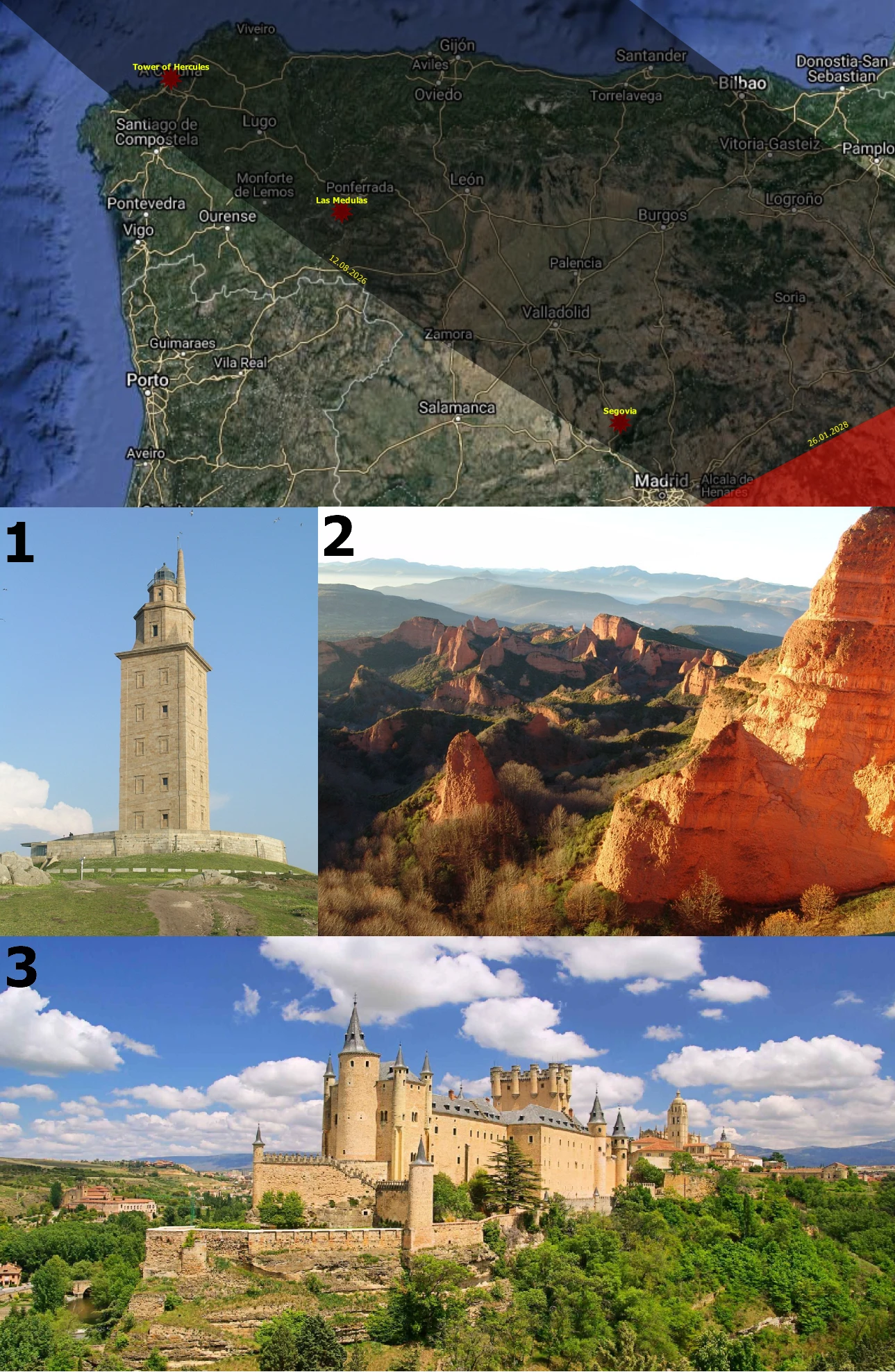
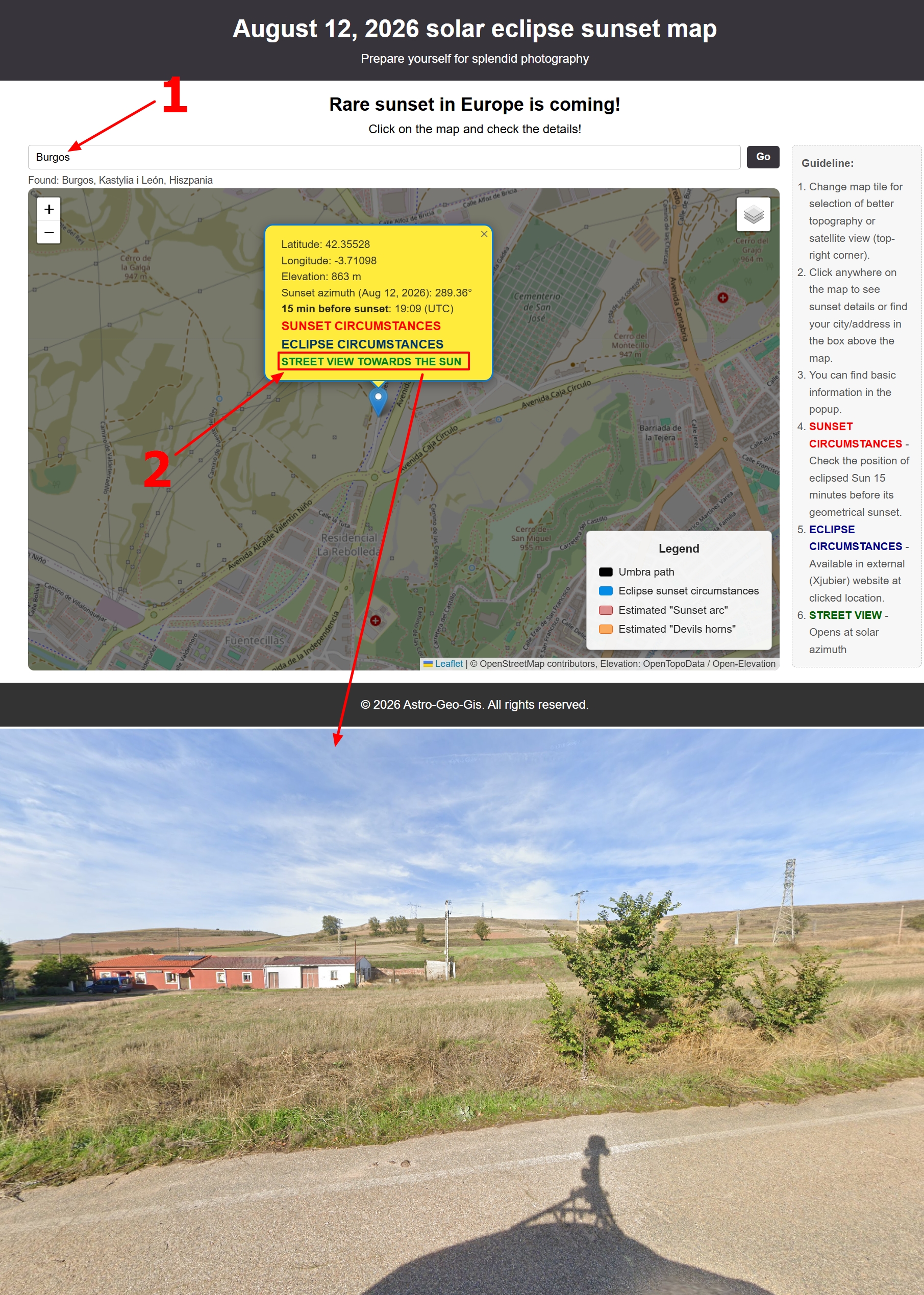
For other landmarks or scenic views, it would be extremely hard to gather them all here. Many observers travel across Spain and choose their best venues. Listing interesting venues is a subjective approach, so I propose another approach. I’ve upgraded to the Eclipse Sunset Map described in Chapter 10, which includes an option to quickly find the address and open Google Street View in the desired direction! This is a handy benefit that can help anyone choose a good observation spot. As the primary drawback is street coverage only, you can sometimes find user-contributed Street View images, which are also oriented to solar azimuth on August 12.
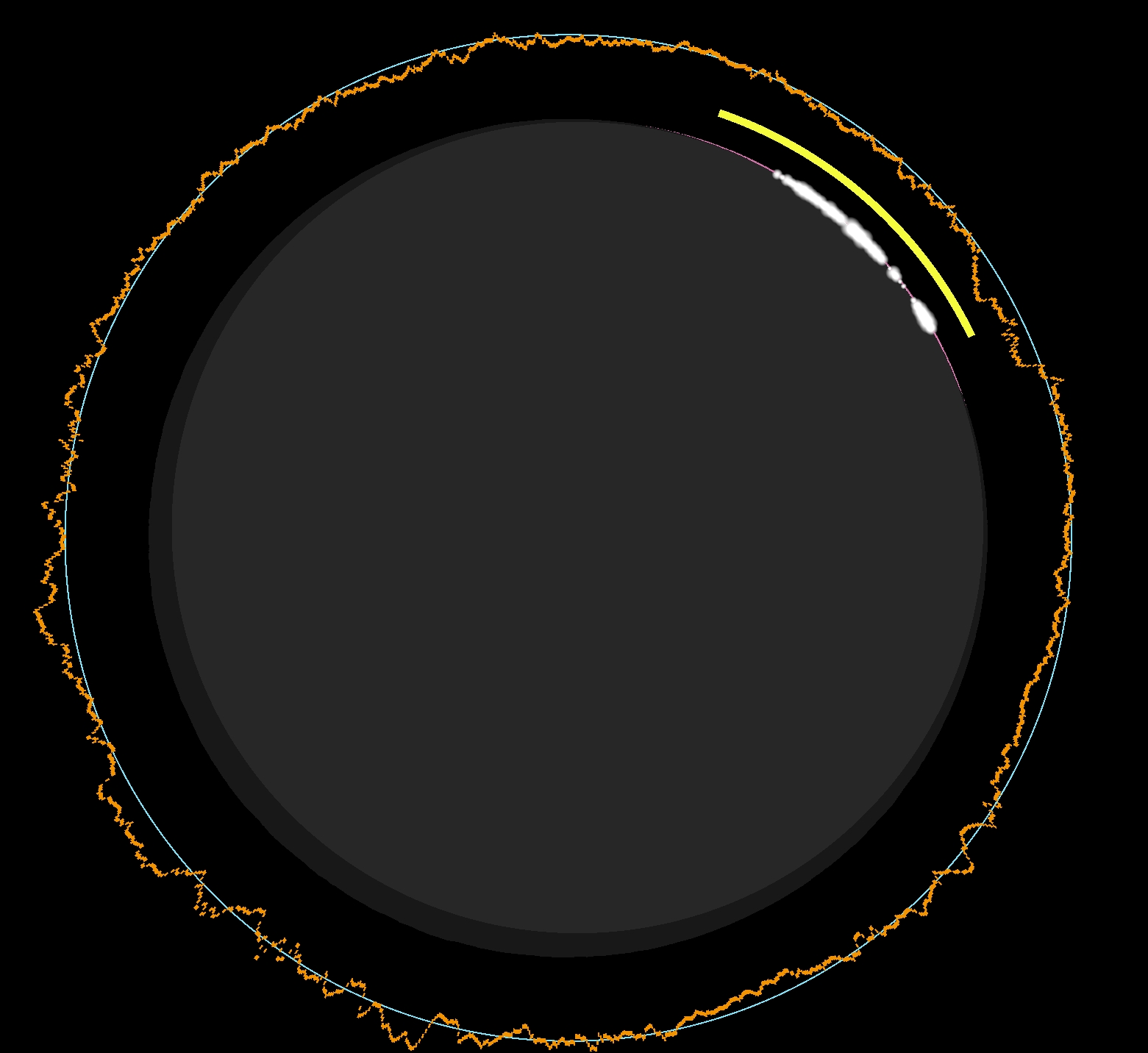
C. CIRCUMSTANCES – as Spain lies on the entire path width, an observer can theoretically be placed on any side of the zone of totality as far as various umbral depths are concerned. It’s surely translated to various characters of Bailey’s Beads’ appearance, which mostly rely on the lunar limb profile. Analyzing some instances from the northern to the southern limit of totality, we can start from Bilbao. This city is located nearly at the edge of the northern totality limit, as you know from earlier text about the umbra. According to the Photoephemeris application, there is 1 minute from the moment the solar filters can be theoretically taken down to the second contact. It’s quite a long time, because the umbral depth is 3-4% only, and the chromosphere remains visible over the entire short period of totality. The transition between the diamond ring and Baily’s Beads is also gentle, and it looks best after the third contact due to the lunar limb profile (Pic. 51).
The most interesting situation will apply to Santander. Despite an estimated 1m02s of totality in the city centre, Xavier Jubier estimates just 57 seconds after lunar limb correction! It’s about 5 seconds of difference, quite a lot!. A deep lunar valley will shorten the eclipse along the line of umbral depth by about 18% on the northern side of the path. (Pic. 52)
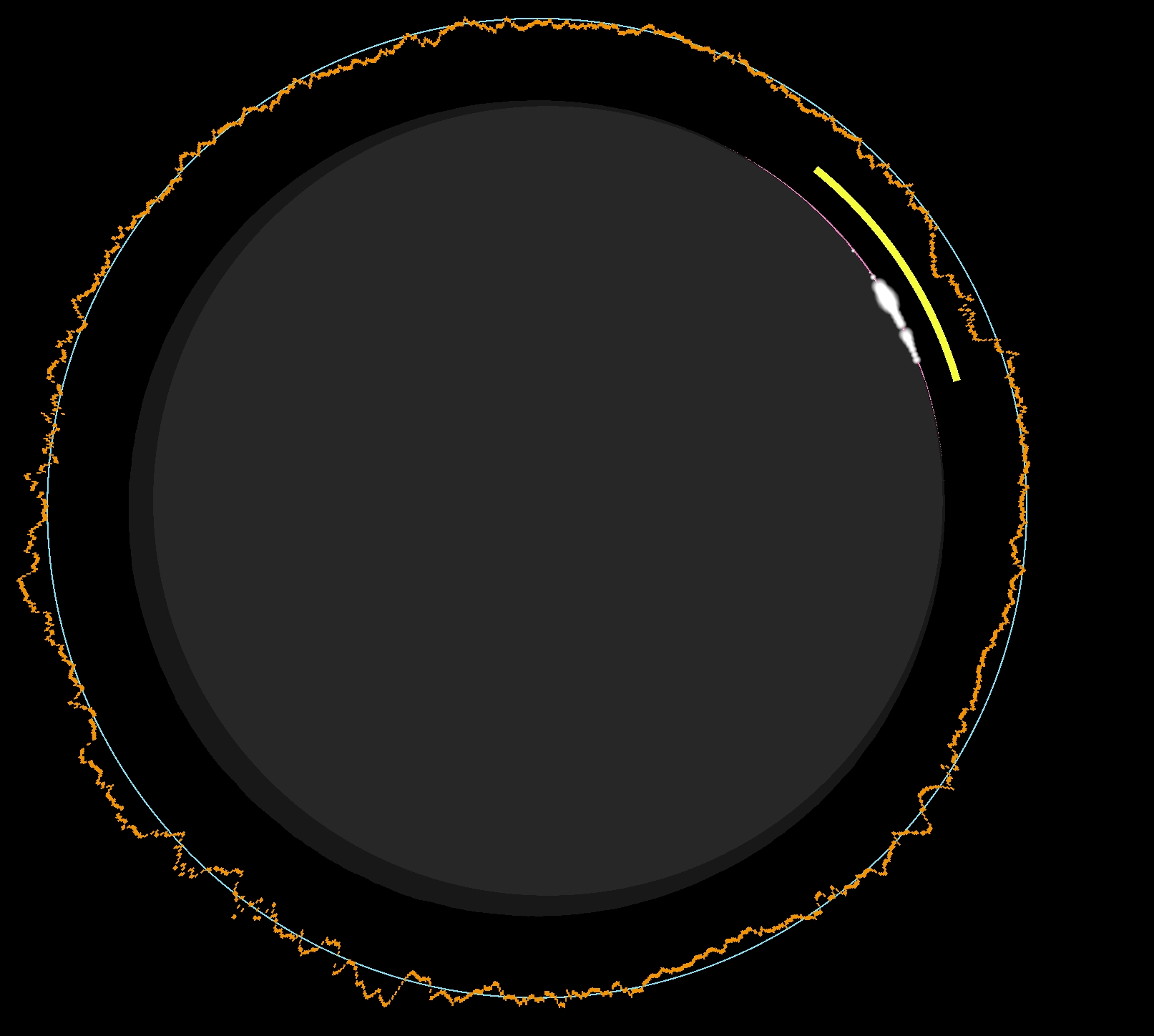
The first shaft of sunlight will shine through this deep lunar valley at all locations with a shadow depth between 15 and 45% on the northern side of the path. In Zaragoza, where umbral depth is 42%, the first shaft of sunlight approximately 1,5 second before the 3rd contact will precede an exciting chain of Baily’s Beads 3-4 seconds later (Pic. 53).
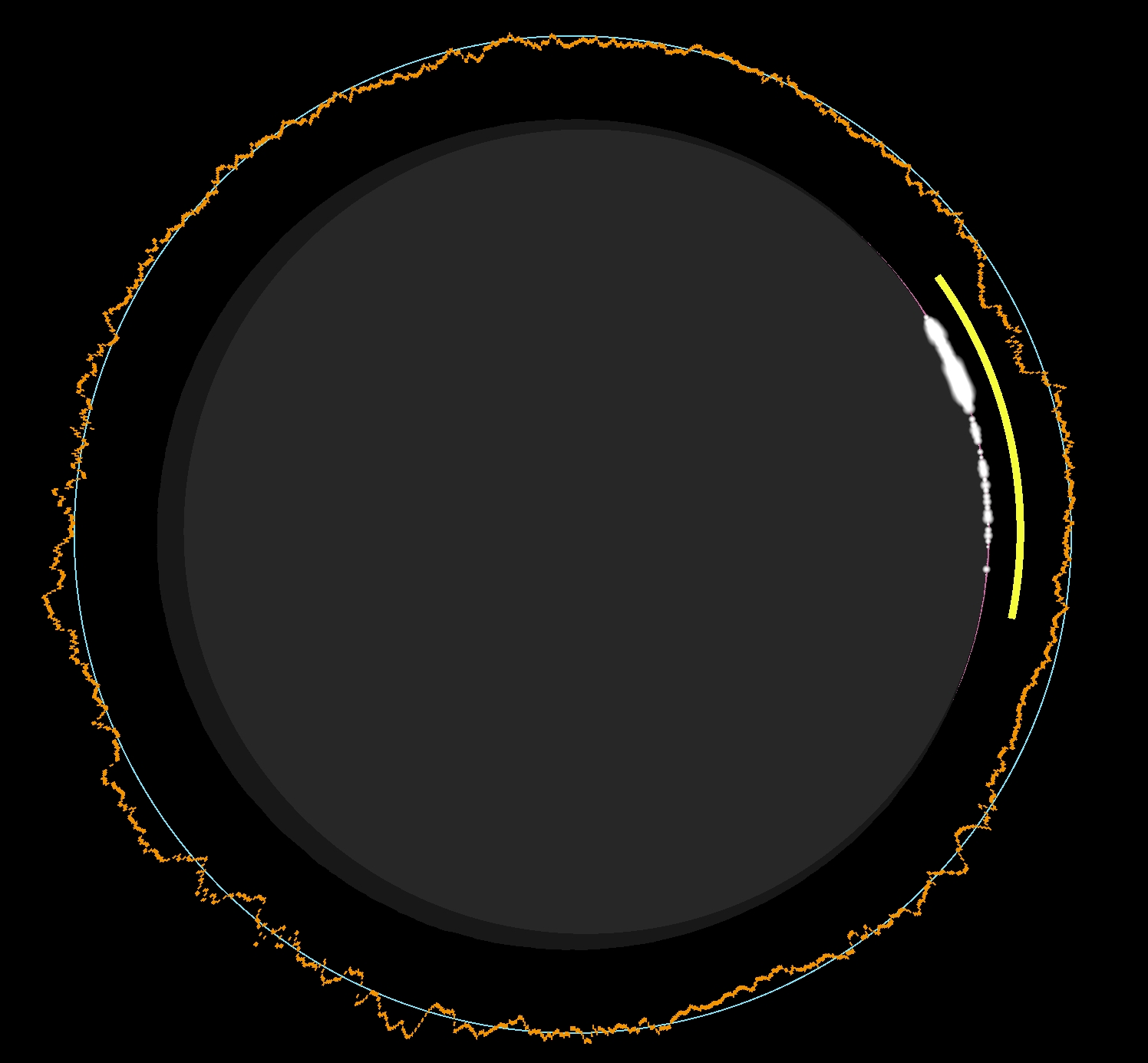
For all locations with an umbral depth greater than 70%, the chances of seeing Baily’s Beads are small. The lunar limb profile is quite unfavorable, and they’re visible just for a couple of seconds before and after totality. This situation applies to cities like Burgos, Leon, or the southern surroundings of Palma de Mallorca, which lie roughly along the centerline. The Bailey’s Beads appearance will look as illustrated below (Pic. 54).
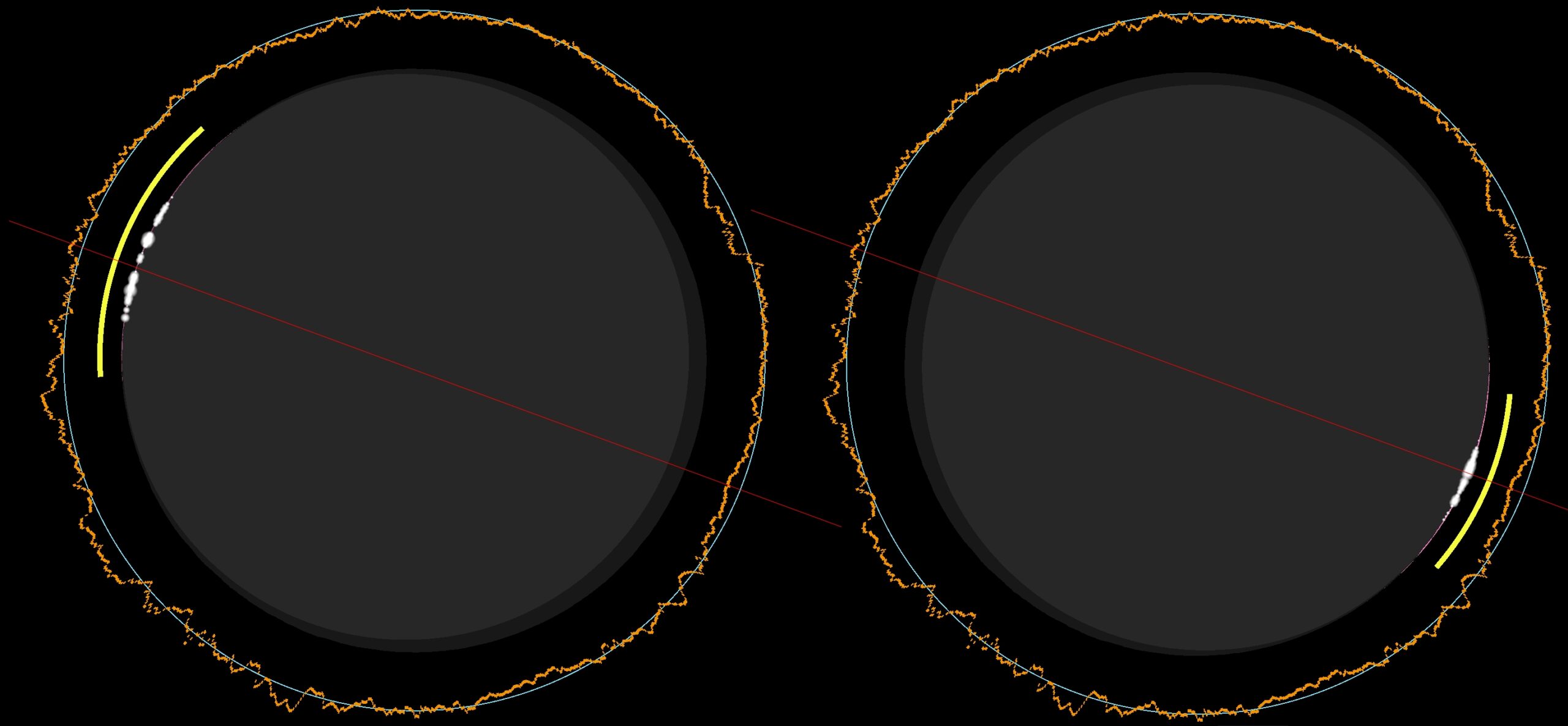
The southern part of the eclipse path looks more dynamic, due to favourable lunar topography. The chance for a double diamond ring, which lasts only 1-2 seconds, increases along with the umbral depth of 40-50%, where cities like Valladolid are located (Pic. 55).
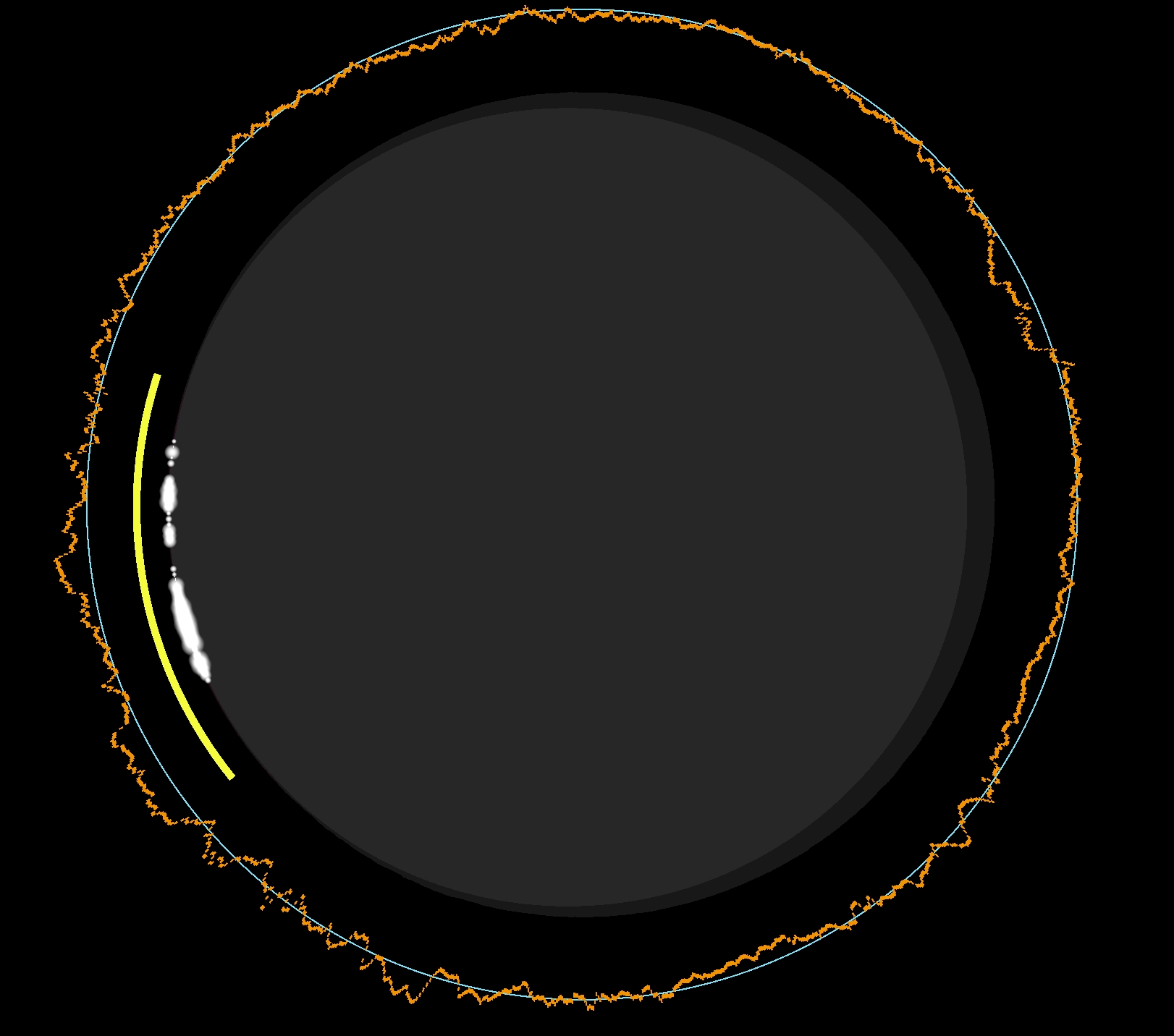
As moving towards the southern limit of totality, the Baily’s Beads tend to look more extended and prominent before the second contact. A good spectacle is expected in A Coruna, located within the umbral depth of 28% (Pic. 56).
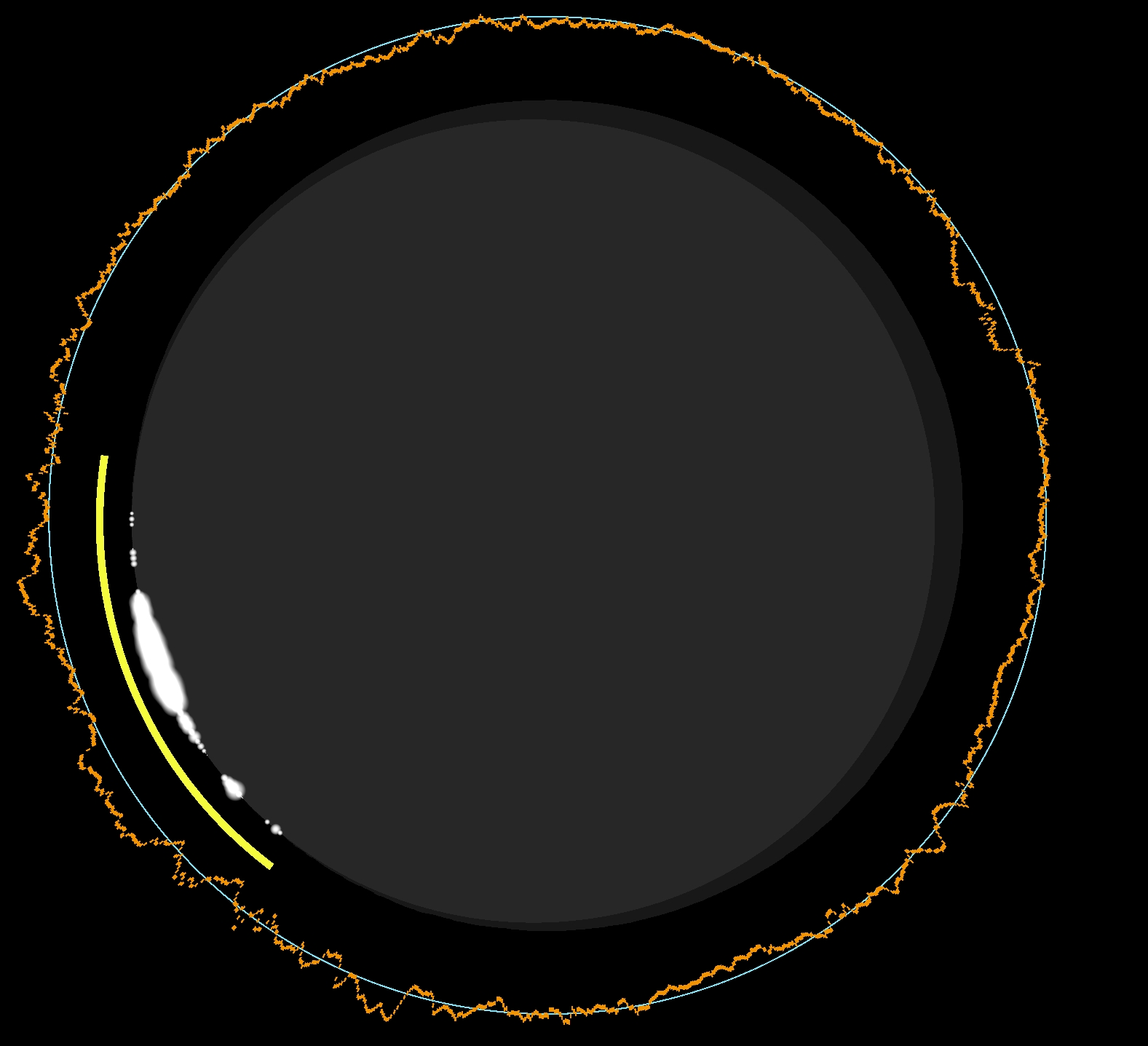
A similar view is expected in Valencia, where the umbral depth is around 20% (Pic. 57).
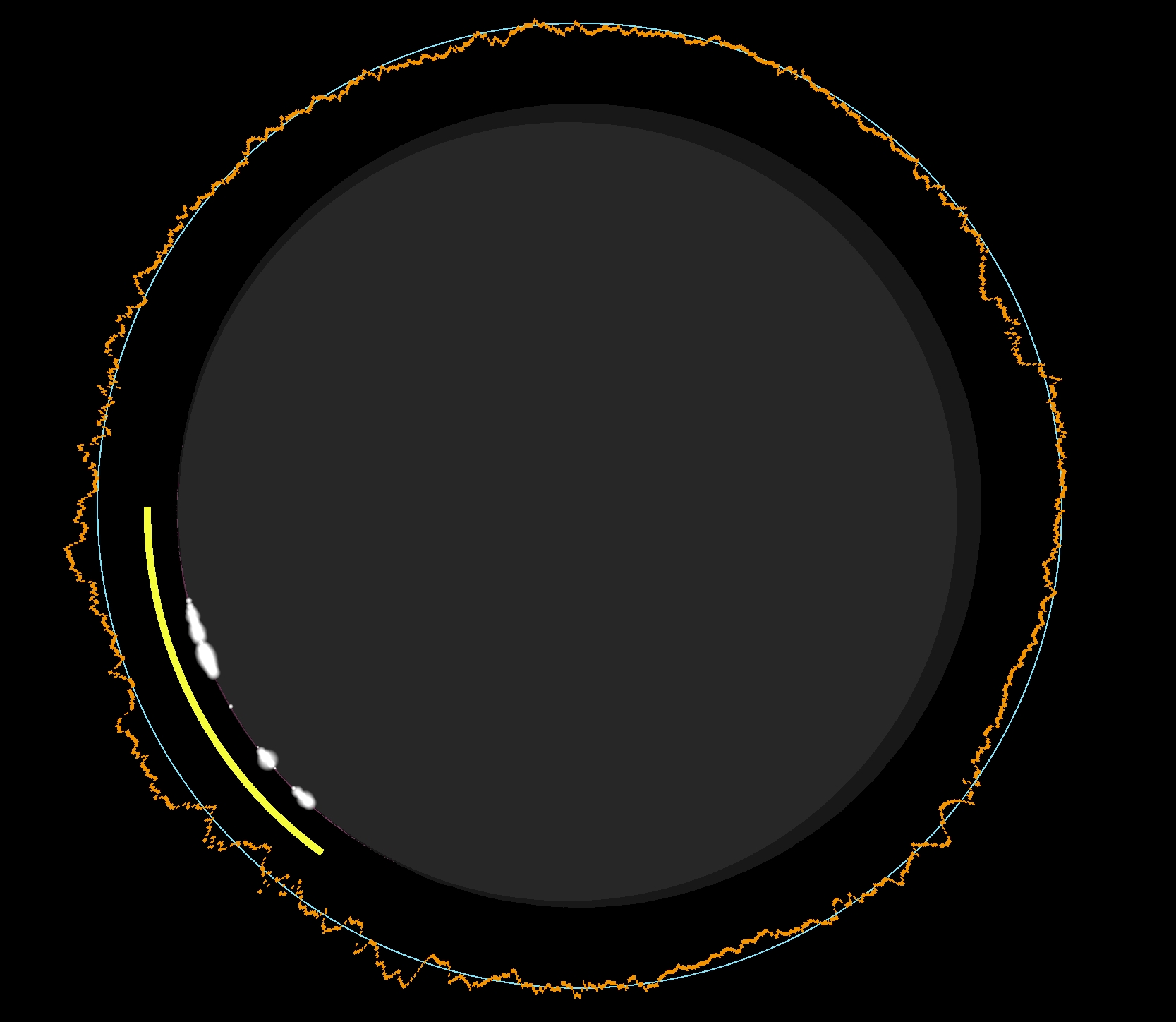
Concluding, the appearance of Baily’s Beads looks very interesting at small umbral depth, especially at the southern side of totality. The last thing is the visibility of the stars during totality, which varies slightly with the umbral depth and the Sun’s position above the horizon. The separate analyses will be performed in the future text, but for now I just want to share the comparison between the two most extreme locations in Spain lying on the centerline (Pic. 58).
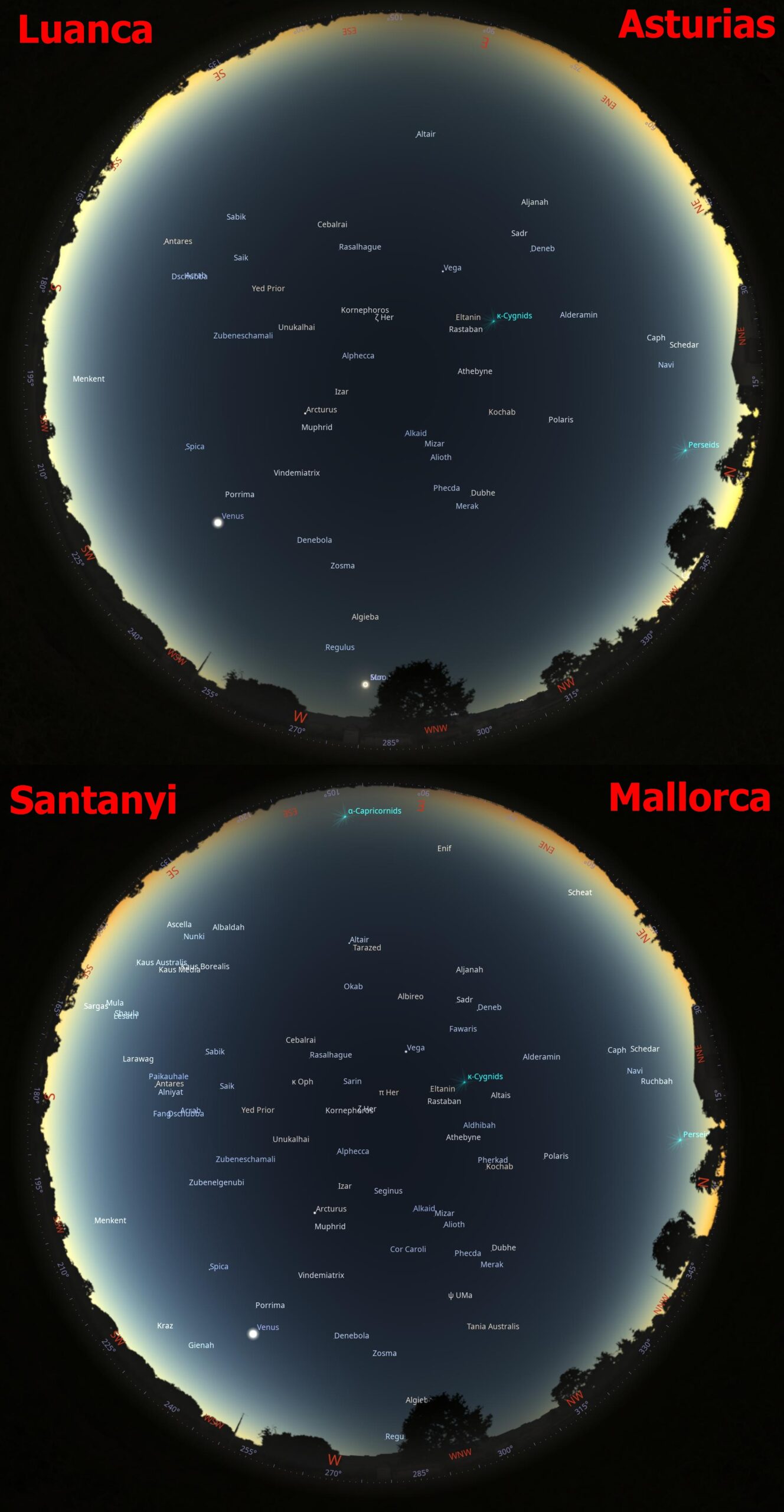
The difference in altitude between over 10° in Asturias and just 3° at eastern Mallorca reflects the number of stars possible to see with the naked eye. We will see a few in Iceland, which is typical. However, the situation in Spain is different, as the low position of the Sun causes light extinction in the atmosphere, reducing the solar corona and ambient light. In turn, up to 45 stars can be detectable by the human eye during mid-totality in Asturias, and even 77 at Mallorca, according to Stellarium calculations. Especially at Mallorca, when the eclipsed Sun will be very low above the horizon, an observer should experience conditions comparable to early nautical twilight.
5.3 Portugal
The most unsung country, which lies on the path of totality, and it’s true at some point, as only the northeasternmost corner will experience this fascinating event. The main website for information about the solar eclipse in Portugal in 2026 is Eclipse2026pt. However, because the totality almost misses the country, there is not much information, much less than in the case of Iceland, and especially in Spain.
It doesn’t change the fact that if anyone at some point watches the totality from Portugal, they might not regret the decision!
The detailed map below shows the circumstances of totality across Portugal’s northwestern corner.
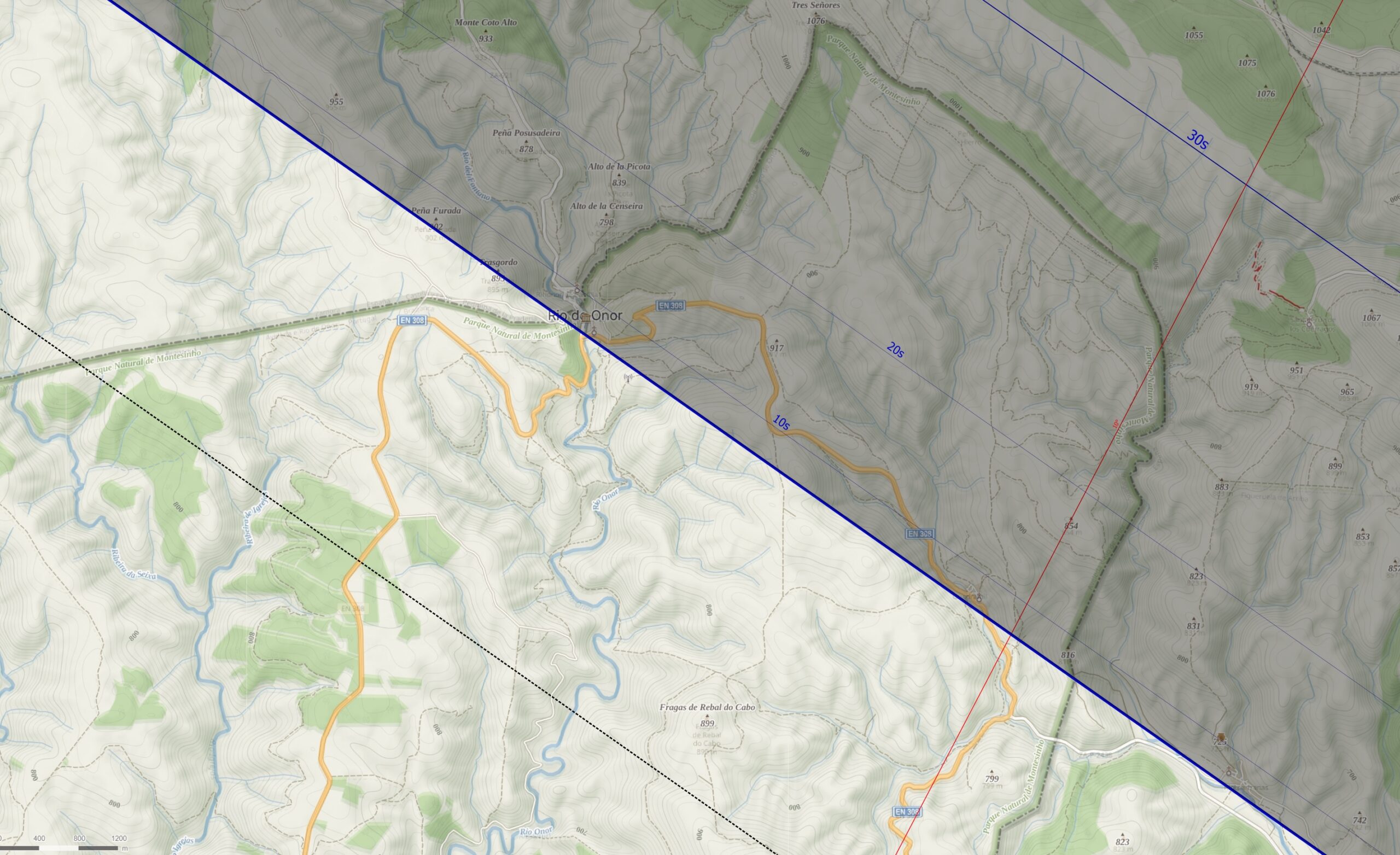
The only reasonable way to get there by car is to take the EN308 road and pull over onto the tarmac subsidiary road leading to the farmlands. Alternatively, the Tres Señores hill (1076 m.a.s.l.), marking the geodetic northeastern « corner » of the country, is accessible from the path along the country’s border on the Spanish side. The area belongs to the Montesinho Natural Park and has very limited tourist infrastructure. The exact position of the southern path of totality can be ambiguous and depends on lunar limb correction. The fixed edge of the limit means the eclipse magnitude of 1.00, at which, in theory, the Sun’s disk shouldn’t be visible. But because of lunar topography, the Sun still shines through the Moon’s valleys. Another reason is the general accuracy of the eclipse maps, about which you can find more information in this article. We can assume that the maximum duration of totality on Portuguese grounds is approximately 30 seconds. Below, you can see three case-study visualizations for the 2026 totality in Portugal (Pic. 30).
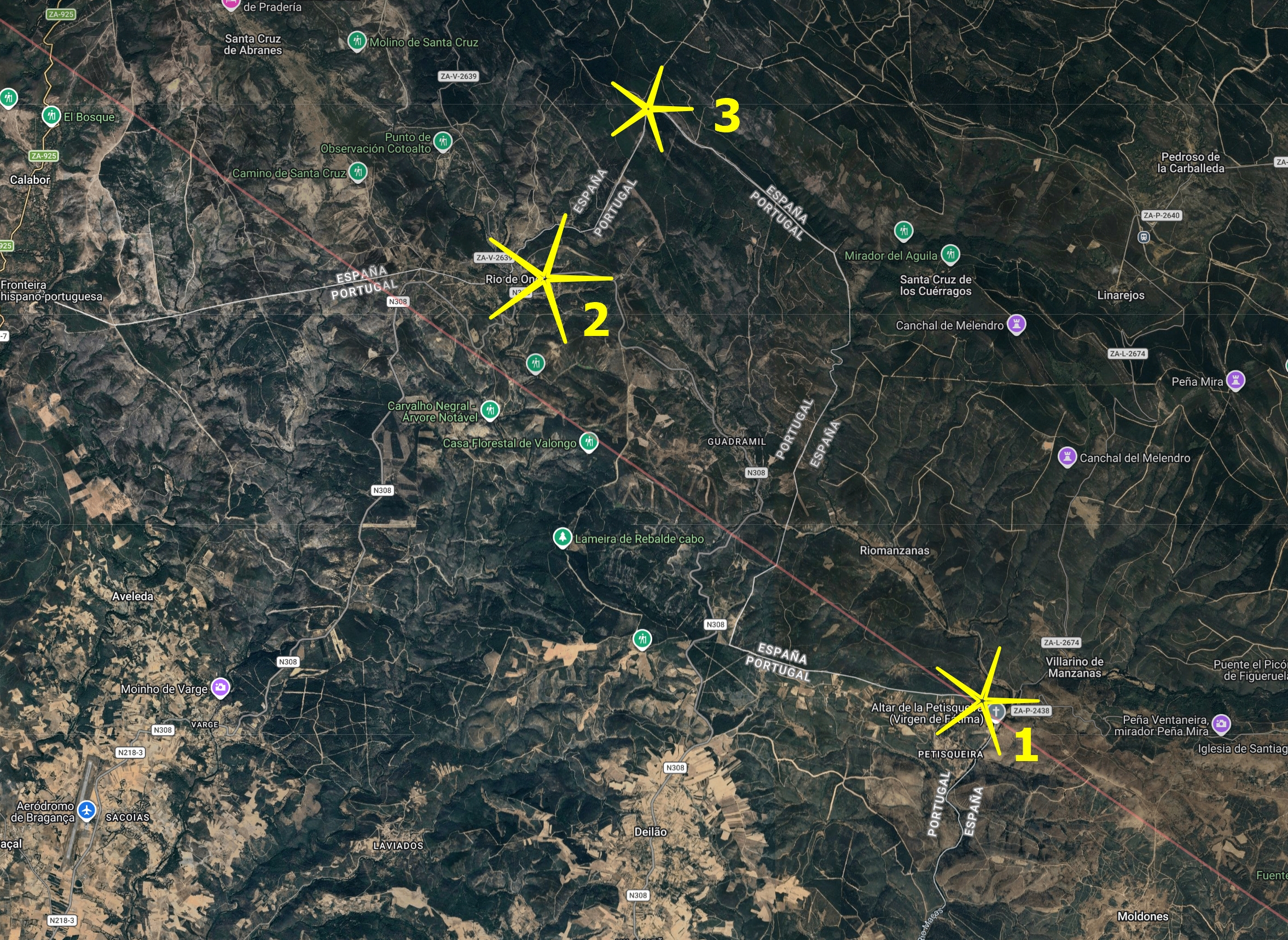
The first place is on the eastern slope of the Boca da Baleia (839 m.a.s.l.) hill, in the Petisqueira village, and falls at the exact edge of the totality. According to the Eclipsewise.com website, this corner of Portugal falls within the grazing zone, whereas according to Xavier Jubier’s eclipse website, it gains even 15 seconds of totality. Indeed, the total solar eclipse occurs here, but it is very short. The overall duration between separate « beads » is just 10,8 seconds. The Petisqueira village will experience the deep partial eclipse with 100% of obscuration. How is it possible? The lunar limb profile at the direction of greatest eclipse is rich with a few lunar valleys, which will allow the solar beams to pass through, despite Xavier Jubier’s estimated totality of approximately 10 seconds!
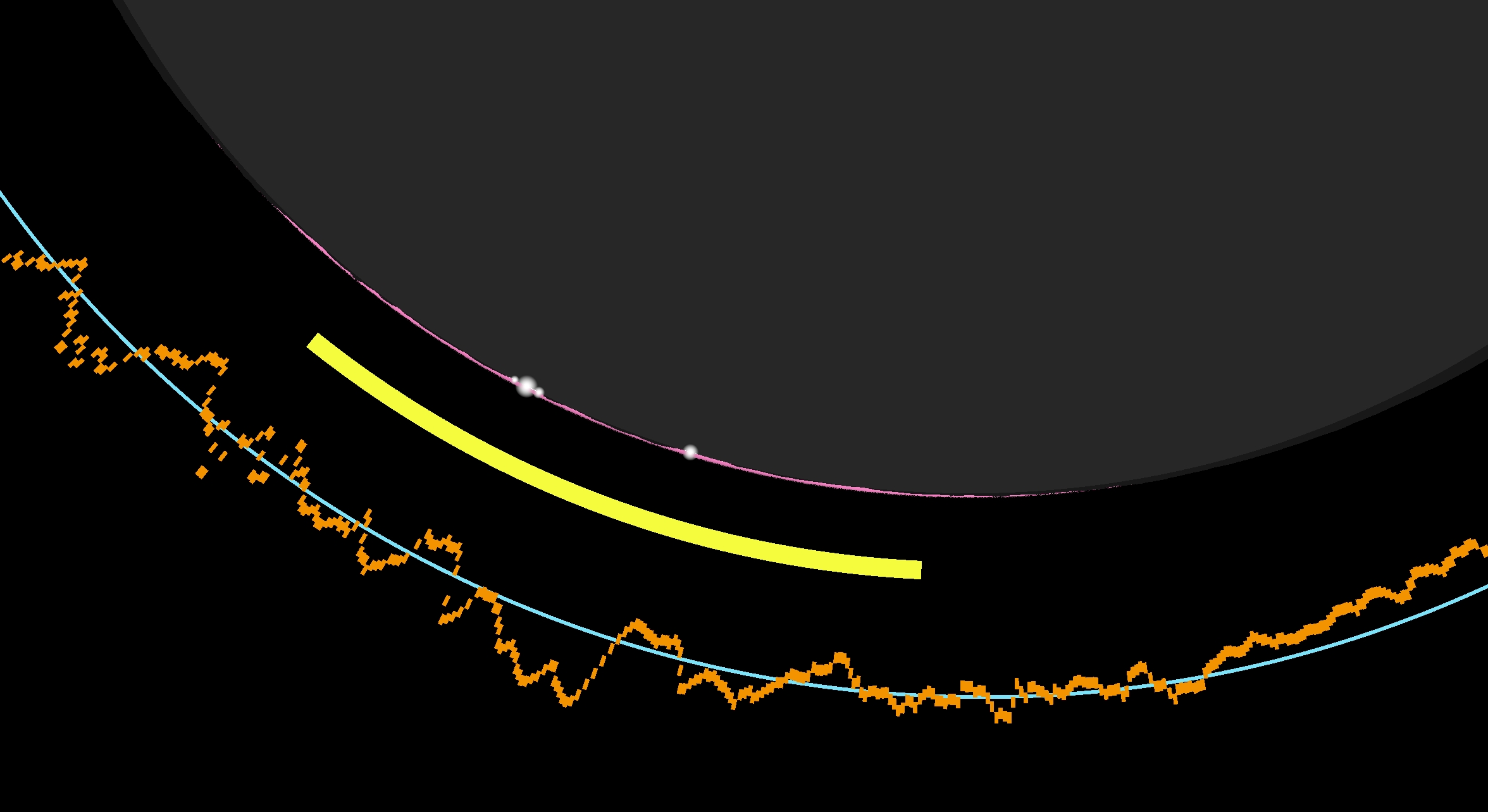
According to the Photoephemeris application, the southern limit of totality lies just a few tens of meters south of the Nossa Senhora de Fatima religious complex, which straddles the Spanish-Portuguese border. On the Spanish side, it’s called Altar de la Petisqueira. Anyway, the estimated totality at this location is just…4 seconds, and, what is most curious, the single Solar beams will pass through the deepest lunar valleys over this entire period! (Pic. 32).
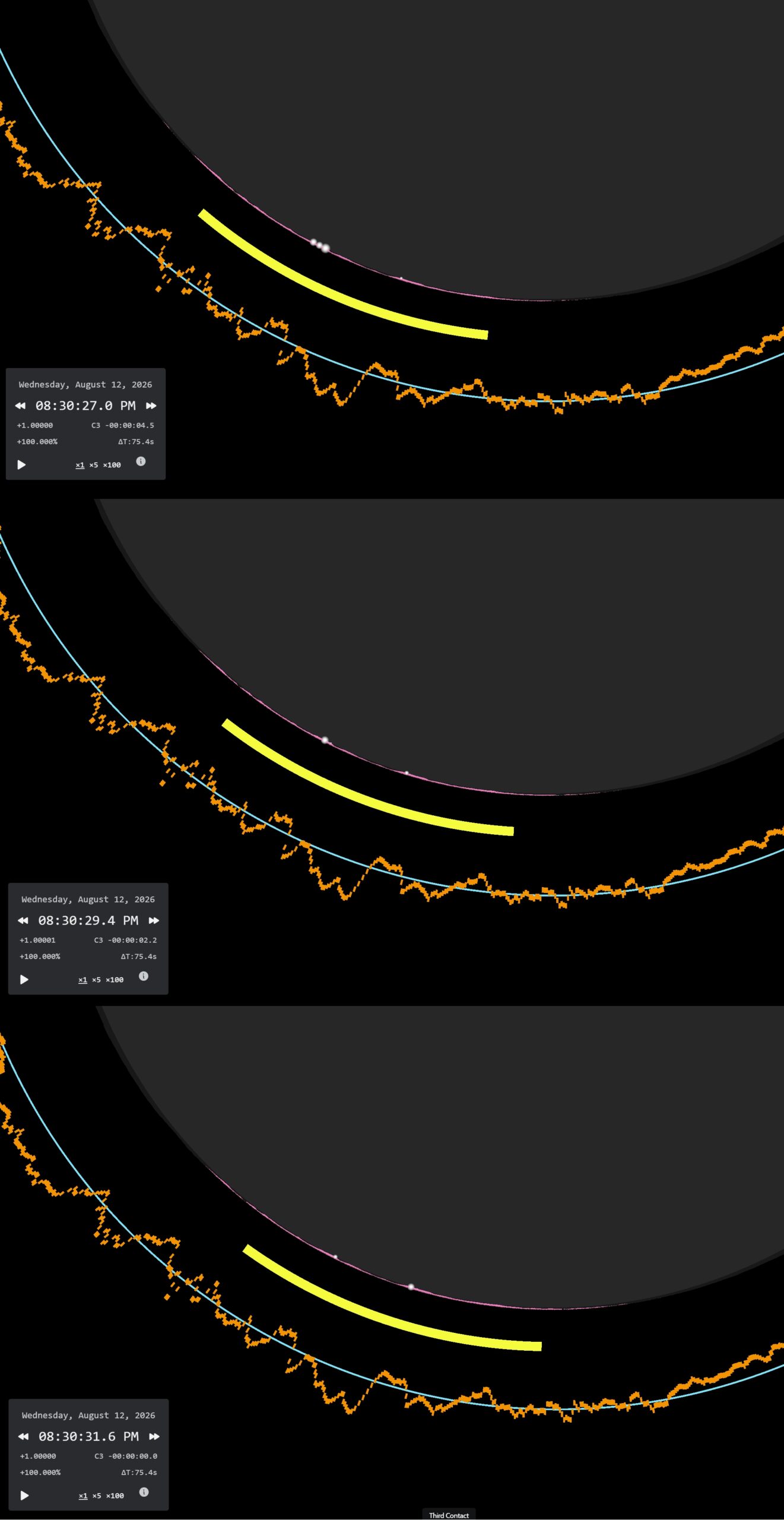
Finally, at « Point 1 », the totality lasts around 10 seconds, and the shadow is well visible in the sky for a while (Pic. 34).
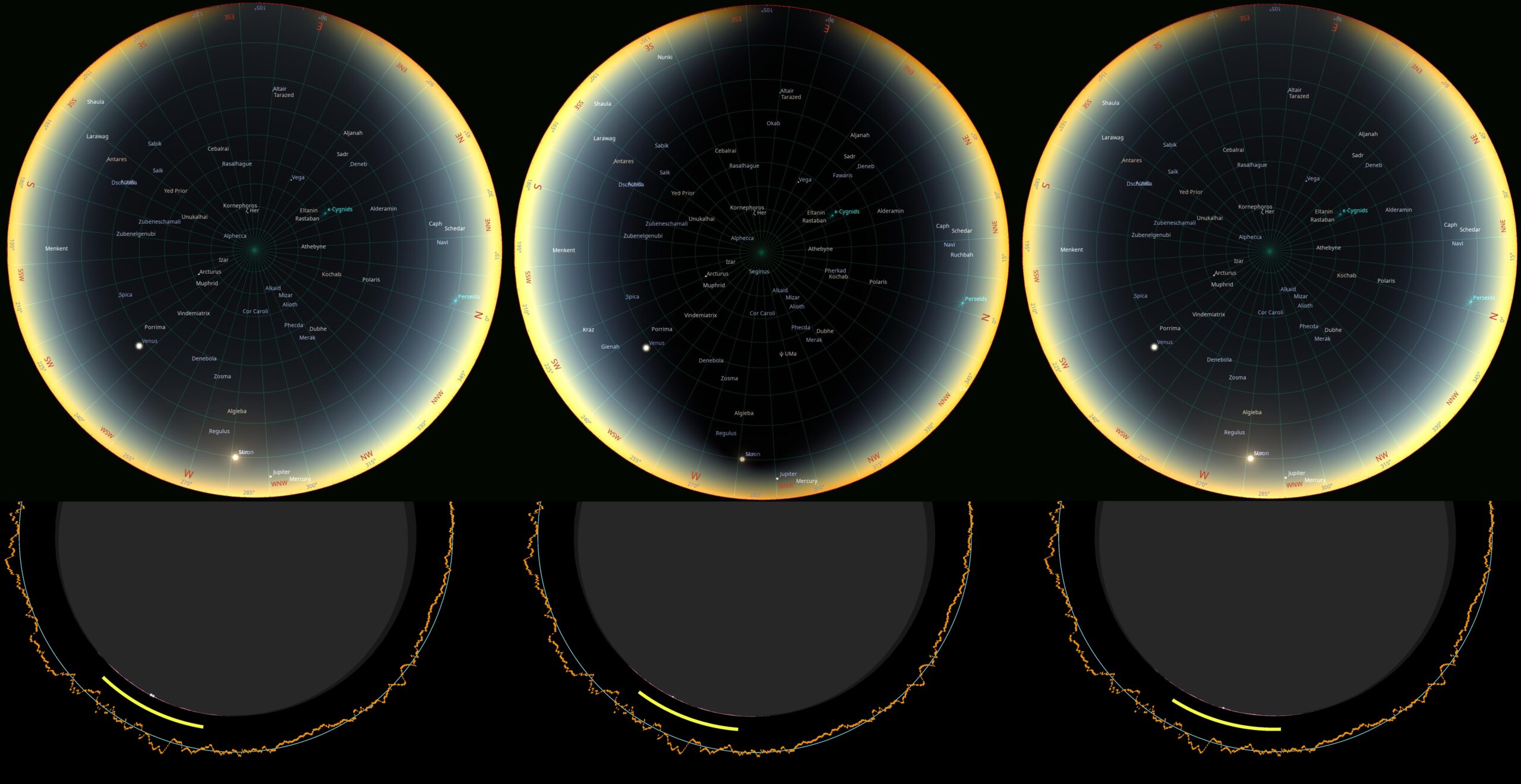
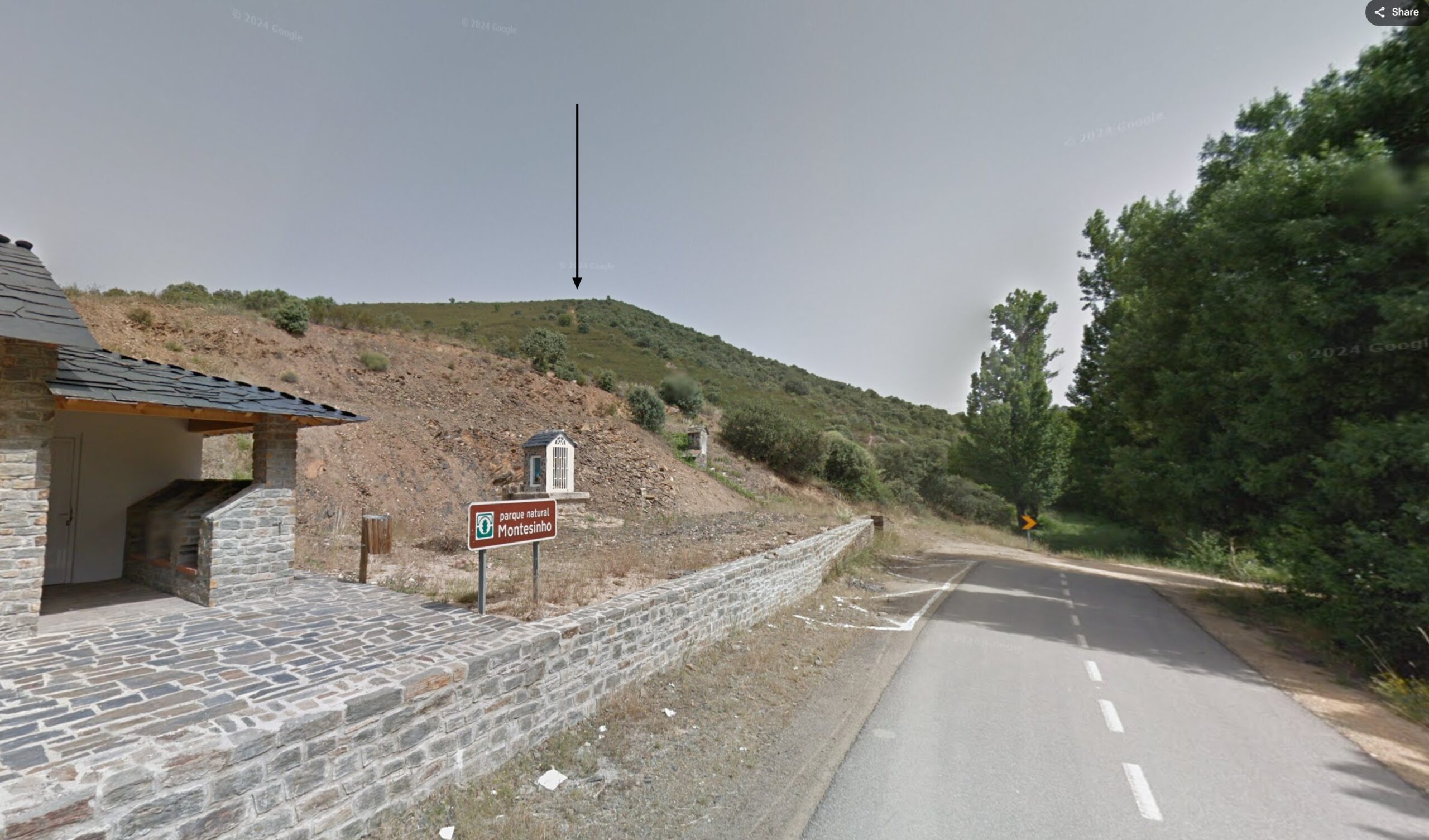
The second considered place is located east of Rio de Onor, where the estimated duration of totality is approximately 20 seconds. Amidst the forestry sections, there is a decent viewpoint from where the eclipse can be watched without additional walking from your car.
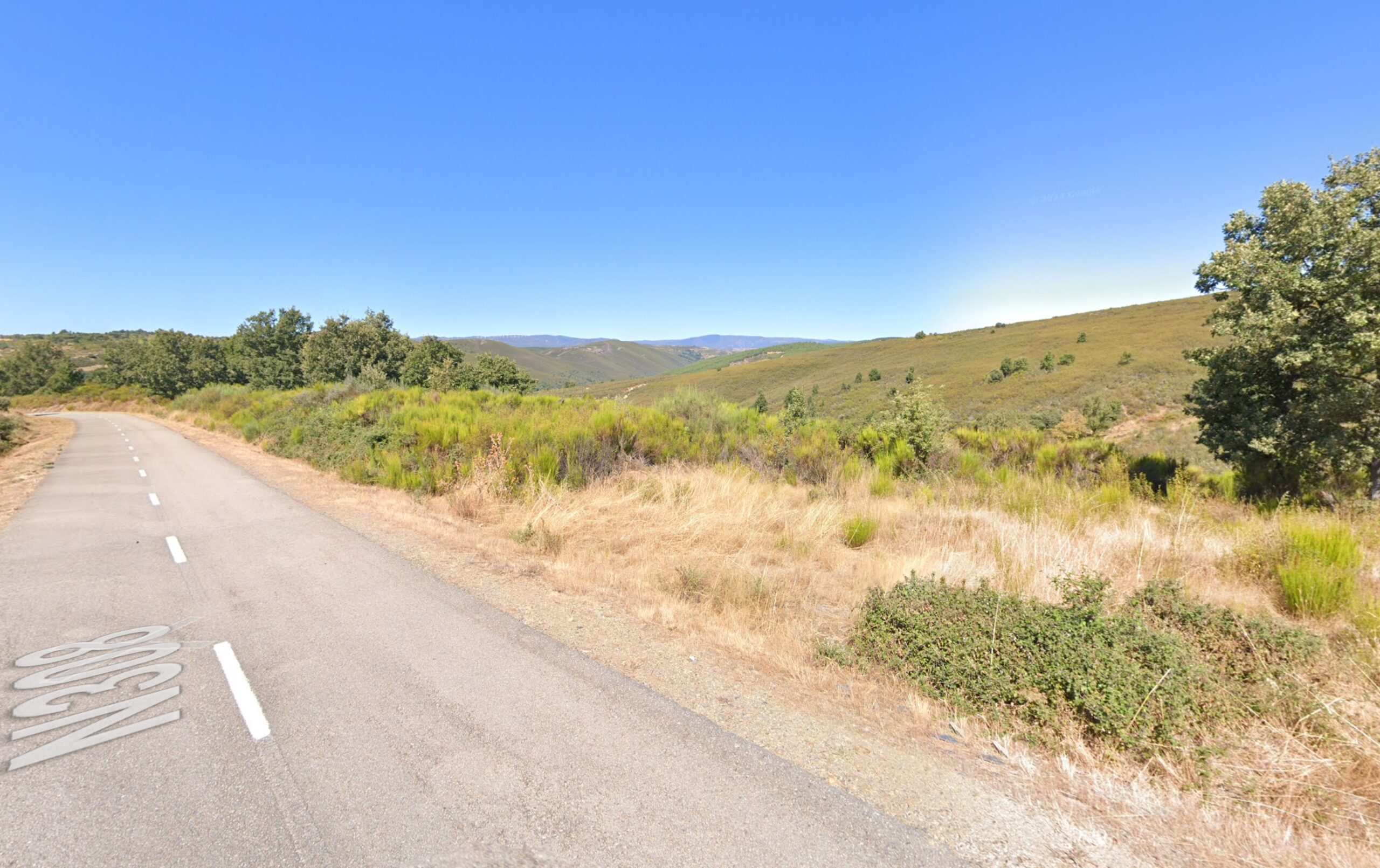
The umbral depth of 2,5% is enough to block the solar beams completely, even if the lunar limb profile is unfavourable for it. During this short period of totality, the chromosphere will be visible very well.
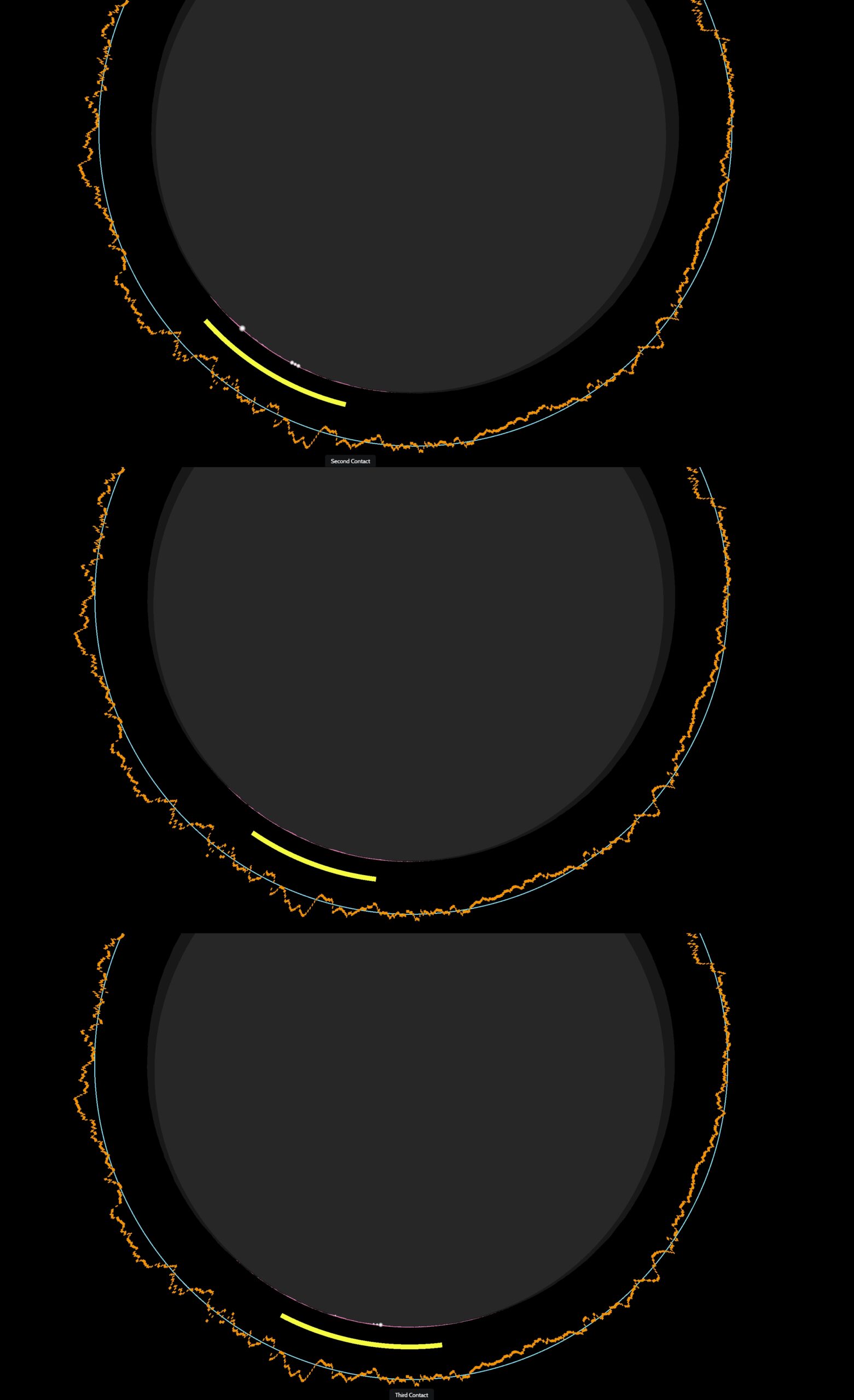
Finally, the third place is the geodetic point marking the Tres Señores hill, which gains about 30 seconds of totality. The difference in the sky between the very edge of the path isn’t big, similar to the projection of contacts (Pic. 36).
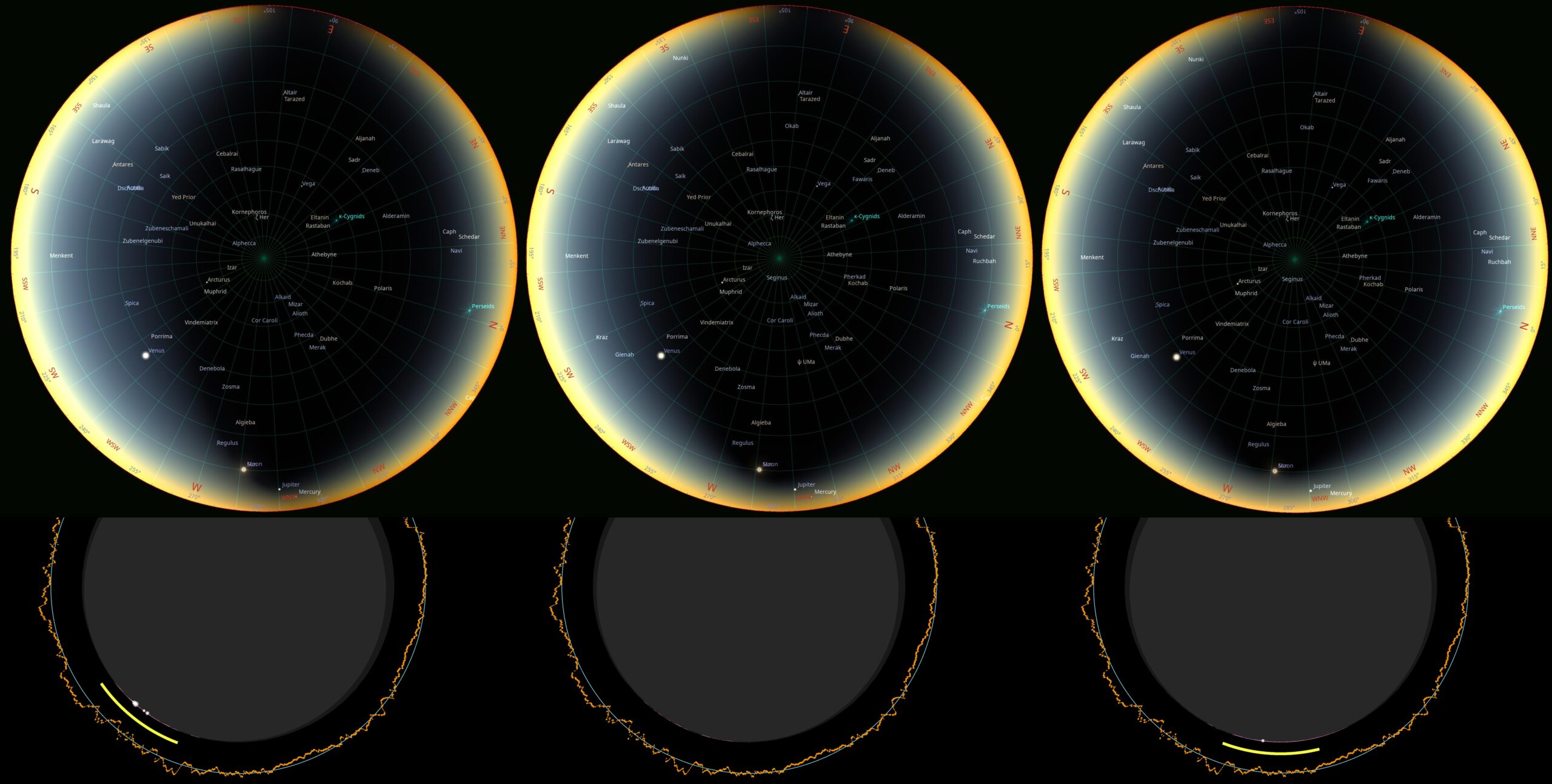
The most challenging is getting to the top of this hill, as there is no marked trail, and an observer has to use the local road leading from the Rihonor de Castilla village on the Spanish side. After reaching the traverse of Alto de Fuente Abedul (1022 m.a.s.l.), at least 2,5km walk is required. Not sure if this road is accessible by car. Alternatively, we can get there from Puebla de Sanabria, a Spanish town located over 10km away.
6. THE PARTIAL PHASE
As with the total phase, the partial phase of the eclipse can also be interesting, especially since the minimum obscuration in Europe on the afternoon of August 12, 2026, will reach 79%. There are many events accompanying the partiality, which can be boosted by golden-hour conditions in some cases. On the other hand, the partial solar eclipse also comprises the grazing zones, within which diamond ring and Baily’s beads can be visible, without a moment of totality. Thirdly, standing in the direct vicinity of the totality path, an observer can experience similar optical effects as known from the period of totality. This chapter is not for discussion about the obscuration across various European countries, as was presented in the case of the 2024 analyses. The primary focus is on various phenomena that occur during the eclipse and at particular places, which should be described with the greatest possible detail in a given European country.
At first, some of the phenomena accompanying the deep partial solar eclipse are listed in bullet points below.
A. SKY BRIGHTNESS AND COLORATION CHANGES – Sky brightness and colour changes during a solar eclipse become noticeable when solar obscuration exceeds 50%. As the Moon progressively covers the solar disk, the overall illumination decreases and the sky becomes darker. During deep partial phases, a subtle shift toward reddish tones may occur. At the maximum phase of a partial eclipse, the reduction in brightness and slight colour modifications can become clearly perceptible.
One important factor responsible for these changes is solar limb darkening, a phenomenon in which the outer regions of the solar disk emit less intense radiation than the central region.
The Sun, a G-type main-sequence star, emits light that is slightly yellowish due to radiative processes occurring in the solar photosphere. During a partial eclipse, the obscuration of different parts of the solar disk alters the spectral contribution of these regions, which may influence both the colour of direct illumination and the scattered light in the atmosphere. In natural environments, these effects are often difficult to detect because objects reflect light differently across wavelengths. As a result, small spectral changes in sunlight may remain unnoticed when observing scenes containing many colours and textures.
As the Moon covers different parts of the Sun, the relative contributions of the bright central region and the darker limb to the total solar irradiance change, about which you can read more here.
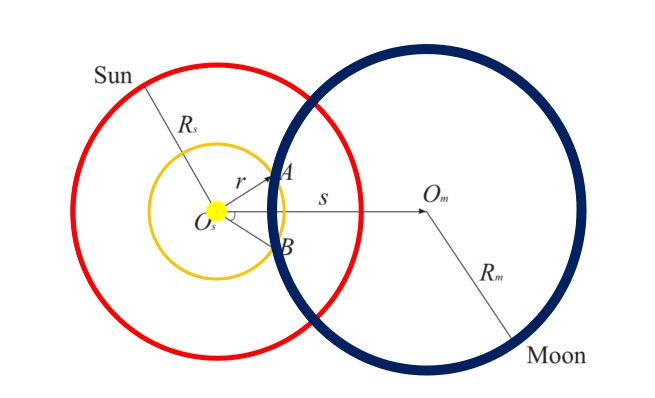
These variations slightly modify the spectral composition of the sunlight reaching the Earth’s surface. Atmospheric Rayleigh scattering also contributes to the observed changes, because the wavelength-dependent scattering of sunlight determines the colour of the sky. Small shifts in the spectral distribution of incoming sunlight, therefore, translate into subtle changes in sky colour. Because the proportion of Rayleigh scattering changes as the Sun shines lower above the horizon, this effect in the sky can be enhanced (Learn more in chapter 8).

Overall, the changes in sky brightness and colour during a solar eclipse result from a combination of reduced solar irradiance, the spectral effects of solar limb darkening, and atmospheric scattering processes. Atmospheric conditions such as humidity and clarity can further modify these effects, which explains why the observed colour changes may vary between different eclipses and observation sites.
B. PINHOLE CAMERA EFFECT – During a partial solar eclipse, crescent-shaped projections of the Sun can be observed on the ground beneath trees. Sunlight passing through small gaps between leaves acts as a series of natural pinholes, projecting images of the partially obscured solar disk onto nearby surfaces such as sidewalks or walls. This phenomenon is an example of the pinhole camera (camera obscura) effect.
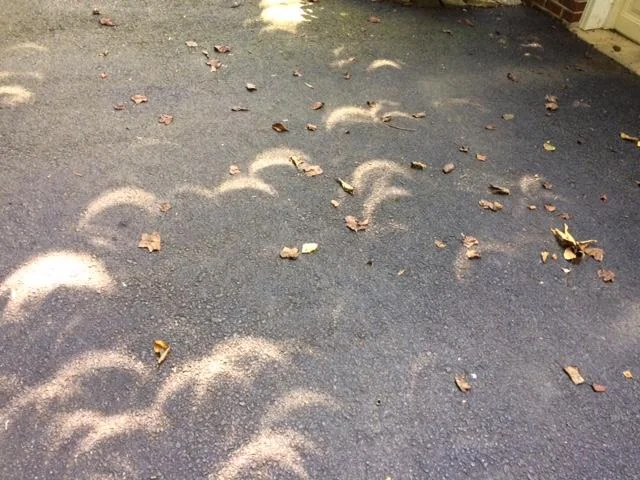
The effect occurs on any sunny day; however, the projected images normally appear circular because the unobscured solar disk is round. During a partial eclipse, these projections become crescent-shaped, reflecting the current phase of the eclipsed Sun. As a result, observers can indirectly view multiple real-time projections of the eclipse without specialized equipment.
The principle of image formation through small apertures was recognized in antiquity. Aristotle is often credited with describing this phenomenon after observing crescent-shaped solar images projected onto the ground during a partial solar eclipse.
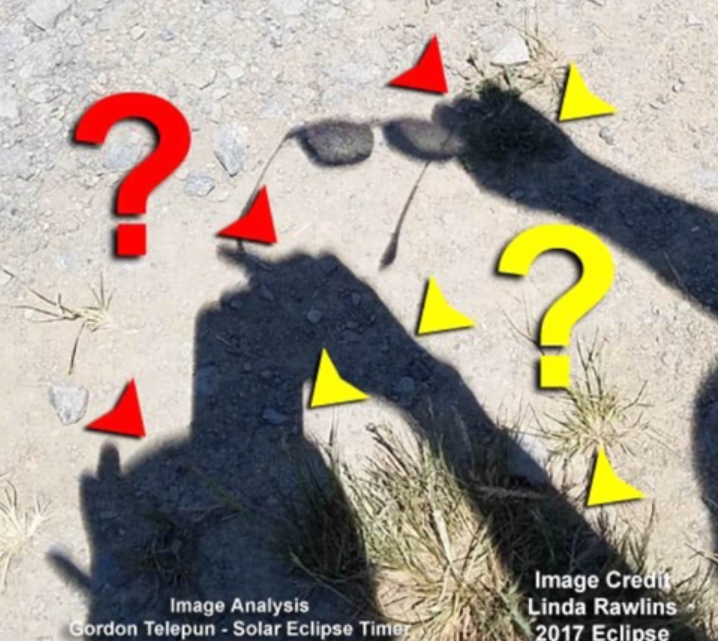
C. SHARP AND FUZZY SHADOWS – visible by deeper partialities, when the Sun shines as a crescent over 50% of obscuration. When the object is in line with the crescent, then a sharp shadow is produced. Conversely, for objects perpendicular to the crescent sun, the fuzzy shadows are produced.
D. CORONALITY – is defined as a period when the brightness of the sky falls below the brightness of the solar corona. Instead of totality, the event can be observed just outside of the umbral path within the so-called grazing zone. The event is also seen well from a location very close to the path edge, where it lasts much longer than the totality. For example, if an observer is located several hundred meters within the path, he can see, i.e., 10-20 seconds of totality and even 1 minute of coronality.
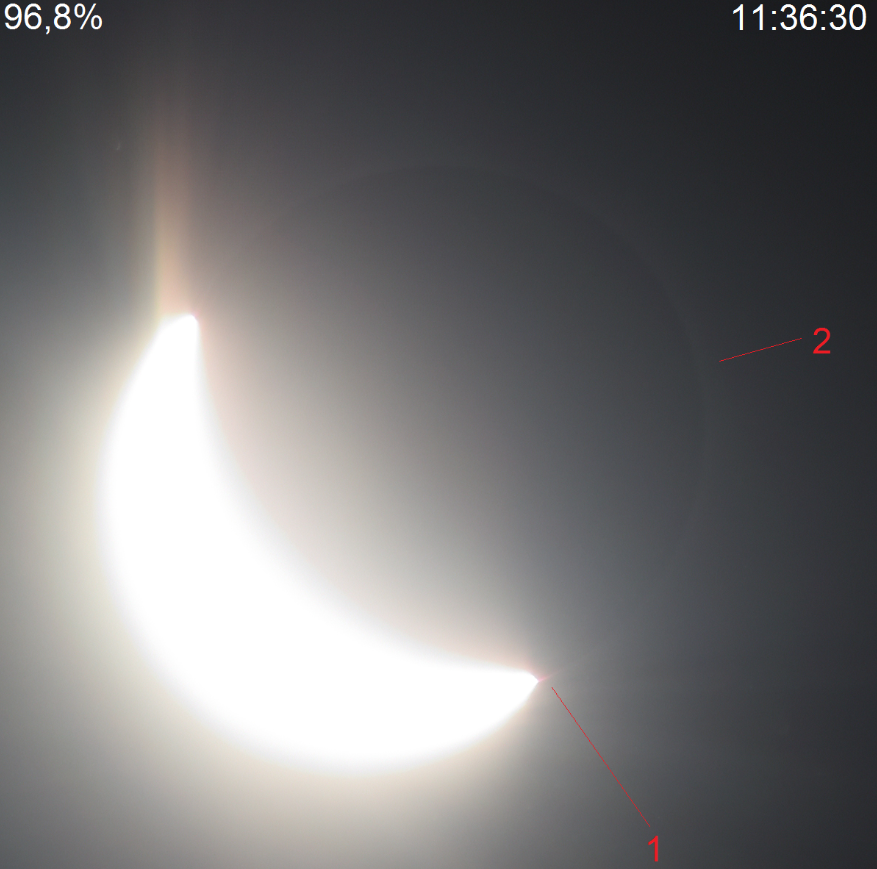
E. SOLAR CORONA OUTSIDE OF TOTALITY – As it has been mentioned in the previous section, the solar corona visibility isn’t restricted just to the period of totality. In principle, the solar corona, with a brightness comparable to the full Moon (about –11.5 mag), could be visible during the deep partial phase when the lunar disk nearly covers the Sun. In practice, however, the bright solar crescent usually overwhelms the faint coronal light. When the Moon nearly obscures the photosphere and the observer is close to the umbral region, the brightness of the solar crescent becomes sufficiently reduced to allow a faint coronal outline to appear on the opposite side of the lunar disk. The detectability of this feature strongly depends on the thickness of the solar crescent and on atmospheric scattering of sunlight. By placing the solar crescent outside the field of view to reduce glare, a faint coronal arc could be recorded during the deep partial phase.
F. DARK SHADOW CONE – is shortly before or immediately after totality, usually at the same azimuth where the eclipsed Sun is visible in the sky. It appears as a grey, wall-like structure adjacent to the illuminated region where the observer is located. Its character is driven by light’s forward scattering. As the umbra approaches the observer, the directly scattered sunlight is reduced by shadowed haze, which forms a blue-greyish zone.
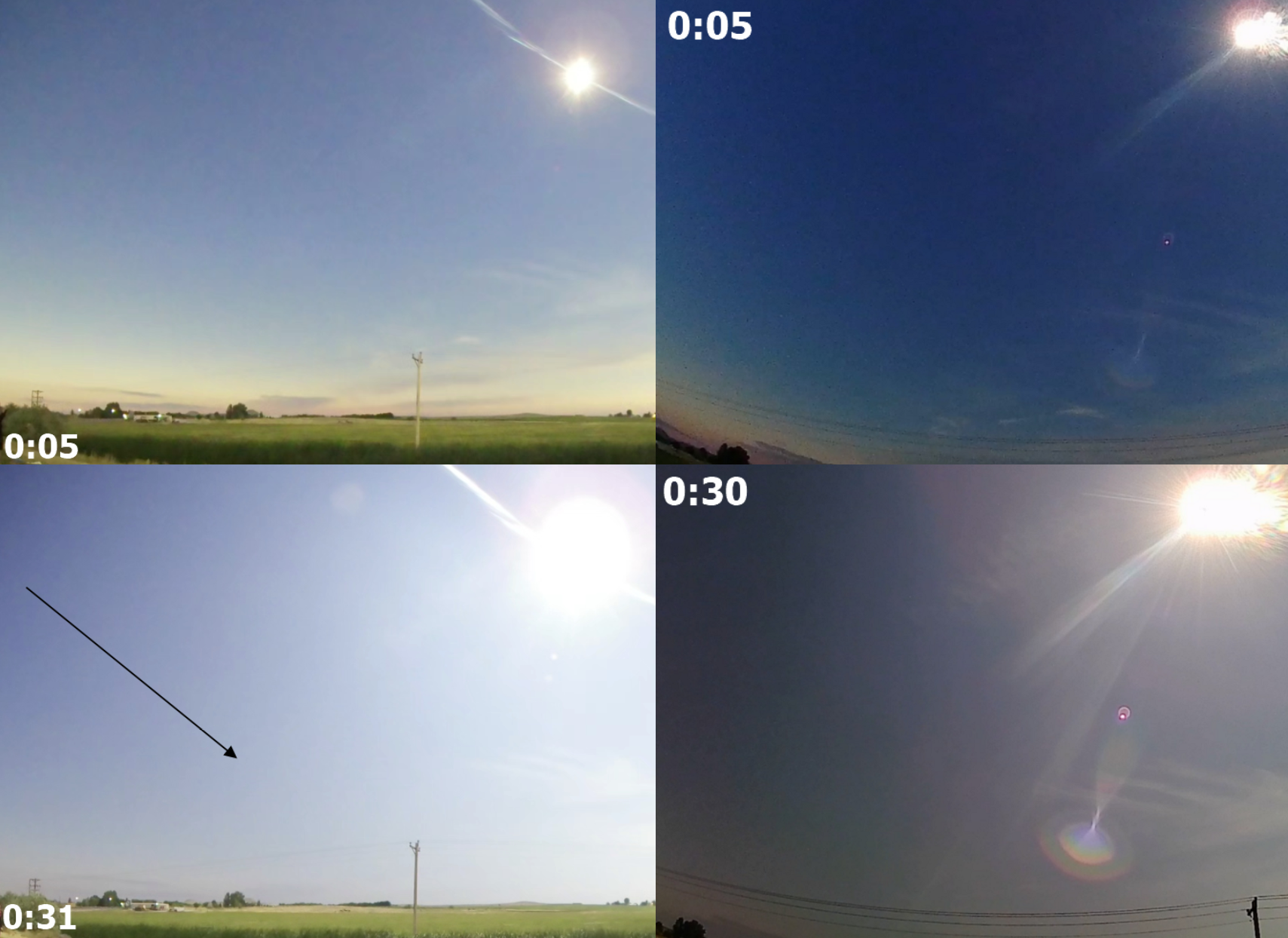
This example represents the umbra cone visible directly after totality. However, we can experience the effect at solar azimuth when watching a very deep partial eclipse. One of the best examples was visible in Iceland in 2015.
Below are some example projections of the dark shadow cone, which will be visible in Iceland (Pic. 43).
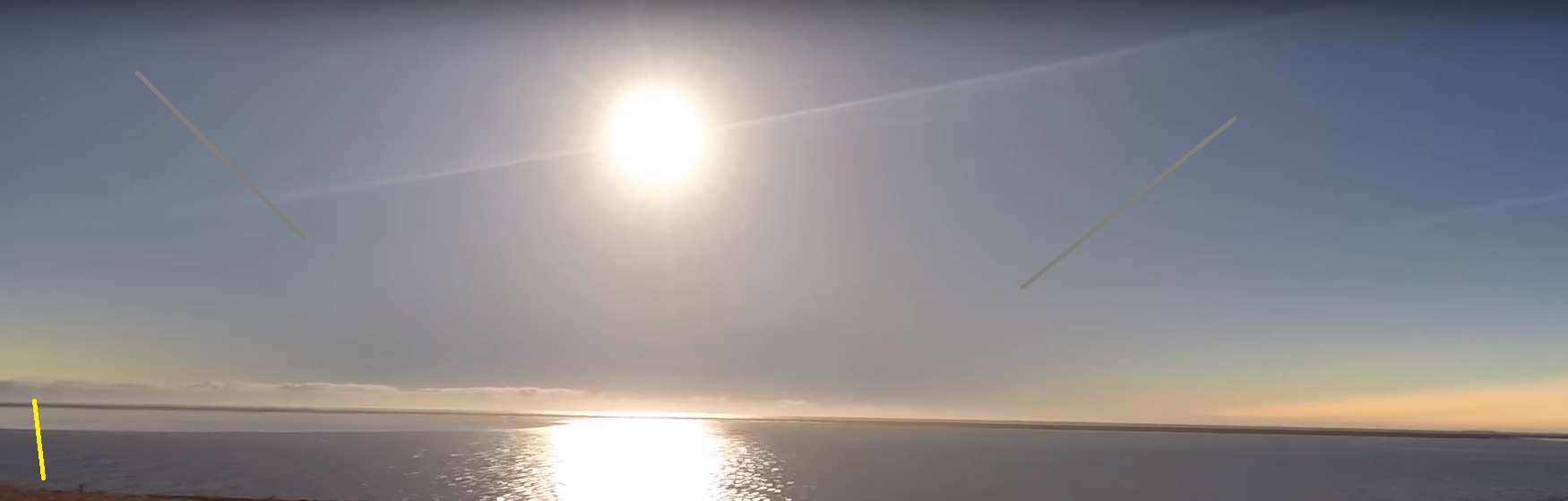
Below, we can see the rendered shadow cone passing the observation place from about 30 km at solar azimuth. Because the Sun is obscured in 99,8% of the sky, the directly scattered bright light mixes with the dark, shadowed area beyond, giving a grayish visual output (Pic. 43).
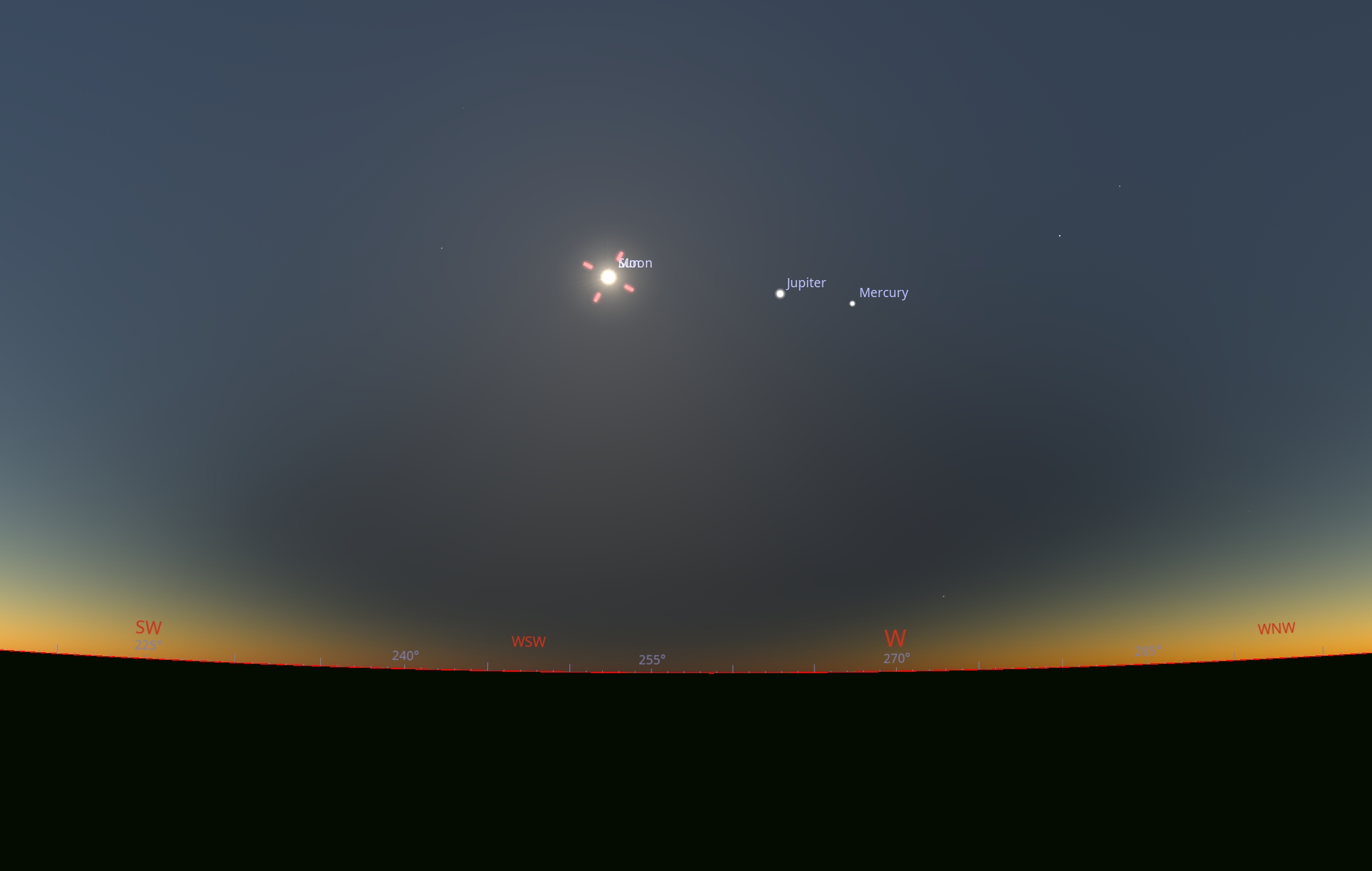
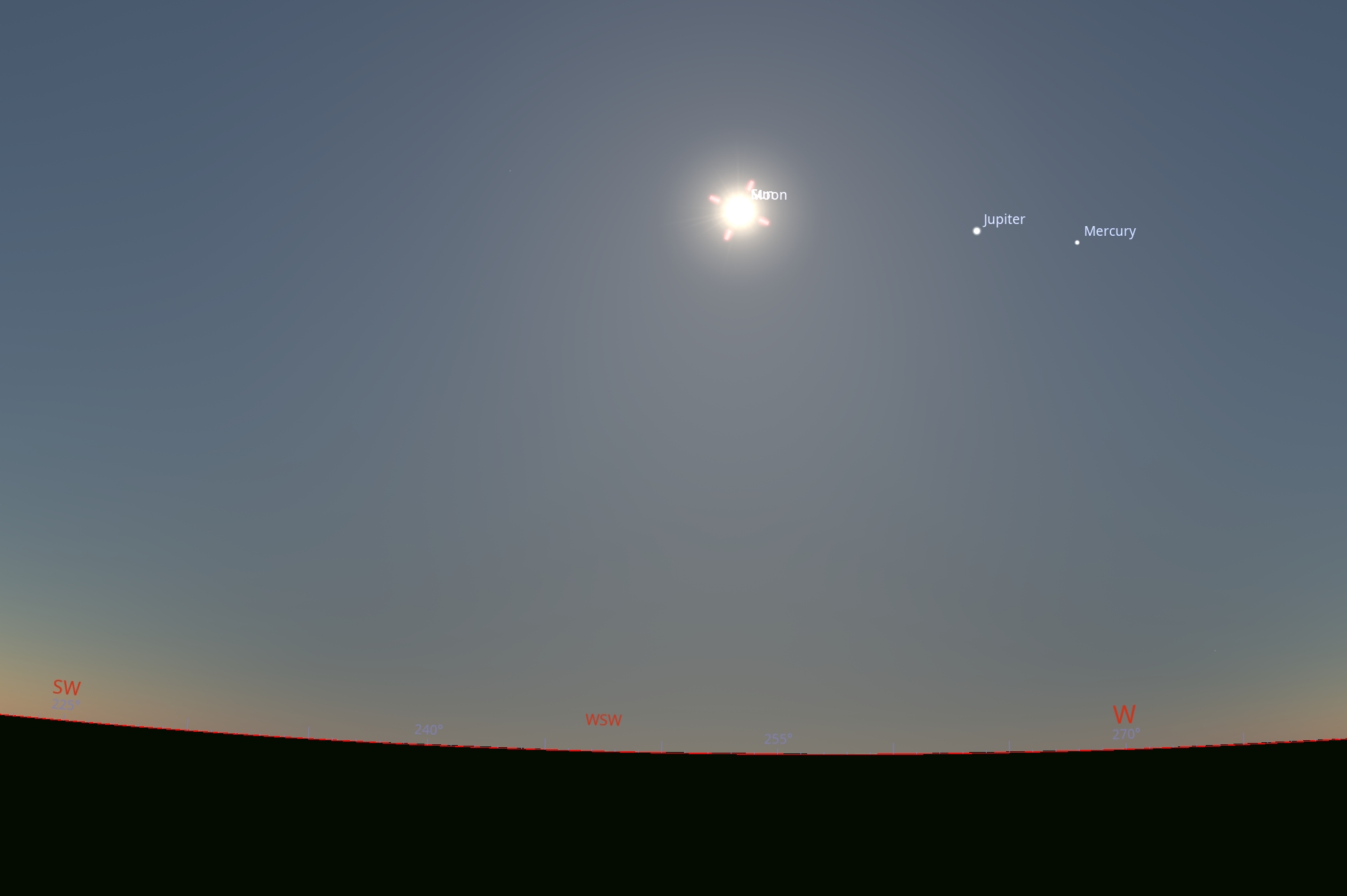
Another image shows the effect at a distance of 60km from the eclipse path, where the Sun is obscured with 99,4% at the greatest phase.
G. UMBRA AT A DISTANCE – The deep partial solar eclipse gives an opportunity to see the umbra at a larger distance. However, in this case, it’s advisable to look in the antisolar direction, which is south of the limit of totality. There are reports of umbra visibility at 250km in daylight conditions. Rather impossible by the August 12, 2026, eclipse configuration from European lands. It doesn’t mean the effect isn’t visible in the solar sector of the sky. When the totality occurs about 100 km ahead at solar azimuth, an observer can detect some changes in the horizontal sky (Pic. 45).
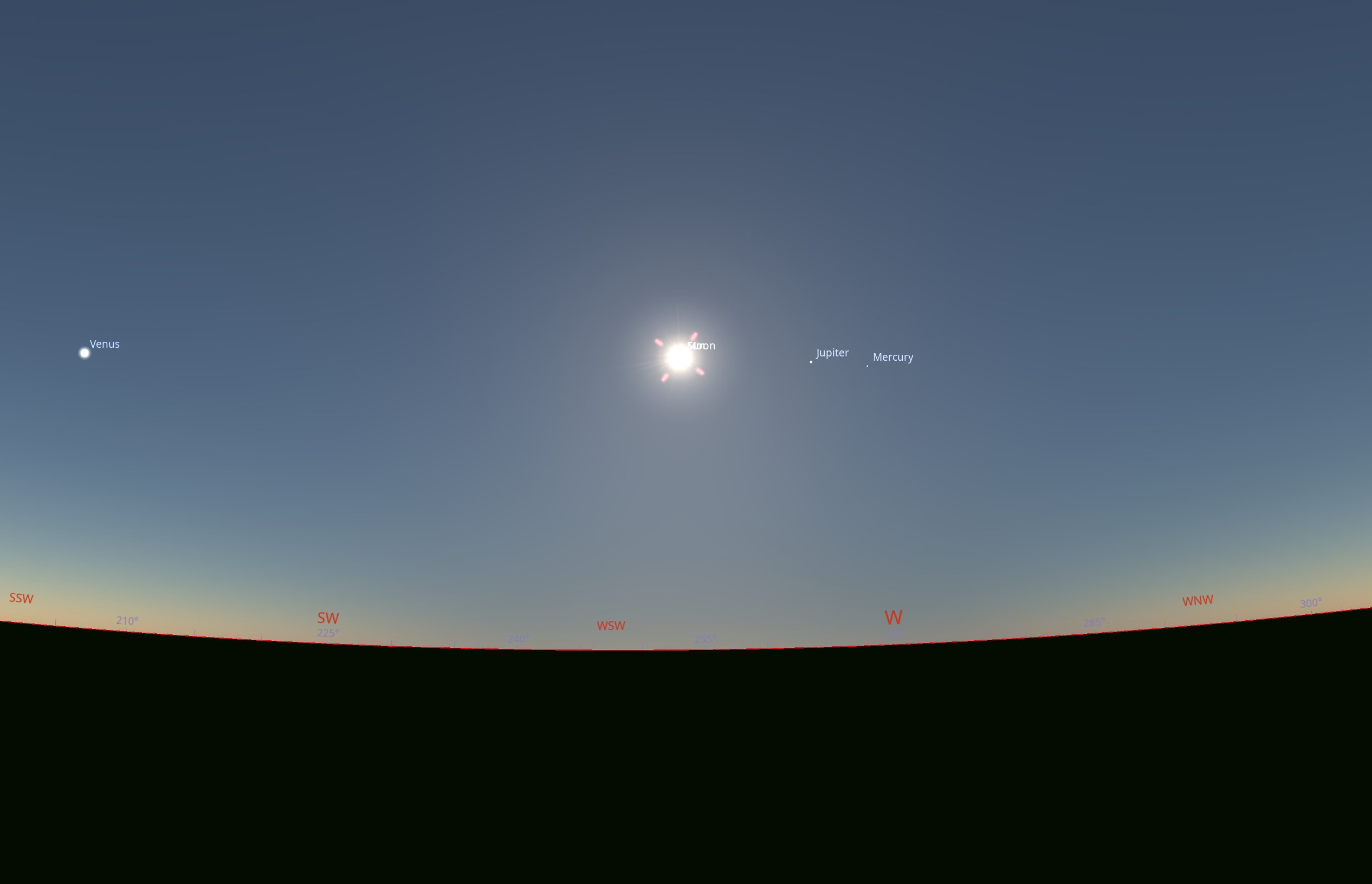
The situation will look different in Spain, Portugal, or even France,m where the deep partial eclipse occurs late in the afternoon. Depending on the location relative to the path, the observers will see a different configuration of the umbral column. For anyone located north of the path, e.g., in Barcelona, the umbra will emerge in the southern part of the sky and then disappear in the southern direction (Pic. 46, 47).
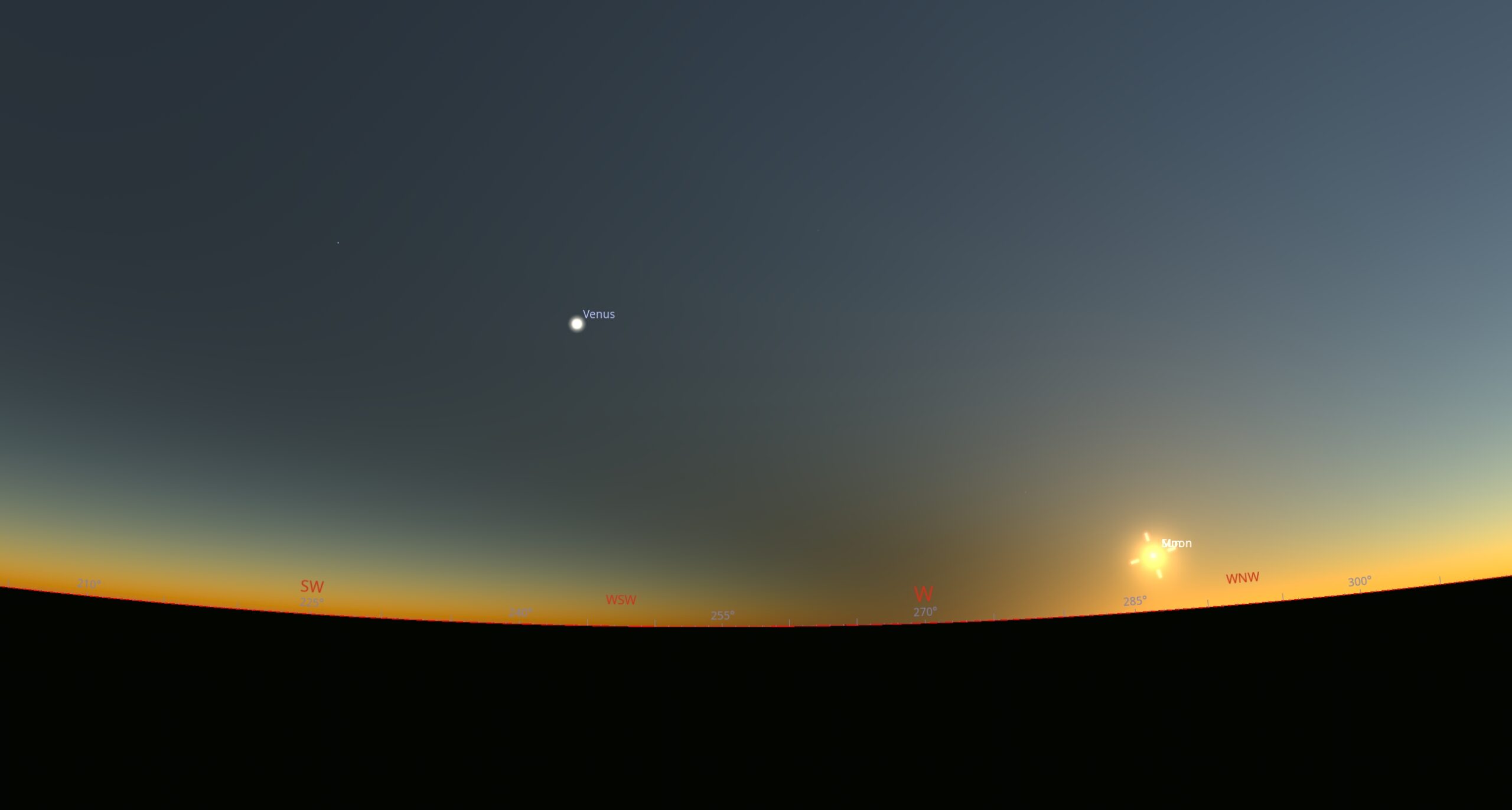
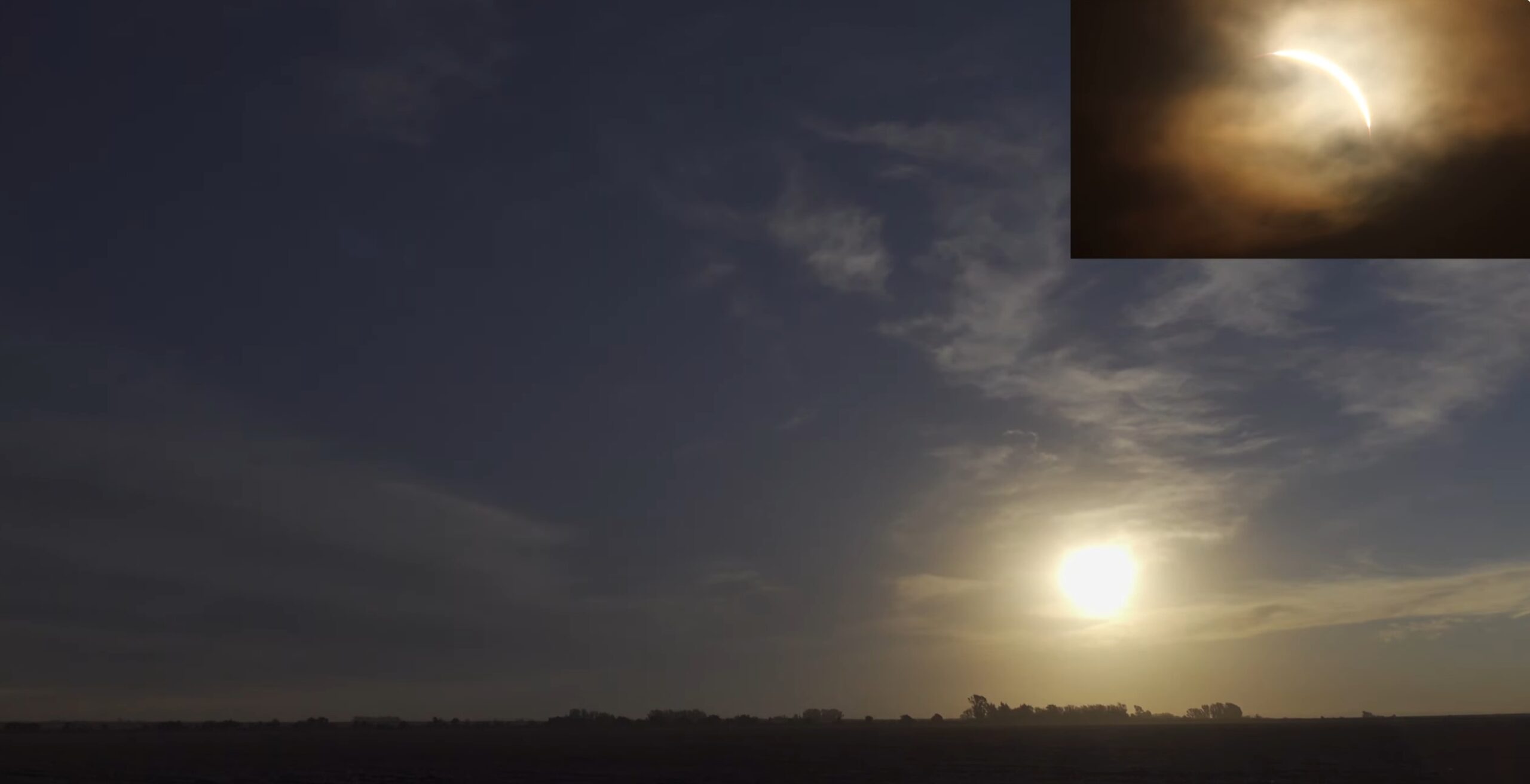
In fact, the centre of Barcelona lies just 23 km north of the path, but because the eclipse occurs low above the horizon, the umbral column stretches across the entire sky, and there is no option to see the « gray wall » because the umbra is situated next to the Sun, not under the Sun. In exchange for it, an observer will see the « dark zone » very similar to, or even the same as, the one below, captured on July 2, 2019, by Jorg Schoppmeyer in Argentina.
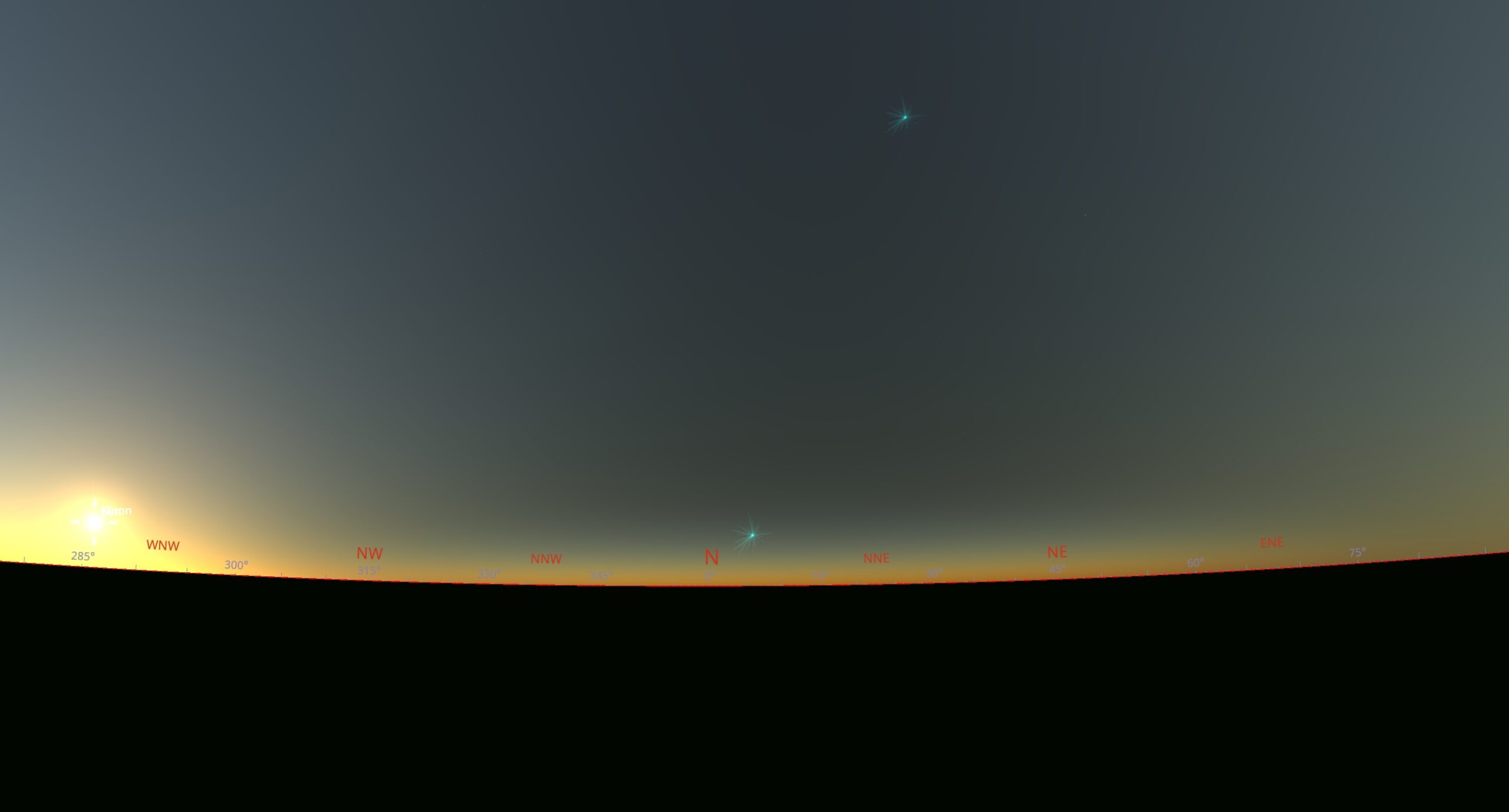
For observers located in Alicante, over 90 km from the southern limit of totality, the umbra will appear as a darkened patch in the northern sky, whereas the northern horizon should look relatively brighter (Pic. 48).
Concluding, an observer should be able to detect the Moon’s shadow from a distance of over 100 km during the forthcoming 2026 total solar eclipse.
6.1 Sample Locations
A. ICELAND – this small country will experience the partial solar eclipse with the minimum obscuration of 95,1% (Pic. 49).
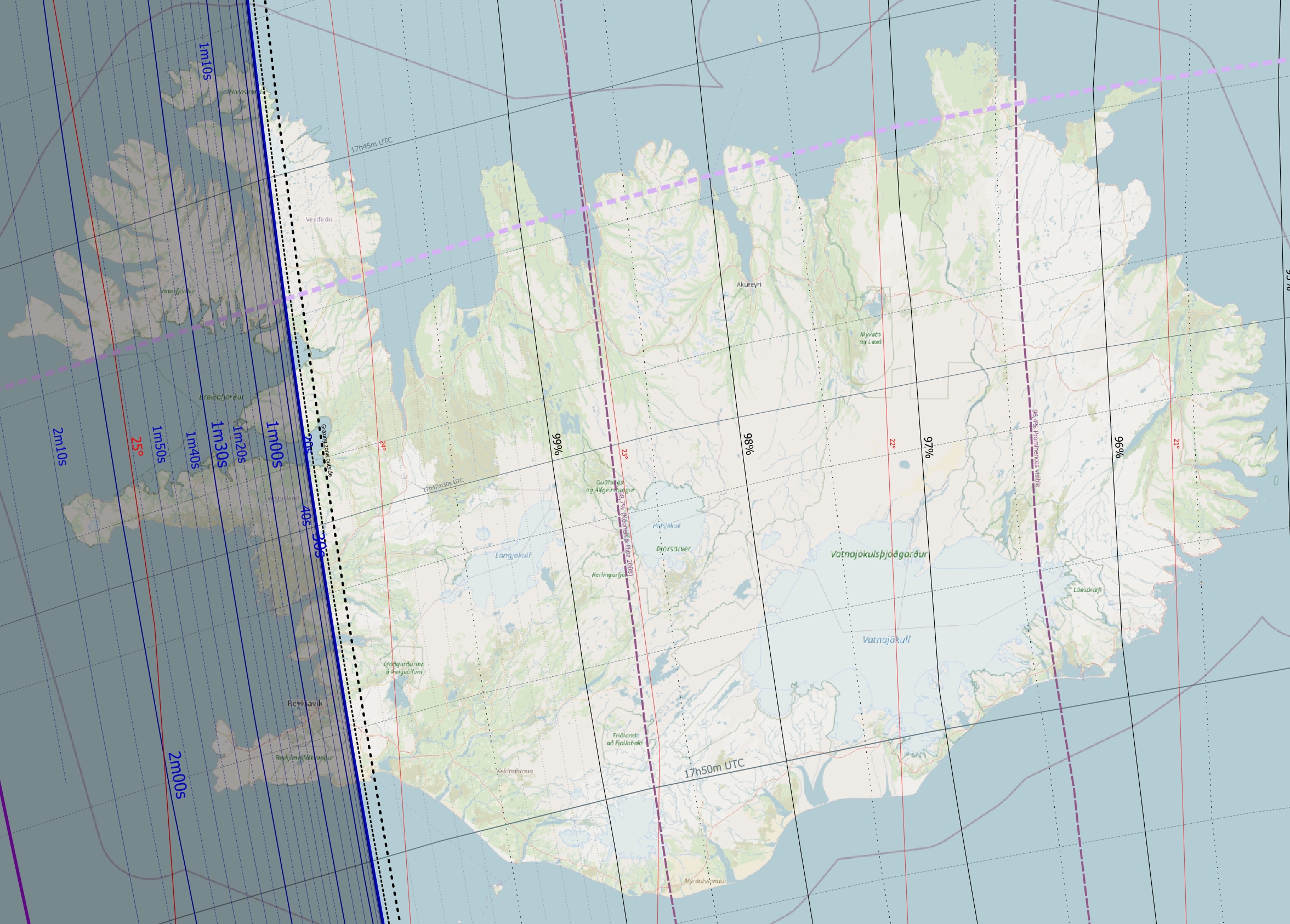
The most interesting locations are undeniably in the vicinity of the edge of totality. The map below presents two example locations considered for the observation within the grazing zone, with a level of obscuration of 99,8%.
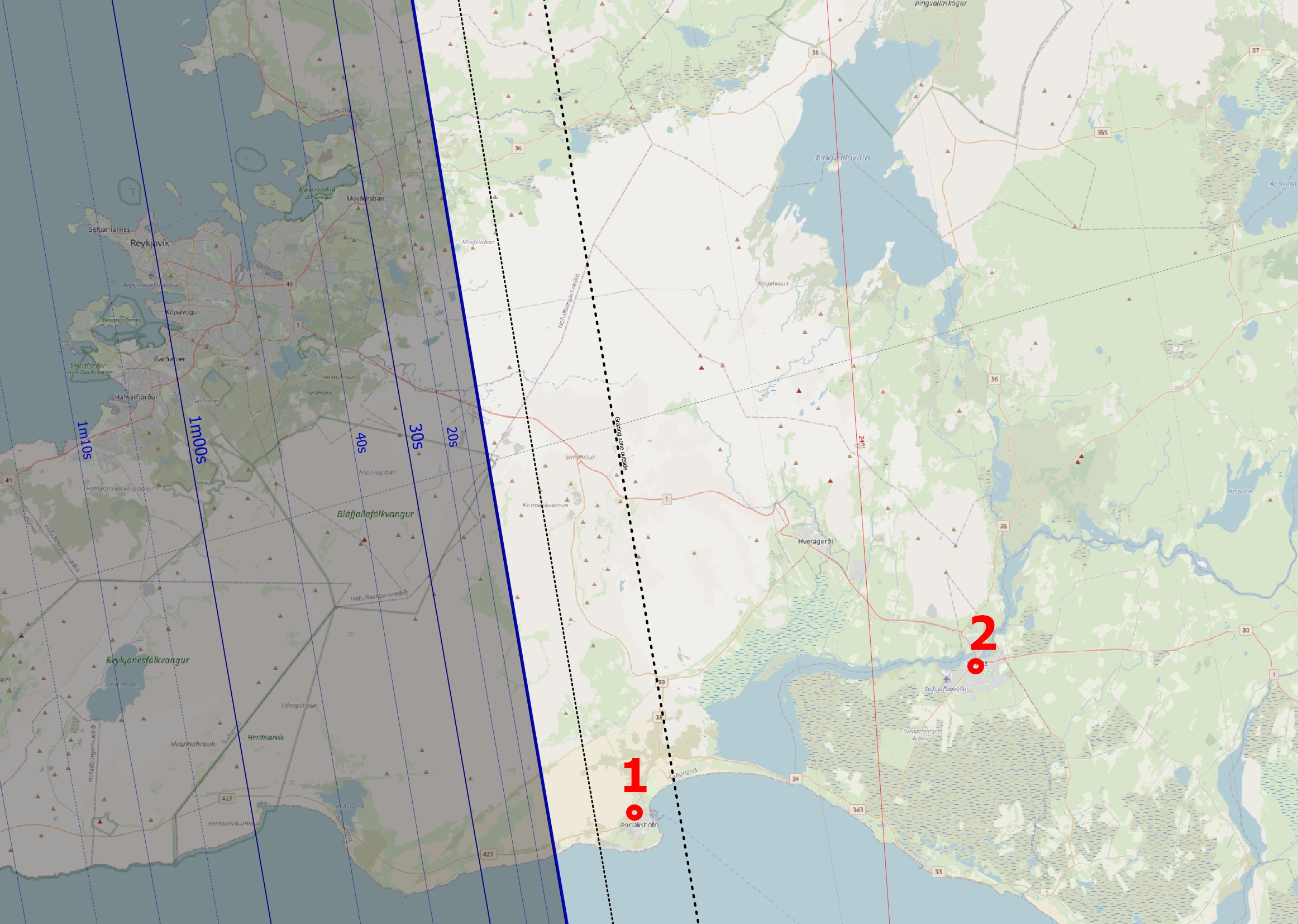
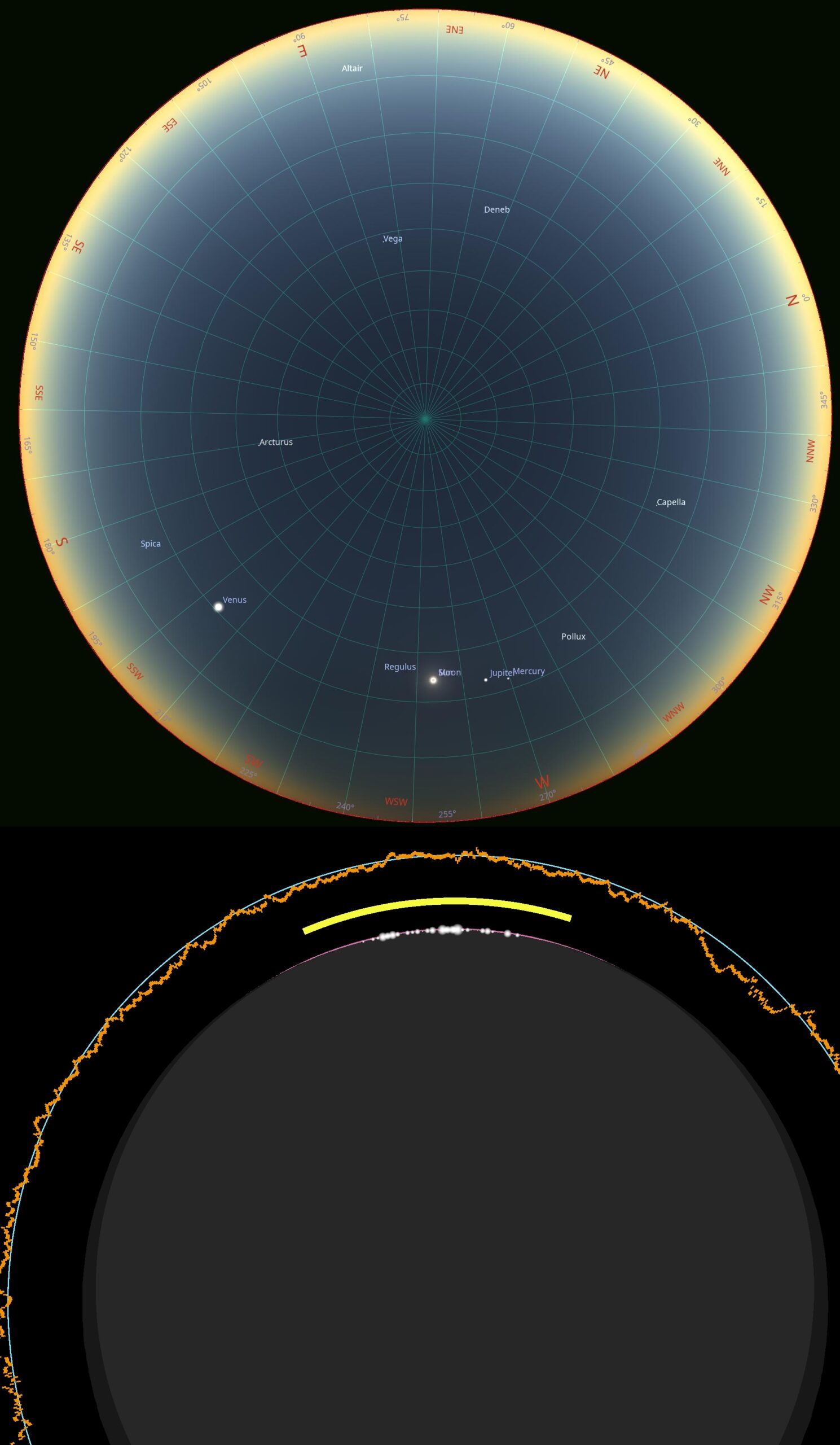
In the Þorlákshöfn village, located within the grazing zone, there is 2m55s of eclipse exceeding 99% obscuration, meaning de facto the time without solar filters and over 1 minute of beautiful diamond ring combined with Baily’s Beads. The chances for a double diamond ring from this location are the same as those at other locations, and occur shortly after the greatest phase. Meanwhile, the shadow is visible in great detail just under the Sun, along with its opposite, the southern boundary just above the horizon. There will be a few stars visible.
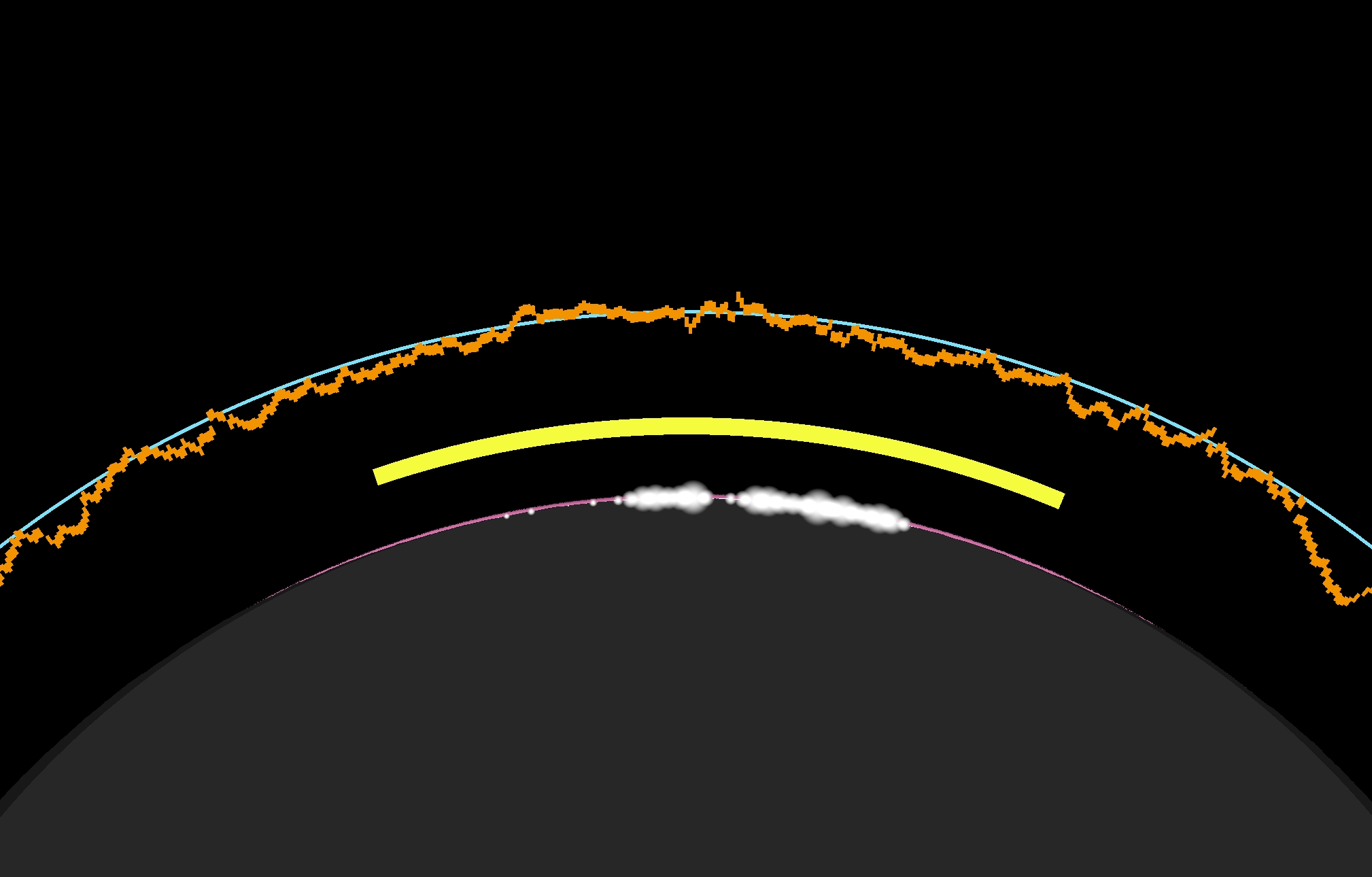
The town of Selfoss is located 5 times farther from the eclipse path than the village of Þorlákshöfn. As a result, there is no chance for Baily’s Beads, in exchange for which, the large diamond ring will be visible (Pic. 53).
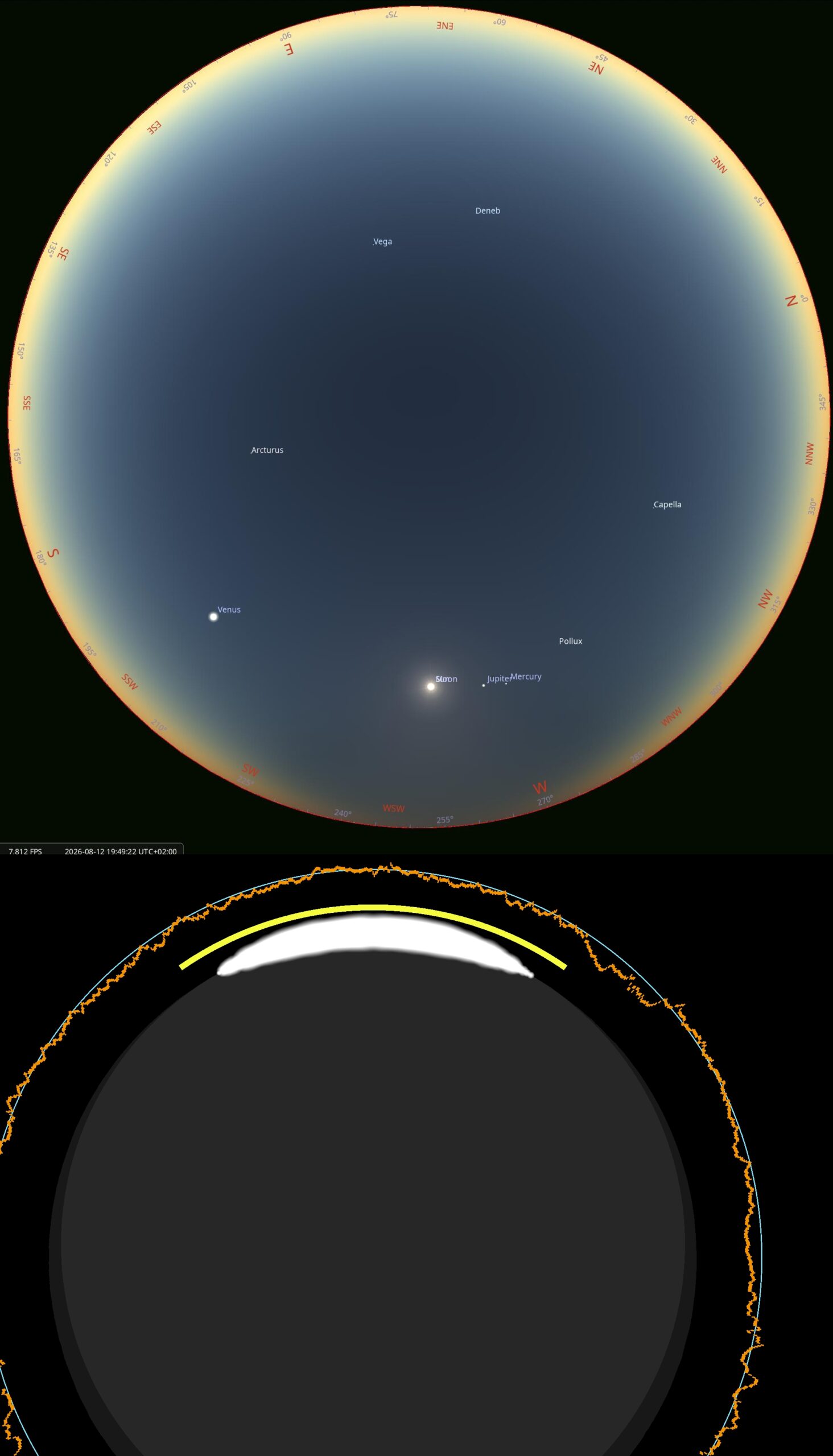
Despite almost 1m50s with obscuration exceeding 99%, the difference in the greatest eclipse is streaking between these 2 locations. This is only 20 km! An observer can literally see a thin solar crescent from these locations. On the other hand, the sky sphere still looks interesting, with some bright stars visible and the umbra outline just beneath the Sun. The final obscuration is estimated to exceed 99,8% across all these locations.
The interesting subject for consideration is the presence of umbra, discussed earlier in this chapter with respect to the light transition between the illuminated and shadowed sections of the sky.
The opposite side of the umbra can be visible during deep partiality, but only above a certain obscuration, which is quite flexible as far as the air quality is considered. In Stellarium 25.3, SkowMySky mode simulates it in ideal near-Rayleigh atmospheric conditions, free of water vapor particles and any aerosols. In practice, we should expect different circumstances, especially within the planetary boundary layer, where, by definition, the air isn’t fully clear. The presence of aerosols enhances forward light scattering.
The image below, rendered by Stellarium, shows the relevant circumstances. The opposite side of the umbra becomes invisible at obscuration of 99,7%, and next, the « gray wall » represented by the umbral cone disappears at obscuration of about 99,2-99,3%. As the obscuration decreases, the near-horizon sky brightens again, though it remains darker than the surrounding horizon, allowing the shadow column to be identified from a distance.
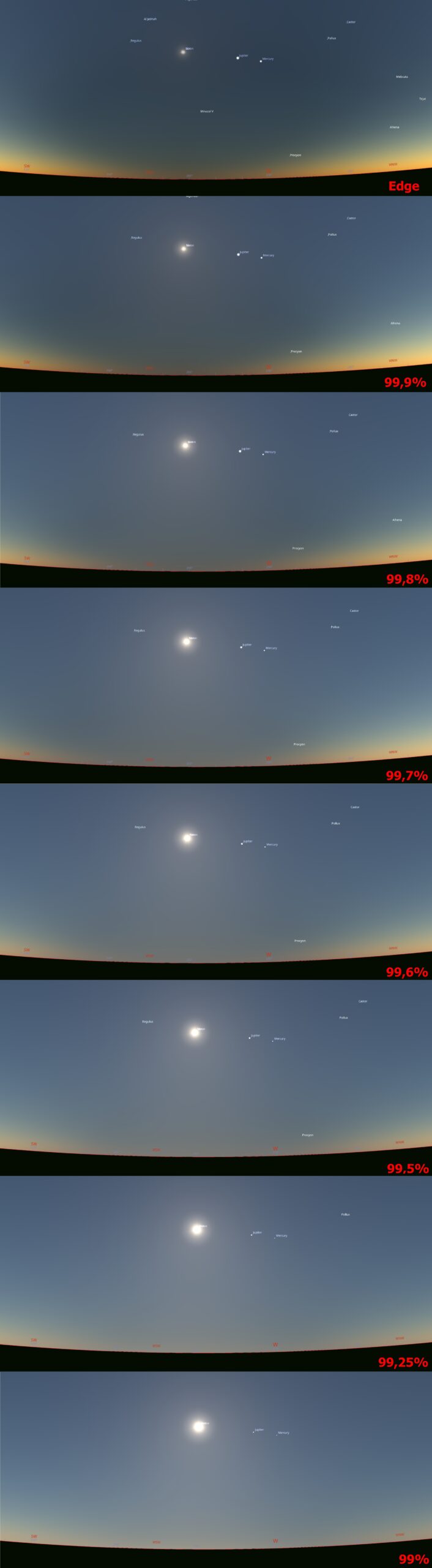
B. UK & IRELAND – The British Isles will face a deep partial solar eclipse with obscuration over 90% as presented on the map below (Pic. 54), which covers the easternmost coast and Orkney & Shetland islands.
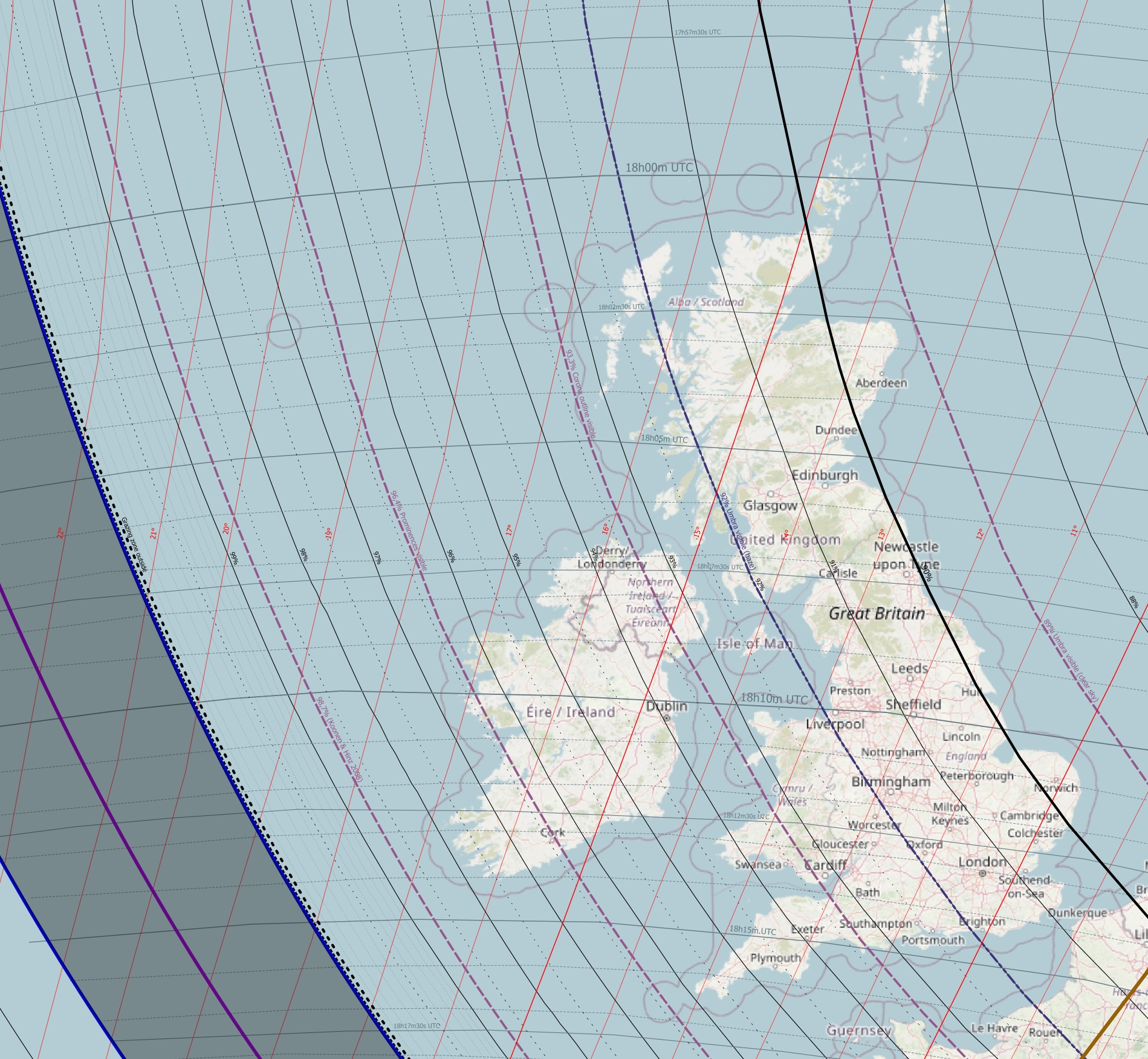
The most interesting places are Iveragh and Dingle Peninsula, as well as the Blasket Islands, where obscuration reaches 97-98%.
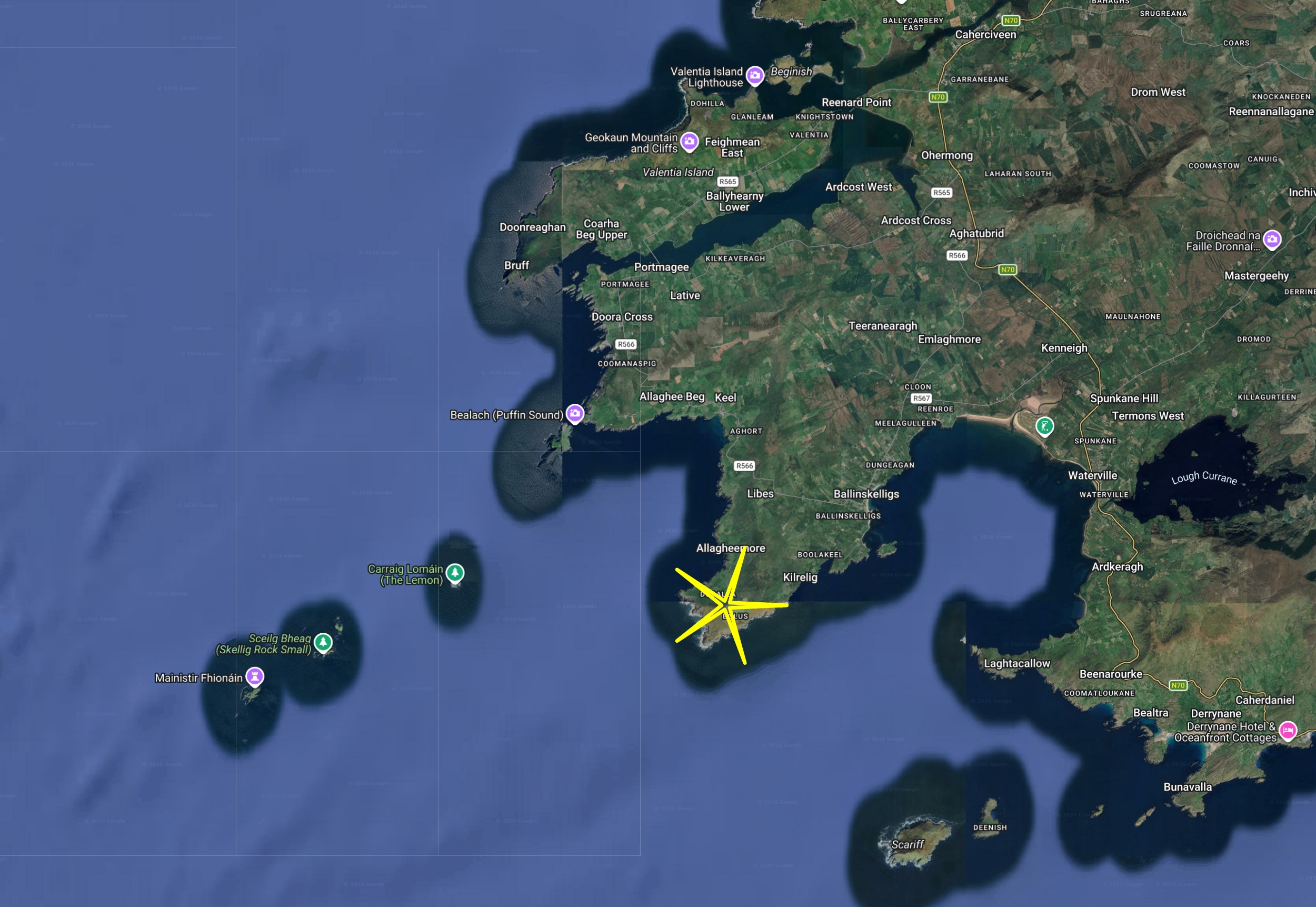
Our considered place is the Bolus Napoleonic Tower (Pic. 54).
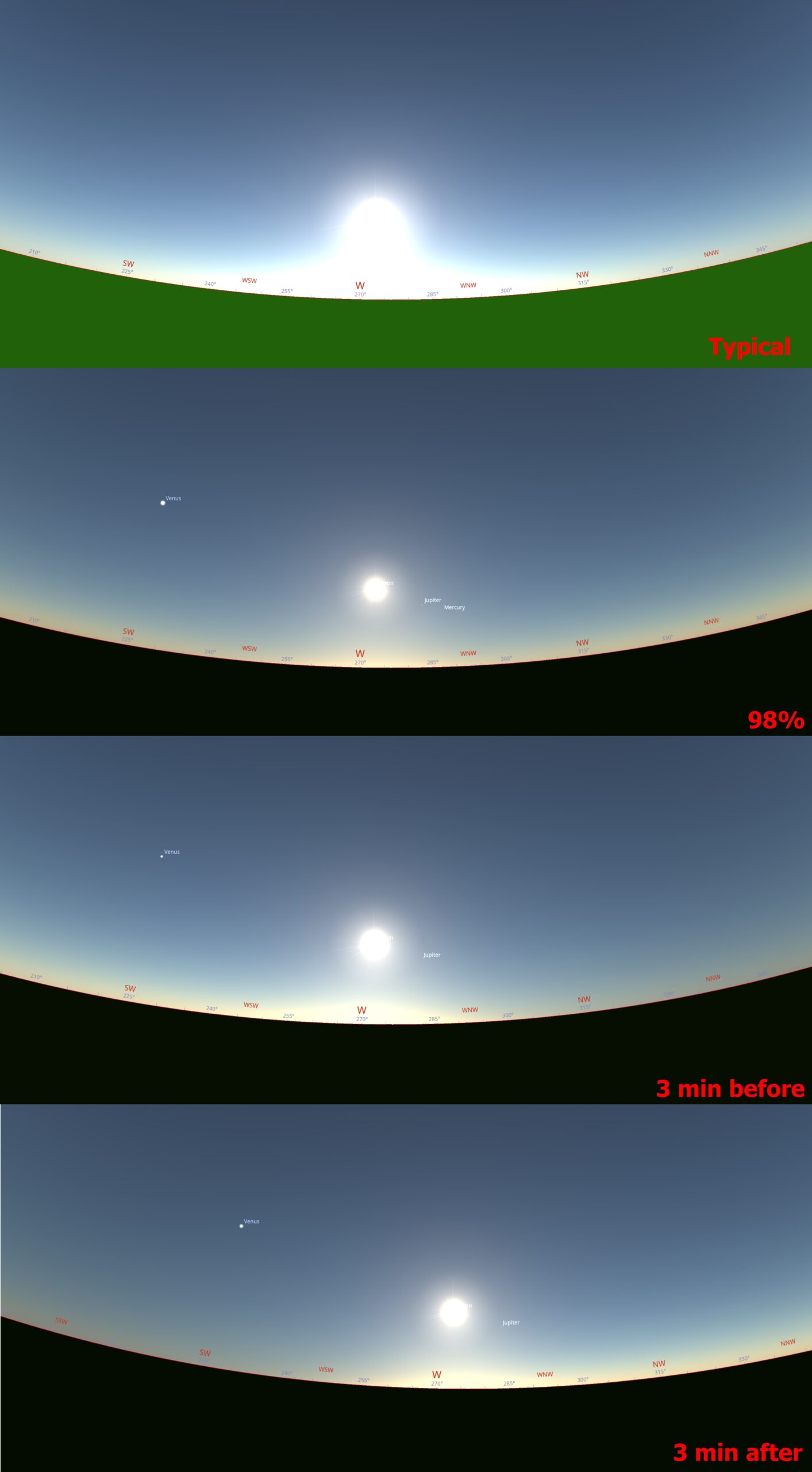
The shadow column should still be visible before and after the greatest phase, because of a bit smaller forward light scattering, when the observer doesn’t watch the solar azimuth directly. The distance to the limit of totality is approximately 220 km from this location.
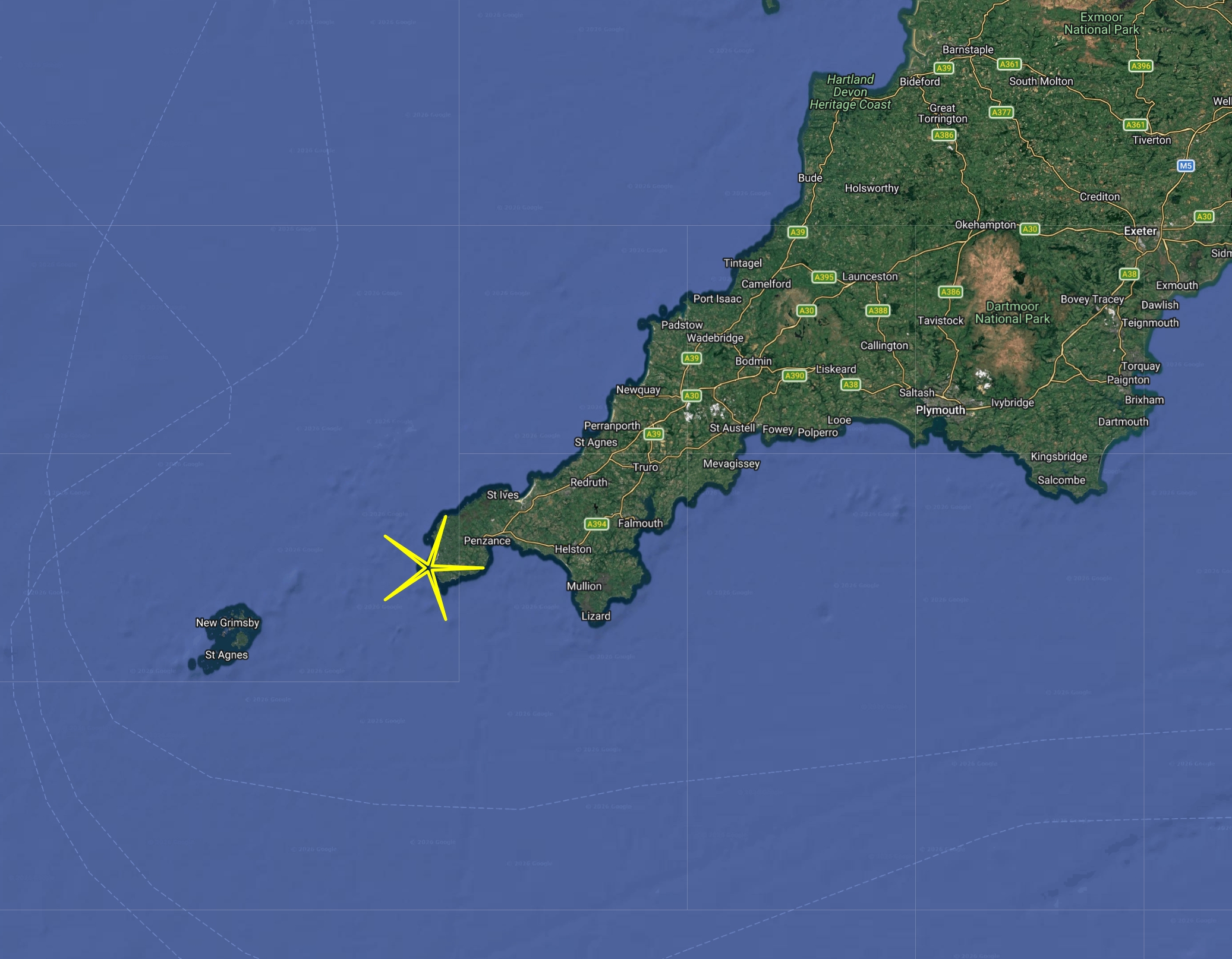
Considering Great Britain, the largest obscurity of 96,5% will be observed at the Isles of Scilly and 95,9% at the southwesternmost tip of Cornwall.
Our case study is Lands’ End (Pic. 56), which is easily accessible by car (Pic. 57).
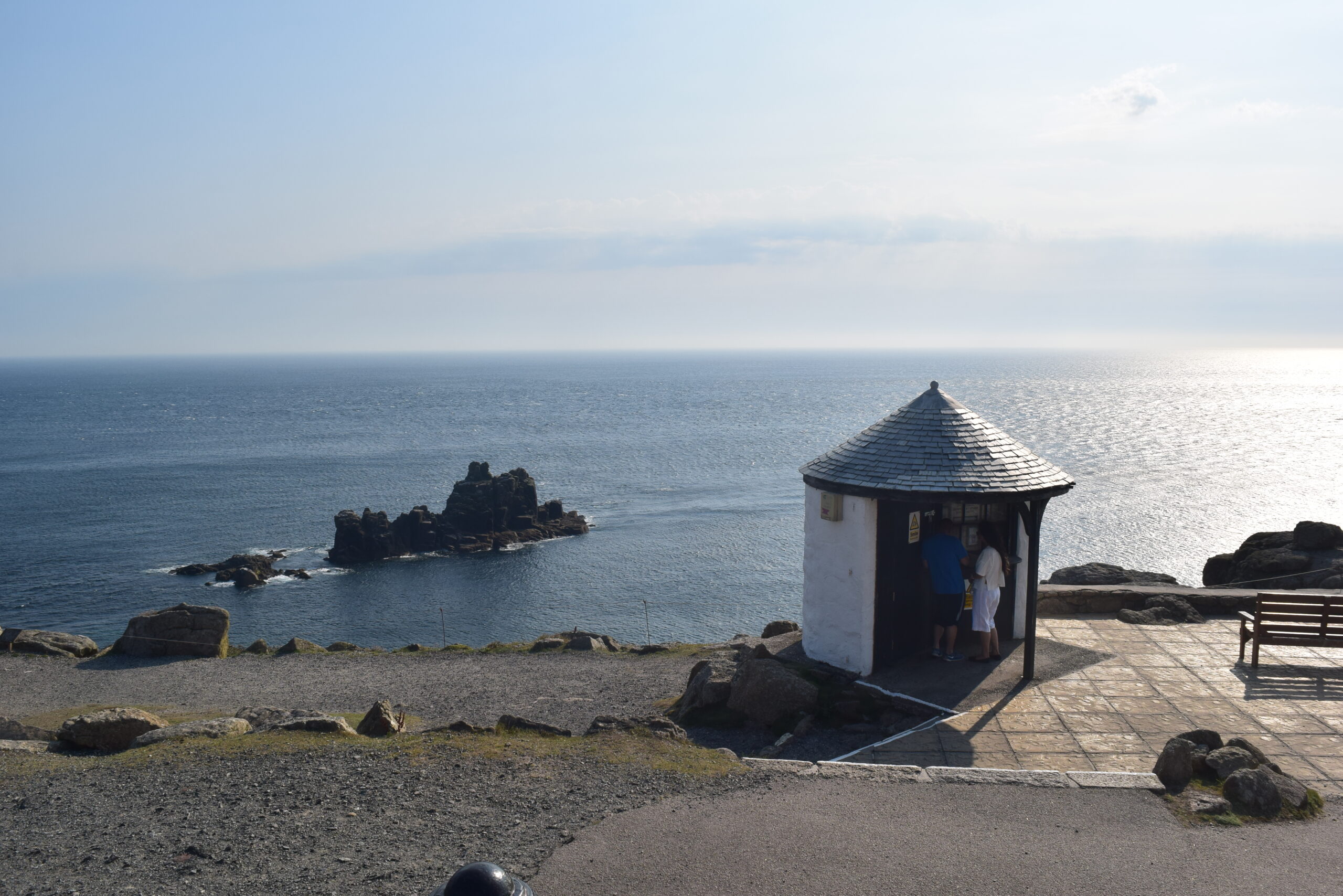
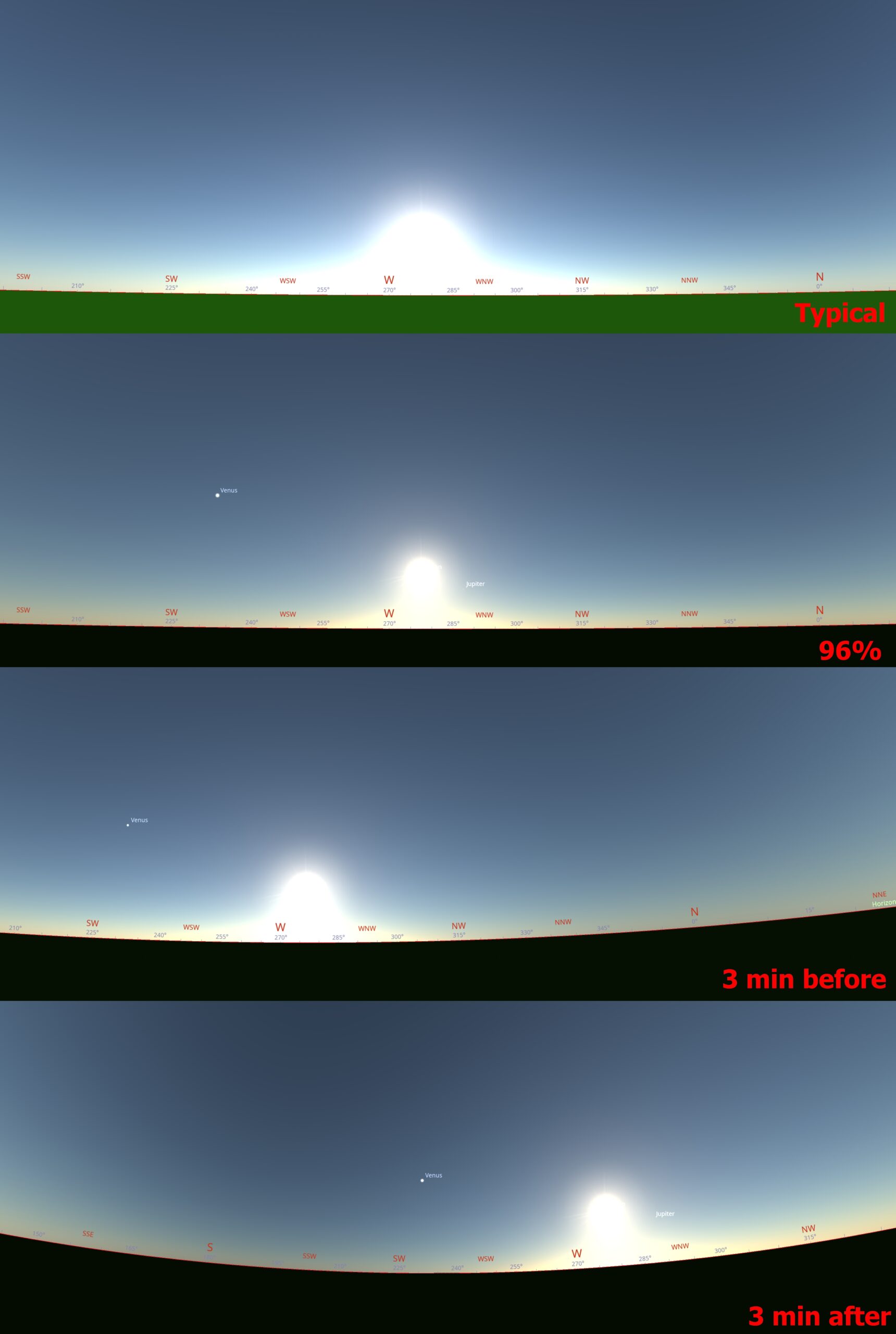
The distance from Land’s End to the totality path is over 390km, so chasing the distant umbra column will be a challenge. However, an observer will see an interesting optical phenomenon mentioned in Chapter 8 – the contrast triangle. On Ireland’s coast, this effect should be boosted more by a deeper eclipse phase.
C. FRANCE – The deepest partial eclipse will be observed in a municipality of Urepel (97%) and the Isterbegi hill (1027m.a.s.l.) (Pic. 57) straddling the border with Spain, where the expected maximum obscuration is to reach 99,72%.
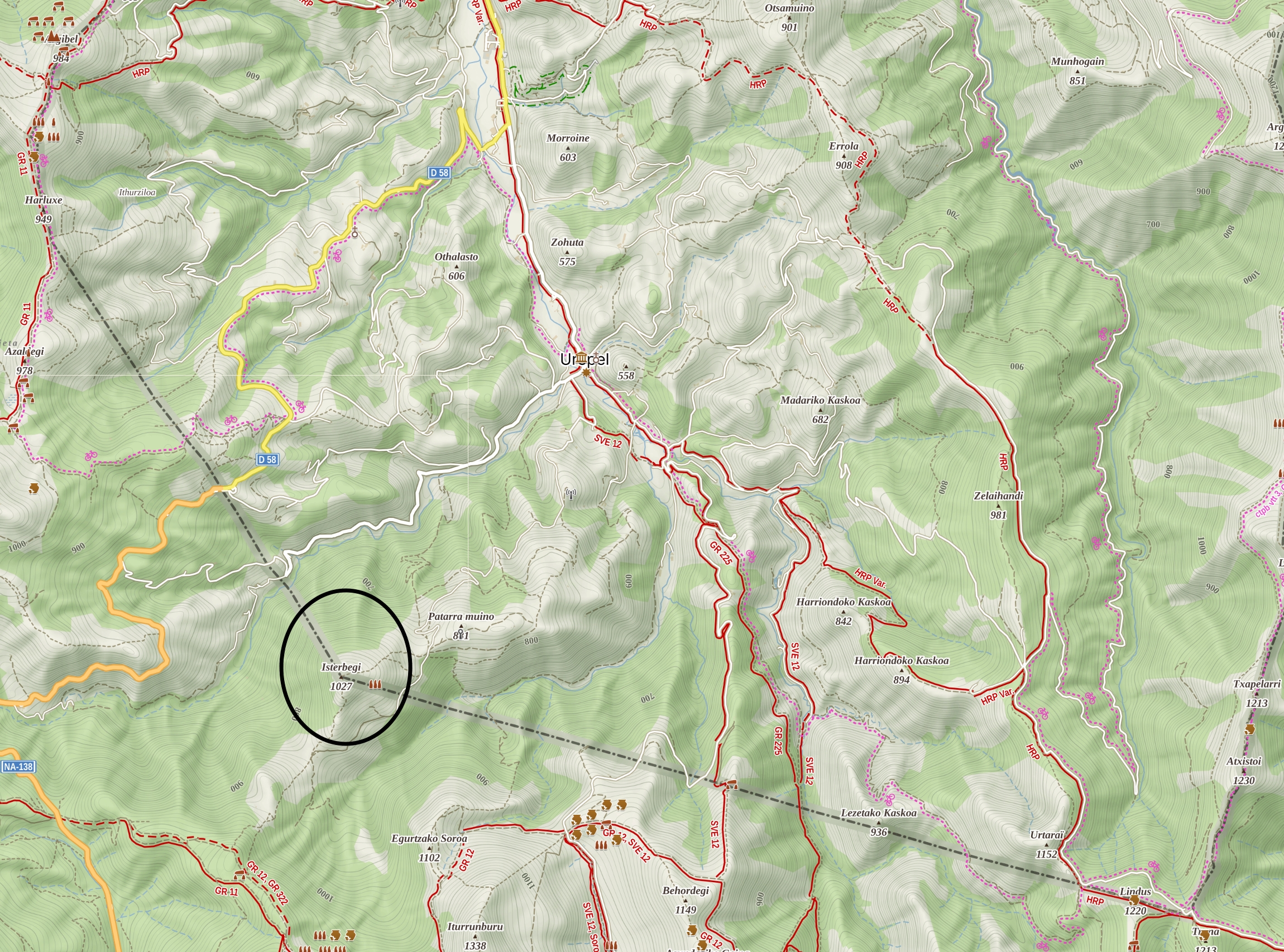
Unfortunately, no chances for Baily’s Beads. At most large diamond ring can be visible during the period of coronality. The Sun, obscured by at least 99%, will be visible for about 1m40s.
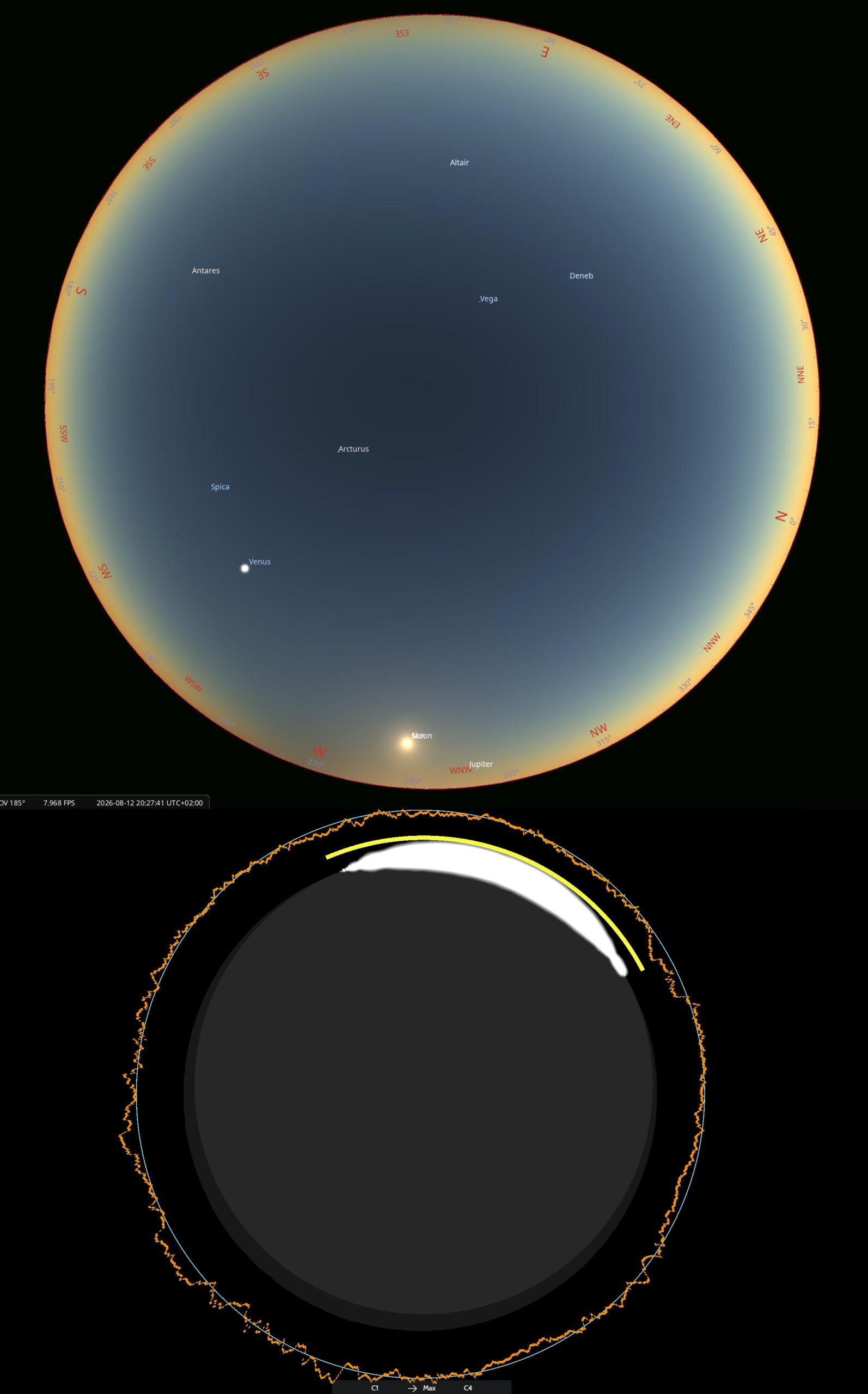
The obscuration is large enough to cause the thin solar crescent to break in several places around maximum. During this moment, an observer should detect at most 6 bright stars in the sky, except for bright Venus and maybe setting Jupiter.
The last thing is the position of the Moon’s shadow in the sky, which will be best expressed right after maximum (Pic. 59), because it will be very close to the location. The minimum distance of French grounds from the limit of totality is only 41,5 km, therefore the umbra should be visible quite well in the southern section of the sky.
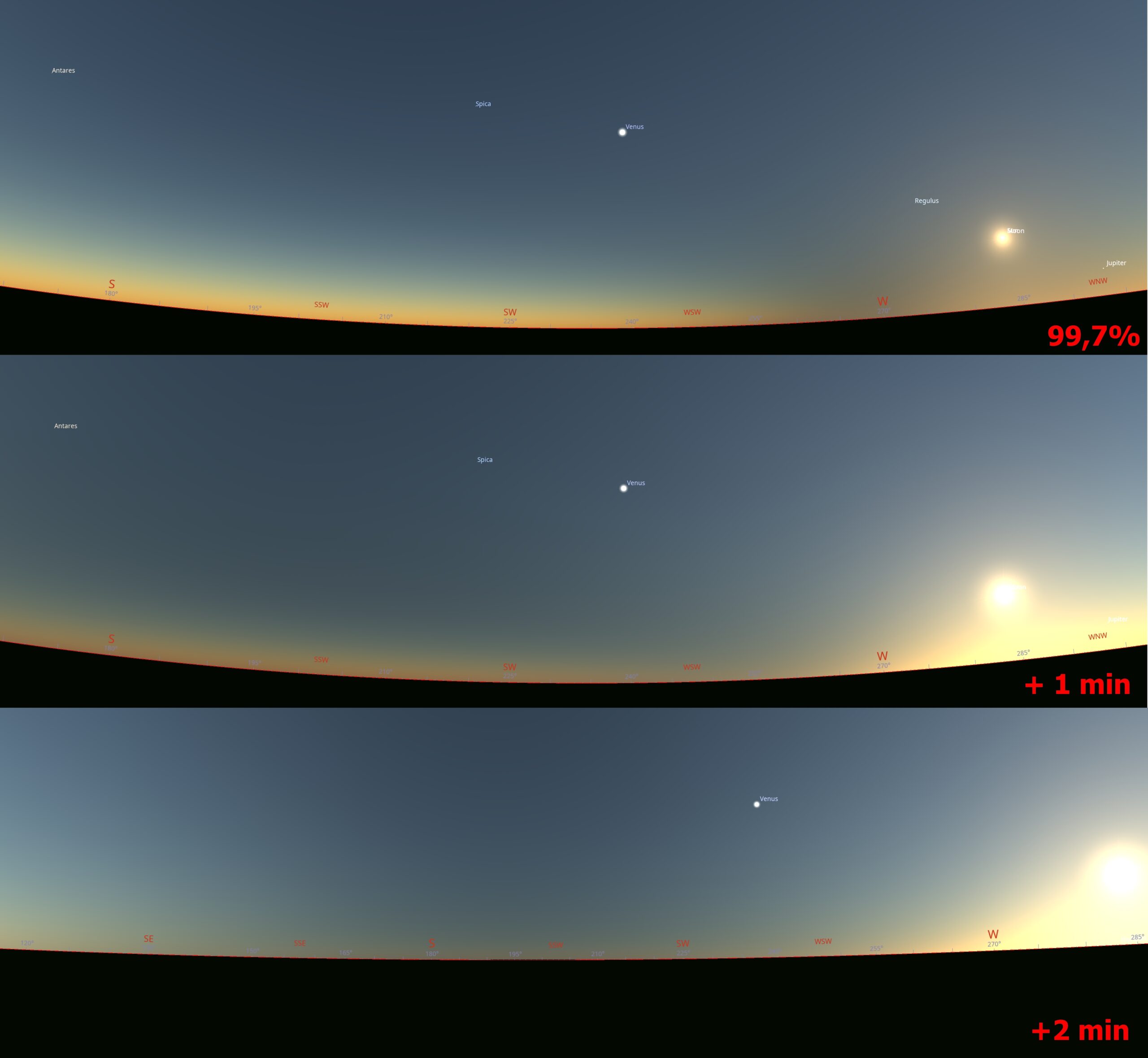
D. ANDORA – This small country will experience around 99% eclipse obscuration, so technically speaking, the period of observation without solar filters will be very narrow. The observation will be impossible in most places across the country, as the greatest eclipse will occur when the Sun, shining at an altitude of just below 5 degrees, sets behind the mountains.
E. SPAIN – As this is a major country with a total phase along with Iceland, there are the same circumstances, which refer to the grazing zones and the nearest vicinity of totality. Unlike Iceland, the observers in Spain can watch these phenomena from both sides of the path. As we know, the southern limit looks more interesting for two reasons:
– possibility of capturing a double diamond ring,
– better visibility of the shadow.
Considering the first element, the illustration below represents the view of Baily’s Beads and diamond ring at the greatest phases for all deep partialities down to 99,91% obscuration (Pic. 60).
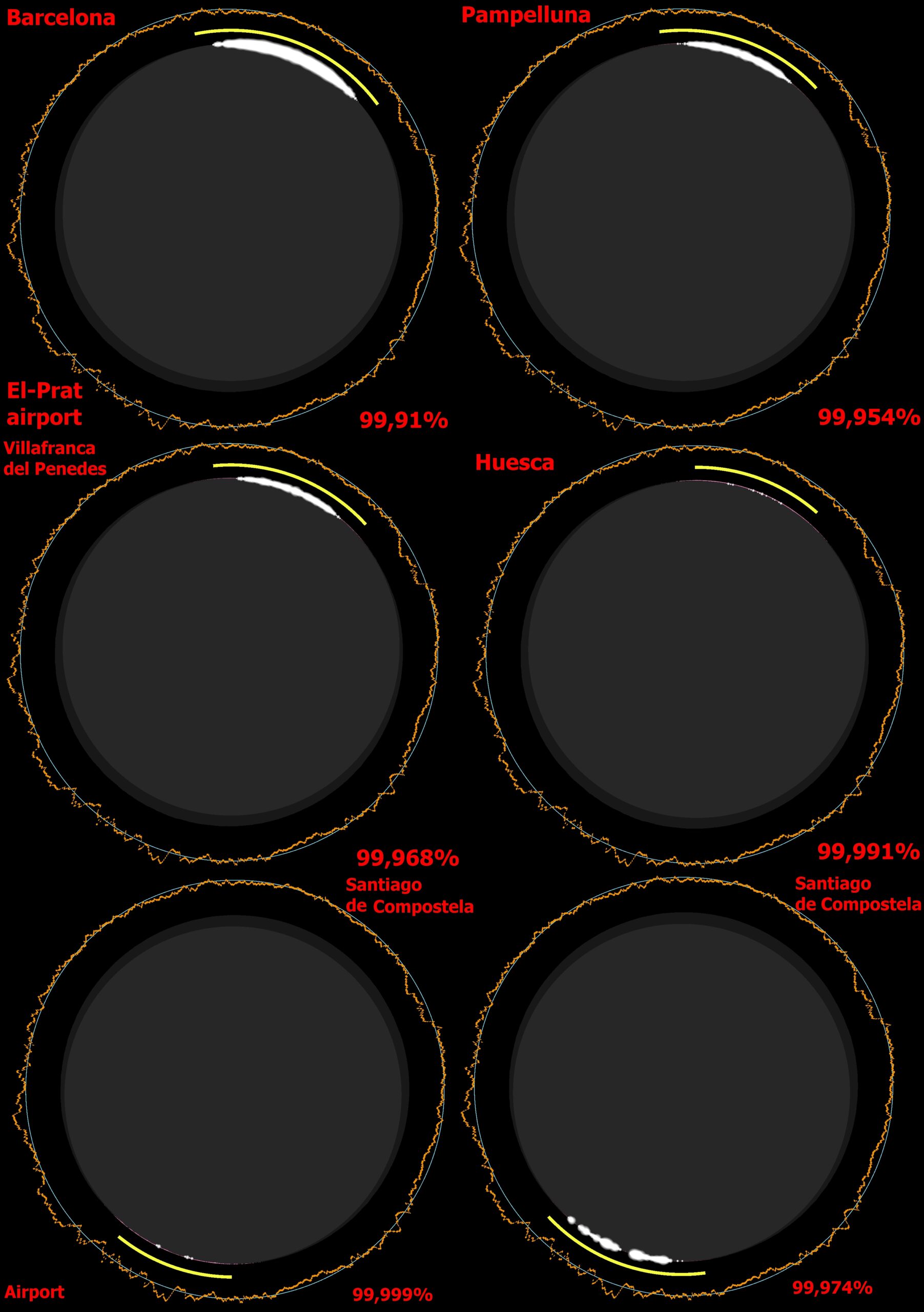
The distance from Barcelona El-Prat airport (BCN) to the northern limit of totality (Xjubier) is around 18,5km. Observers can see large Baily’s Beads.
On the opposite side, at Santiago de Compostela Airport (SCQ), located only 3km along the path, the Baily’s Beads should be visible for over 30 seconds.
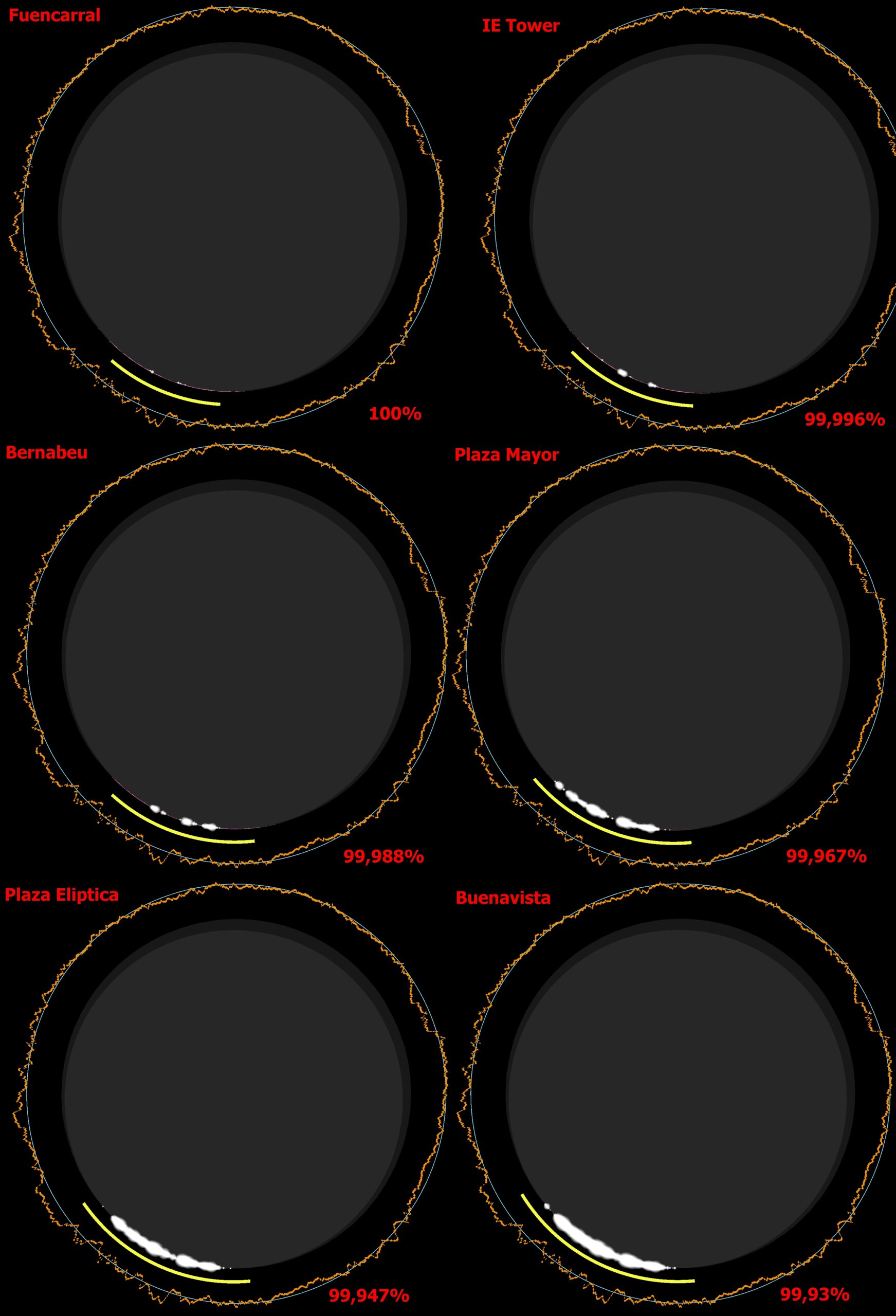
The most interesting deep partial eclipse view is expected in Madrid, where views will be quite different across the city (Pic. 61), offering a chance to capture a double diamond ring in some places.
As far as the umbra is concerned, there are decent analyses for its view from the south in the Portuguese section. It will predominantly apply to Spain as well. The view from the north is much different, as an observer can see the shadow passing somewhat « under » the eclipsed Sun. The best view is, of course, at the closest locations; likewise, the center of Huesca town, located just 1km north of the path (Xjubier). In any case, the best umbra visibility occurs not at the greatest phase, as it happens for the southern side, but about 1 or even 2 minutes after (Pic. 62-64)
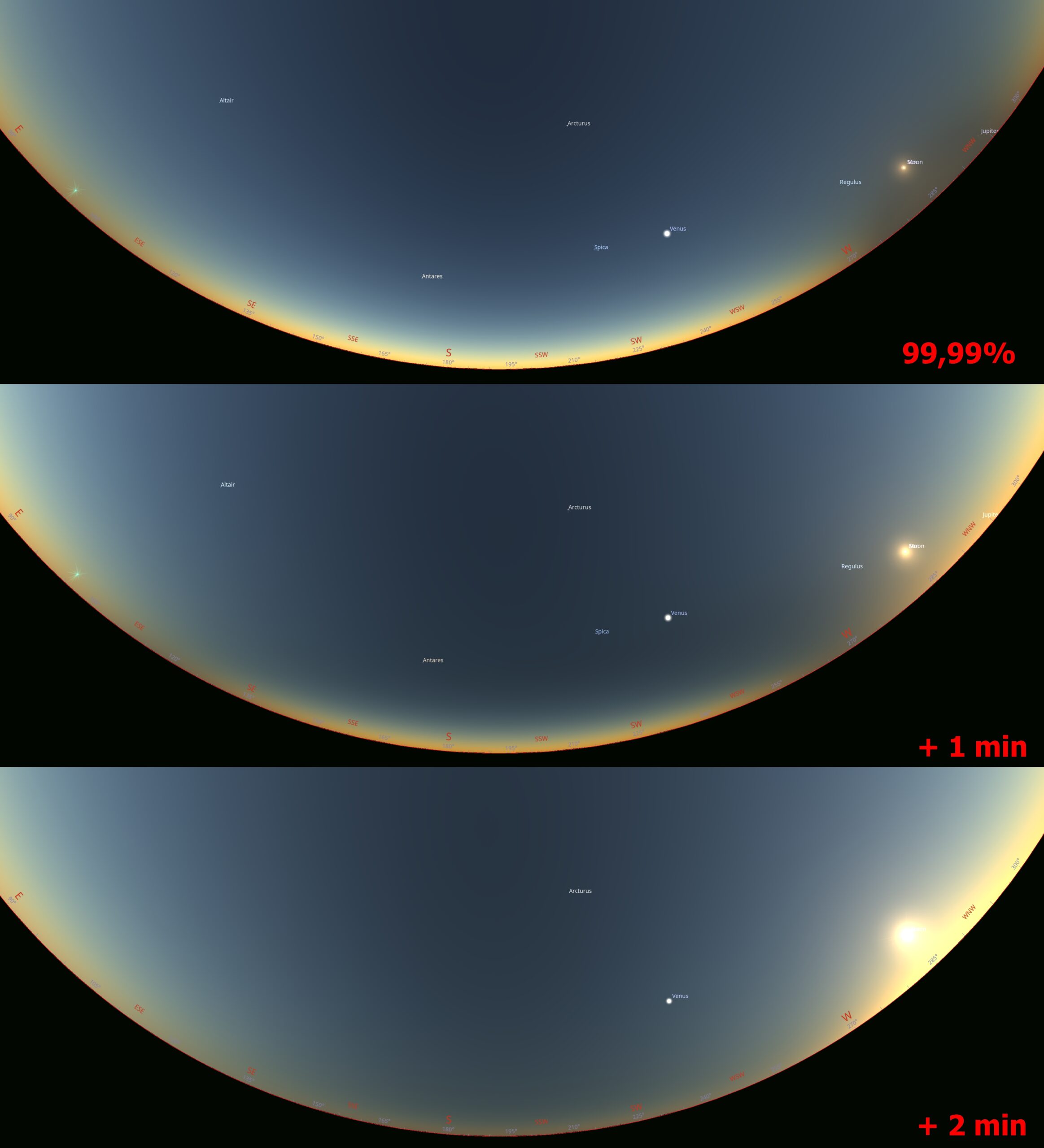
On the northern side, in any case, the greatest phase corresponds to the umbra at solar azimuth; next, an observer would need to « wait » one minute for the best contrast between the southern sky and the southern horizon. About 2 minutes after the greatest eclipse, the southern horizon looks dark.
In Barcelona, located around 35km from the limit of totality (99,9% of obscuration), this effect is naturally weaker, but still visible well.
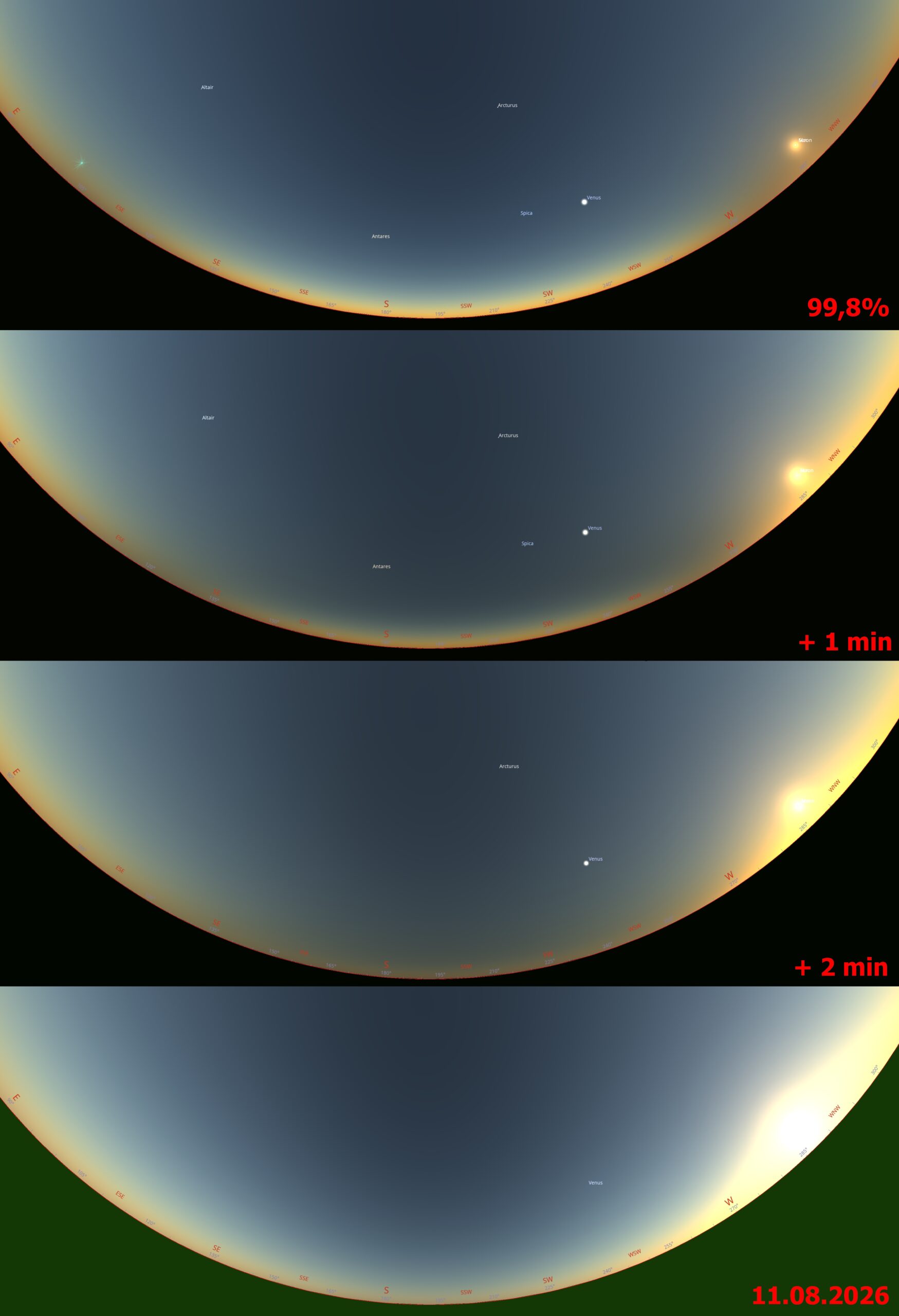
The most intriguing is the view from Girona town, located 115km from the path, with the « magic » obscuration of 99%, which somewhat reflects the « psychological » barrier between partial and total solar eclipses, as many people deem that 99% doesn’t make a large difference. They’re wrong! The 99% obscuration means that removing the Sun’s filters is risky, and the umbra at a distance is only barely visible.
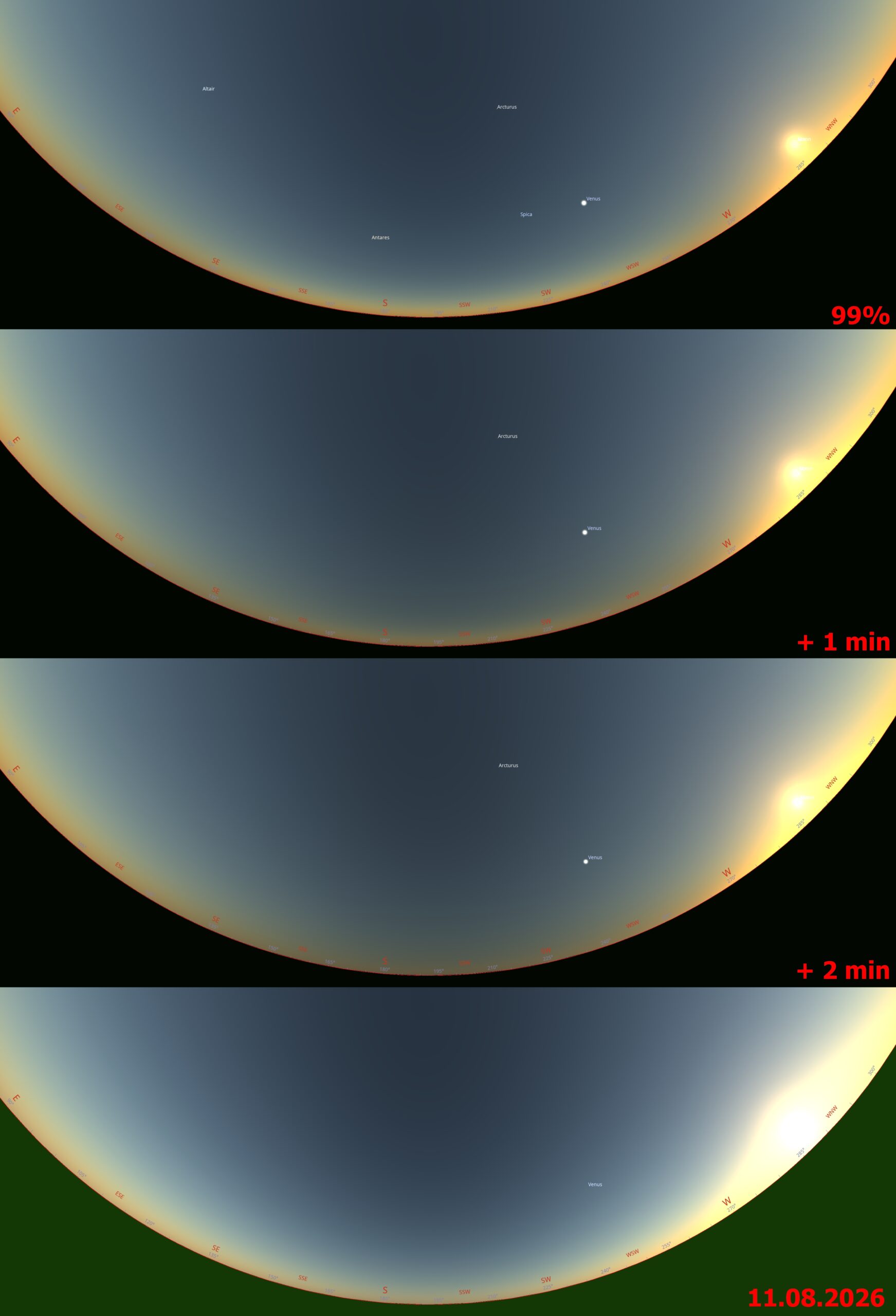
The smallest obscuration in Spain north of the path is about 98,7%, indicated as a boundary at which the sky view significantly changes due to eclipse impact (Koonen & Hinz, 2008).
F. PORTUGAL – Except for the southeasternmost corner, which will experience the totality (see chapter 5), the adjacent municipalities can also be good venues to watch the grazing total solar eclipse event. The Braganca airport is located just 12km southwest of the totality path. The greatest eclipse will reach 99,85% obscuration, giving a chance to see spectacular Baily’s Beads for about 10 seconds, whereas the entire period without solar filters will last 2m10s.
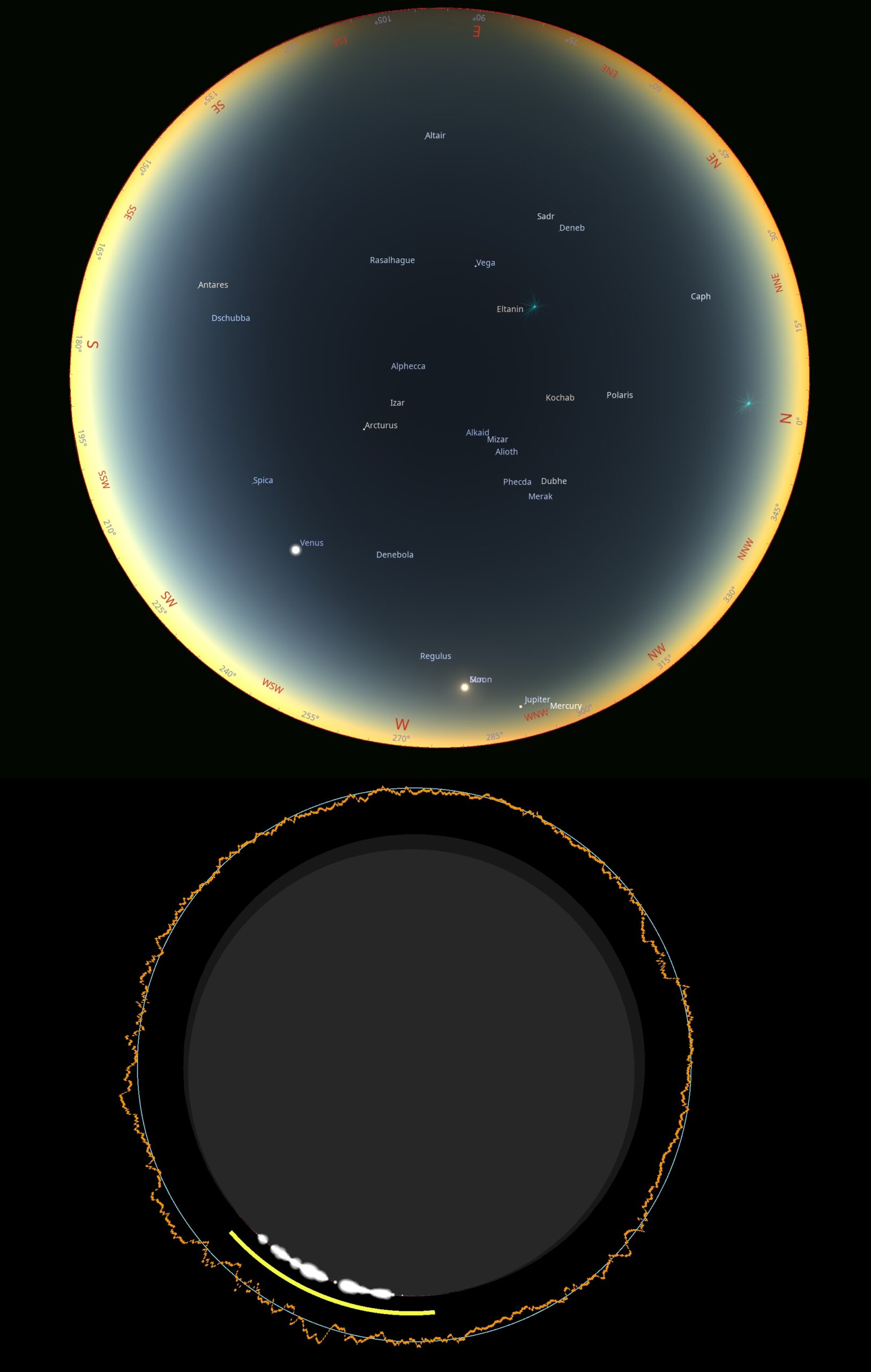
This spectacle will be visible in an almost entirely shadowed sky! The reason the zenith sky is shadowed in these circumstances will be explained later.
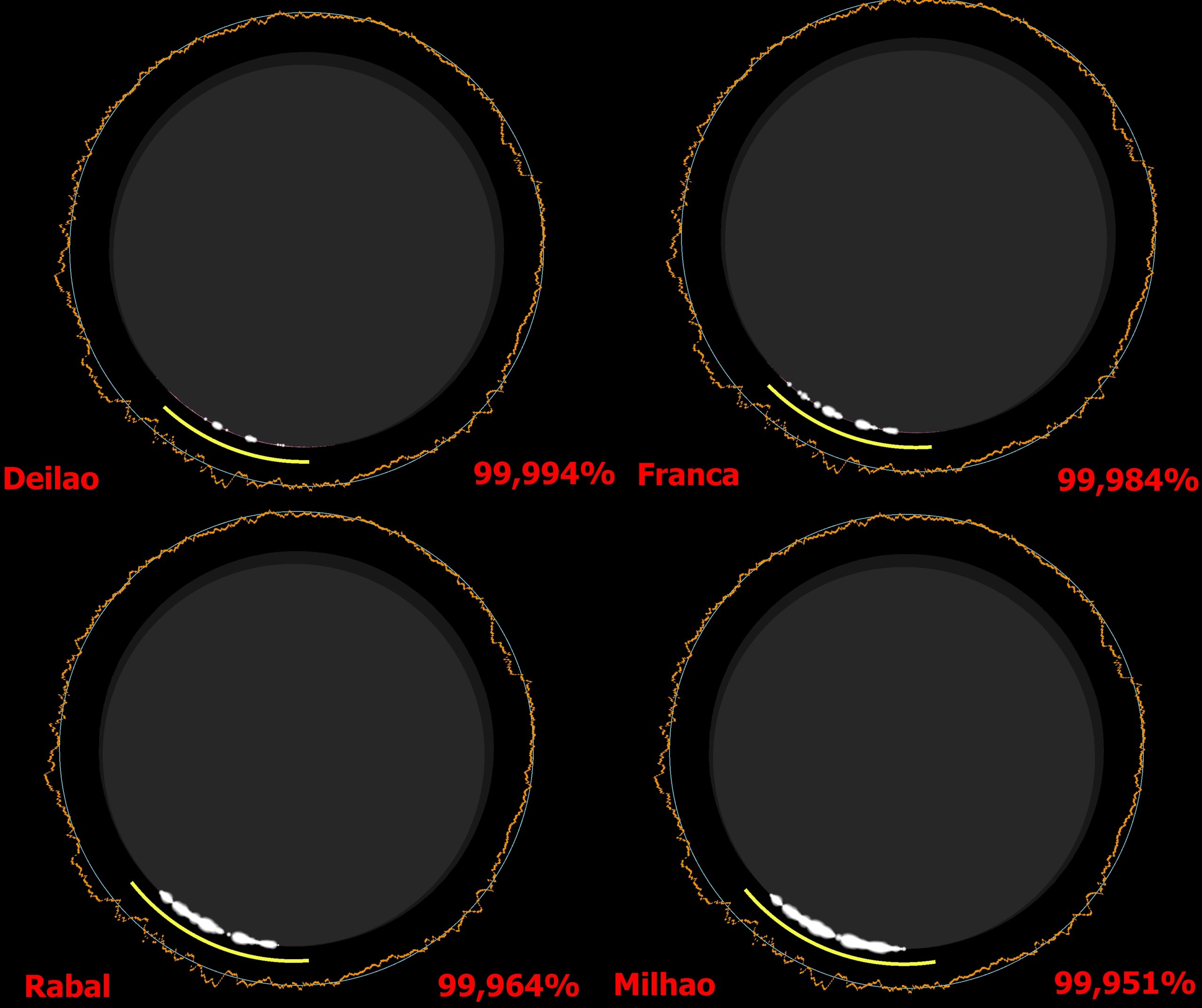
Below, you can find the Baily’s Beads circumstances within the obscuration of 99,95% and higger (Pic. 73).
The last thing is the shadow in the sky, which requires attention in areas farther from the zone of totality, especially because, given the Sun’s low altitude above the horizon, the umbra behaves differently.
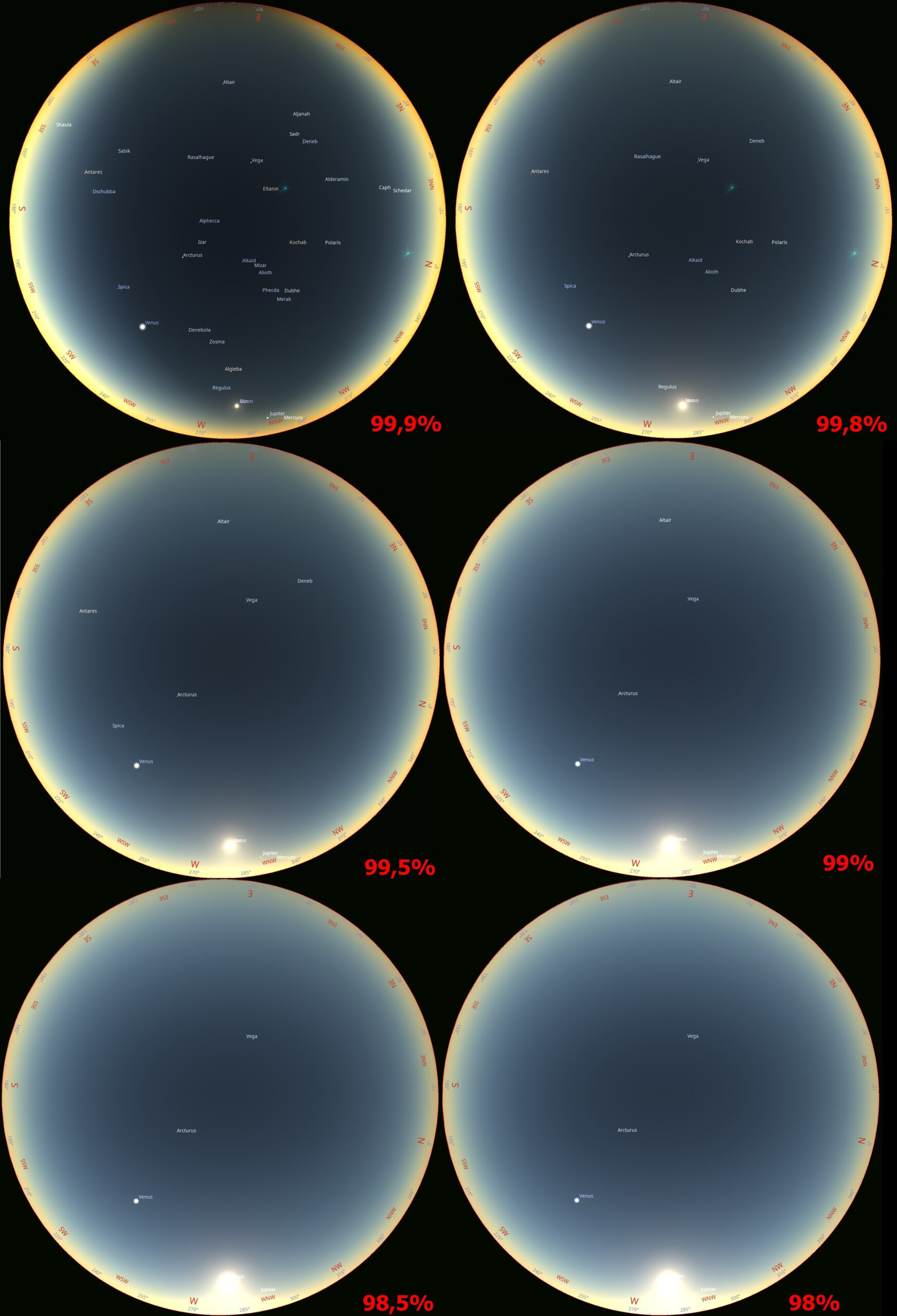
For better identifying the presence of umbra when located south of the totality path and the Sun is about to set, we need to look at the antisolar direction. At the eastern azimuth, the horizon looks much darker. It occurs for obscurations larger than 98%. For obscuration larger than 99%, some bright stars appear to be visible.
H. ITALY – The partial eclipse will be visible across the entire country, and especially the Sunset arc, as mentioned in chapter 10, is worth attention. In this text, only the greatest eclipse is considered. The maximum obscuration, which can be observable at the horizon or above, is at most 98,5%. Of course, it will occur along the western coast of Sardinia, as mentioned especially in chapters 7 and 15.
An example of a venue that will experience a very thin crescent is the Argentiera village (Pic. 70).
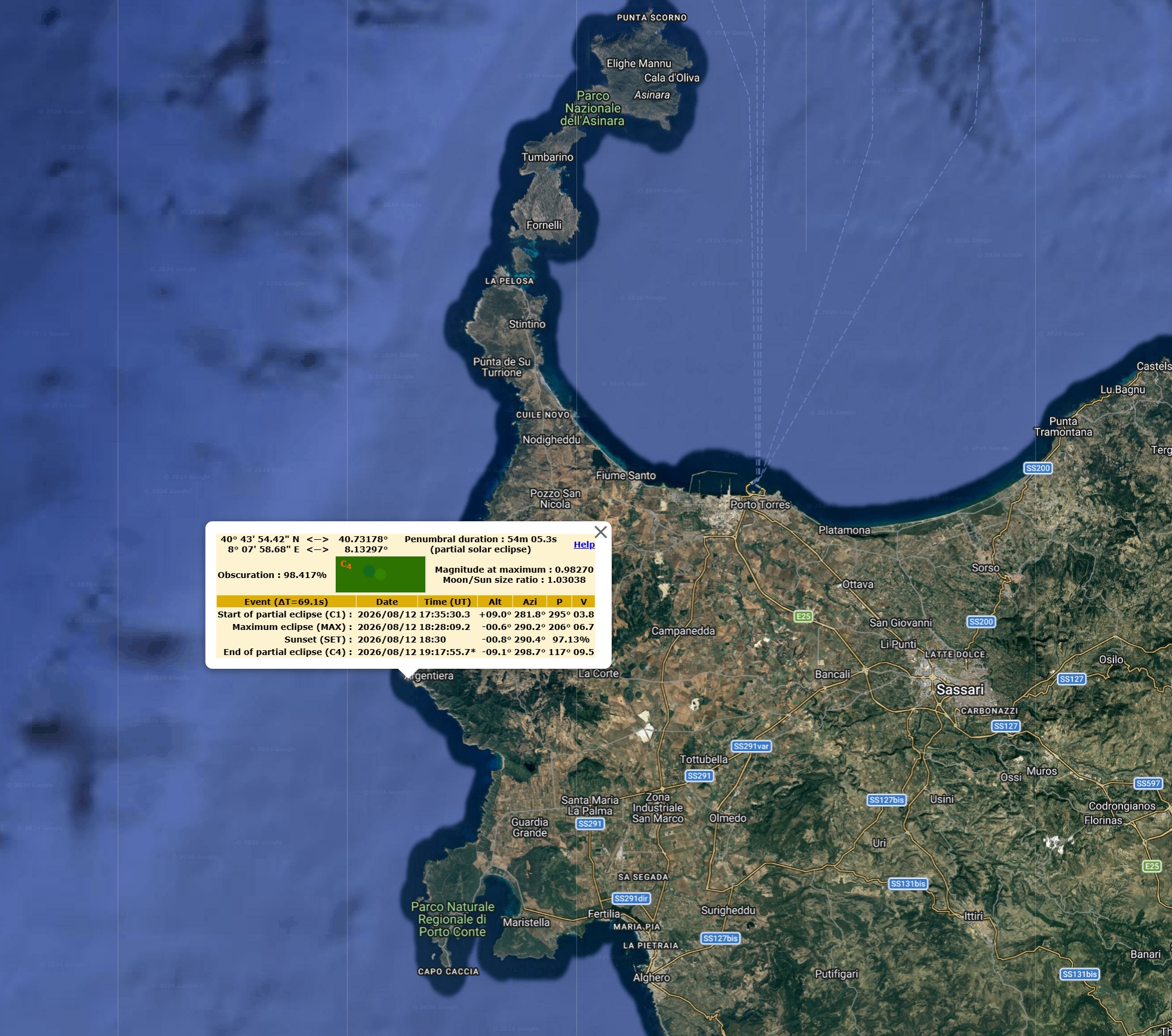
The sunset arc is unfortunately the least favourable for potential viewing of the solar corona outline. There is no such observation, and personally, I am looking forward to it!
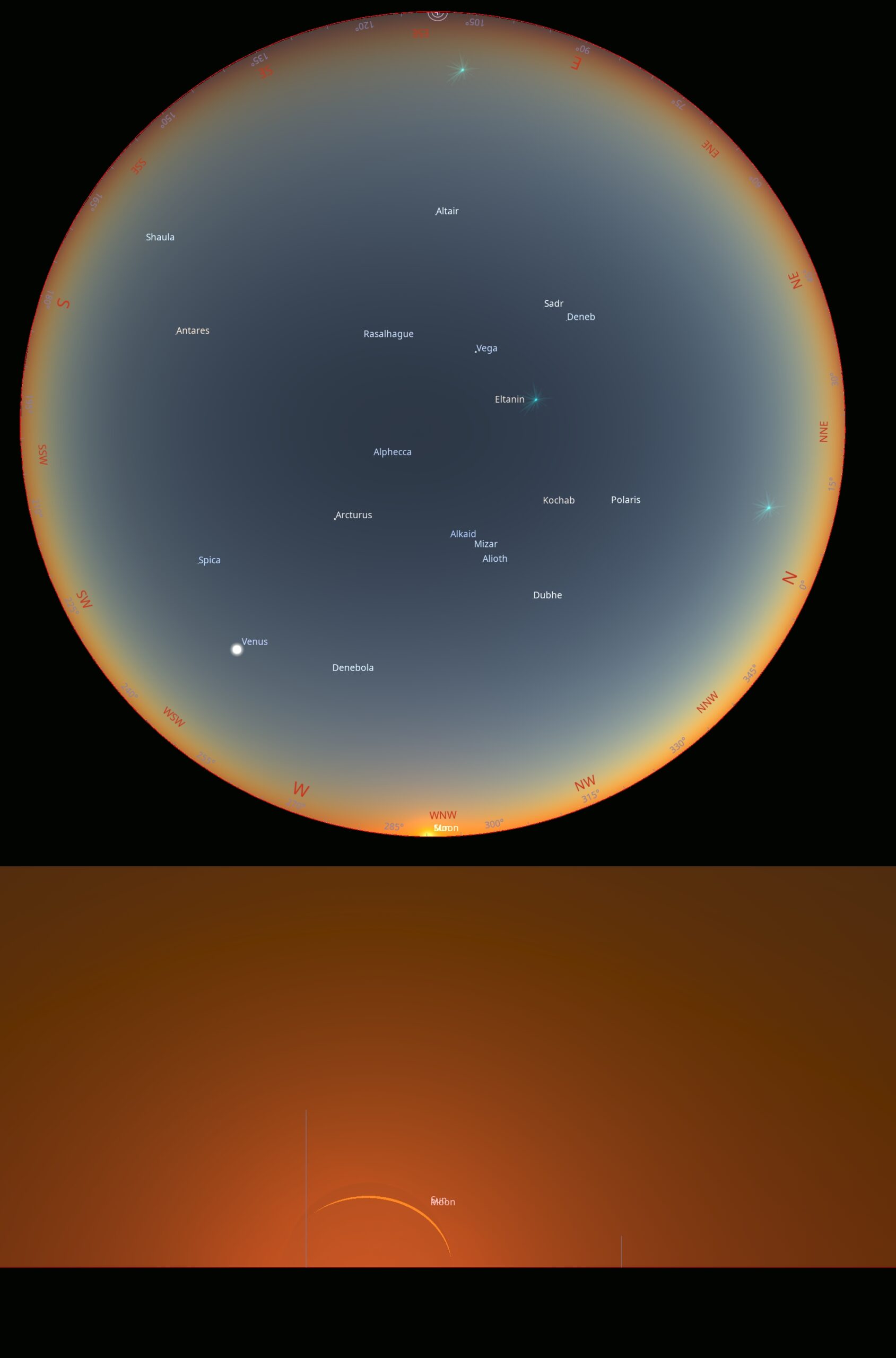
The serious obscuration of the Sun, combined with its position against the horizon, and therefore the level of light diminishing in a thick atmosphere, should allow observers to see quite a lot of bright stars in the sky, which normally appear at least about a mid-civil twilight. Another thing is darkening at the antisolar azimuth, which is related to the false umbra emerging from behind the globe, as explained in this text. Next, the observer should see the umbra outline at a distance, which will move rapidly southwards.
7. ECLIPSE EVENT BELOW THE HORIZON
7.1 Algeria
7.2 Tunisia
7.3 Italy
7.4 Malta
7.5 Other countries
Libya
Greece
Cyprus
7.6 Central and Eastern Europe
8. ACCOMPANYING OPTICAL EVENTS
There are at least several rare optical phenomena possible to see on the path of this total solar eclipse and its extension. They have been described extensively in this text and are now listed in a concise form.
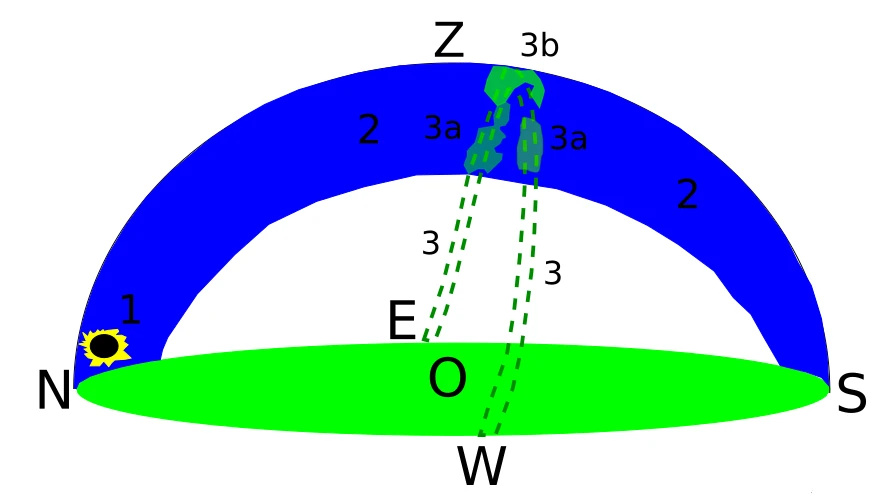
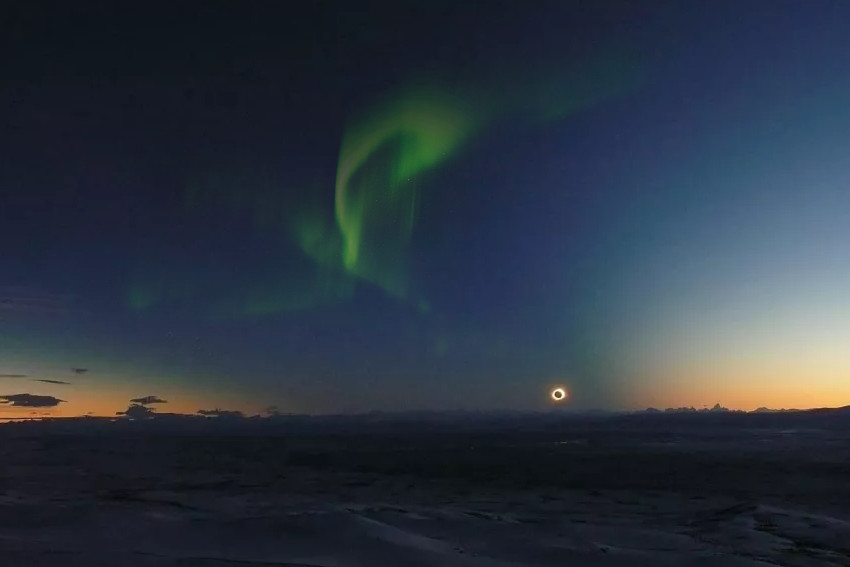
A. AURORA BOREALIS – The simultaneous observation of a total solar eclipse and the aurora borealis is theoretically possible, but it requires specific photometric and geophysical conditions. The principal constraint is the brightness relationship between the eclipsed sky and auroral emissions.
Aurorae are produced by collisions between energetic solar wind electrons and atmospheric gases in the ionosphere. Excited oxygen atoms emit mainly green light at 557.7 nm (and sometimes red), while nitrogen produces blue and purple emissions. As per Auroral brightness classification, which uses the International Brightness Coefficient (IBC), expressed in kiloRayleighs (kR), where 1 Rayleigh corresponds to approximately 1.5 × 10⁻⁷ lux at 557.7 nm we would need extremely bright aurorae (IBC4, ~1000 kR), comparable to full-moon illumination (~0.15 lux) able to cast shadows, and possible only during strong geomagnetic storms (Kp 8–9), although such events are rare.
Auroral visibility strongly depends on sky brightness. In general, aurorae become clearly visible near the end of nautical twilight (Sun at –12°). Bright events may remain visible when the Sun is 10–11° below the horizon, but typical strong aurorae fade when the Sun rises above –8° to –8.5°. There is no confirmed evidence of auroral visibility during civil twilight. During a total solar eclipse, sky brightness approaches deep twilight levels but does not reach full nighttime darkness, especially near the solar azimuth. The zenith and antisolar directions remain significantly darker and thus more favorable for auroral detection. The total solar eclipse of 12–13 August 2026 crosses northern Russia near local midnight. At locations such as the Taymyr Peninsula, totality occurs under low solar elevation associated with the midnight sun. With Solar Cycle 25 approaching its maximum around 2025–2026, the probability of strong geomagnetic storms increases. In addition, the migration of the north magnetic pole toward the Russian Arctic enhances the likelihood that the region will lie near the auroral oval (Pic. 40).
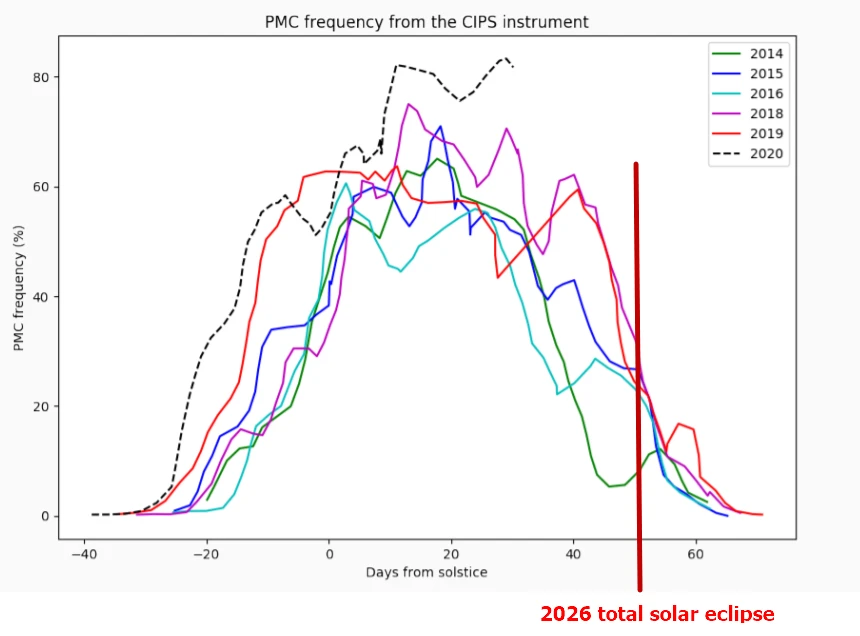
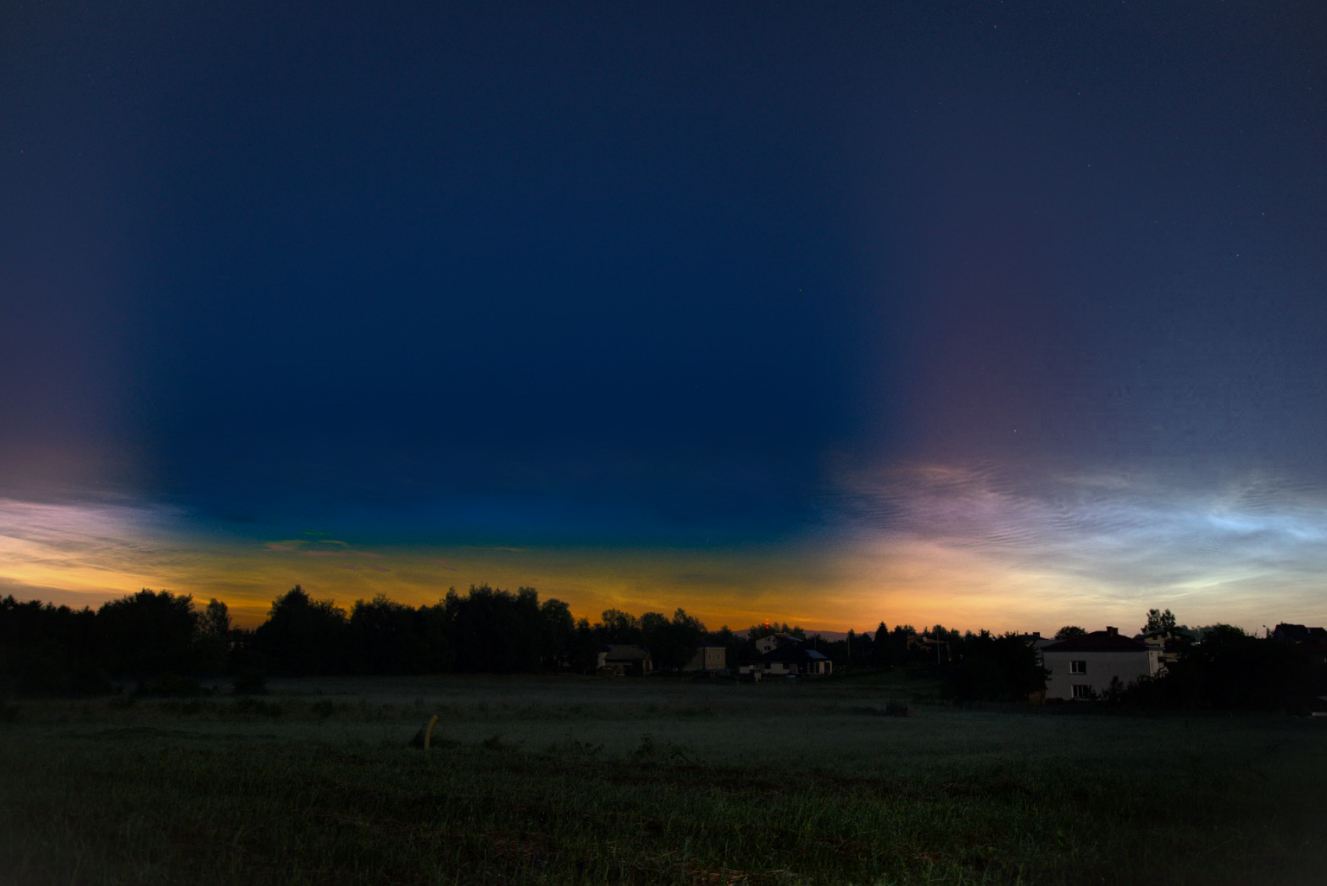
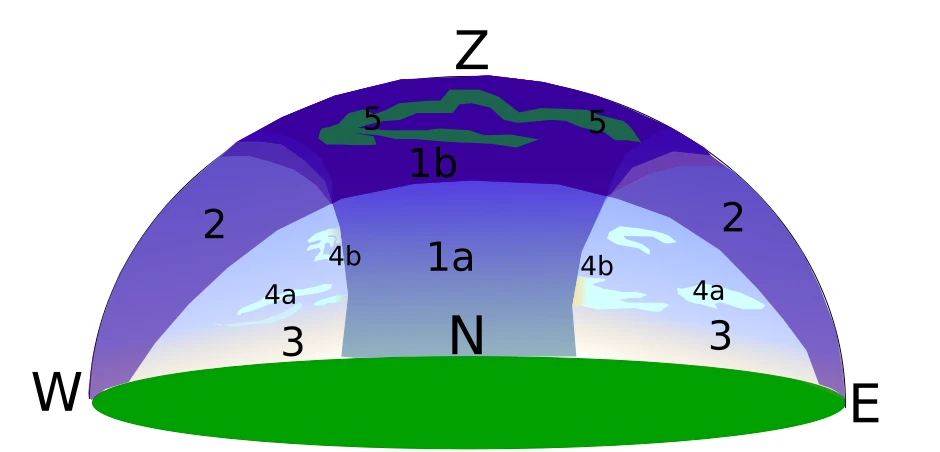
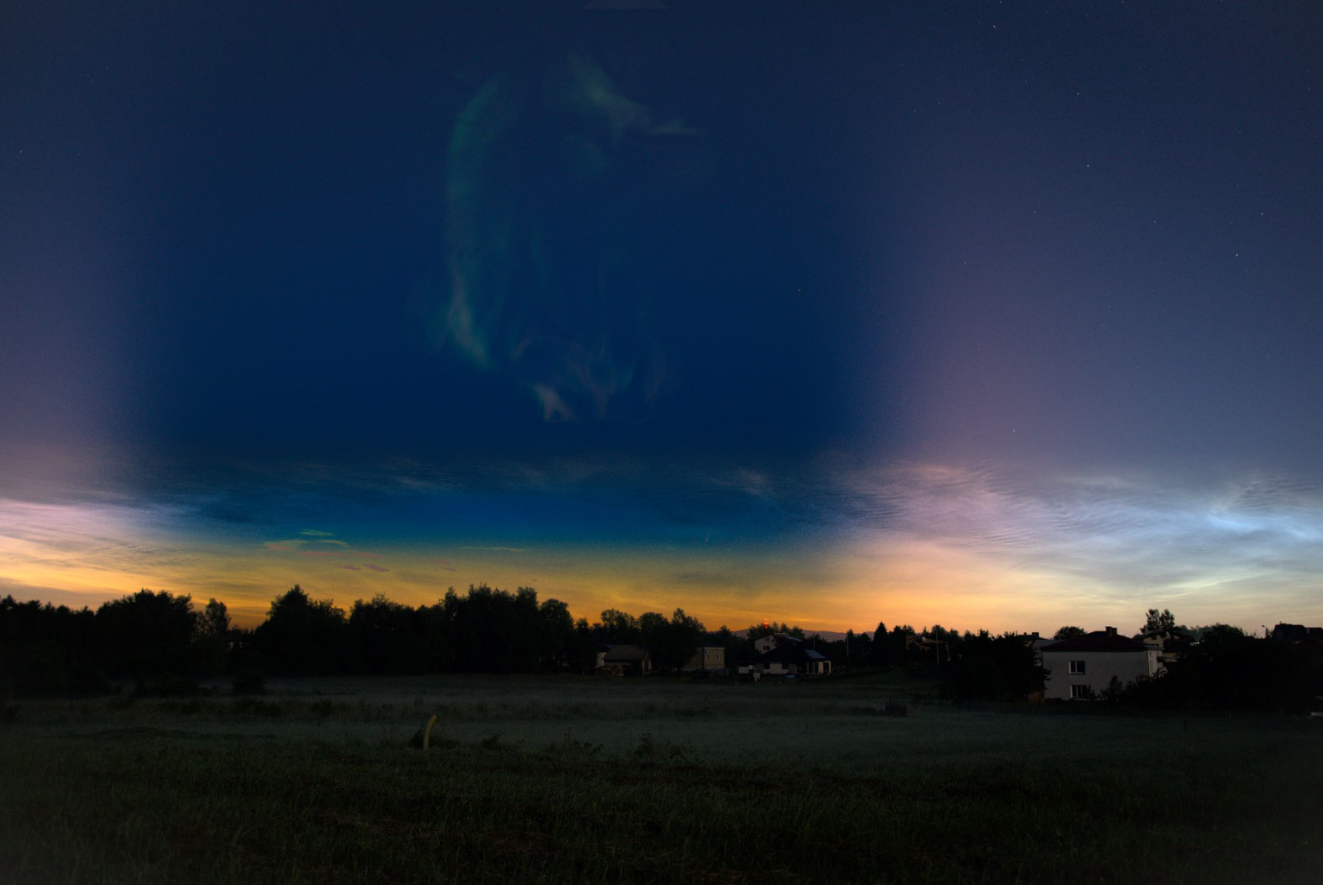
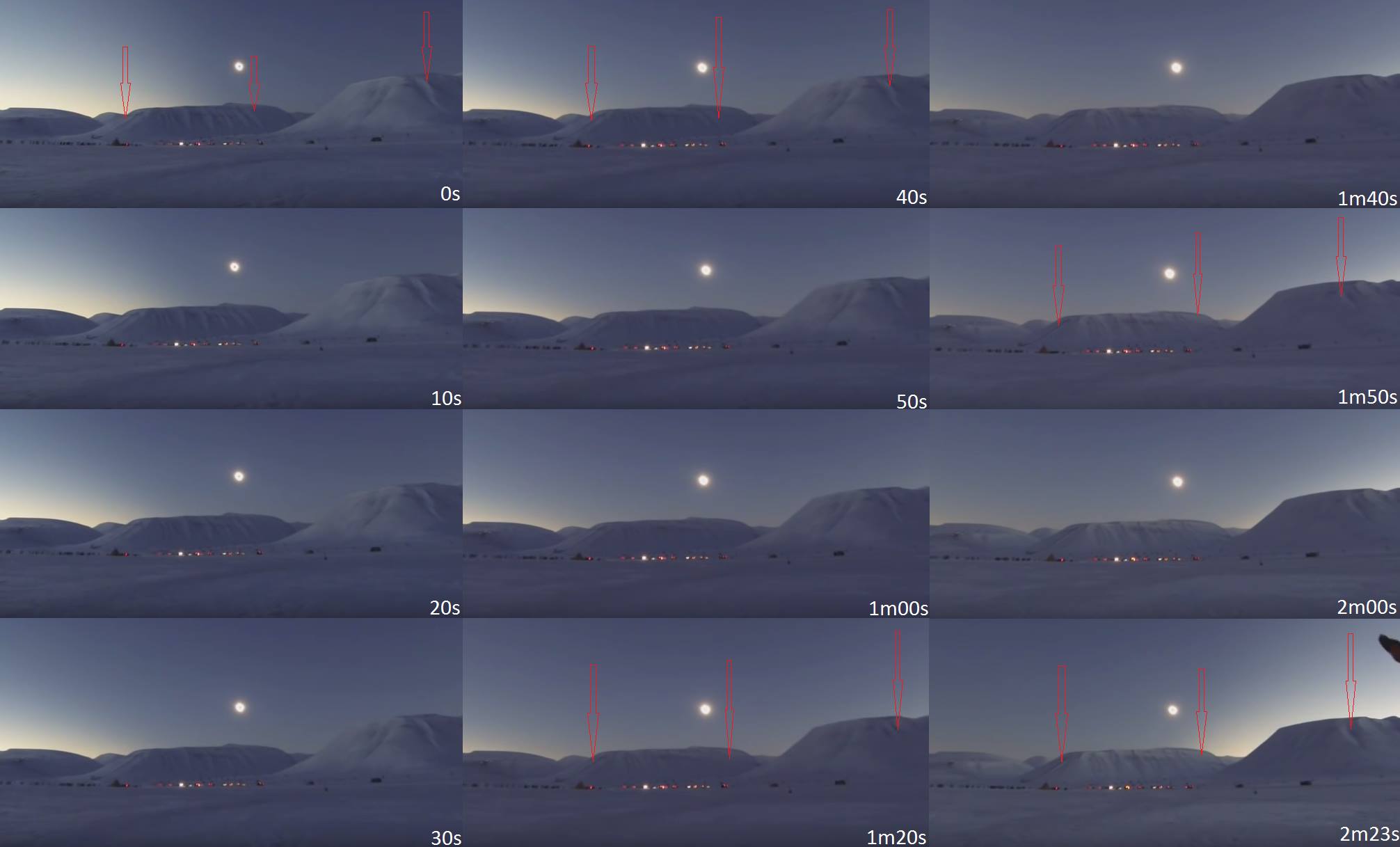
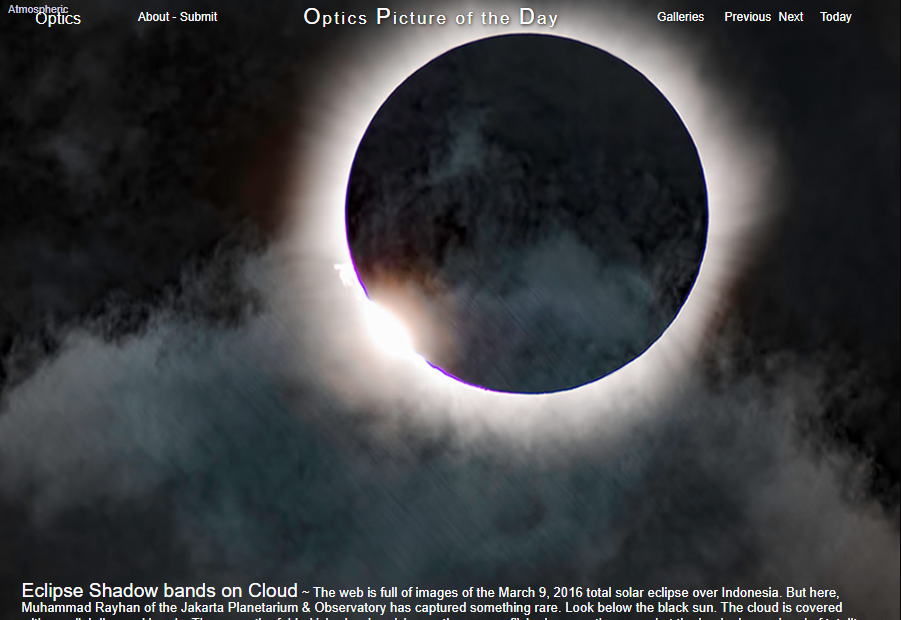
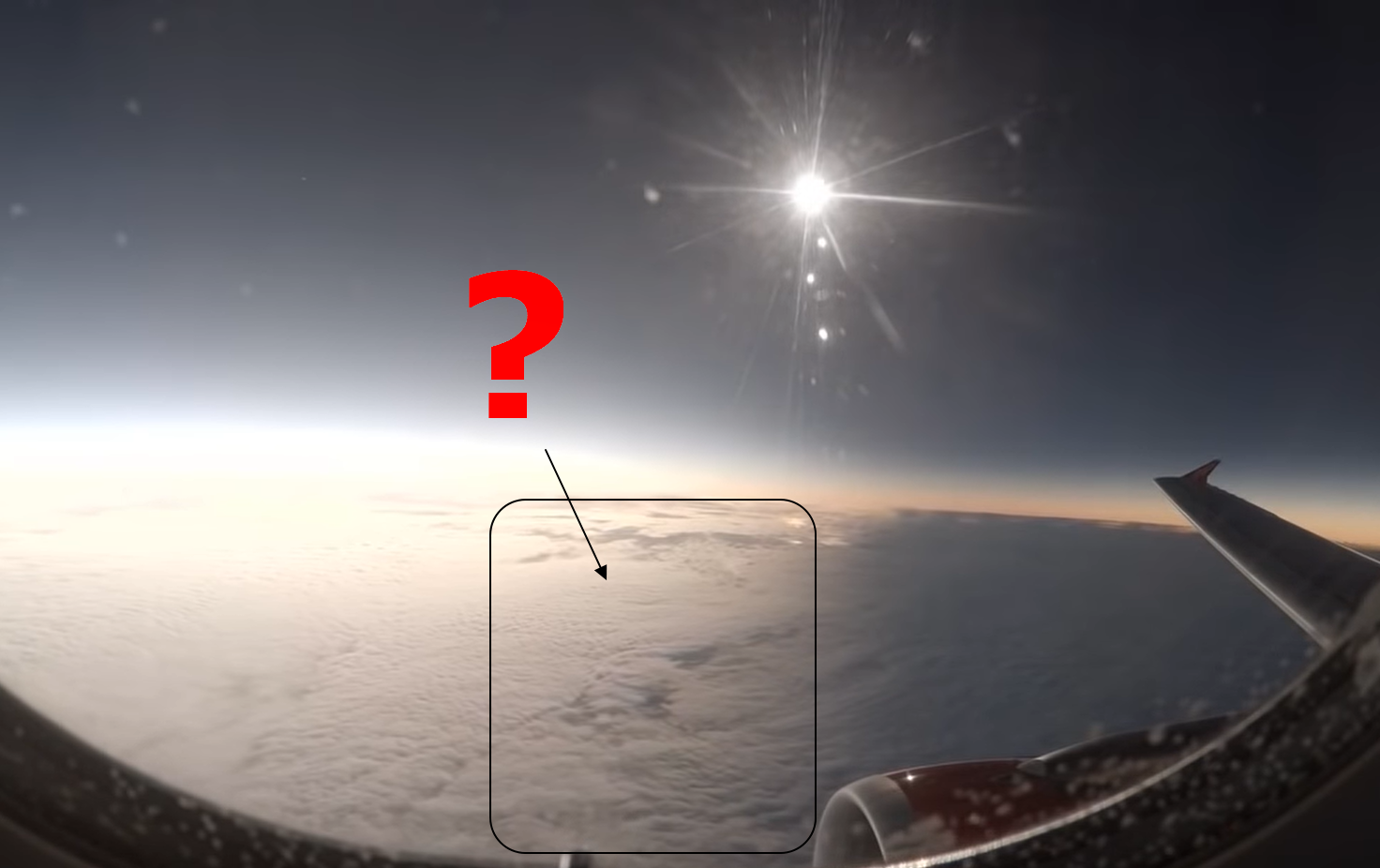
E. LARGE-SCALE SHADOW BANDS – Possible to observe over Greenland at cruising altitude. The Greenland Ice Sheet provides optimal conditions for observing shadow bands during the 2026 total solar eclipse because these faint, alternating light and dark stripes are most visible against uniform, high-albedo surfaces such as snow or ice. Shadow bands typically appear immediately before and after totality, when the Sun is reduced to a thin crescent. Before totality, they generally move in the direction of the advancing umbra; after totality, their orientation may shift relative to the eclipse track. The most widely accepted explanation attributes shadow bands to atmospheric scintillation and refractive index fluctuations in turbulent air. When sunlight from a thin solar crescent passes through layers of the atmosphere with varying temperature and density, it is refracted along slightly different paths. Constructive and destructive interference of these perturbed wavefronts produces a moving pattern of bright and dark bands on the ground. The bands tend to align approximately parallel to the solar crescent. Diffraction effects from the narrow crescent may contribute, while hypotheses involving infrasound remain less established. Because the phenomenon depends on atmospheric turbulence rather than surface structure, large, homogeneous reflective areas enhance visibility but do not generate the bands themselves. Observations have demonstrated that shadow bands can also be detected from aircraft at high altitude, where a uniform cloud deck or ice surface increases contrast. The 2026 eclipse over Greenland offers particularly favorable conditions for large-scale documentation of shadow band dynamics both at ground level and from cruising altitude.
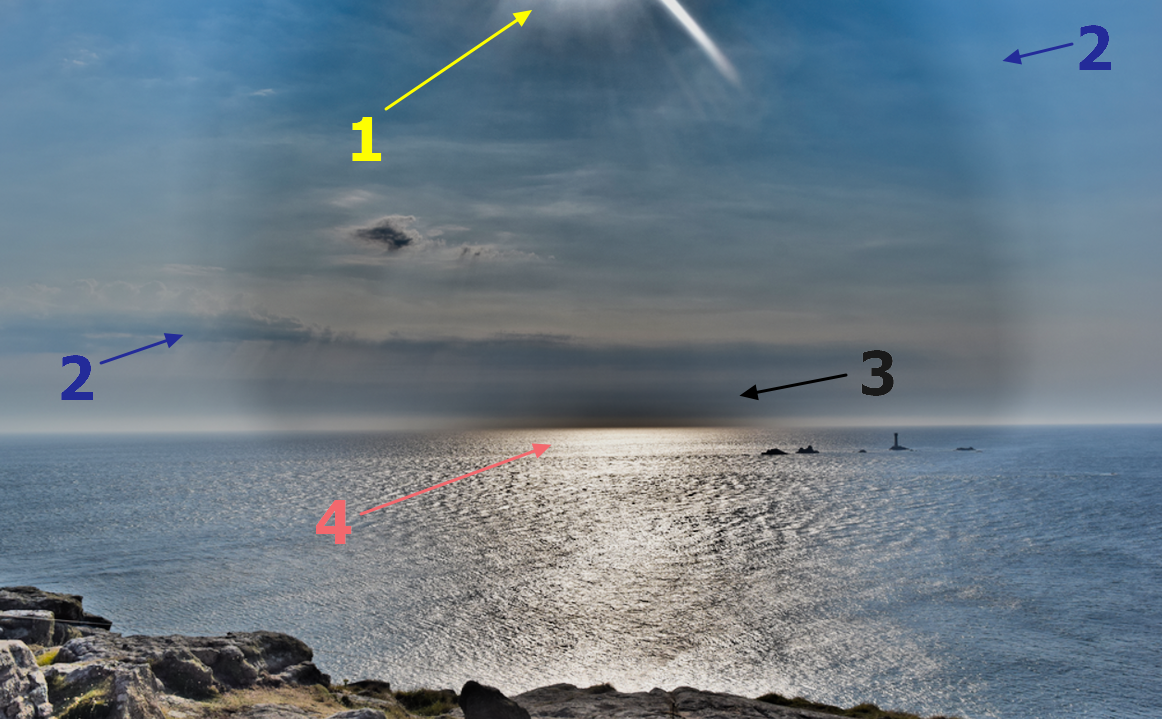
F. ENHANCED CONTRAST TRIANGLE – The typical optical phenomenon is widely described here. During the deep partial phase of the 12 August 2026 solar eclipse, southwestern Great Britain and southwestern Ireland will experience very high obscuration, reaching approximately 96% at Land’s End (Cornwall) and up to about 98% near Dursey Island off the Beara Peninsula. An even greater magnitude will occur offshore near the Skellig Islands and the Isles of Scilly. Although brightness reduction during a partial eclipse is nearly uniform across the sky, strong horizontal luminance gradients may arise due to proximity to the path of totality.
From southwestern Ireland, located roughly 230 km from the umbral path, it may be possible to observe the so-called “contrast triangle” effect over the sea. This phenomenon consists of a darker triangular sector extending upward from the horizon in the direction of the Sun, caused by reduced forward scattering and contrast between the eclipsed solar disk and the surrounding sky. Under clear conditions, the distant umbral column may also be detectable as a grey or bluish darkening of the sky beyond the triangle, similar to the shadow cone observed shortly before and after totality.
If haze or mist obscures the distant umbra, the contrast triangle may still be enhanced by the overall darkening toward the totality region. In southwestern England, approximately 420 km from the umbral path, direct observation of the umbral column is unlikely; however, a pronounced luminance gradient toward the solar azimuth may still intensify the contrast triangle effect.
Because maximum eclipse occurs in the late afternoon, low solar elevation and sea-surface reflection are expected to strengthen perceived contrast. Under favorable atmospheric conditions, the combination of high obscuration and proximity to totality could produce a visually distinct and scientifically interesting large-scale sky brightness gradient.
G. SUN’S GLITTER DISAPPEARANCE – A notable optical effect during a total solar eclipse over coastal regions is the disappearance and reappearance of the Sun’s glitter (specular reflection) on a water surface. When direct solar rays strike the sea, reflection occurs according to the law of reflection and Fresnel equations, producing a bright elongated glare aligned with the observer’s line of sight.
As totality approaches and the lunar umbra intercepts direct sunlight, the solar glitter shortens rapidly and vanishes as the illuminated sea surface enters shadow. If the observer is sufficiently elevated above sea level, the progression of the umbral boundary across the water can be clearly perceived. During totality, a much fainter glitter may persist due to the reflection of coronal light, whose integrated brightness is comparable to that of the full Moon. After totality, direct solar illumination reappears beyond the retreating umbra, and the bright solar glitter rapidly expands toward the observer.
Low solar elevation enhances this phenomenon because reflection dominates over subsurface scattering at shallow incidence angles. Observer altitude is also critical: a higher vantage point increases the visible extent of the sea surface and lengthens the observable transition as the shadow advances and recedes. For the 12 August 2026 eclipse, elevated coastal locations in Spain provide optimal conditions. Suitable sites include high cliffs in Galicia and mountain summits overlooking the Mediterranean in Mallorca, where totality of approximately 1 minute 40 seconds will coincide with extensive sea horizons. These locations offer favorable geometry for detailed observation of umbral motion and specular reflection dynamics.
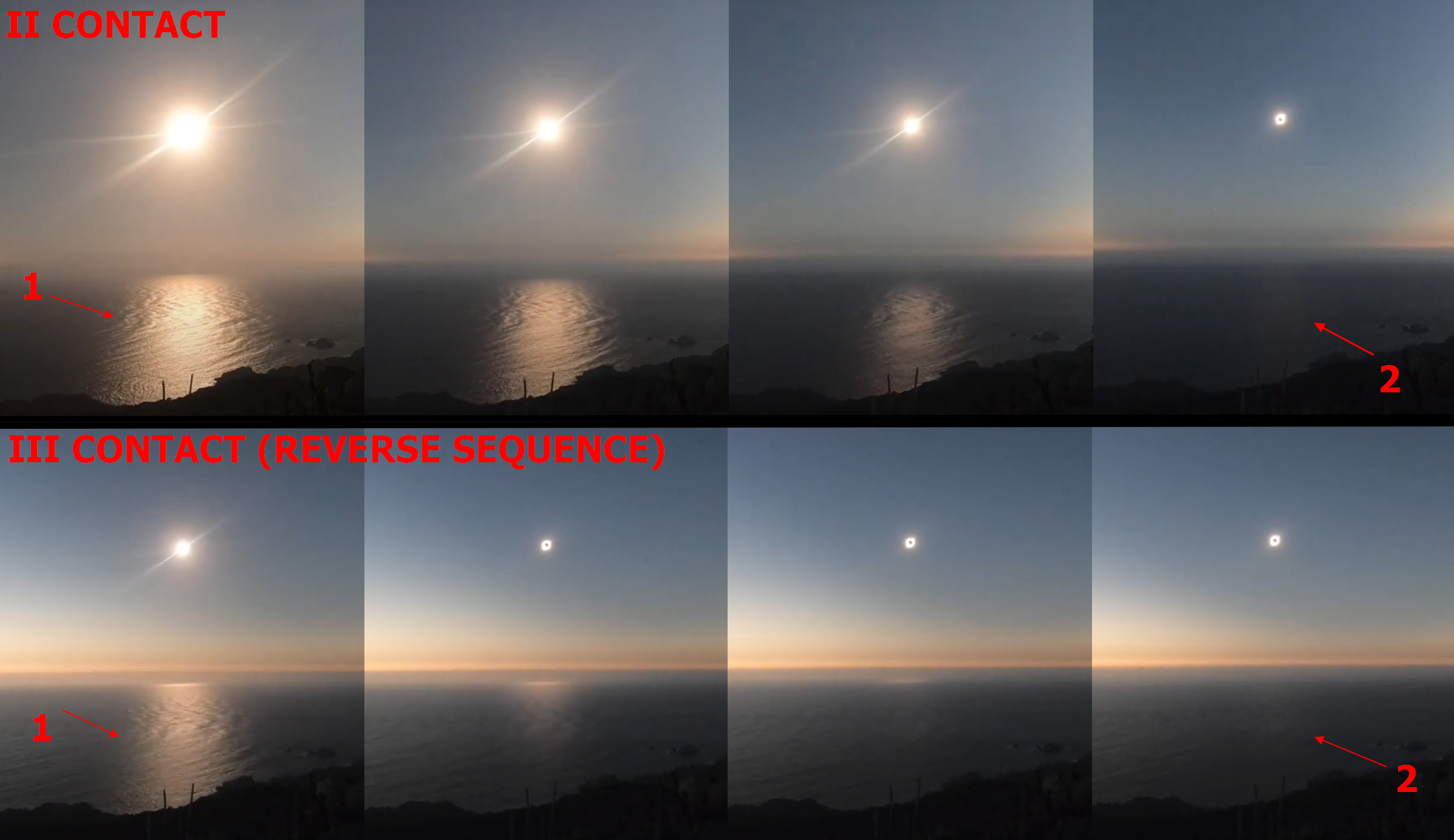
We observe phenomena like this mostly when the Sun is low enough above the horizon, when most of the light is reflected from the water body rather than diffracted within the medium (Fresnel equation). Moreover, the elevated position offers an opportunity to observe how this glitter casts an umbra and, conversely, how the umbra casts a shadow on it at the end of the eclipse (Youtube.com). Click to enlarge.
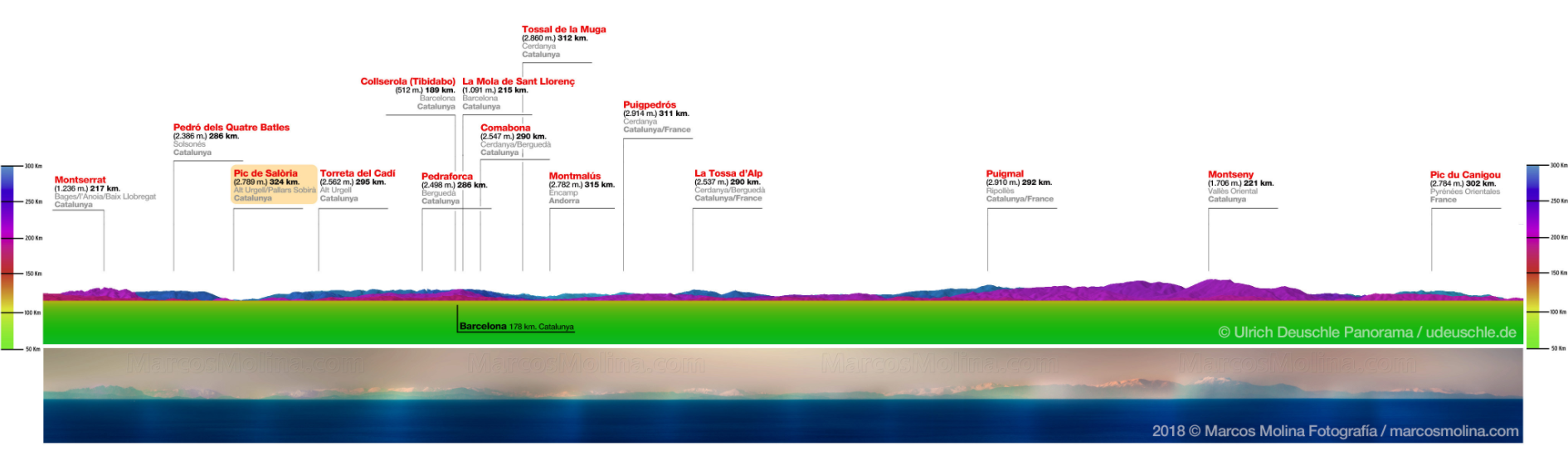
H. EXTENDED LIMIT OF HORIZONTAL VISIBILITY – An exceptionally long-distance terrestrial observation was recorded from Puig d’en Galileu in the Sierra de Tramuntana, rising above the Lluc Sanctuary, toward Pic de Salòria in the Pyrenees. The line-of-sight distance of approximately 324 km represents one of the longest documented observations within a single country.
Such extreme horizontal visibility results primarily from favorable atmospheric optical conditions. A substantial reduction in Rayleigh scattering by air molecules and Mie scattering by aerosols decreases attenuation along the optical path, allowing more reflected light from distant terrain to reach the observer. Additionally, under specific illumination geometries such as a solar eclipse, contrast may increase between shaded terrain and the brighter sky beyond the Earth’s shadow. In this particular case, only the reduction in atmospheric scattering is fully applicable, as the Pyrenees would not simultaneously experience totality. Nevertheless, transient decreases in atmospheric turbidity can significantly enhance long-range visibility and facilitate similar observations.
Comparable extreme-distance sightings have been reported between the Sulcis Mountains in Sardinia and the Tell Atlas, specifically Kef Seba (1025 m a.s.l.) near Annaba, at distances of approximately 260–270 km.
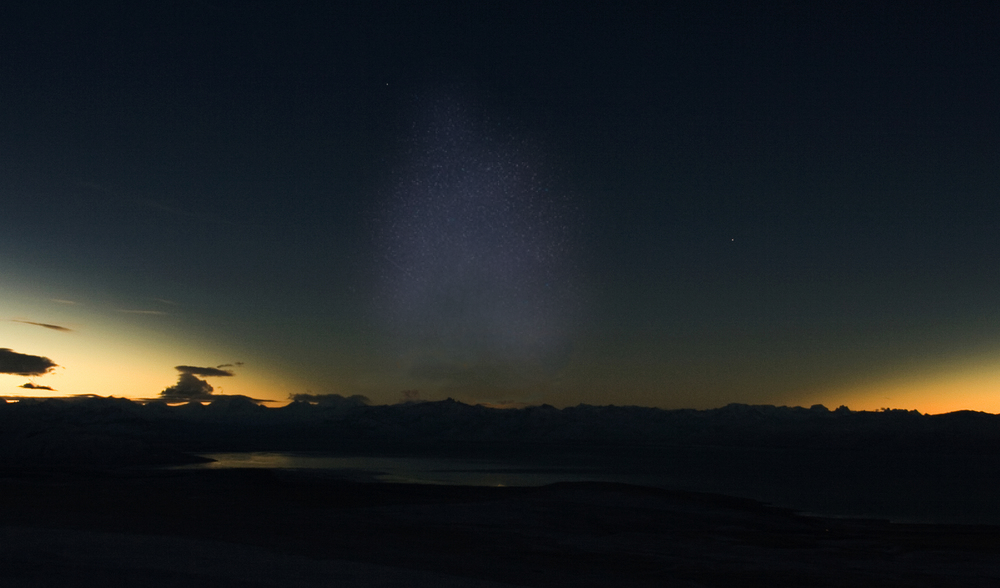
I. ZODIACAL LIGHT – A total solar eclipse occurring with the Sun below the horizon may enhance the detectability of zodiacal light by temporarily reducing sky surface brightness. This possibility was previously proposed for 30 June 1992 (Guliaev, 1992), but without observational confirmation. A comparable configuration will occur on 12 August 2026 across parts of the Mediterranean region, including southern Europe and North Africa, where totality will coincide with sunset or occur just below the horizon. Zodiacal light is produced by the forward scattering of sunlight by interplanetary dust concentrated within the inner Solar System. These particles, typically tens to hundreds of micrometers in size, originate from primordial debris as well as cometary activity and asteroid collisions. The dust density increases toward the Sun and extends beyond the orbit of Mars. When particle sizes fall below ~10 μm, radiation pressure efficiently removes them from the inner Solar System. Observationally, zodiacal light appears as a diffuse conical glow aligned with the ecliptic and is most prominent near the Sun. Its surface brightness near 30° elongation is on the order of 10⁻³ cd m⁻² (~0.005 lux), comparable to or exceeding that of the Milky Way under dark-sky conditions. Maximum visibility occurs near the equinoxes, when the ecliptic forms a steep angle with the horizon (after dusk in spring, before dawn in autumn in the Northern Hemisphere). During the August 2026 eclipse, the ecliptic will lie relatively shallow to the horizon; however, low latitudes may partially compensate for this geometry. Because atmospheric scattering normally obscures the innermost zodiacal light (the F-corona region), any eclipse-induced reduction in atmospheric illumination could improve contrast between the dust-scattered light and the background sky. Although the 2026 configuration is not optimal, the combination of sunset geometry and eclipse-related sky darkening may allow detection of the brighter inner zodiacal cone from selected Mediterranean sites, including parts of Italy, Malta, Greece, Tunisia, and Algeria.

9. ANTITWILIGHT SKY PROJECTIONS
The very late part of the day, when totality will occur east of the Spanish mainland, will affect the antitwilight sky immediately after the eclipse’s greatest phase. The sky at antisolar direction is rich with many optical phenomena around sunset and at the early stage of civil twilight. We shall consider the position of the Sun under major moments presented in the simulations below (Pic. 50).
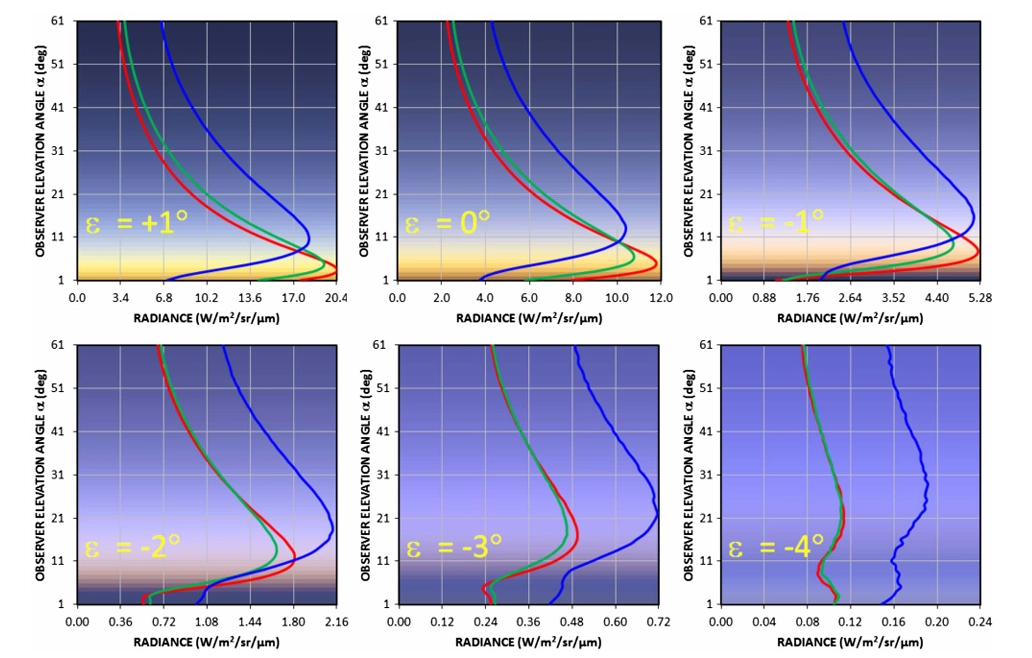
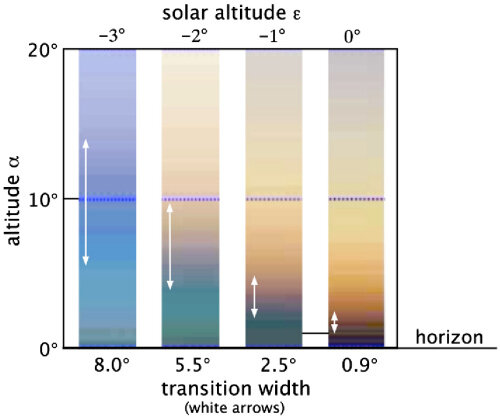
The dynamics of the colour band are significant, resulting in changes in atmospheric illumination around the elevated terminator zone. The position of the Belt of Venus changes rapidly as solar depression increases, thereby changing the visibility of antitwilight features. The solar depression is inversely proportional to the vertical transition width between the Belt of Venus and the Blue Band, which is the sky shadowed by Earth (Pic. 51).
The position of the Sun determines what an observer can precisely see on the antisolar side of the sky within civil twilight. The map below shows the estimated locations of the optical phenomena in the antitwilight sky at various solar positions (Pic. 52).
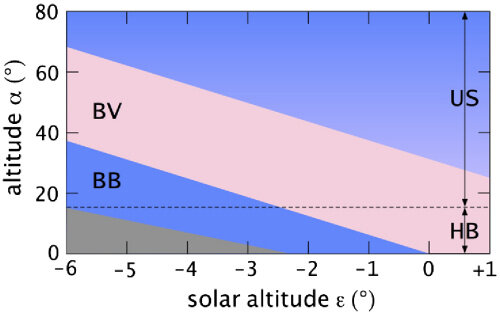
Although, in my opinion, this map requires redefinition, as the Belt of Venus at solar depression of 6° should be located much closer to the zenith. The shape of antitwilight features should look more parabolic instead of linear, because as solar depression increases, they move closer to zenith, and therefore, an observer. This is, anyway, a subject of future investigation.
The dynamics of coloration during civil twilight raise the question of how their distribution would appear under a solar eclipse in any obscuration.
Any hint can be found in the limb darkening effect (Koepke, 2001), which is an inherent part of a solar eclipse. The obscuration of the solar disk by the Moon changes the distribution of the light colour band, which comes to the Earth’s atmosphere. This article explains it well.
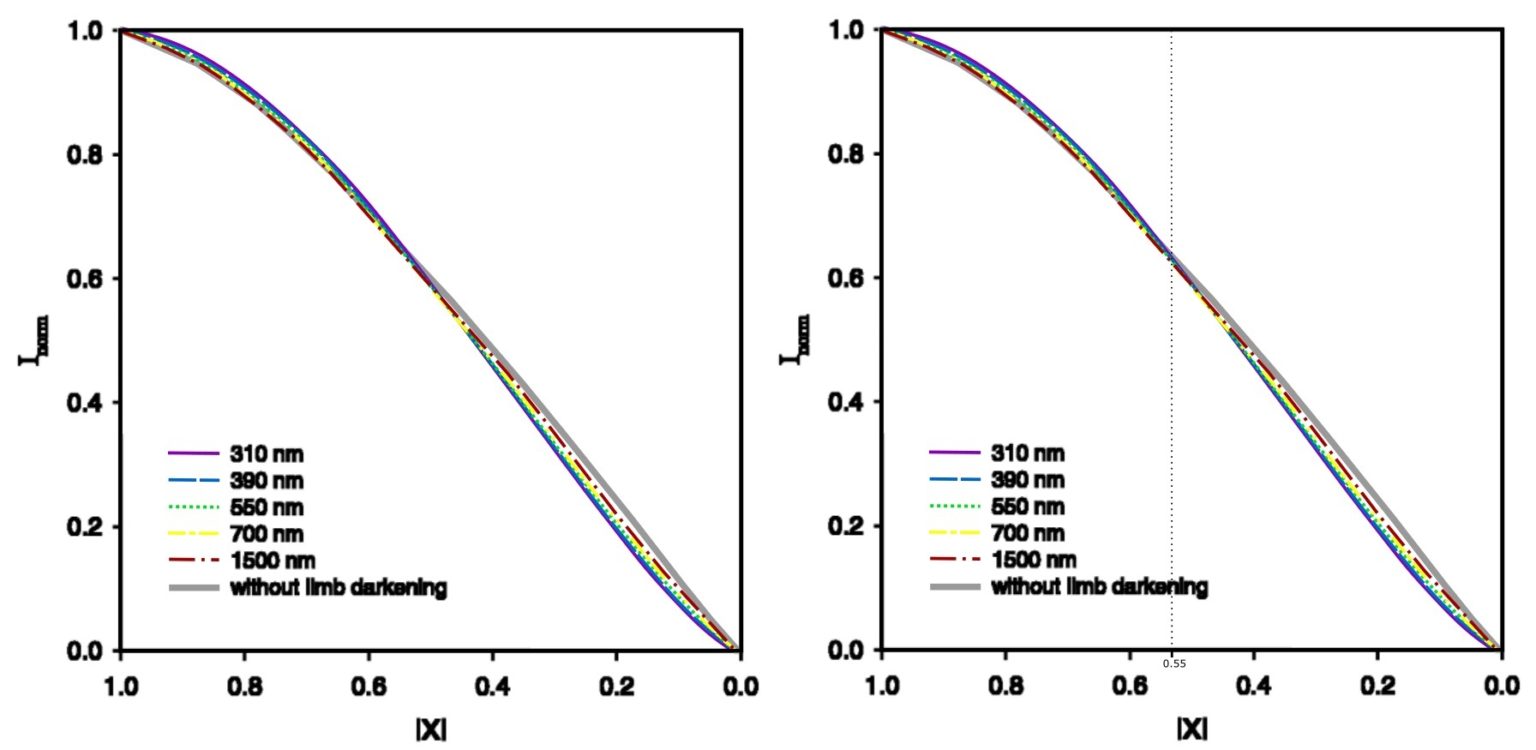
The effect of limb darkening is nullified at an approximate eclipse magnitude of 0.55. When the magnitude is low, the effect is negative and results in a pronounced bluish coloration of the sky. When the eclipse magnitude exceeds 0.55, the reddish tinge comes up as a result of the positive limb darkening effect. It keeps increasing until the eclipse reaches totality.
Now, let’s consider the following circumstances (Pic. 50) with respect to the influence of a solar eclipse. In practice, the Spanish mainland won’t experience significant changes in the appearance of the antitwilight sky as the partial solar eclipse approaches its end.
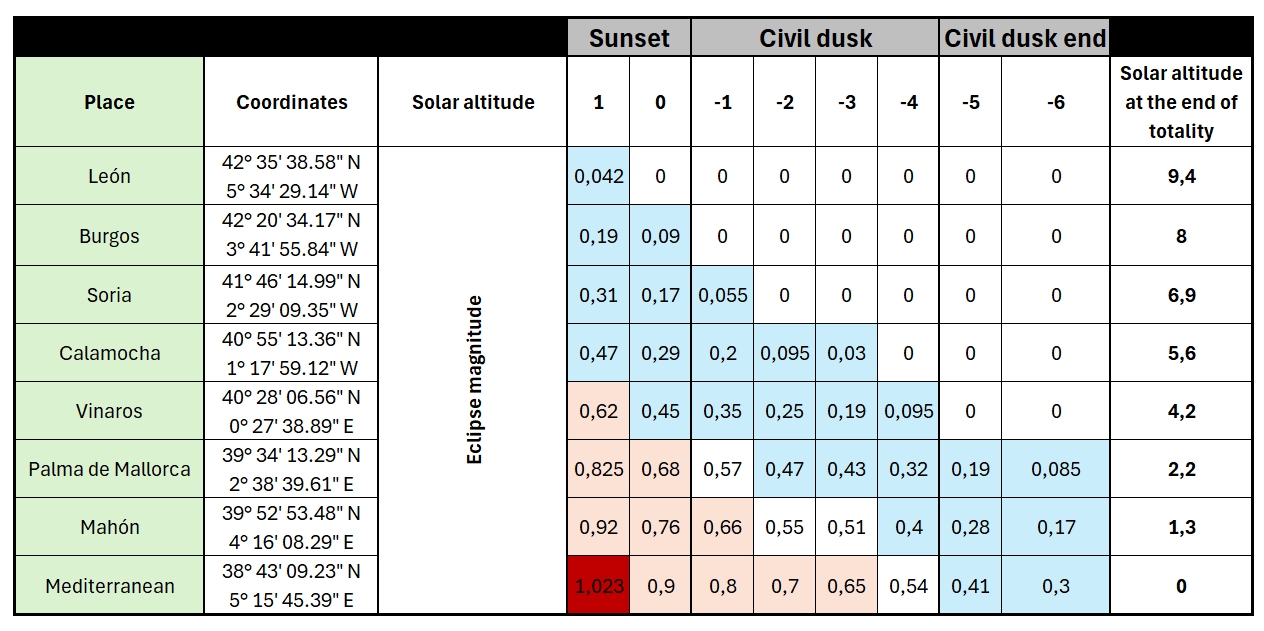
Considering the moment after sunset, when the Belt of Venus becomes visible, the best and most significant influence of the limb darkening effect will be observed at Menorca and the Mediterranean Sea east of the Balearic Islands. It doesn’t change the fact that people in other locations won’t notice anything. The eastern coast of Spain, where the estimated eclipse magnitude is expected to be about 0,29 at sunset, might be able to notice that the antitwilight sky is not as reddish as usual. However, the key factor here will be the weather, precisely the aerosol optical thickness, level of humidity and degree of atmospheric clarity. The observation such as this requires the comparison of a day before or a day after the eclipse event at the same time.
Unfortunately, Stellarium ShowMySky doesn’t support this kind of observation in its full visibility, as a user can see only a small difference in light level and only a thin shift towards red.
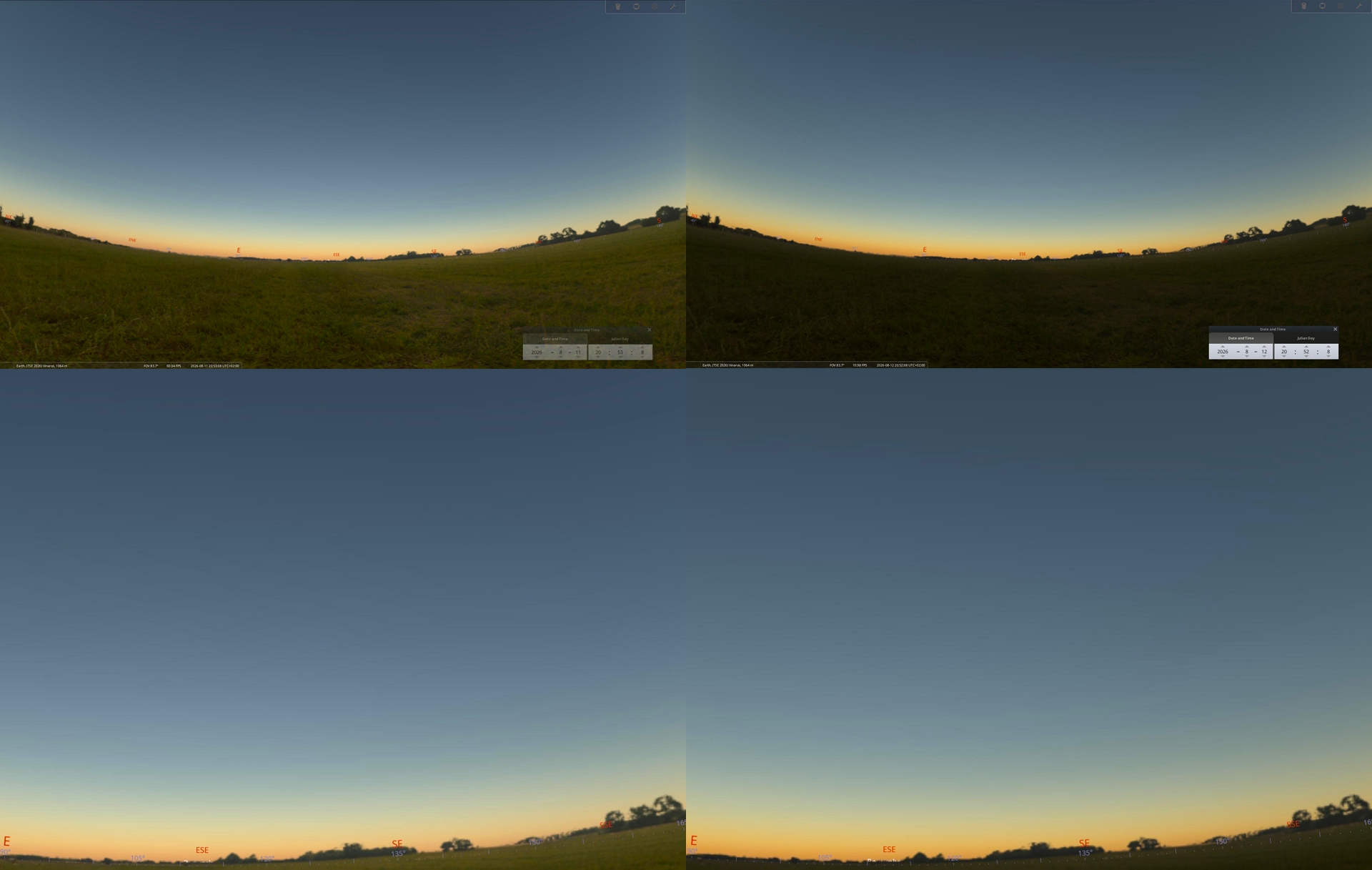
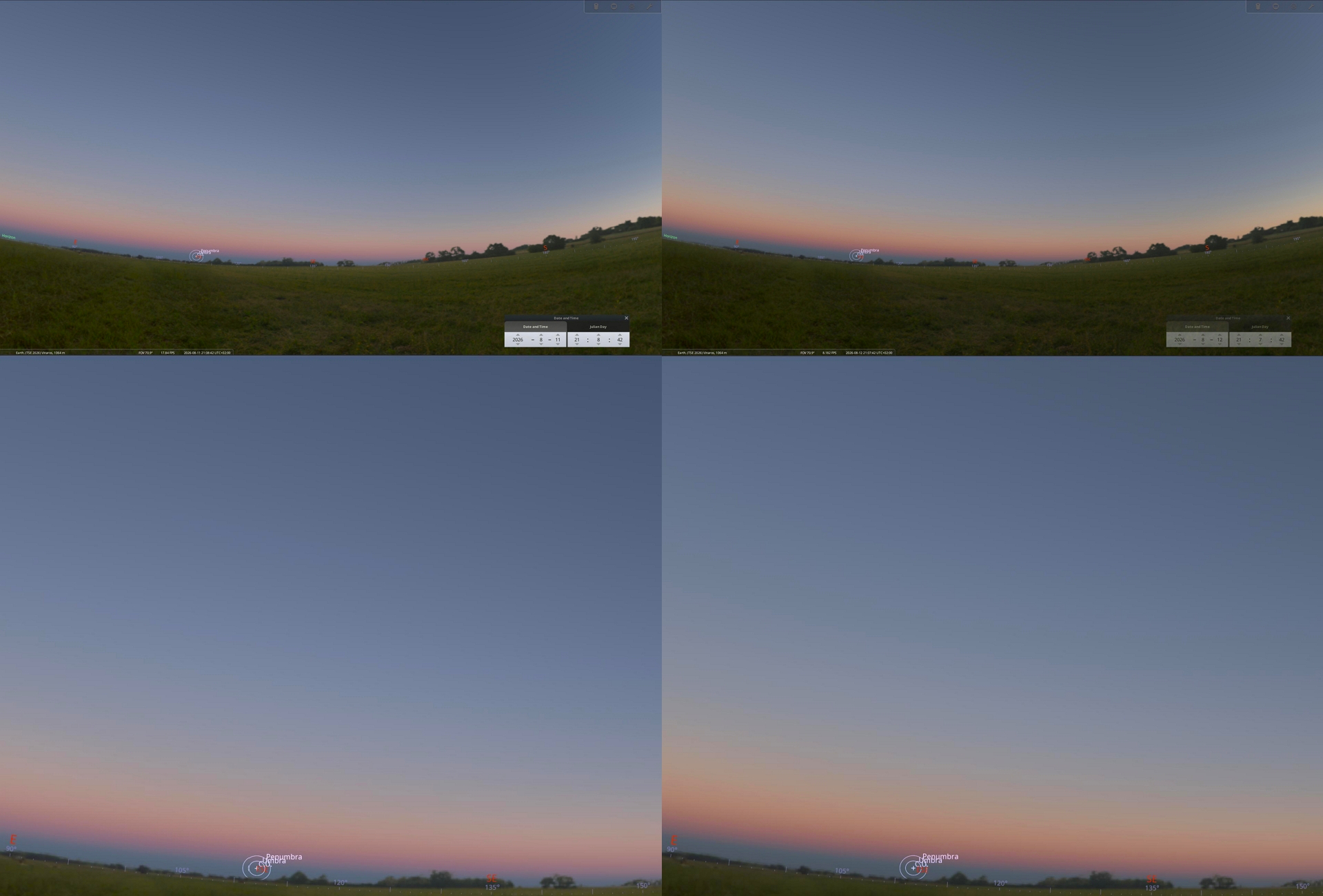
Taking into account the eastern coast of Spanish mainland, where the eclipse obscuration at solar altitude of 1° above and 1° below the horizon will be 52% and 19% respectively an observer should expect slightly redder (Pic. 56) and slightly bluer (Pic. 57) sky scene because of various influence of limb darkening effect as preesented in the table above (Tab. 5). In the other hand, at Menorca, located closely to the geometrical eclipse limit, the influence of limb darkening will be positive only, which however decreases as the Sun goes more down beneath the horizon due to eclipse obscuration of 90% and 58% at solar altitudes of 1° above and 1° below the horizon respectively.
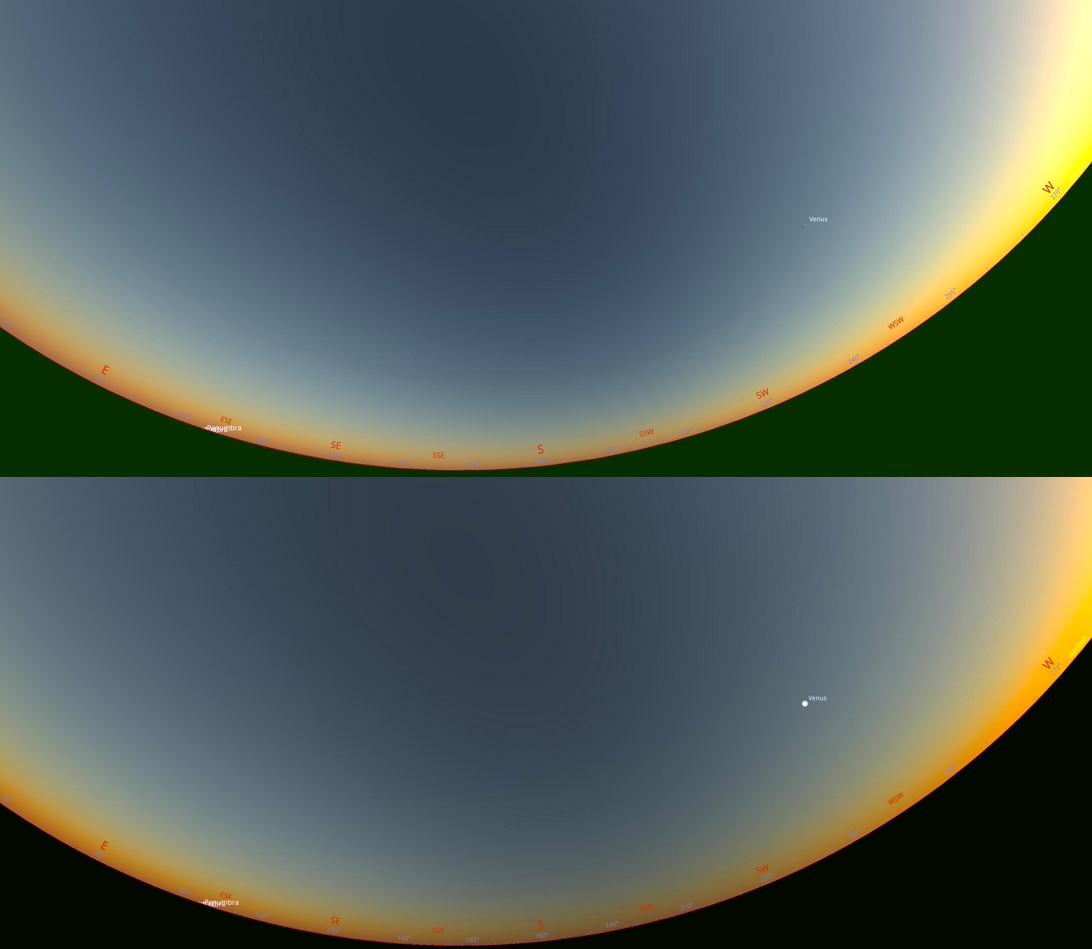
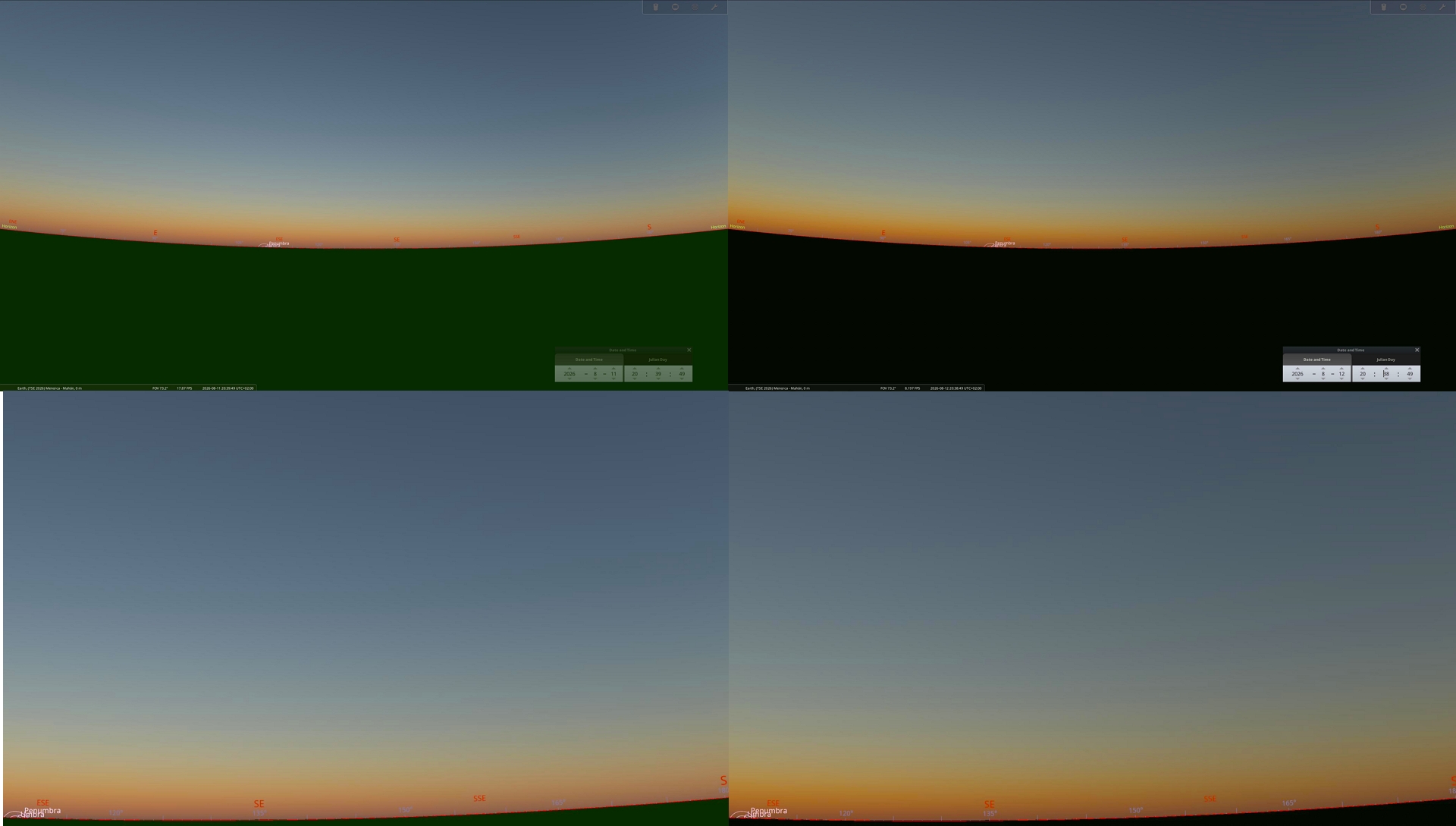
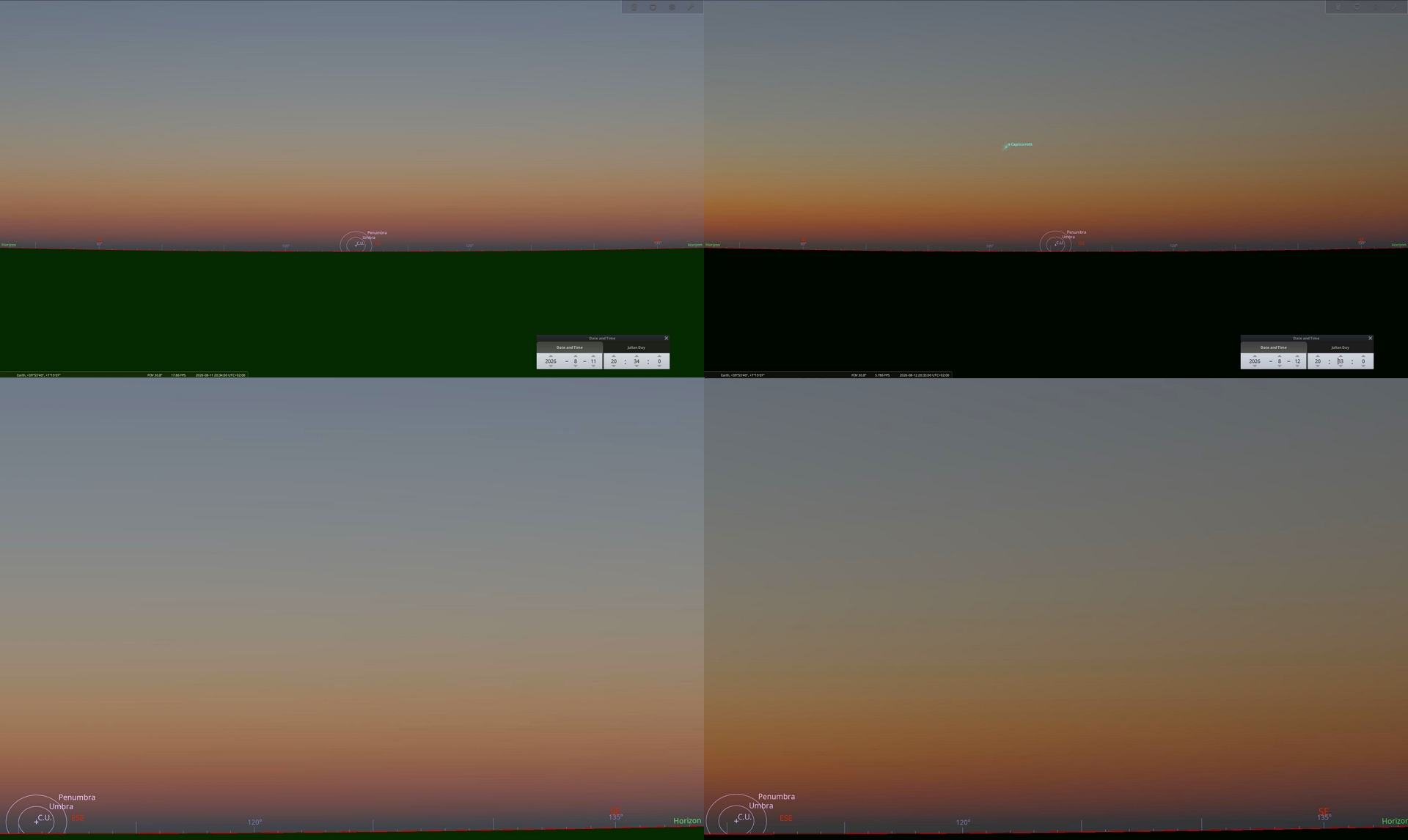
The most effective solar eclipse influence is to be observed on Mahón – the capital of Menorca, lying in the vicinity of the geometrical end of 2026 totality. The observer should expect an interesting combination of long wavelengths scattered in the twilight atmosphere, combined with the limb darkening effect produced by the partial phase of the eclipse. The dynamics of the antitwilight arch during typical twilight are typically large (Fig. 50, 51), especially in the evening, when the air tends to contain more haze particles. As the decreasing magnitude of the partial solar eclipse comes into effect, we shall expect that this dynamic will be boosted, and it’s worth reporting against the existing normal twilight observations.
There are rare situations in which many people flock near the geometrical end of the eclipse path. It’s vital to inform observers that immediately after totality, they can turn their heads in the opposite direction, switch to wide-angle recording, and capture these phenomena from multiple locations.
10. SUNSET CIRCUMSTANCES
A rare observational phenomenon occurs when the Sun sets not as a full disk, but as a thin crescent due to significant partial obscuration during a solar eclipse. The solar eclipse of 12 August 2026 will produce such conditions across much of Europe, where the magnitude of obscuration will exceed 80% in many regions.
Importantly, the time of greatest eclipse will coincide with late afternoon or sunset for a large portion of the continent. As a result, the solar disk will already be substantially covered by the Moon as it approaches the local horizon. In some locations, the maximum eclipse will occur shortly before sunset, while in others it will take place just after the Sun has set.
Under favorable atmospheric conditions—particularly in regions with elevated or mountainous western horizons—the partially eclipsed Sun may appear as a narrow crescent descending behind distant terrain features. The combination of high obscuration, low solar altitude, and atmospheric extinction near the horizon is expected to produce unusual visual effects, potentially making this one of the most remarkable sunset phenomena observable in Europe in recent decades. The image below illustrates several examples of the August 12, 2026, partially eclipsed sunset (Pic. 75)
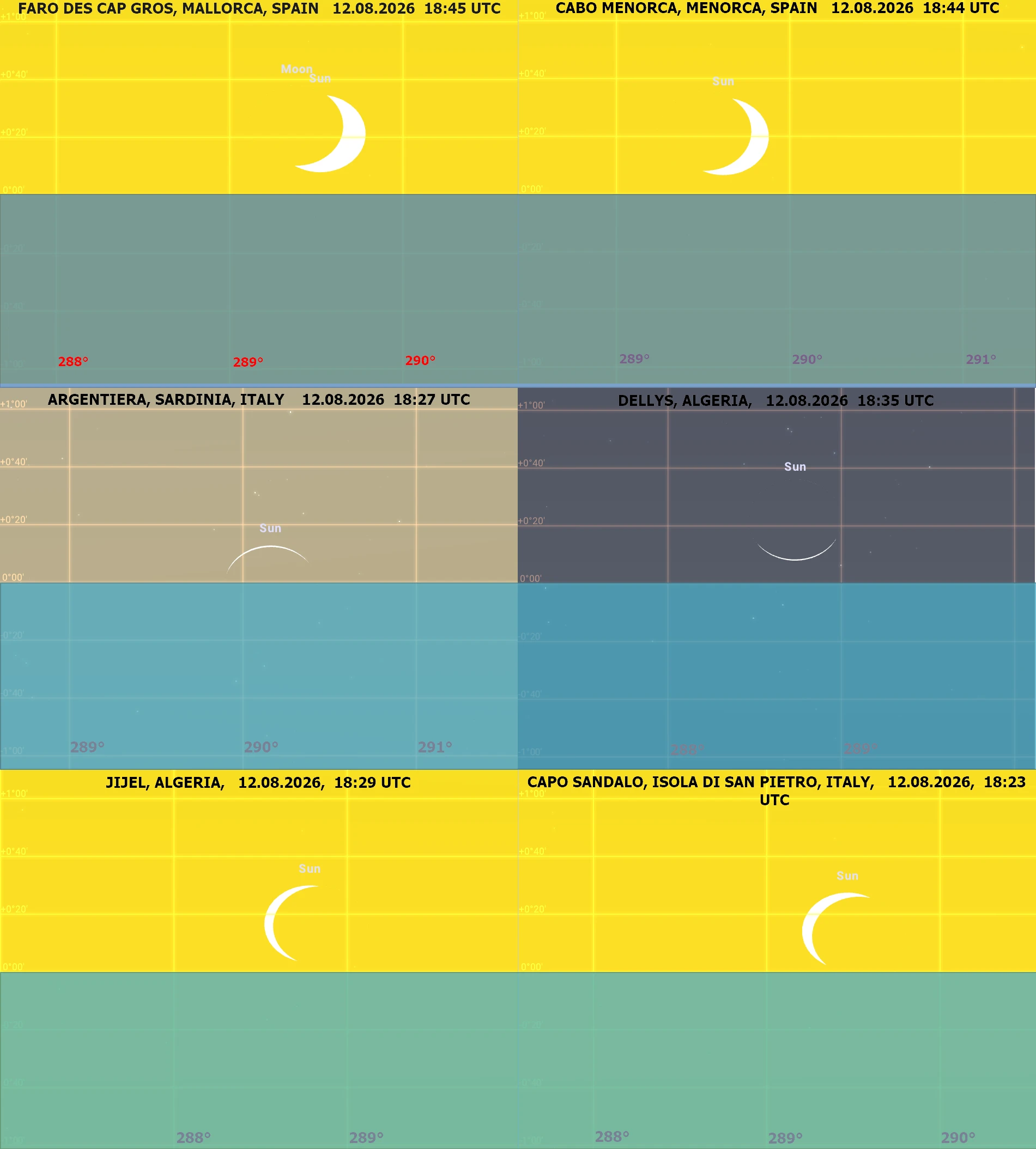
Amidst a number of potential places to watch the eclipsed sunset, there are two elongated regions (or zones) that require special attention. Due to the eclipse geometry and difference between the horizontal and celestial coordinates (Pic. 76), the Sun’s crescent can appear as an arc or represent the devil’s horns as known from deep partial eclipses.
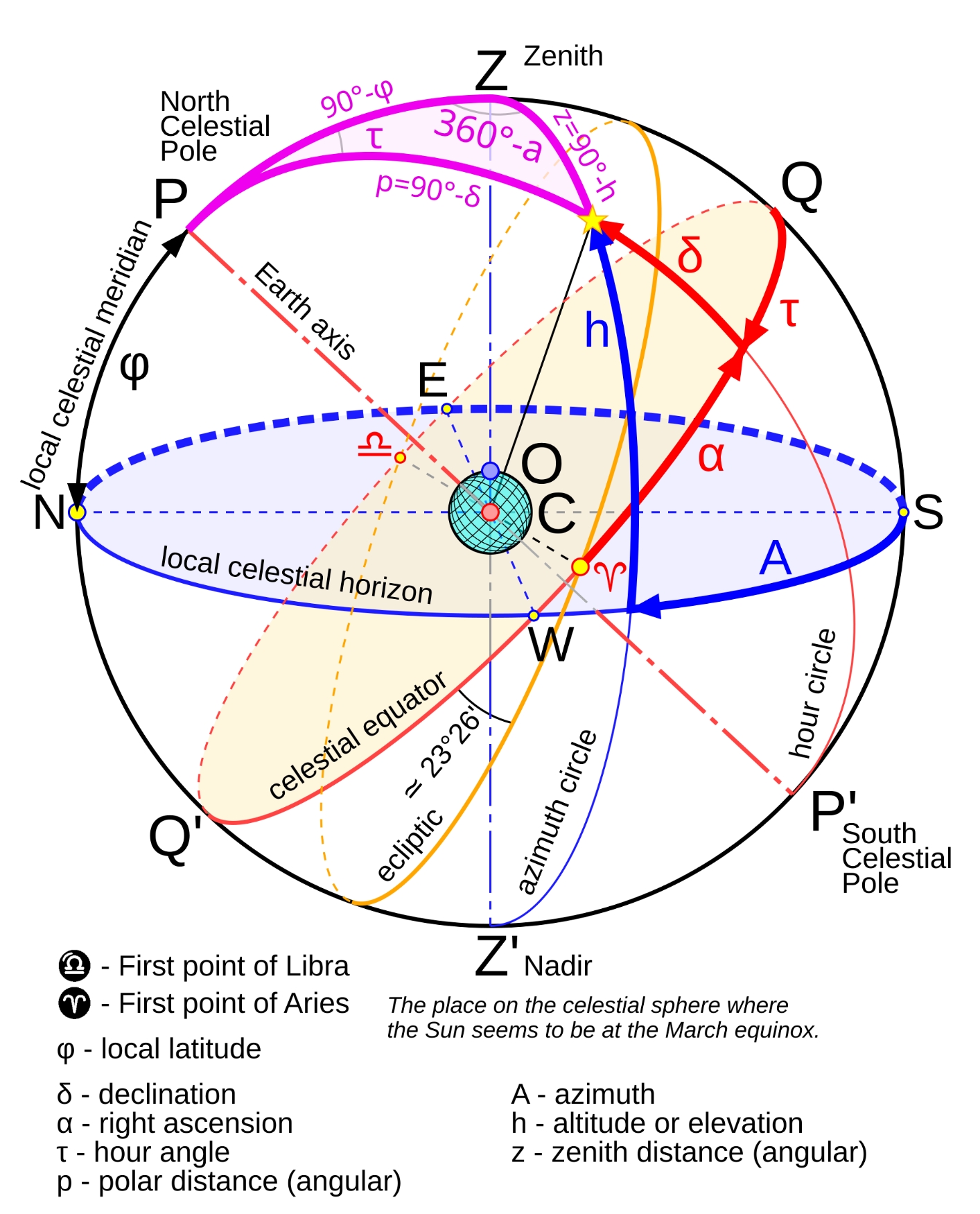
Because of the middle latitudes, celestial bodies rise and set diagonally, as shown in the pattern below (Pic. 76).
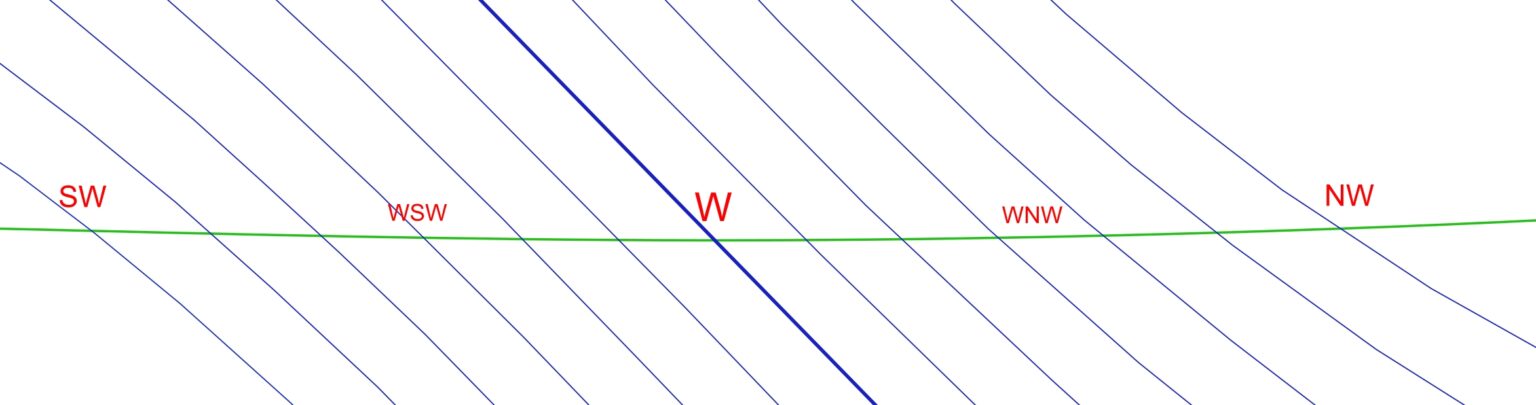
The same as the Sun and Moon do. As they aren’t perfectly aligned, the solar crescent is visible, but its position against the horizon depends strongly on the small circles illustrated above.
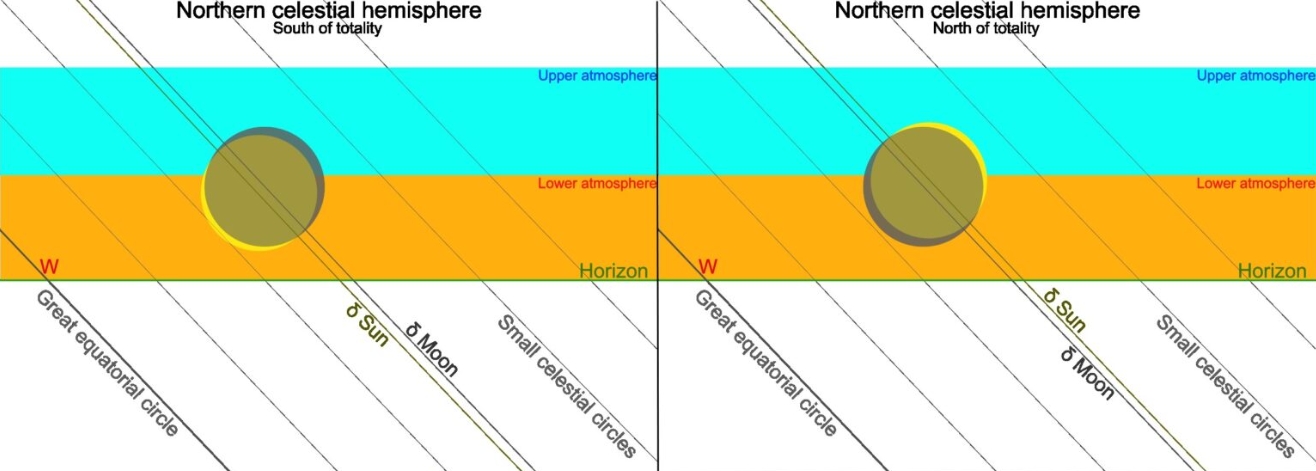
The illustrations, in fact, present the moments of the eclipse culmination, but because the Moon moves across the solar disk, the position of the solar crescent changes. The locations north of the totality path, at the specific moment before the eclipse culmination, will « produce » the arc-like sunset when the solar crescent has both horns down. Conversely, at all the locations south of the path, the solar crescent will have the opposite position, causing the « devil’s horns » appearance shortly before the greatest eclipse. In Europe, the « Sunset arc » is quite feasible. The most effective view is from south Sardinia, where the setting Sun will appear as a thin ring (Pic. 76).
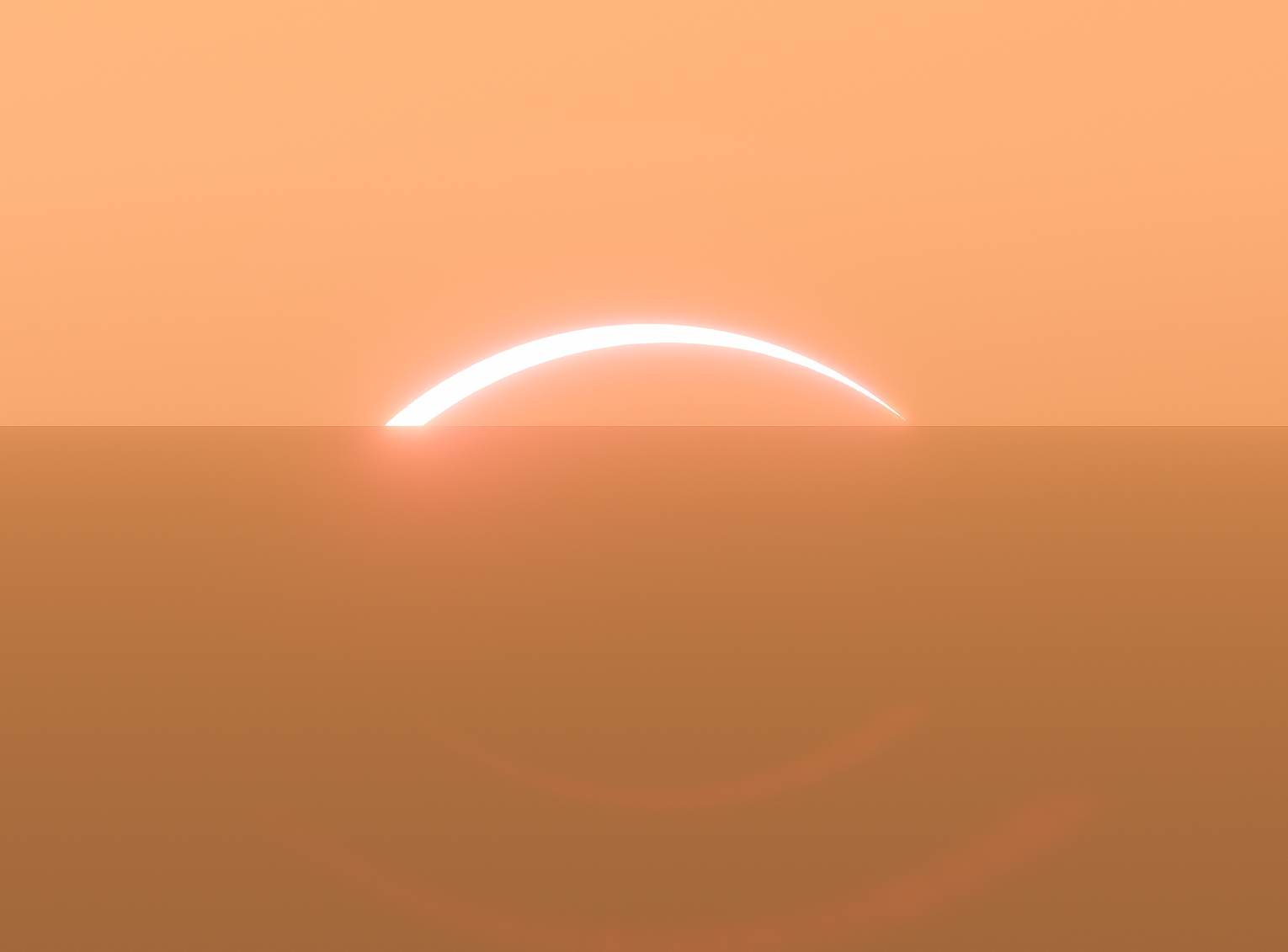
We need to know that Sardinia is not the only place where an observer can watch the sunset like this. The August 12, 2026, solar eclipse sunset map clearly shows the zone where the « Sunset arc » is possible across the entire continent!
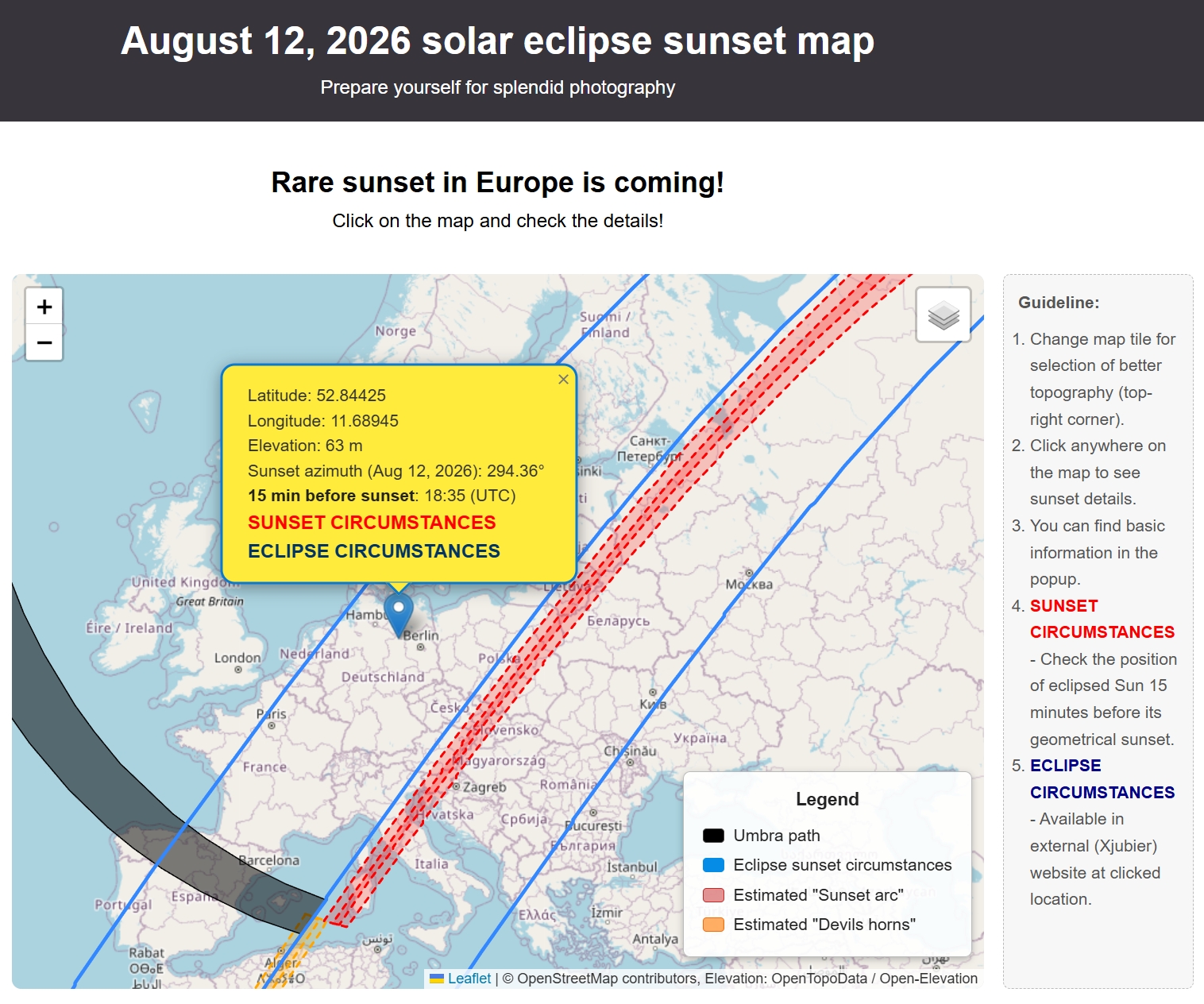
The website opens the Peakfinder.com panorama generator directly at the clicked location, indicating the sunset azimuth. The eclipsed Sun is visible above the horizon, as projected 15 minutes before its set. The second link directly indicates Xavier Jubier’s 2026 eclipse page, precisely at the clicked location. Everyone can check what the August 12 sunset will look like from their home location and plan the observation.
11. SKY VIEW
The eclipse path extends from the polar regions to the Mediterranean, resulting in a very different view of the sky during the eclipse. The animation below shows the difference over Greenland between latitudes 83 and 65 north at the centerline, with the approximate eclipse path oriented from north to south.
Next, you will find the pioneer project for the entire 2026 total solar eclipse path, which shows how the Sun’s position changes from beginning to end.
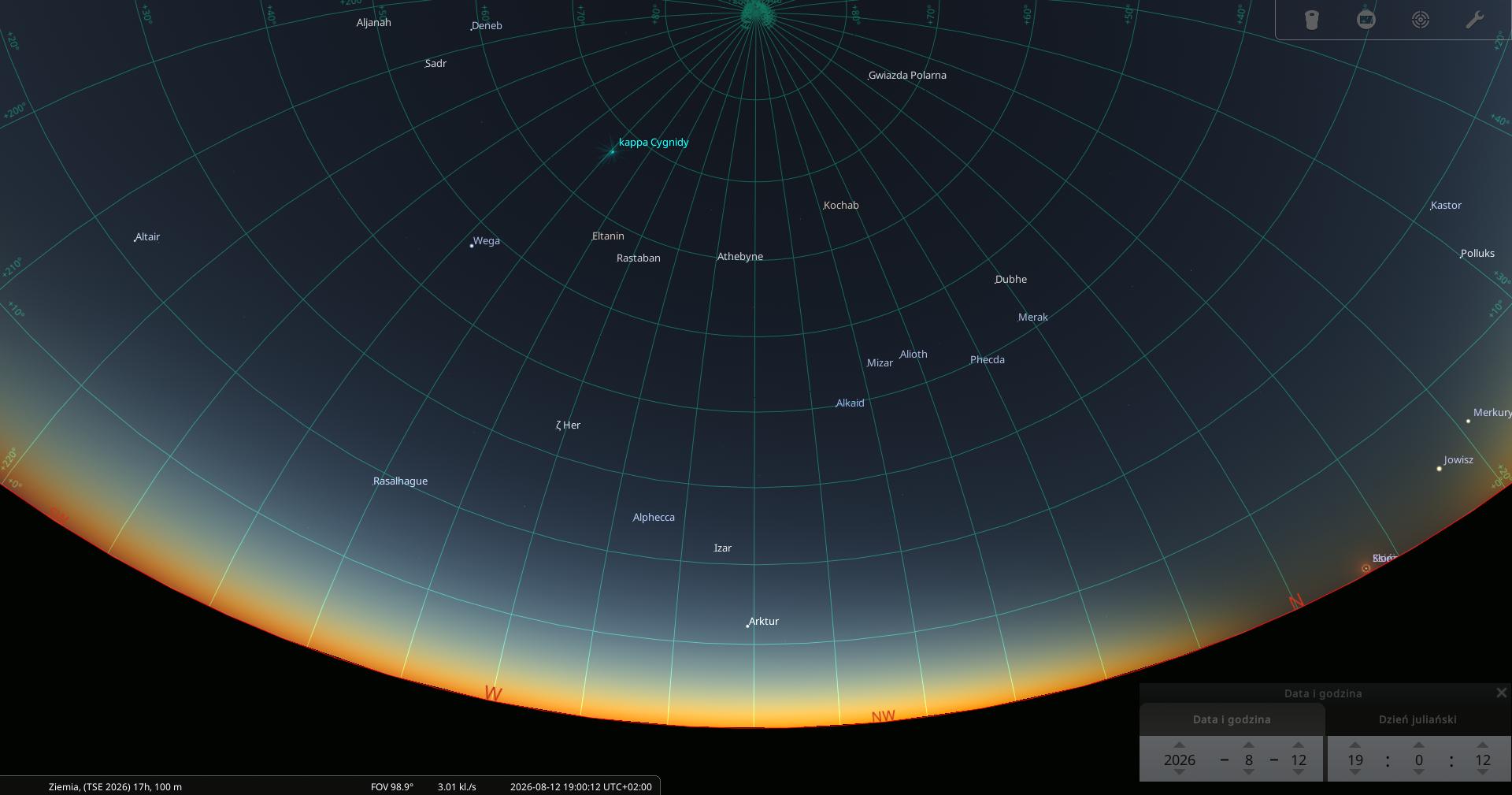
The final result can be reproduced in a single all-sky projection, which includes all 58 moments of mid-totality shown in the video above. Since the solar analemma is commonly known as the diagram of solar position in the sky as seen from the same location on Earth exactly at mean solar time over the course of a year. Lunar analemma is an analog diagram, which corresponds to the same position of the Moon at fixed location every 24 hours and 50 minutes over a course of the lunar month. Here, we could experience something like « eclipsemma », which is the hyphotetical way of the Sun across the celestial sphere as it marks from the very beginning to the very end of the eclipse path. In other words, the hypothetical observer watches the solar eclipse precisely at the moment of mid-totality hurtling with the speed of Moon’s shadow from the beginning to the end of the eclipse path. In result, he could see of how the Sun’s position changes along with rising and setting brightest stars visible at mid-totality. The video above shows exactly how it looks like. The image below illustrates the theoretical way of totally eclipsed Sun in the sky over the entire path.
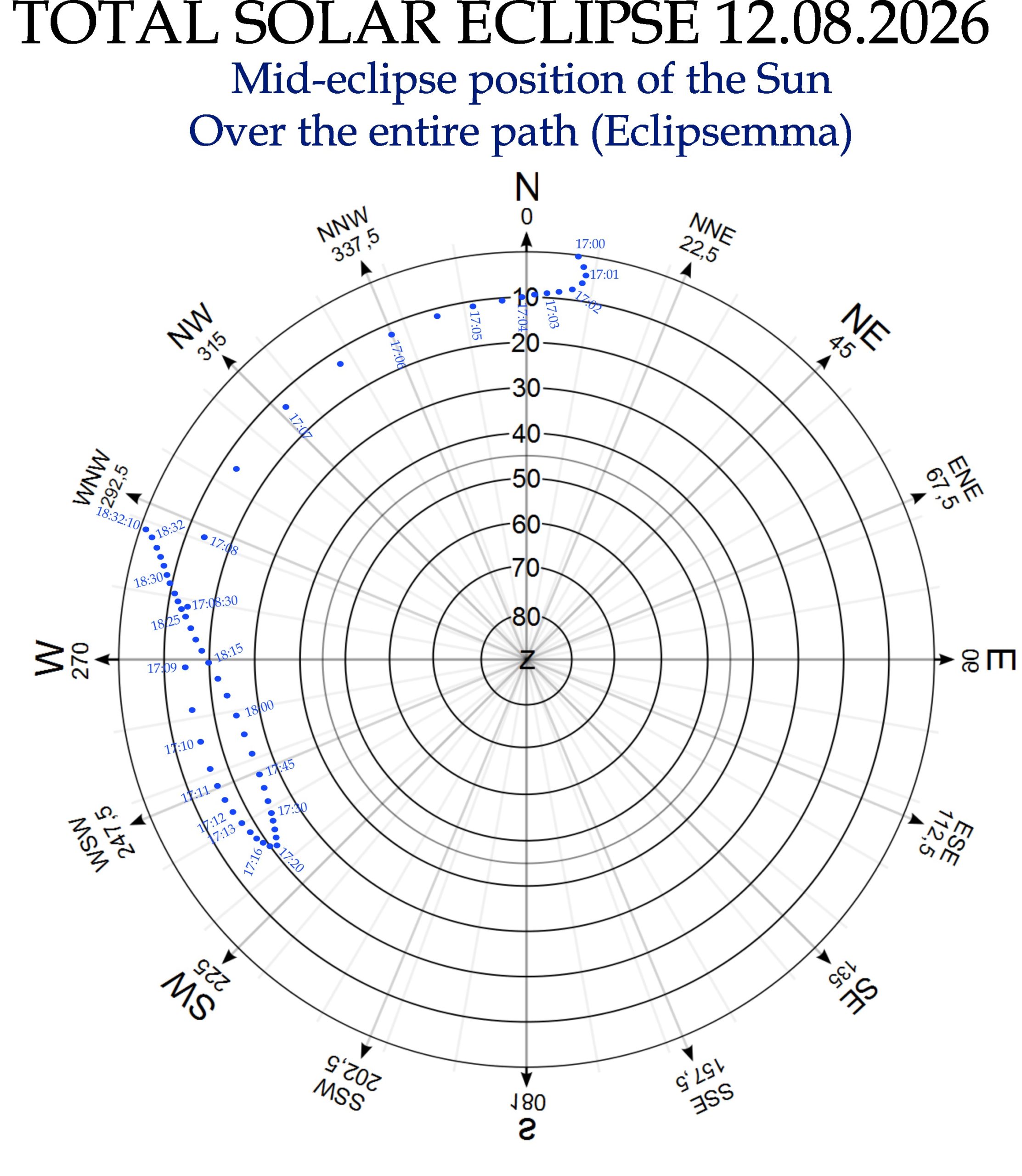
Additionally, there is a map of several other places, which aren’t aligned with the centerline, and therefore, the single-order scattering umbra projection was necessary to emphasize the visibility of the umbra and thereby determine which section of the sky will still be directly illuminated by the solar crescent over the period of totality (Pic. 70, 71).
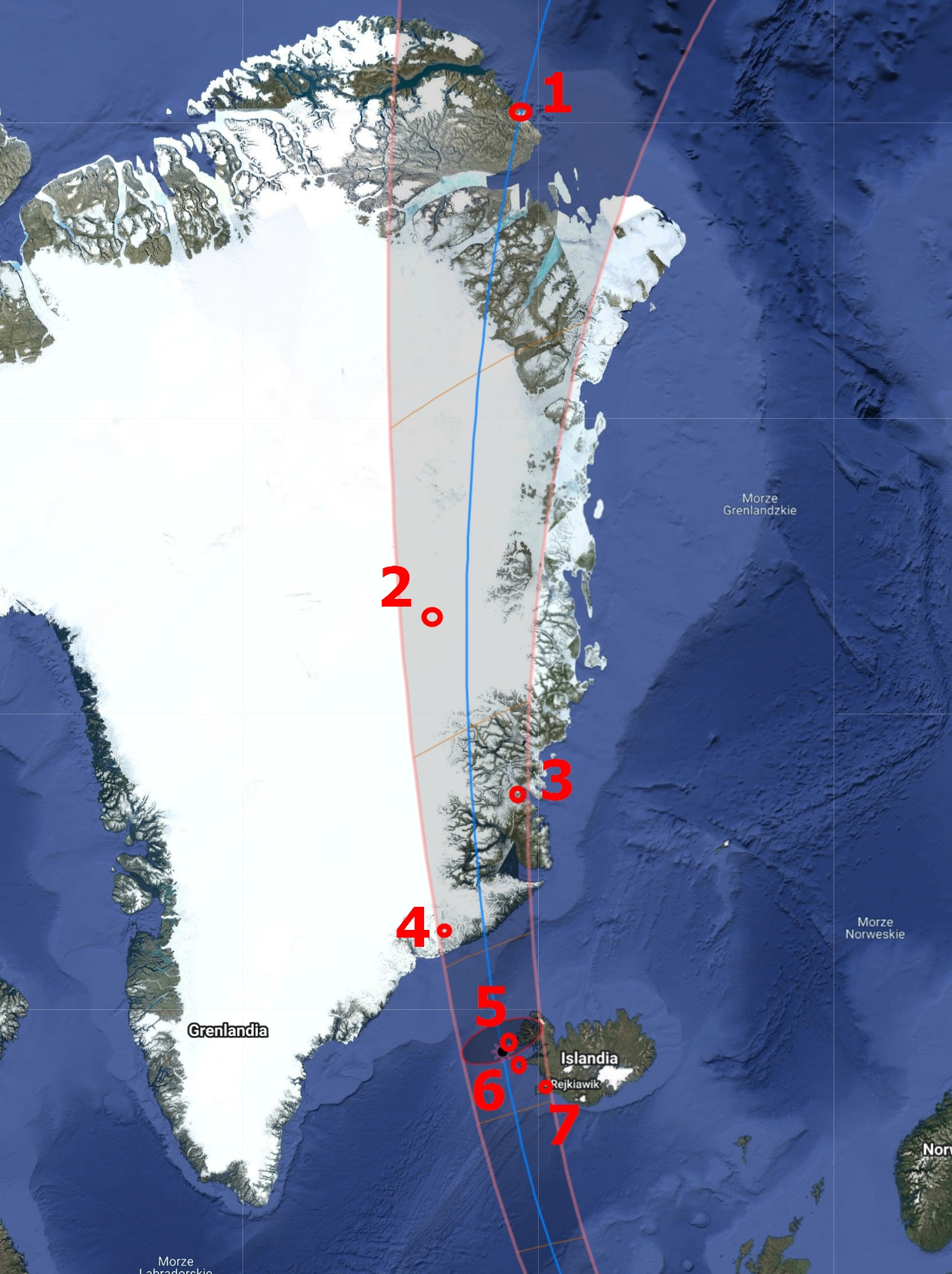
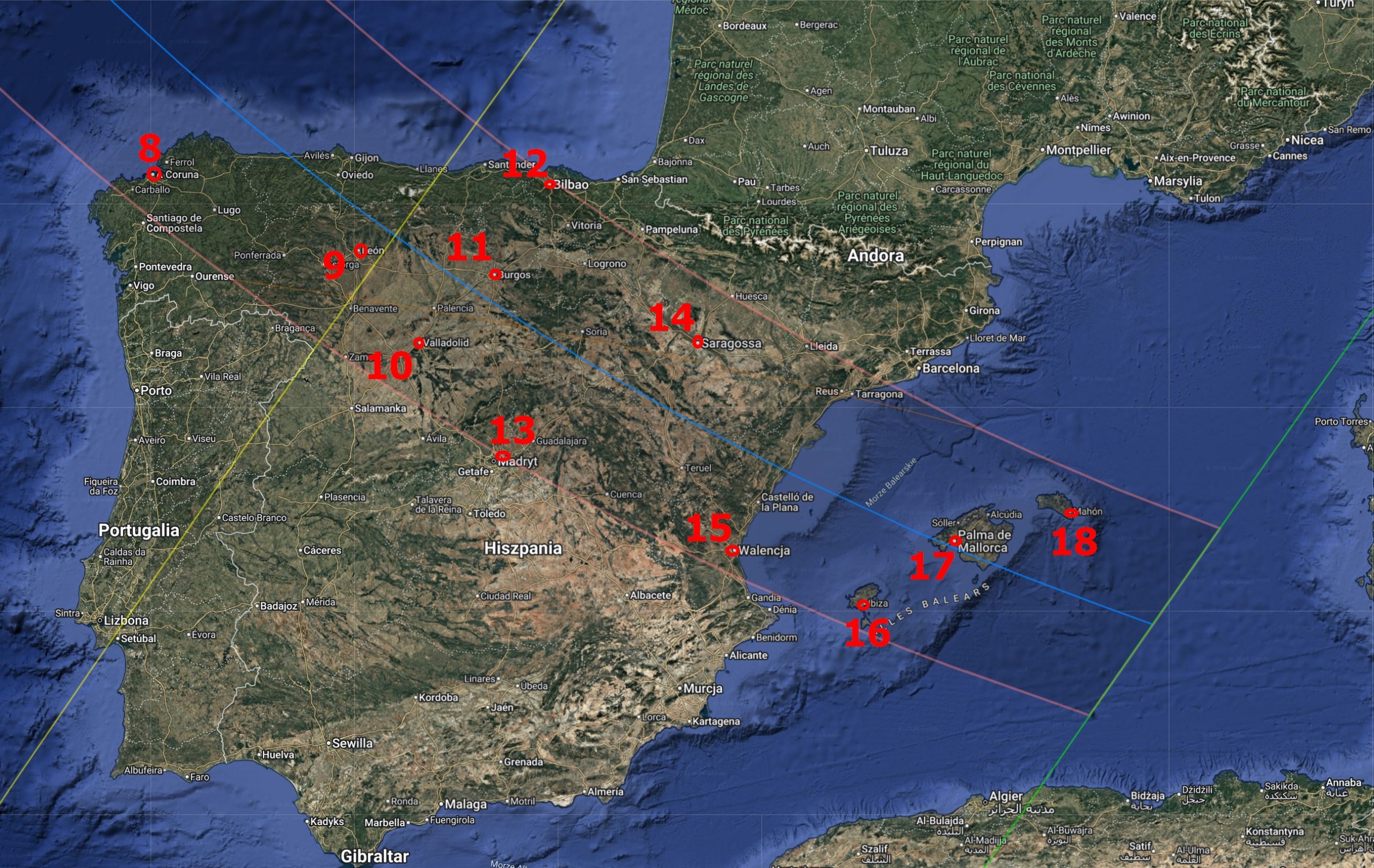
Place 1 – Northernmost shore of Greenland (82° 50′ 17.95″ N ; 23° 42′ 20.23″ W)
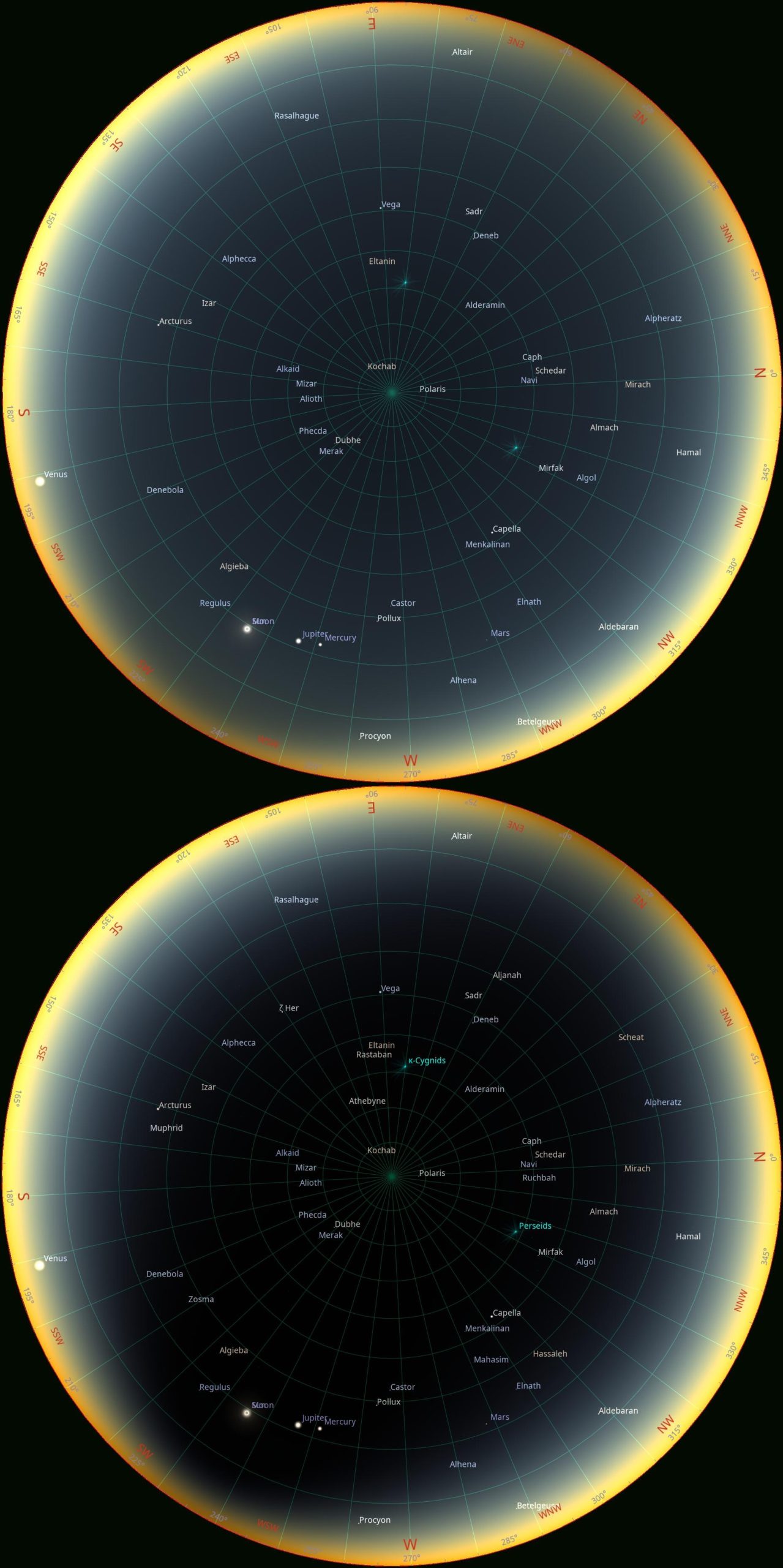
Place 2 – Greenland, the Avannaarsuani region (75° 59′ 18.17″ N; 27° 56′ 11.50″ W)
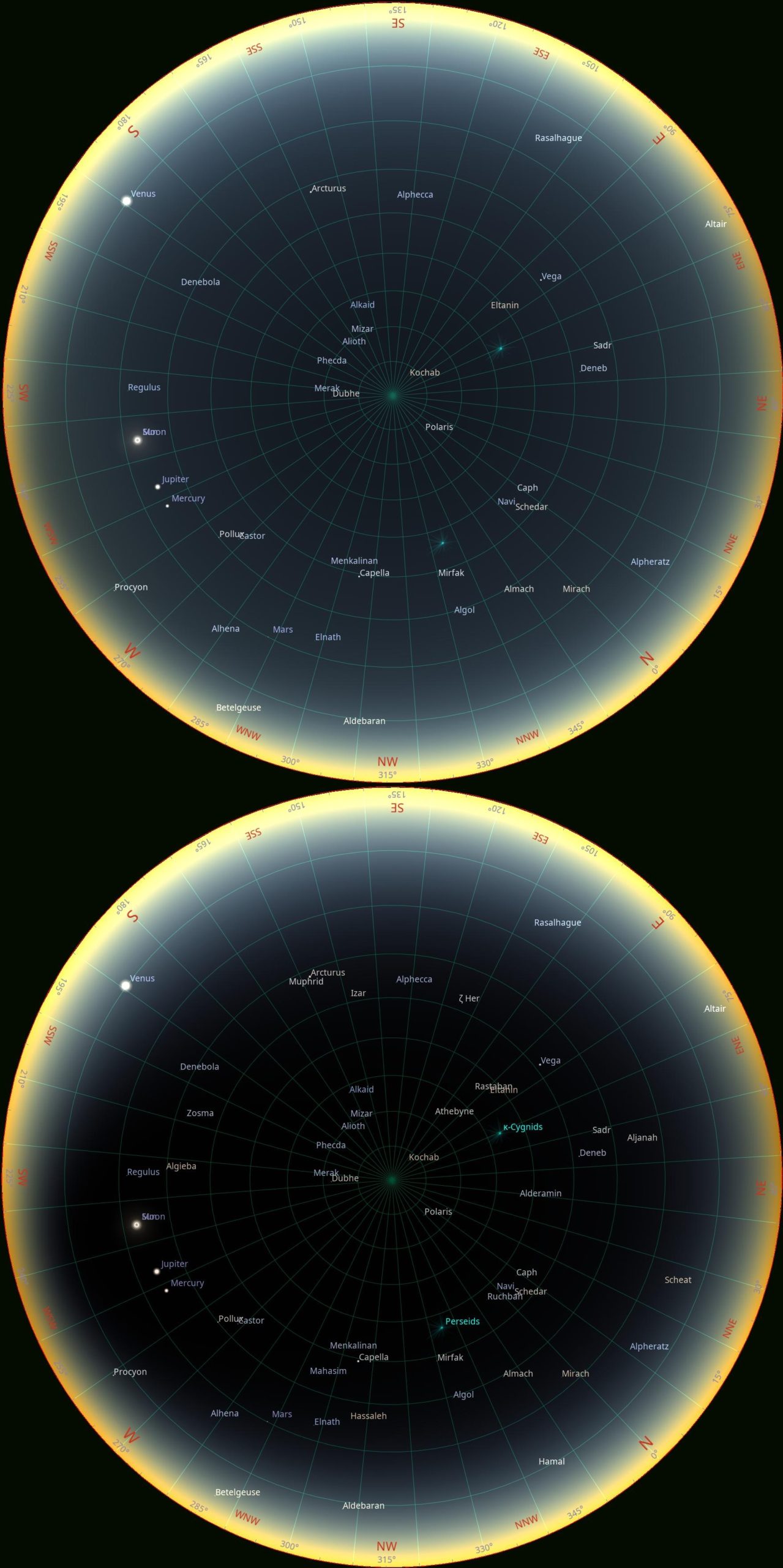
Place 3 – Greenland, the Mestersvig town (72° 13′ 28.24″ N; 23° 56′ 30.11″ W) – because of the umbral depth of 14% only, many fewer stars are estimated to be visible in the sky, since the zenith sky is being illuminated by the crescent Sun.
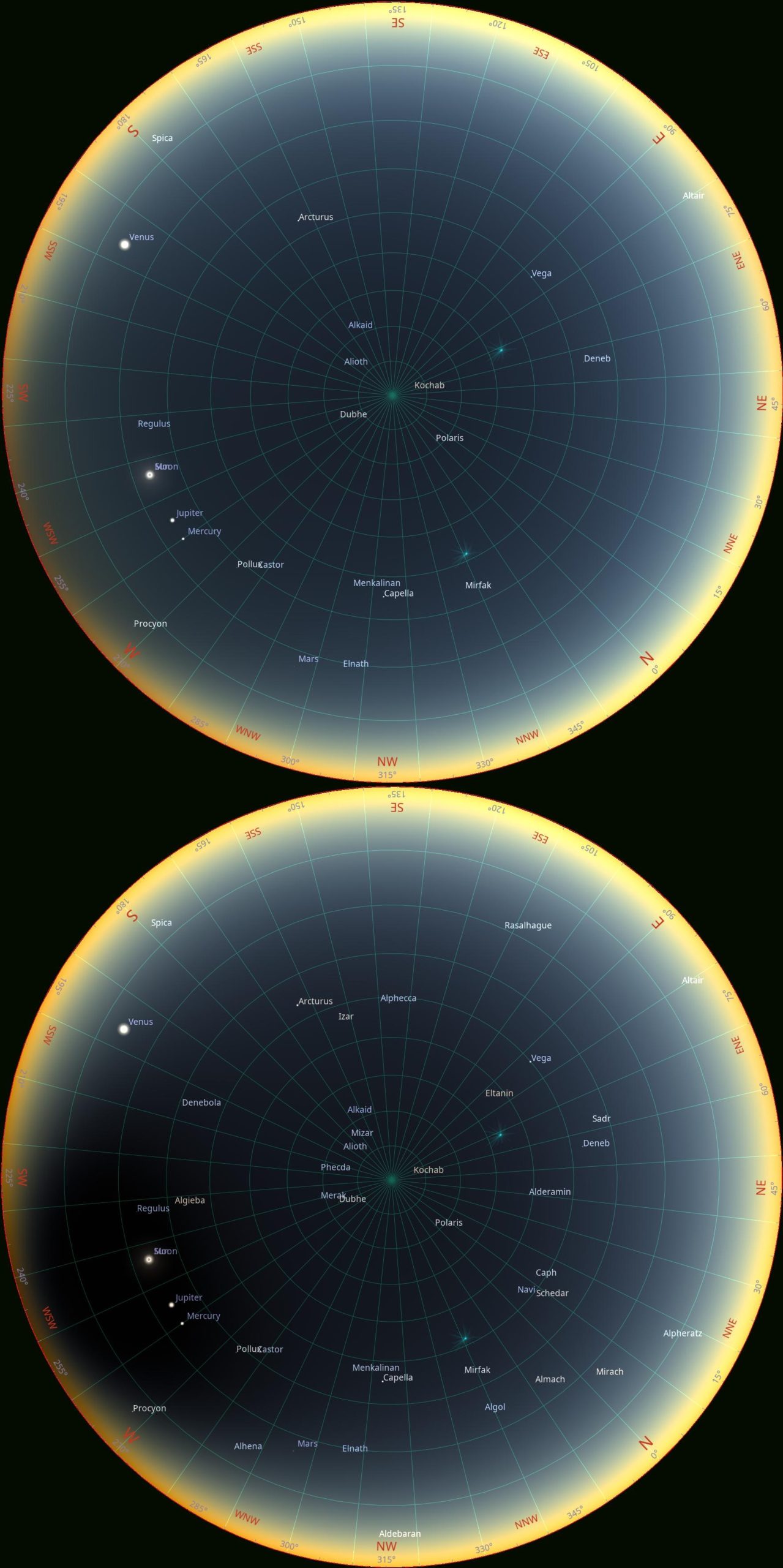
Place 4 – Greenland, Gunnbjørn Fjeld (68° 55′ 28.38″ N; 29° 58′ 33.36″ W) – the perspective of the highest summit in Greenland and the North Arctic Circle. Despite a shadow depth of only 11%, the stars are clearly visible. This is because the location near the southern limit of totality at a small altitude means the presence of the umbra is higher in the atmosphere.
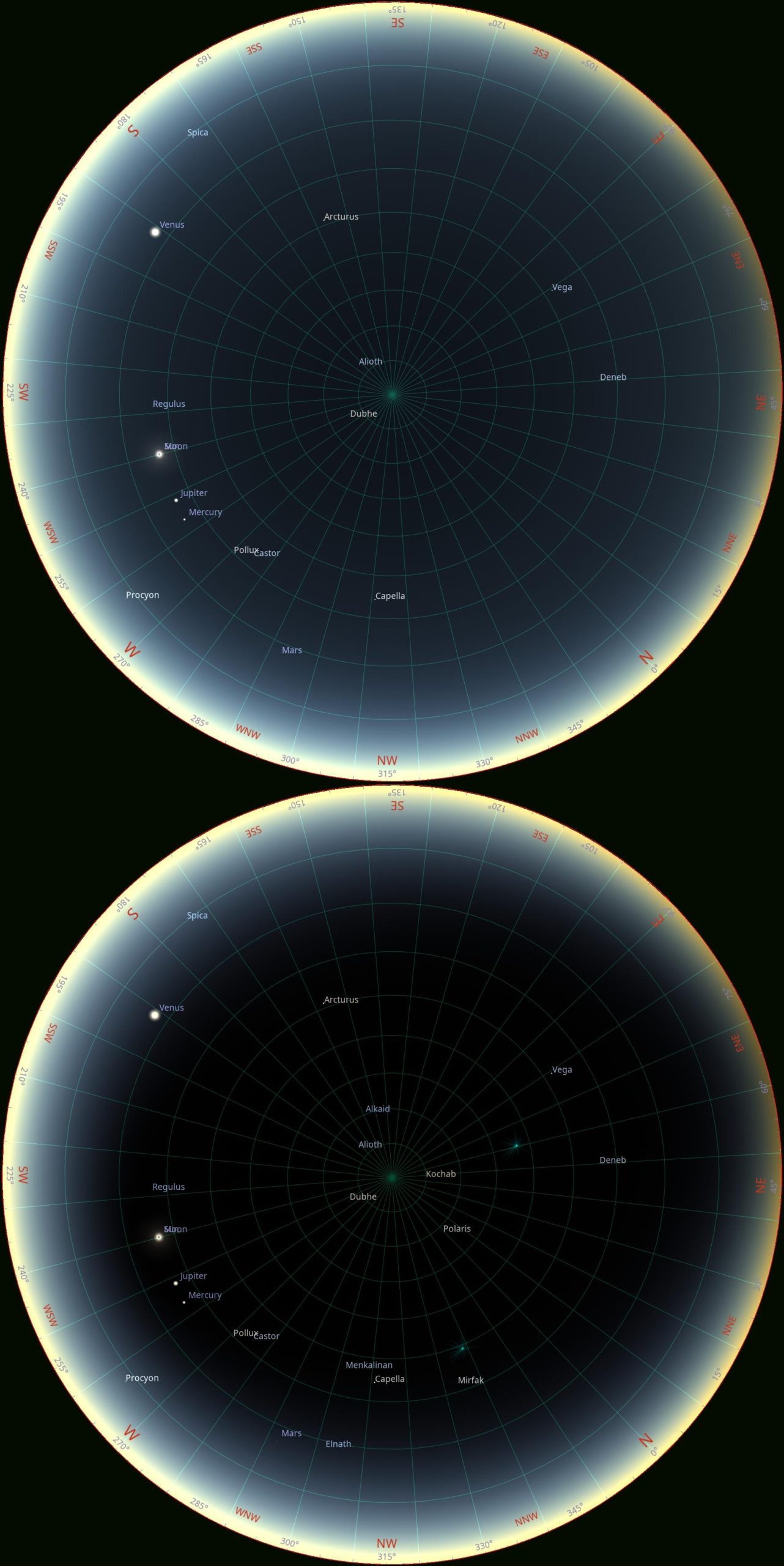
Place 5 – Iceland, Látrabjarg (65° 30′ 06.67″ N; 24° 31′ 51.53″ W) – the westernmost tip of Iceland with the longest duration of totality 2m13s and umbral depth of 74% on the northern side of the path.
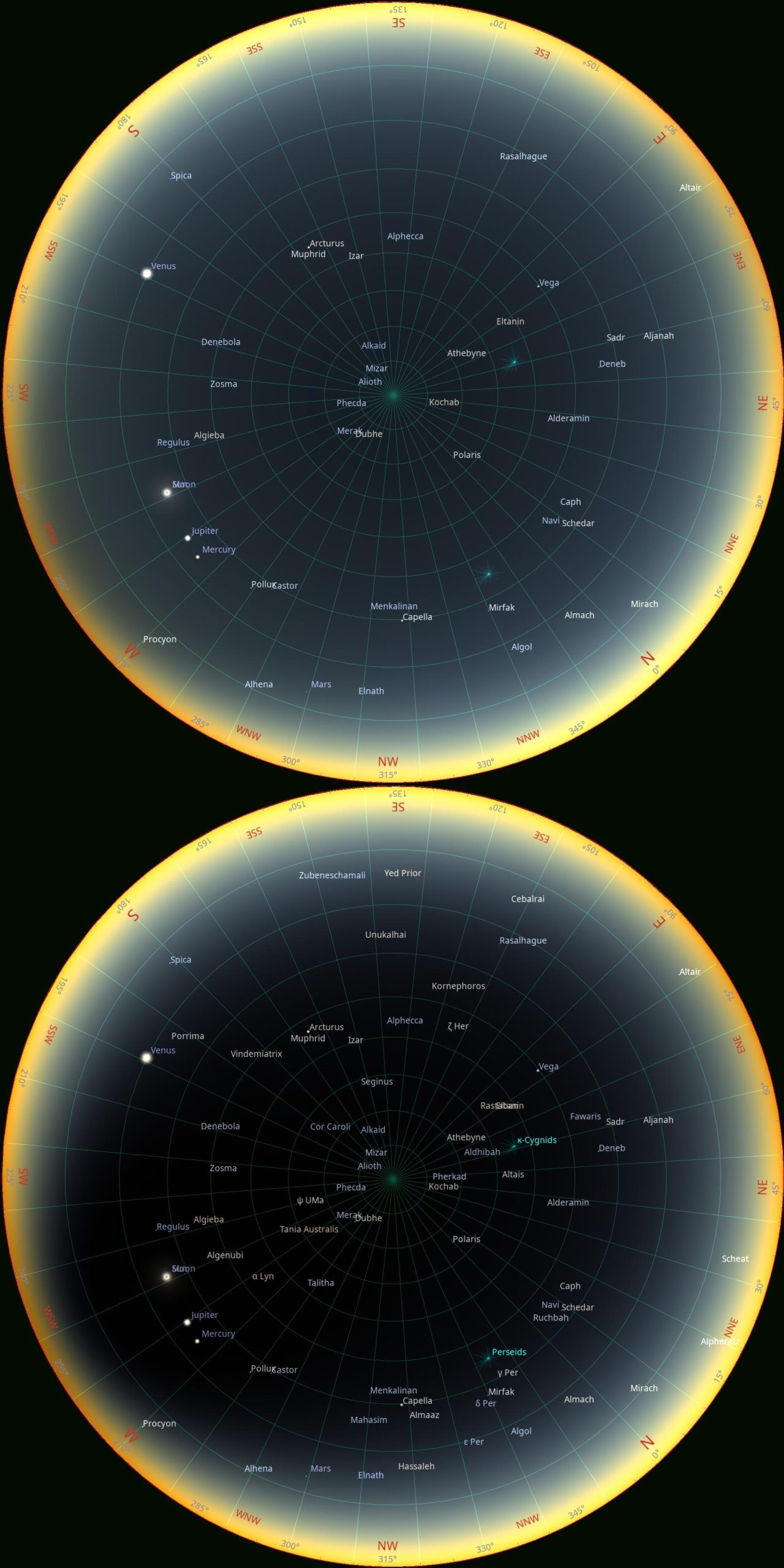
Place 6 – Iceland, Snæfellsjökull (64° 48′ 39.64″ N; 23° 47′ 38.24″ W) – one of the most famous sites in Iceland with 2m04s totality and umbral depth of 57%.
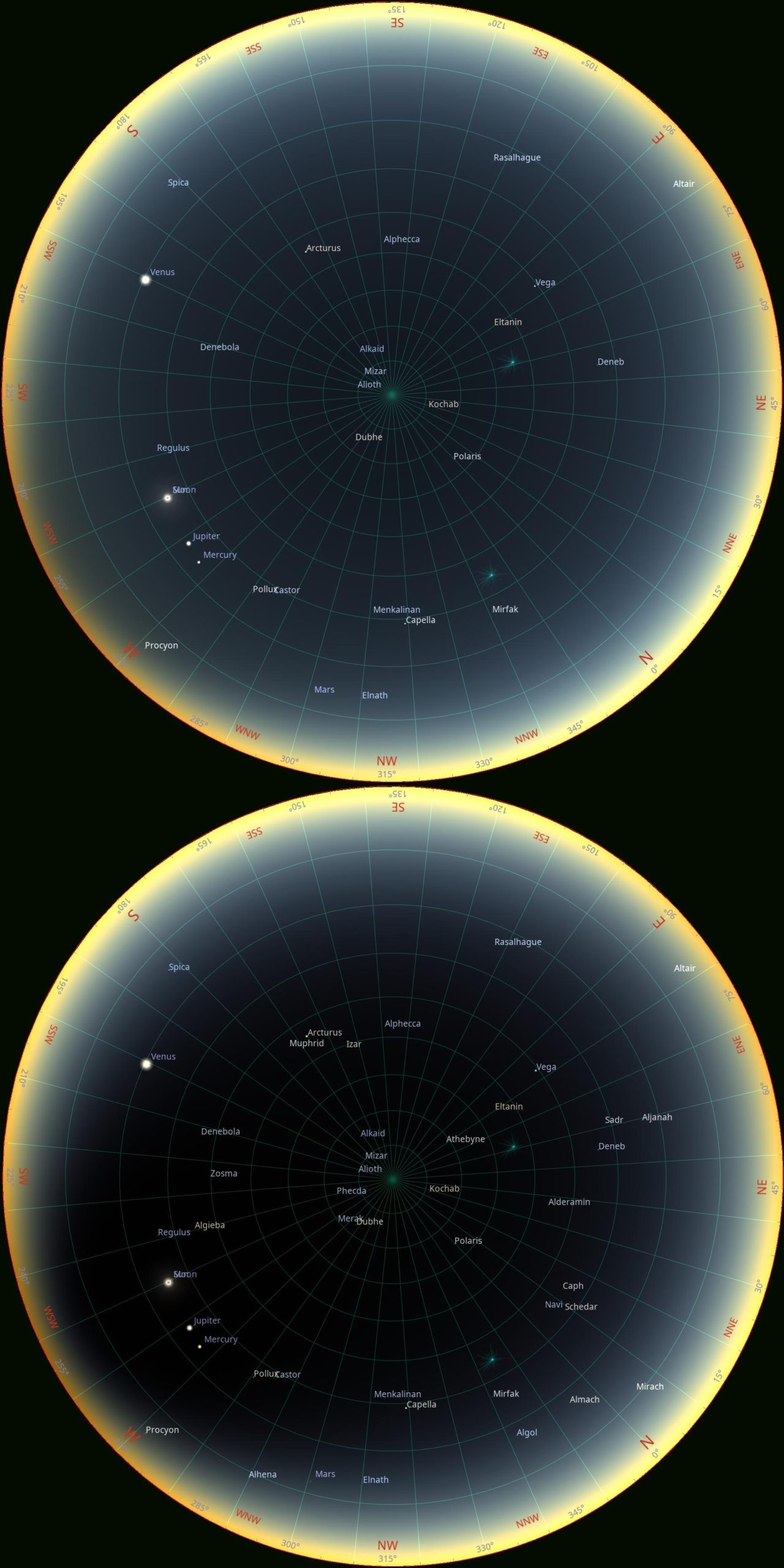
Place 7 – Iceland, Reykjavik (64° 08′ 49.92″ N; 21° 56′ 22.85″ W) – umbral depth about 10% only.
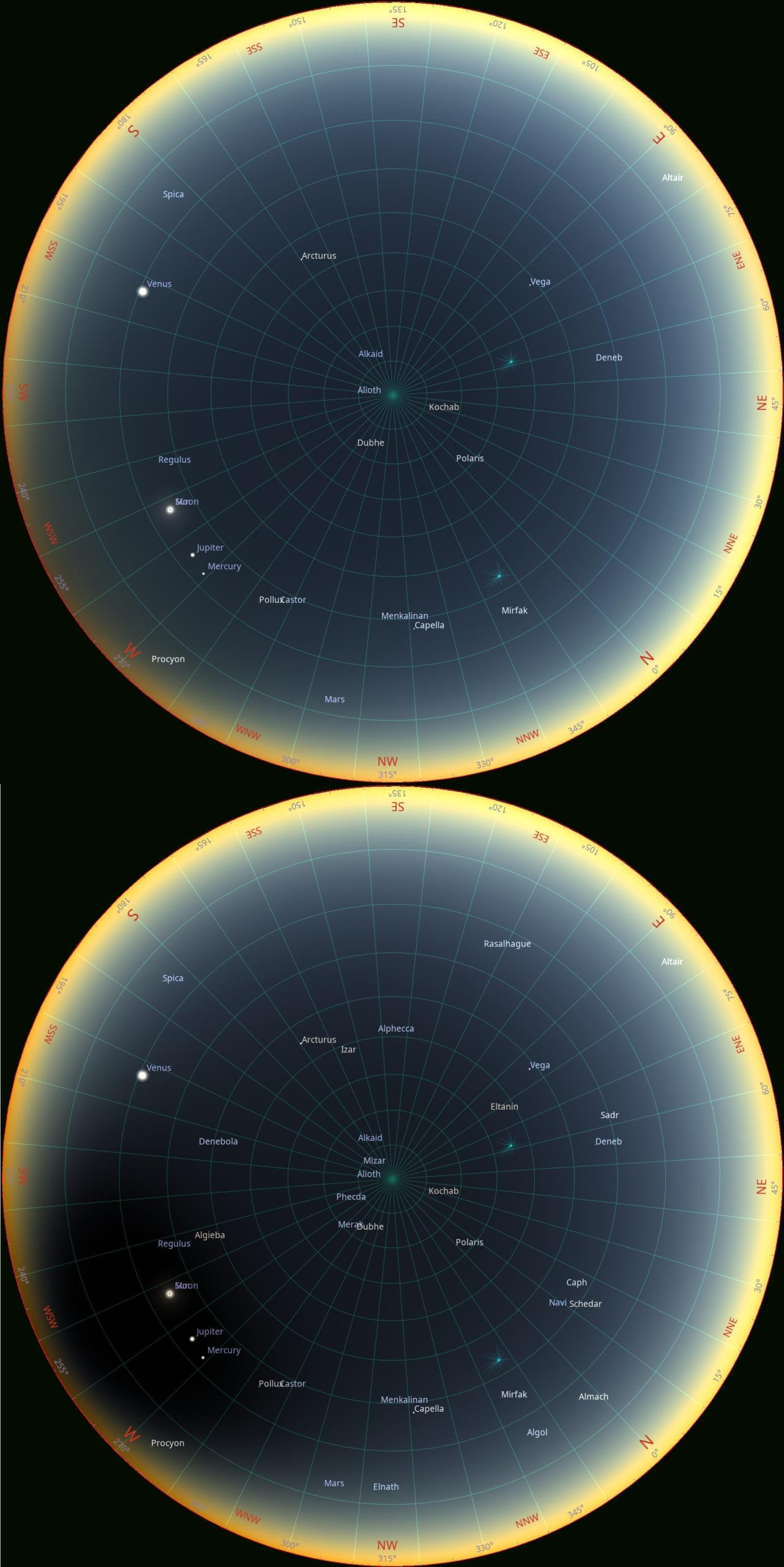
Place 8 – Spain, A Coruña (43° 20′ 55.99″ N; 8° 24′ 31.22″ W) – umbral depth 25% only at the southern part of the path.
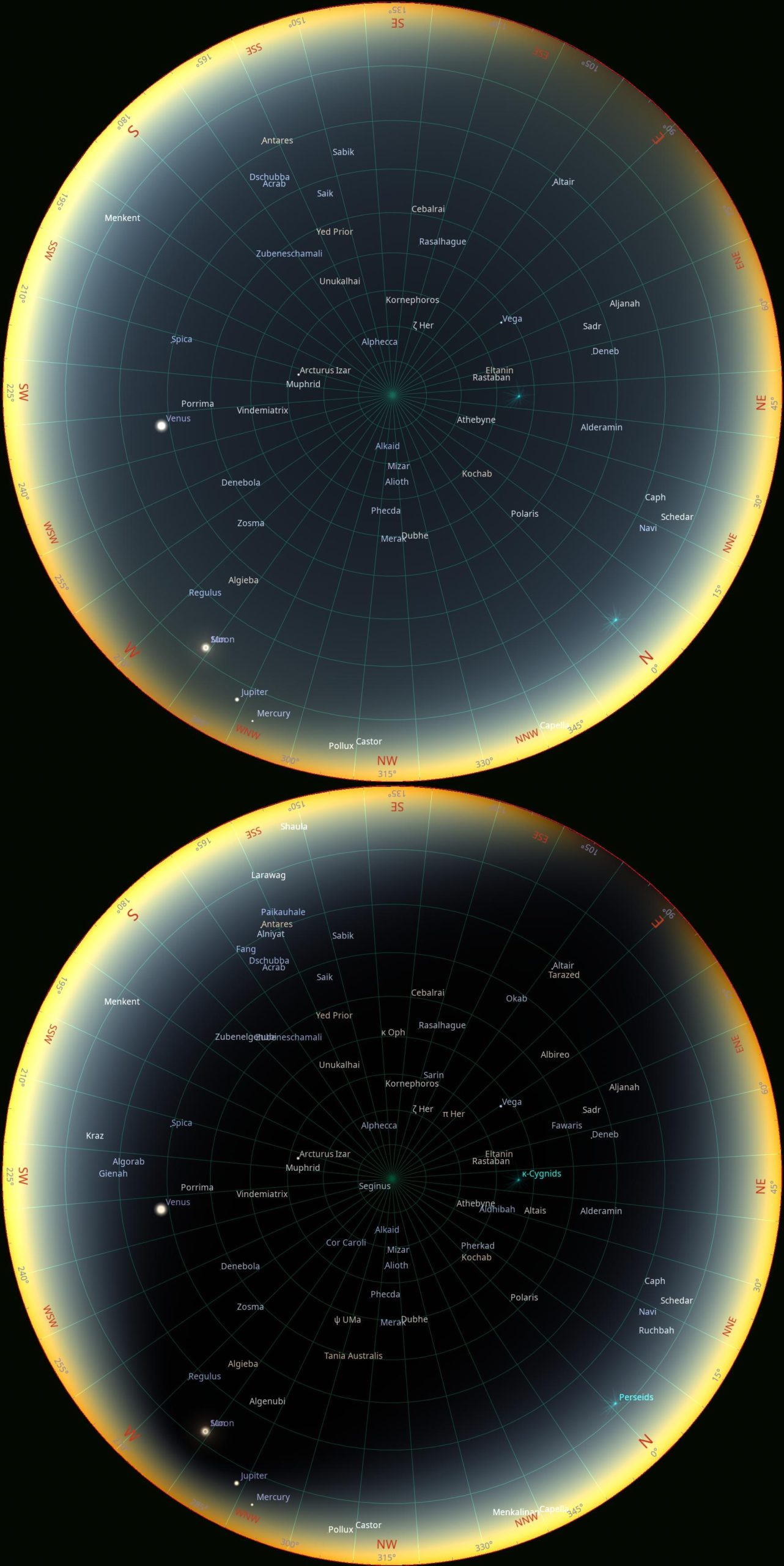
Place 9 – Spain, León (42° 35′ 51.28″ N; 5° 33′ 47.56″ W)
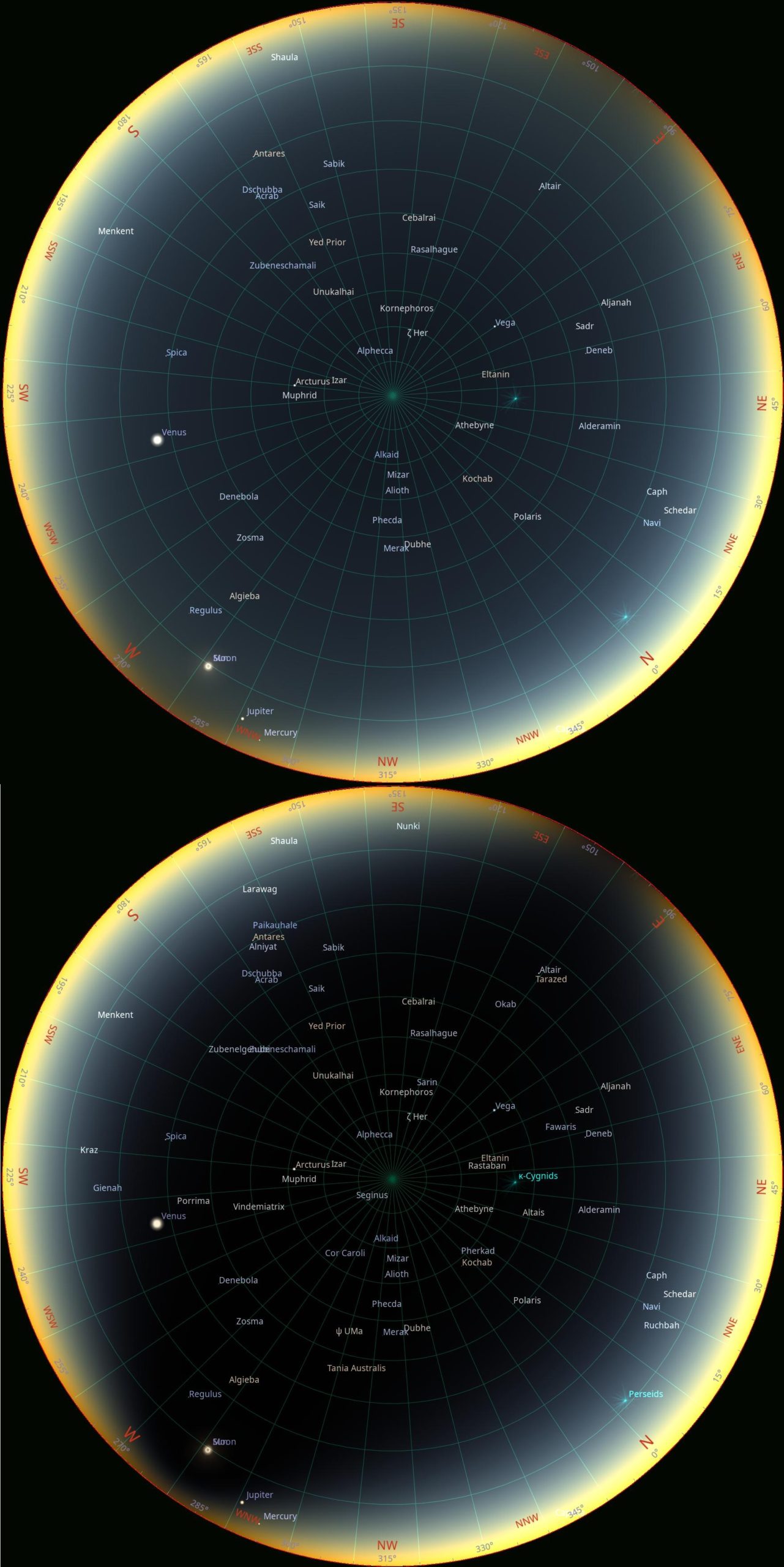
Place 10 – Spain, Valladolid (41° 38′ 24.28″ N; 4° 43′ 21.93″ W)
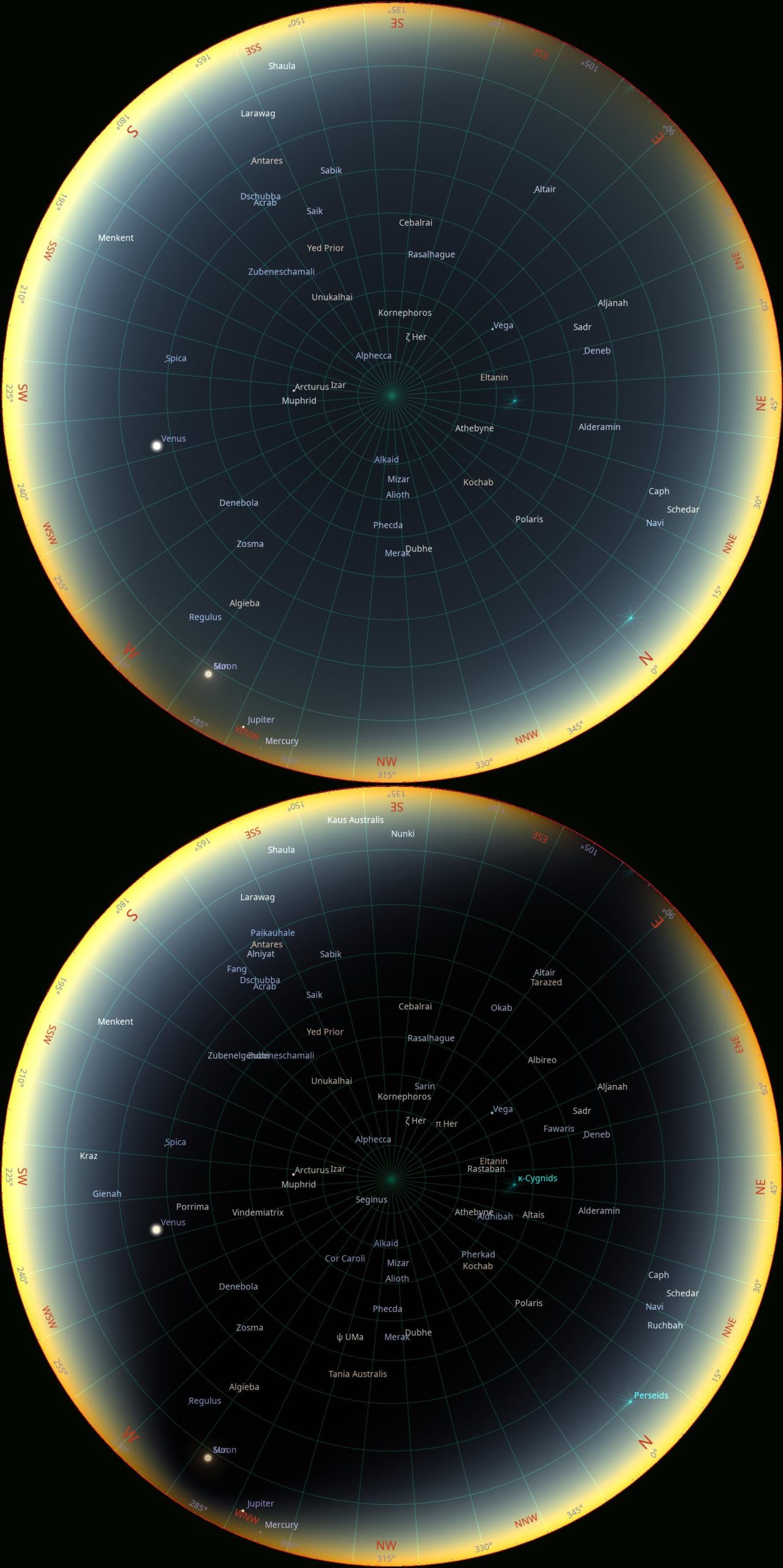
Place 11 – Spain, Burgos (42° 20′ 46.92″ N; 3° 41′ 24.16″ W)
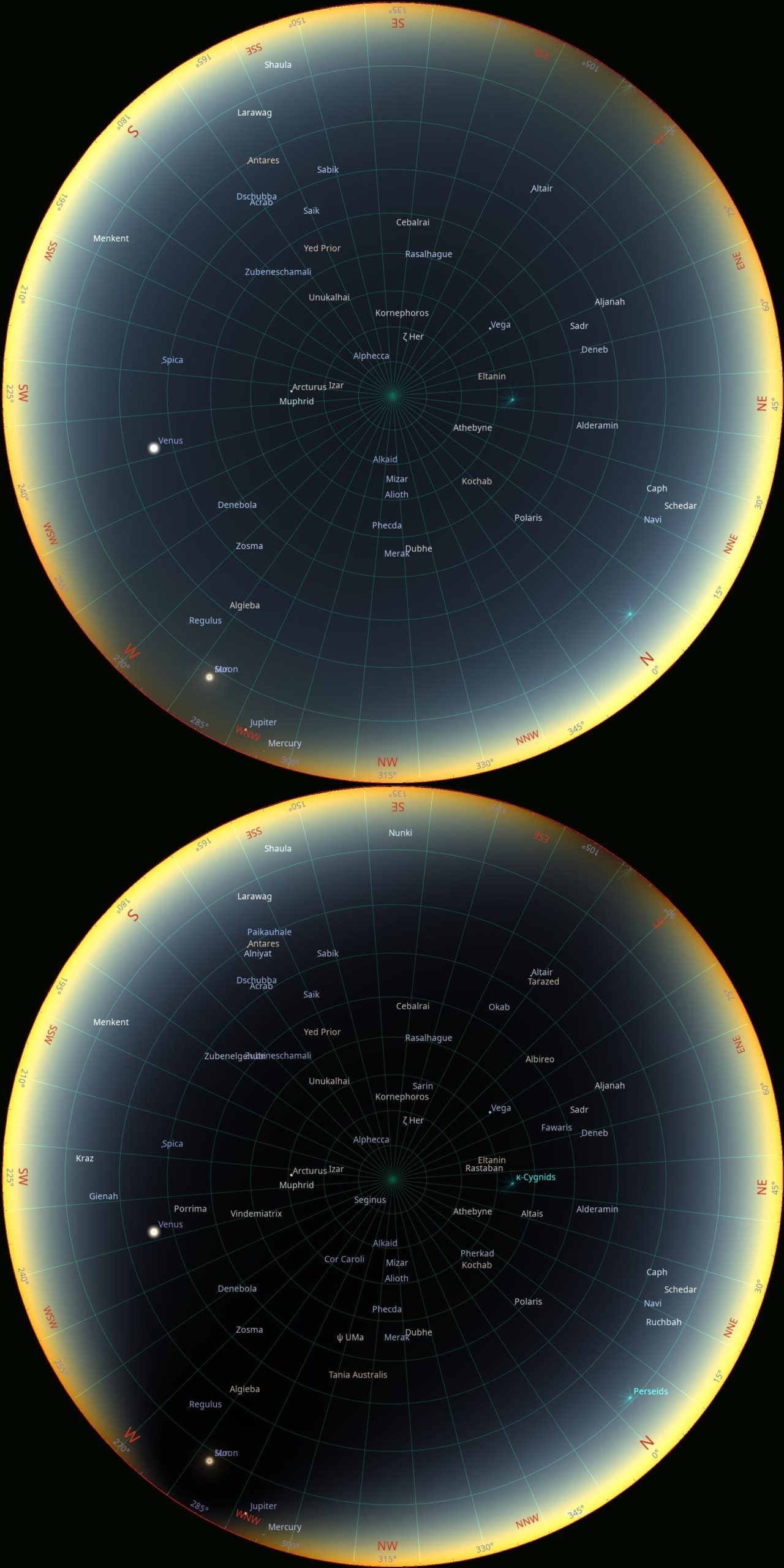
Place 12 – Spain, Bilbao (43° 16′ 37.94″ N; 2° 56′ 54.48″ W) – one of the most interesting locations, where the totality will last 27s only with umbral depth just as small as 3,5%. The umbra will cover only the nearest surroundings of the Sun, leaving the entire sky illuminated. Hence, a small number of stars are visible. What is most curious is that the eclipse limit is around 4000m above Bilbao, which reflects the difference in the visibility of stars. This article outlines what to expect in situations like this.
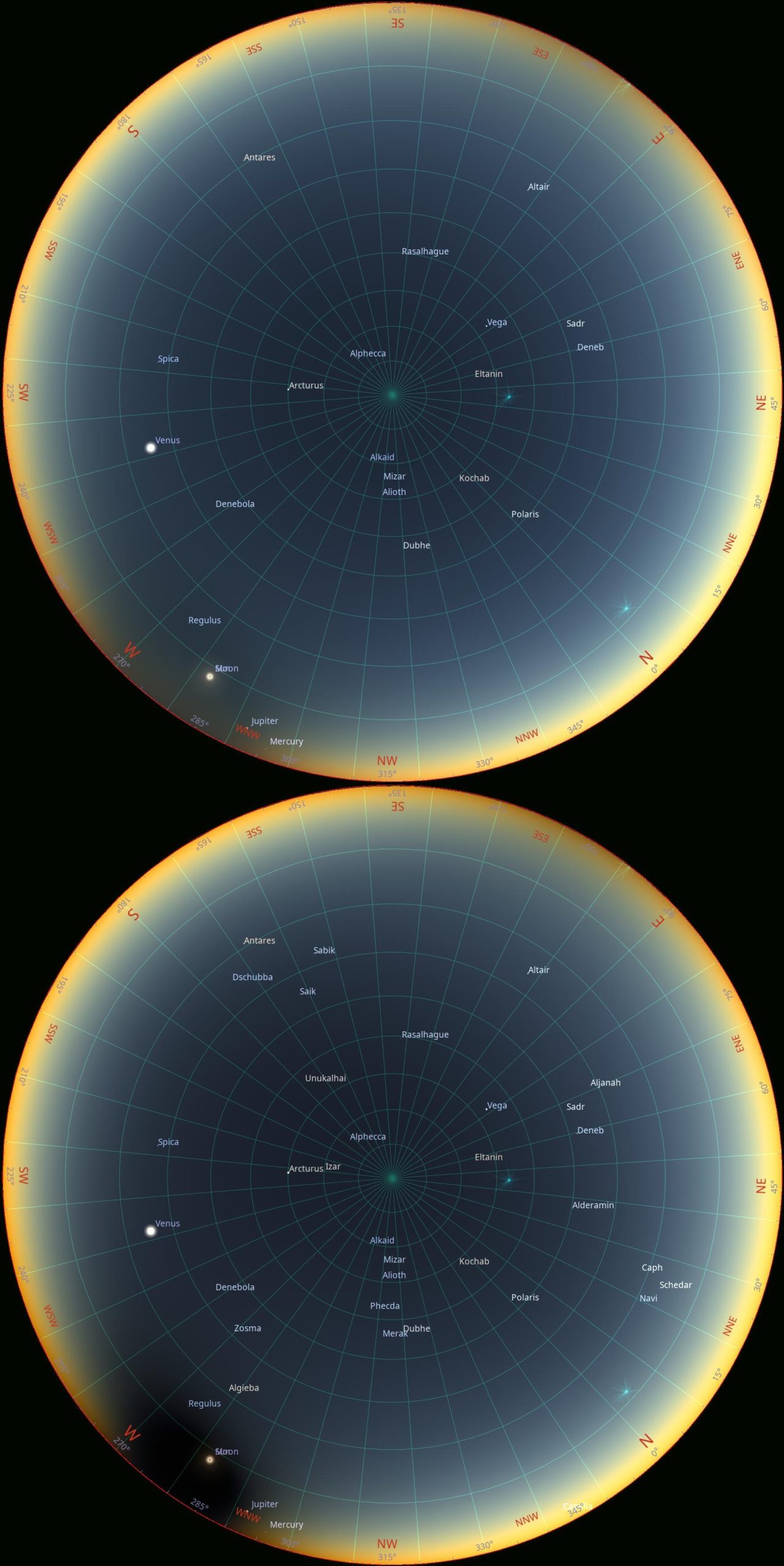
Place 13 – Spain, Madrid (40° 25′ 30.60″ N; 3° 40′ 24.83″ W) – The only location considered just outside of the path with the greatest obscuration of 99,79%. However, because it’s a grazing zone of the southern limit, almost the entire sky will be shadowed, giving an opportunity for stars to be visible to observers. This is the opposite of the previous observation and is explained in the same article.
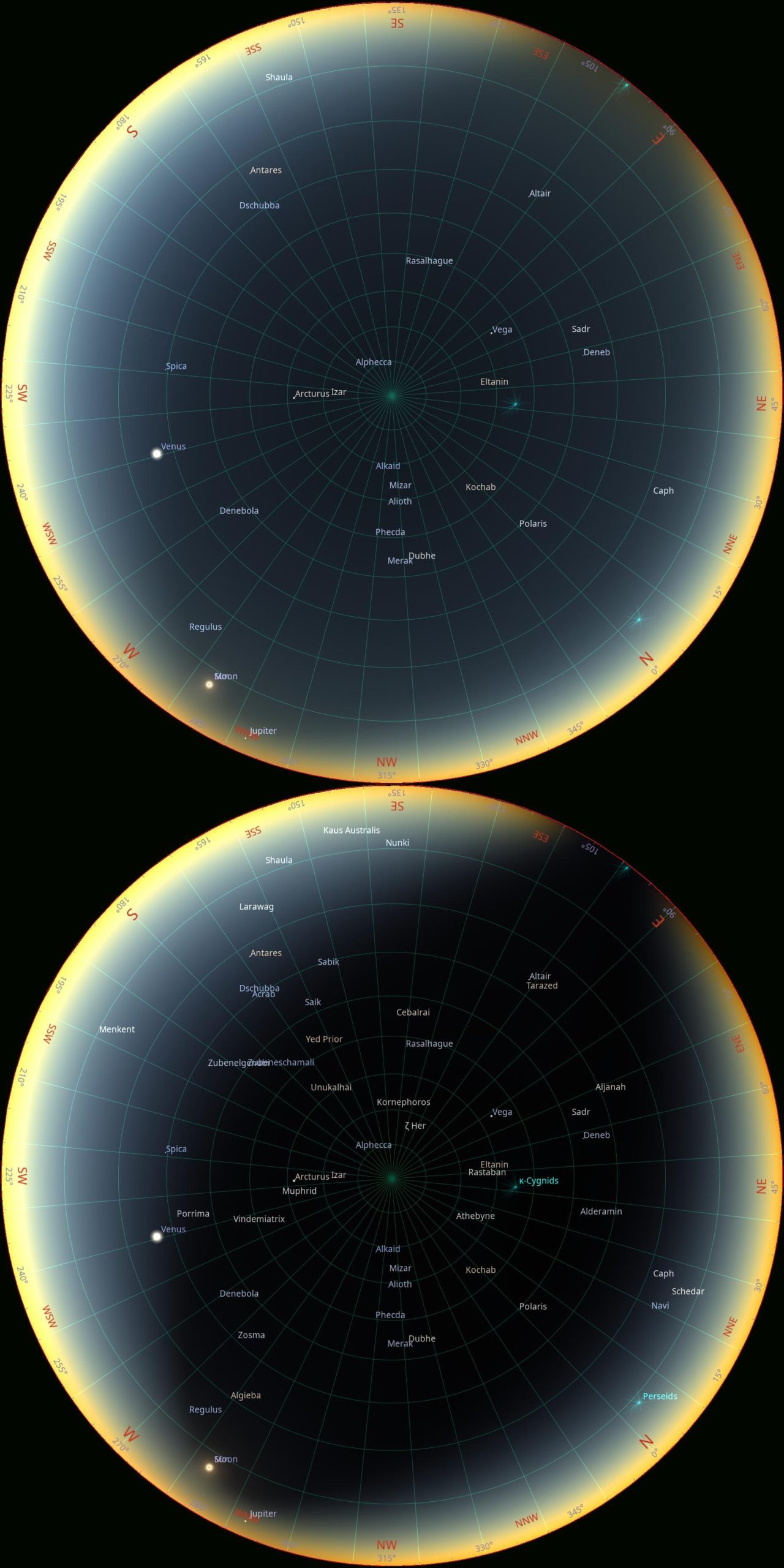
Place 14 – Spain, Zaragoza (41° 38′ 21.19″ N; 0° 53′ 18.71″ W)
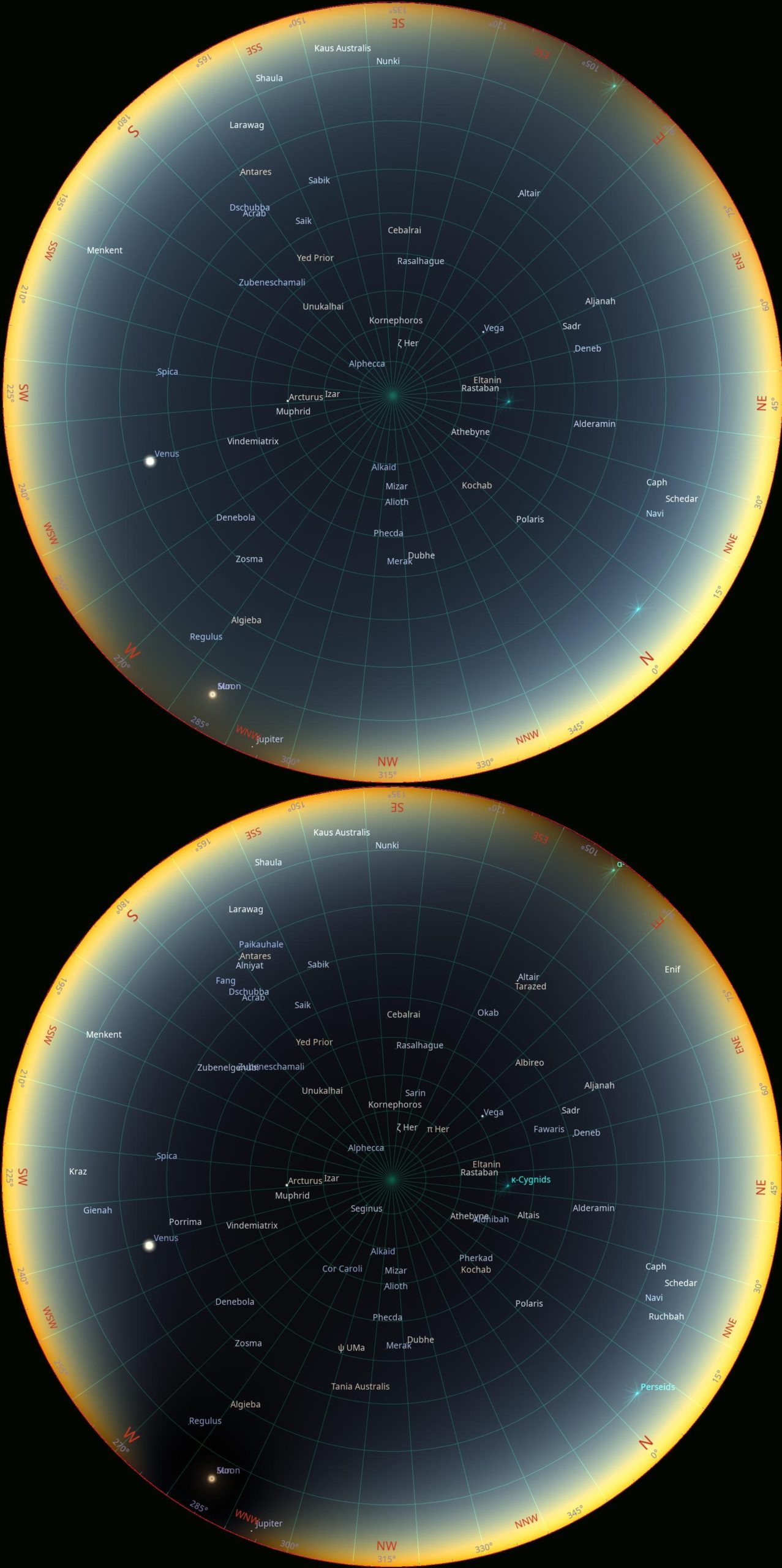
Place 15 – Spain, Valencia (39° 27′ 53.99″ N; 0° 22′ 19.82″ W) – umbral depth just about 20%.
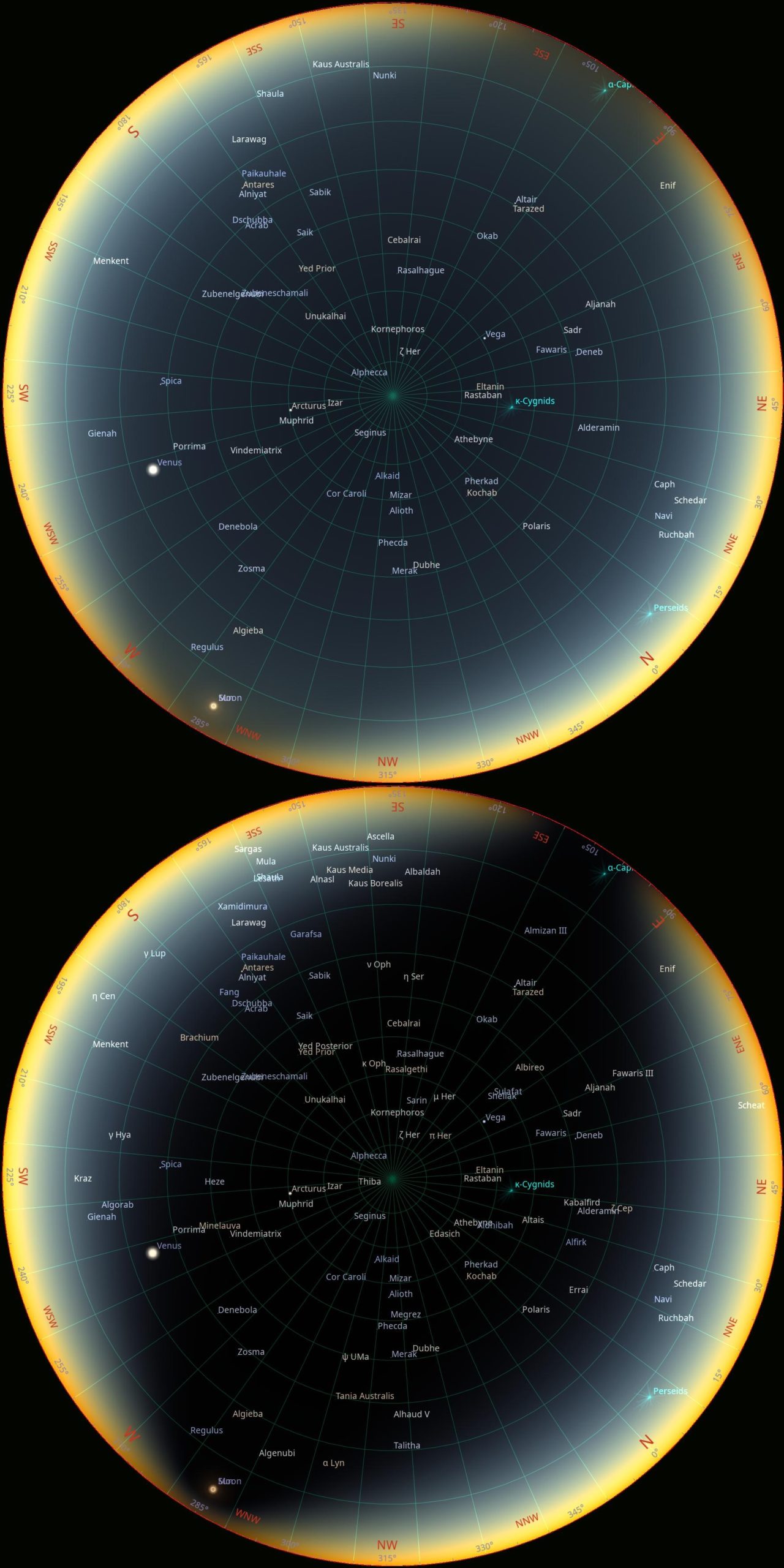
Place 16 – Balearic Islands, Formentera, Cap de Barbaria (38° 38′ 23.68″ N; 1° 23′ 11.52″ E) – another extreme location where the totality can be watched from, but for a very short period of 19s, as far as the lunar limb corrected is considered. Umbral depth is only 3%, but near the southern limit, it will mean almost the entire sky is bathed in the Moon’s shadow.
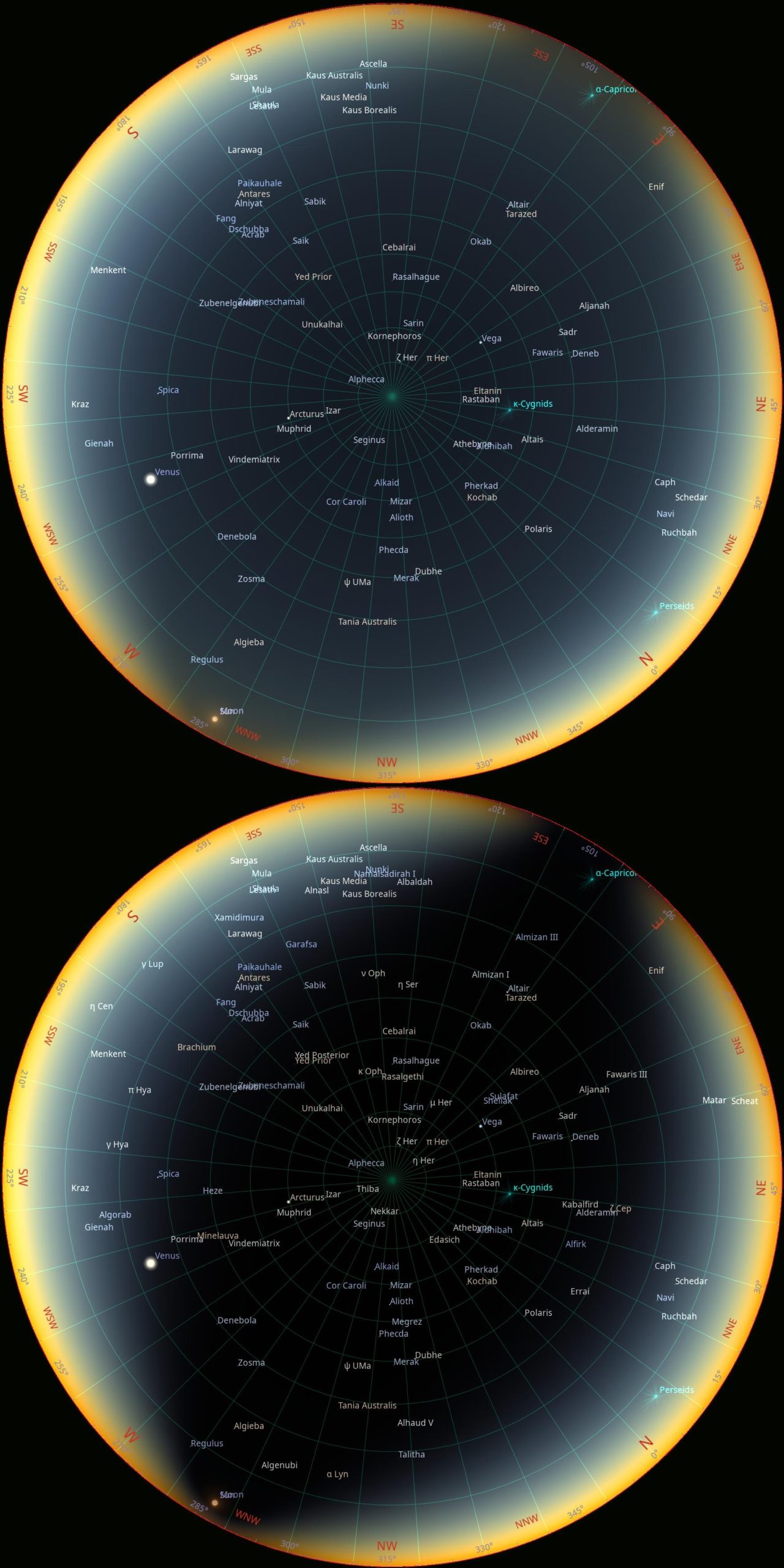
Place 17 – Balearic Islands, Mallorca, Palma de Mallorca (39° 34′ 17.95″ N; 2° 39′ 05.84″ E) – the increased number of stars is a consequence of the low position of the eclipsed Sun above the horizon, as the key role the atmospheric extinction starts to play.
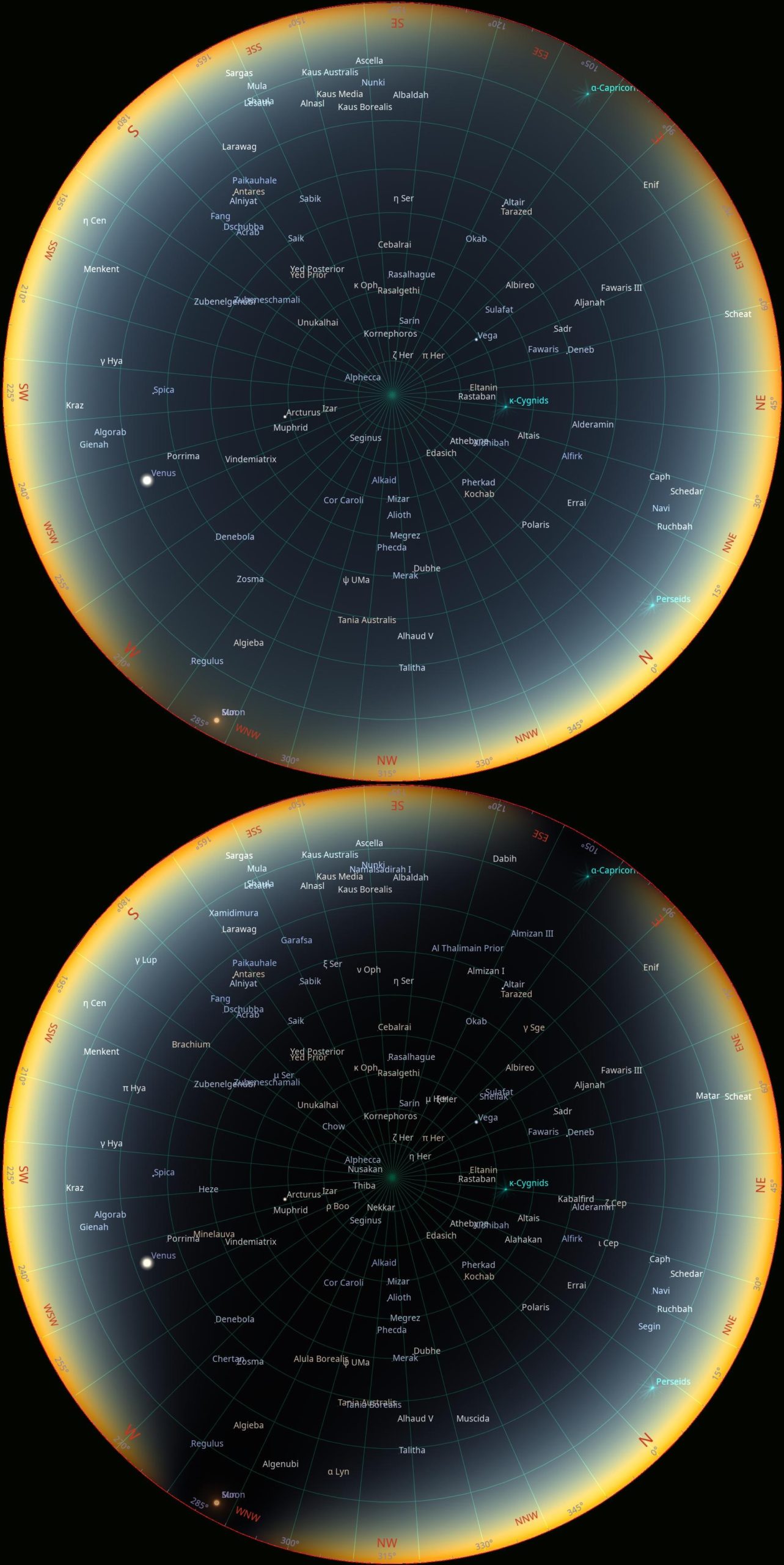
Place 18 – Balearic Islands, Menorca, Mahón (39° 53′ 21.34″ N; 4° 15′ 53.51″ E) – One of the easternmost places the total solar eclipse can be watched from, and thereby one of the easternmost Spanish lands. The greatest eclipse occurs only 1,7° above the horizon, so due to atmospheric extinction, an observer should expect the largest number of stars visible in the sky.
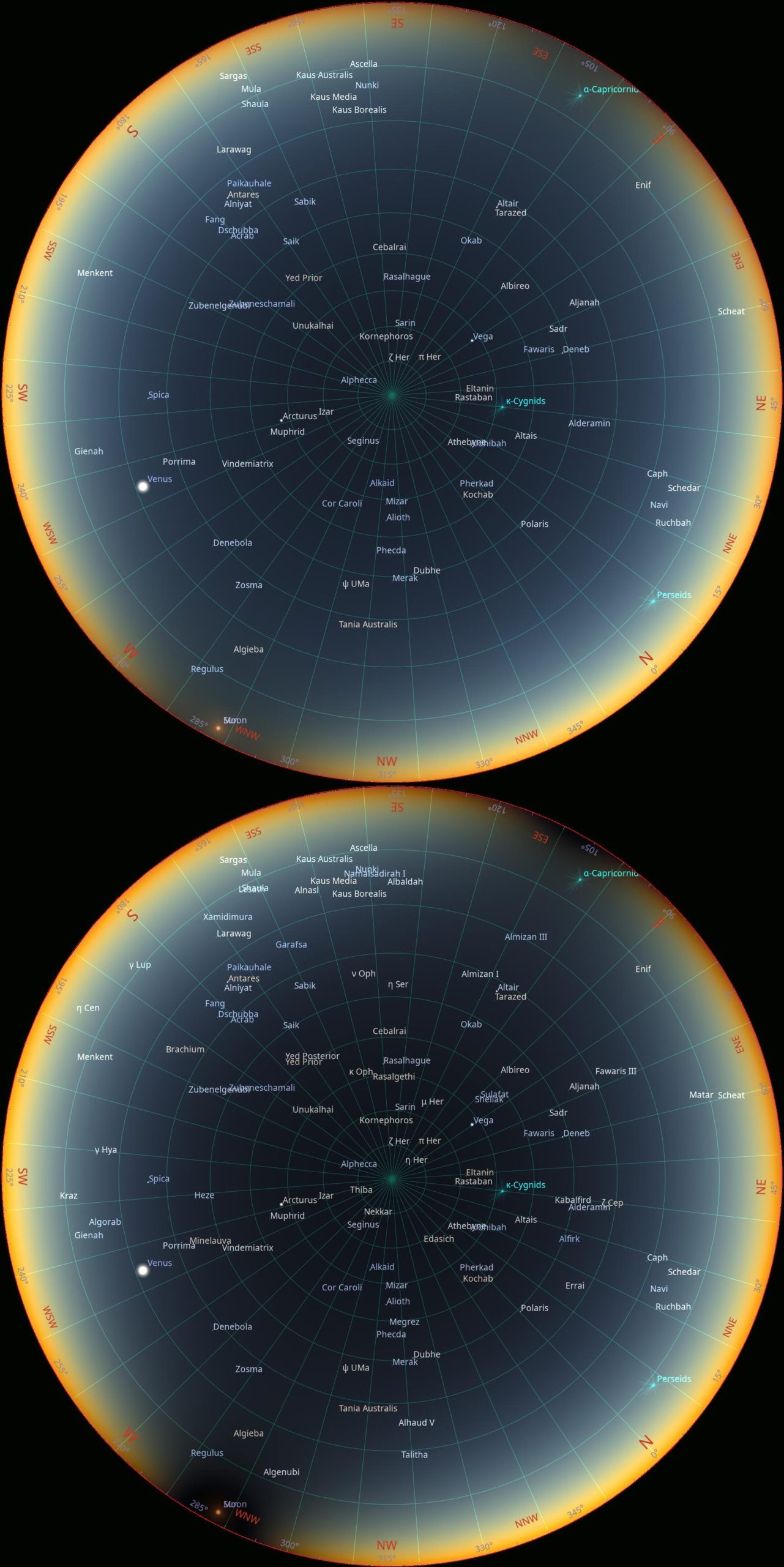
All these projections represent the moment of the greatest or mid-eclipse.
12. PERSEIDS
Around August 12, the Perseids reach their peak. This meteor shower originates from debris left by the periodic comet Swift–Tuttle, which has an orbital period of approximately 133 years. Exceptional outbursts, such as in 1993 following the comet’s 1992 perihelion passage, have produced zenithal hourly rates (ZHR) approaching 300 meteors per hour. Such enhancements are associated with orbital resonances involving meteoroid particles and the gravitational influence of Jupiter and Saturn (Sekhar, Asher, Vaubaillon, 2016). A comparable resonance-related enhancement is projected around 2111, though this remains subject to further modeling. In 2026, no major resonance enhancement is expected; typical Perseid activity (ZHR ~50–100 under dark skies) should prevail. During the 12 August 2026 total solar eclipse, meteor visibility will depend strongly on radiant altitude and local sky brightness. The Perseid radiant, located in the constellation Perseus, will remain high above the horizon for observers in the northern portion of the eclipse path, improving the probability of detecting bright fireballs (magnitude ≤ –3). Optimal observation requires viewing ~30–60° away from the radiant rather than directly toward it.
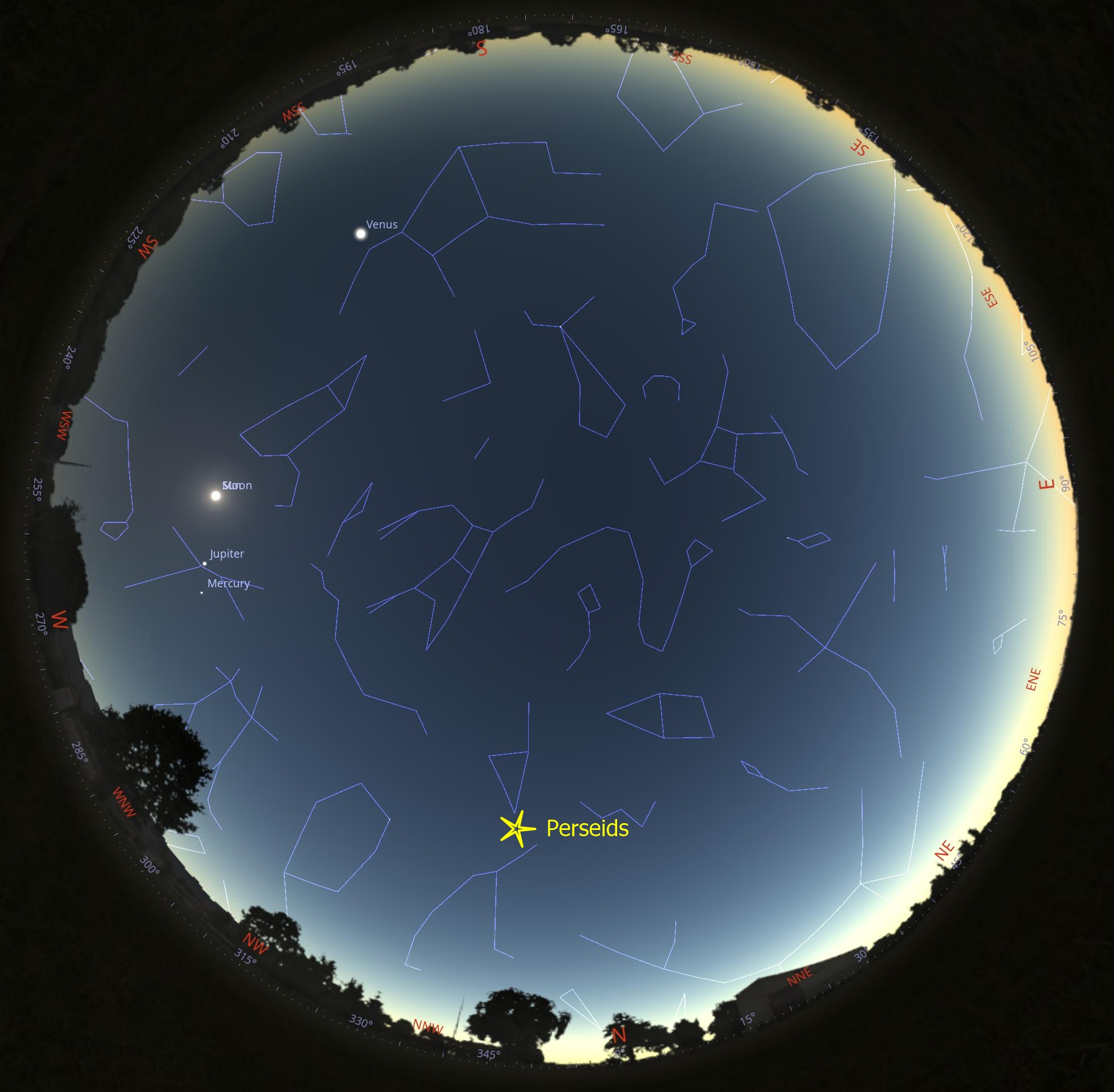
At lower latitudes (e.g., Spain), the radiant will be near the horizon at maximum eclipse, reducing detection probability (Pic. 71).
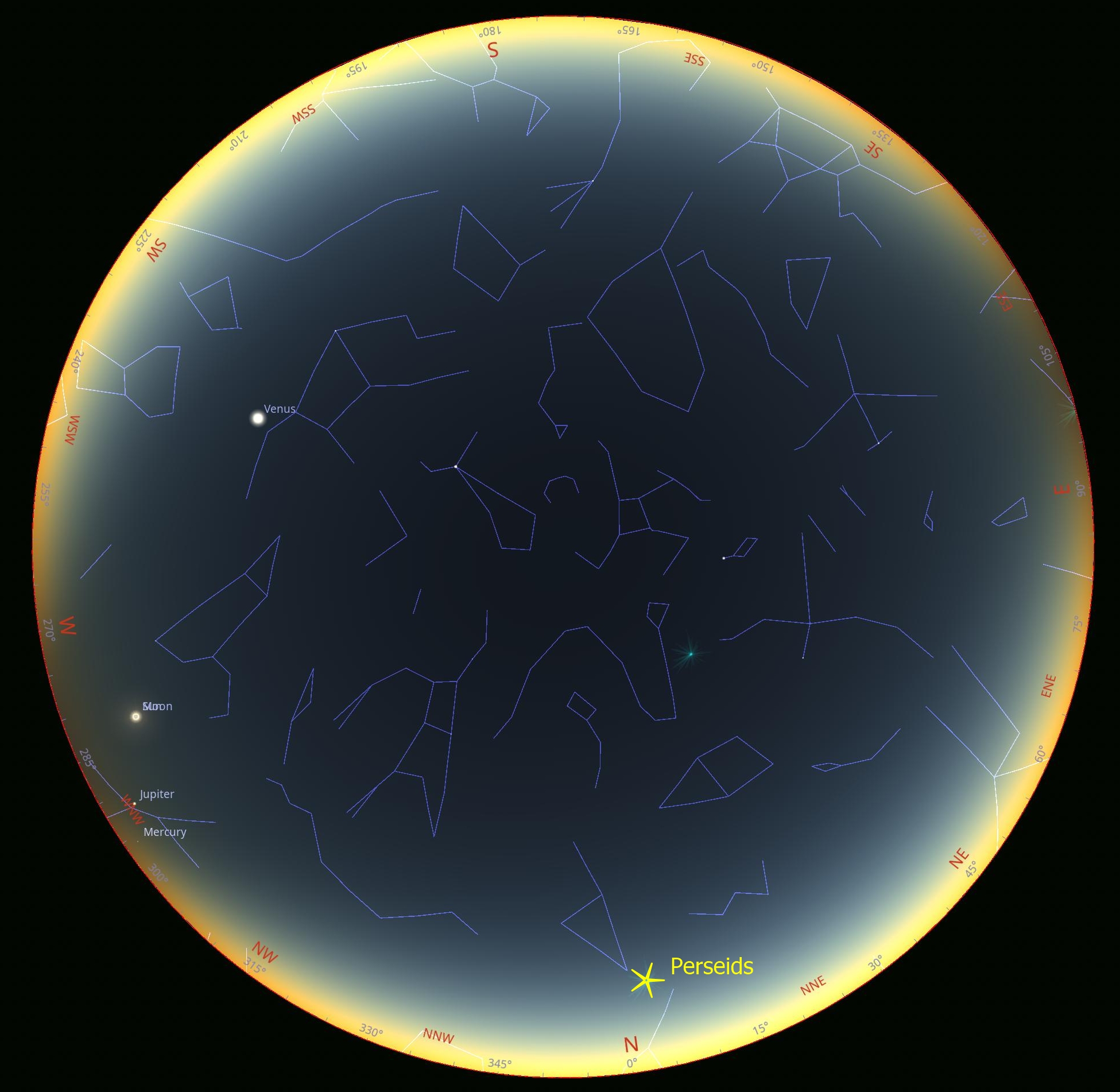
More favorable geometry may occur in parts of Italy, Malta, and Tunisia, where twilight combined with eclipse-induced darkening could marginally enhance visibility. Nevertheless, meteor rates during daylight totality will be substantially lower than nighttime ZHR values, and the probability of observing a bright Perseid during totality remains low, though non-zero.
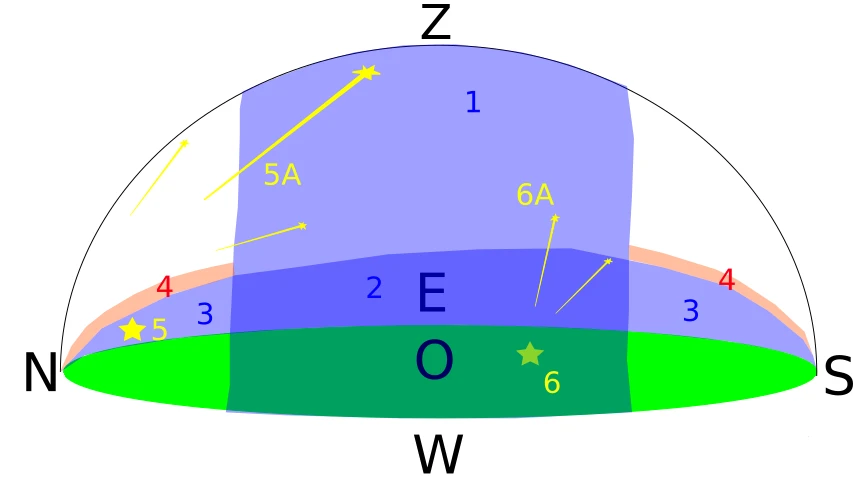
The Southern Delta Aquariids, active from late July to late August (peak ~July 28), will also be present but with a radiant generally positioned unfavorably during eclipse maximum. Overall, while simultaneous observation of meteors during totality is physically possible, expected event frequency is limited by sky brightness and radiant geometry.
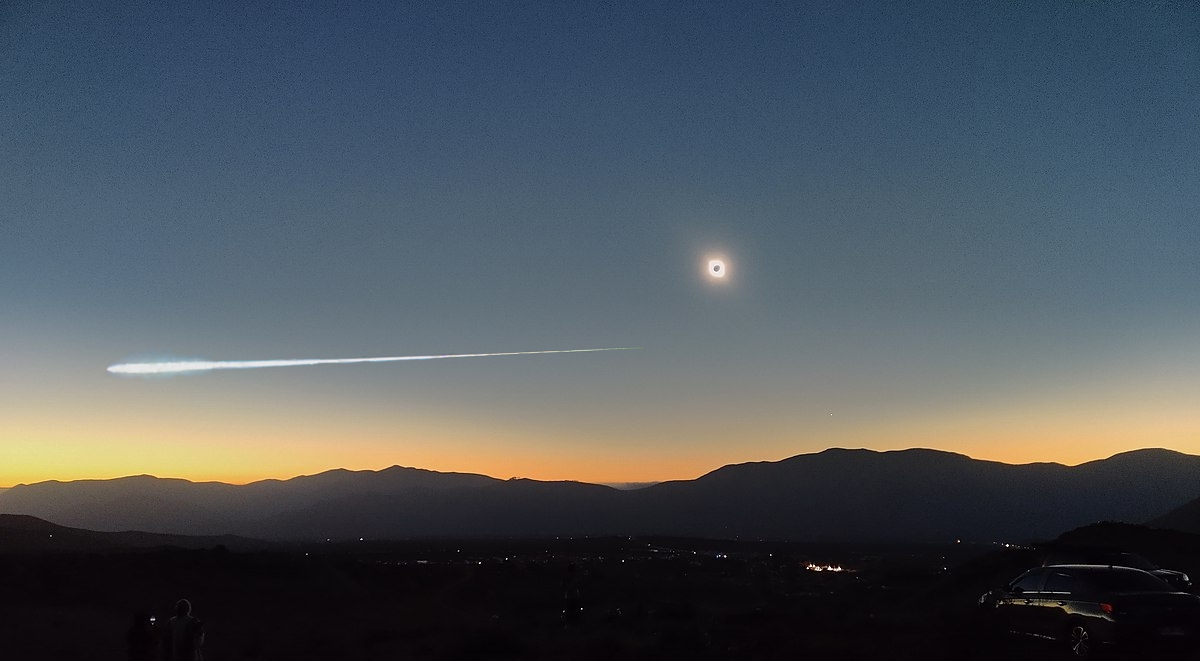
The position of the Perseids in a given location can be simulated in the 3D version of the Photography Ephemeris app (Pic. 74).
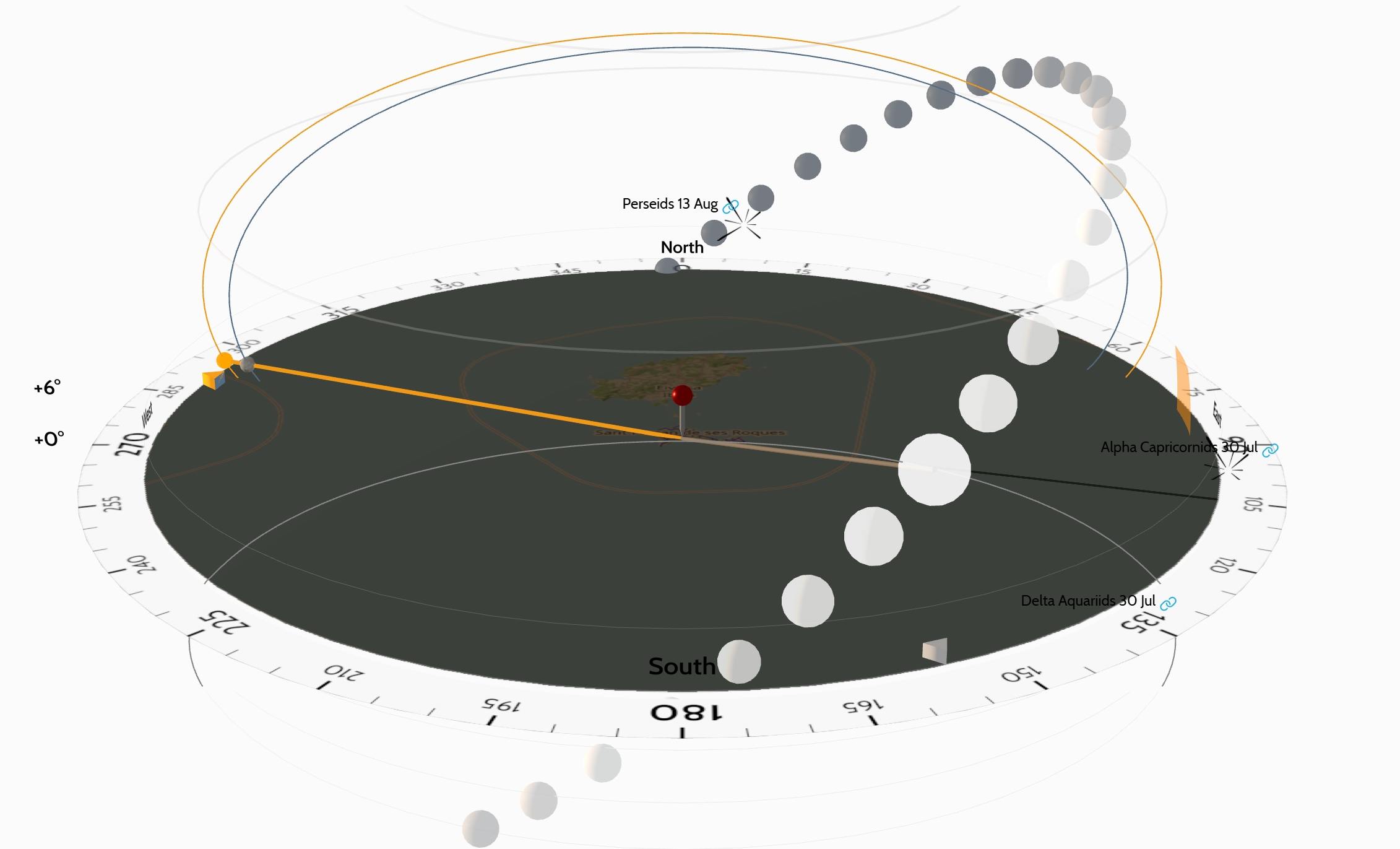
13. WEATHER PROSPECTS
The weather circumstances have been widely discussed in several sources. They refer to the geometrical path of a solar eclipse, which makes this chapter a supplementary section on the twilight zone, as no one has seriously addressed this topic so far. Before I start the analyses, it is worth mentioning one key website, which explains the weather along the solar eclipse path. This is undeniably Jay Anderson’s Eclipsophile.com portal, where we can find useful information about mean cloud coverage over the eclipse area. From the perspective of the impact of the solar eclipse on twilight, what is important is the average nighttime cloud amount for August (Pic. 75).
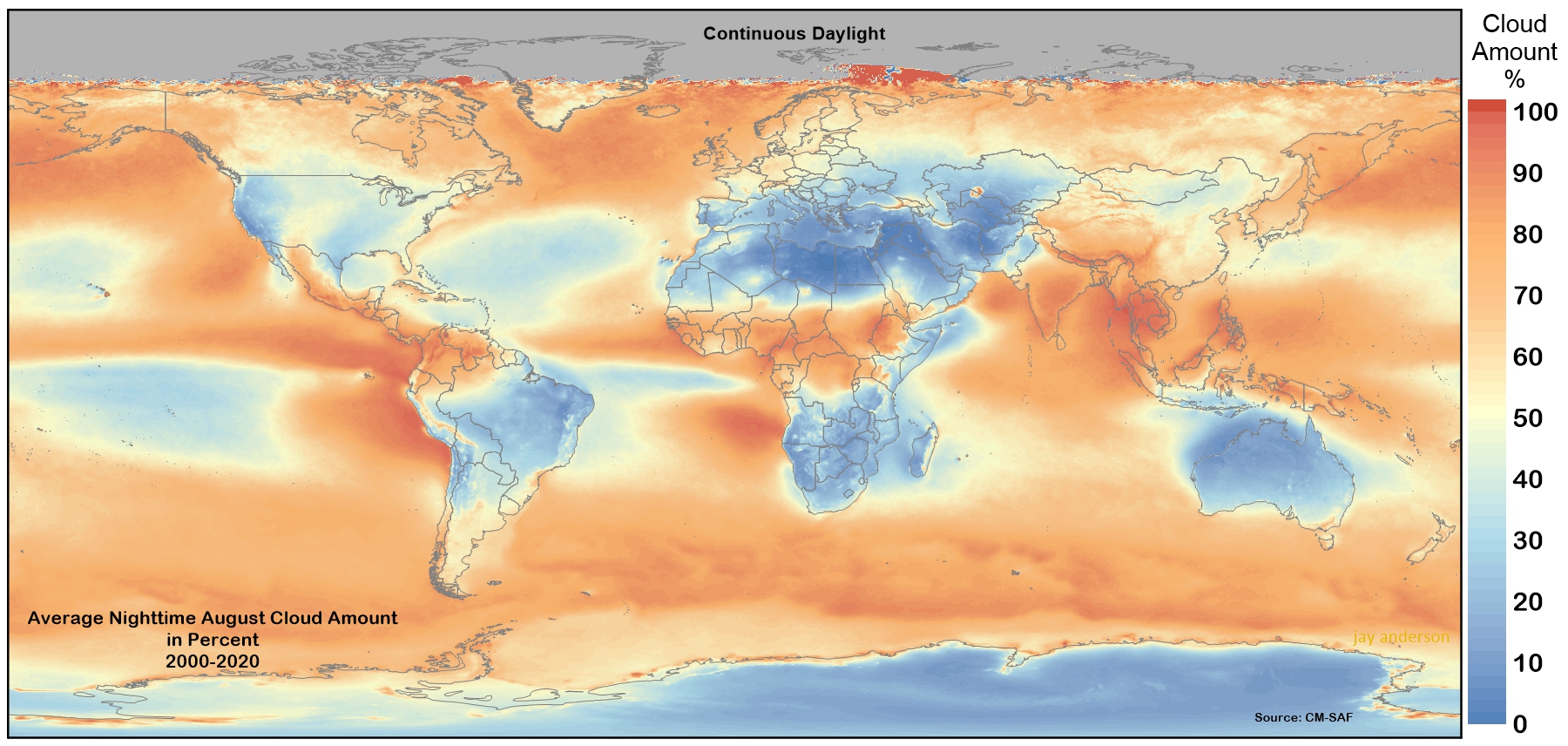
Other, more detailed maps refer to cloud cover at daylight hours. In the map below, the observation venues of the eclipse below the horizon have been marked (Pic. 76).
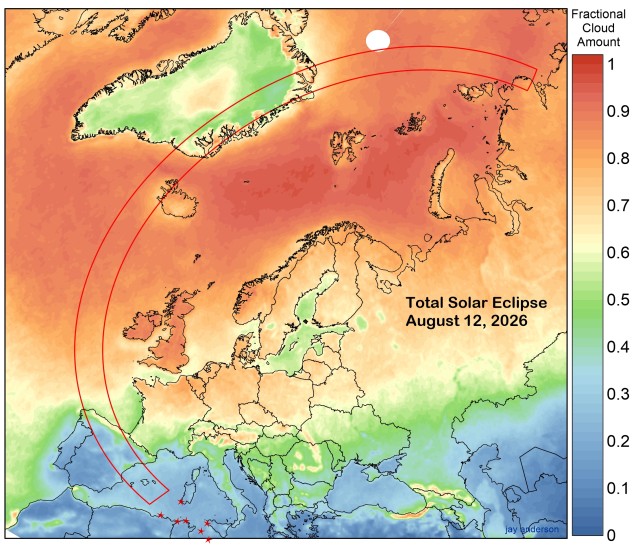
Except for Eclipsophile, this article lists other sources that could help you plan the observation. Additionally, it’s worth looking at two important articles, which explain typical weather patterns for the afternoon of the August 12 eclipse. The cloud coverage is too general, especially since it shows the situation exactly at the considered location. Even if these estimations cover the entire sky, an observer should still be aware of the object’s position. For example, if in the observation area the fractional cloud amount is, let’s say, 20%, but in the adjacent area to the west it increases to 50%, an observer should keep in mind that the western horizon may be more obstructed by clouds. Important is the line of sight, instead of the sky just above your head. Another important thing is the types of cloud. Usually, clouds are about 3-7km above the ground, but when vertically developed, they can reach 10 km. There is a good article explaining which types of clouds are most « dangerous » for observing a solar eclipse, when it occurs low above the horizon, and a map that lets you simulate the shadow of clouds at various altitudes (Pic. 77).
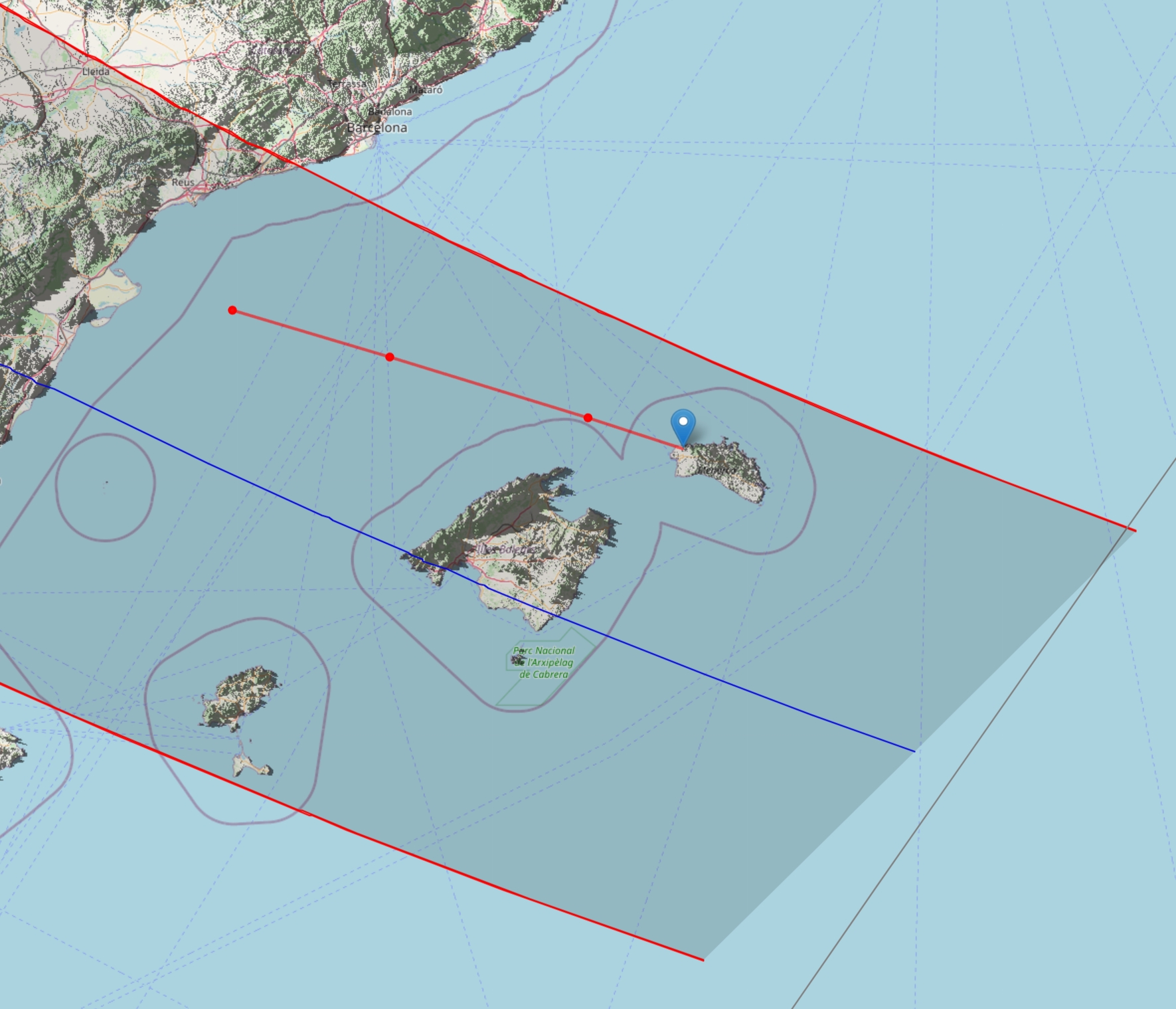
Also, the Photographer’s Ephemeris is a good tool for checking the weather, though it’s only valid for a short time before the eclipse. The level of detail, combined with an interactive map, can be very useful when looking for a place with good weather.
Now let’s dig down into the satellite imagery, on which the aforementioned Eclipsophile.com maps are based. There is a major flaw in these images, as they depict the fixed time of day at which the given region was captured. The weather can change within hours, and when the eclipse occurs in the late afternoon, the static satellite imagery may no longer be valid. This particular problem has already been discussed here. The best example is August 12, 2025, when the Iberian Peninsula was almost completely free of clouds at noon, whereas several hours later the situation was quite the opposite (Pic. 79).
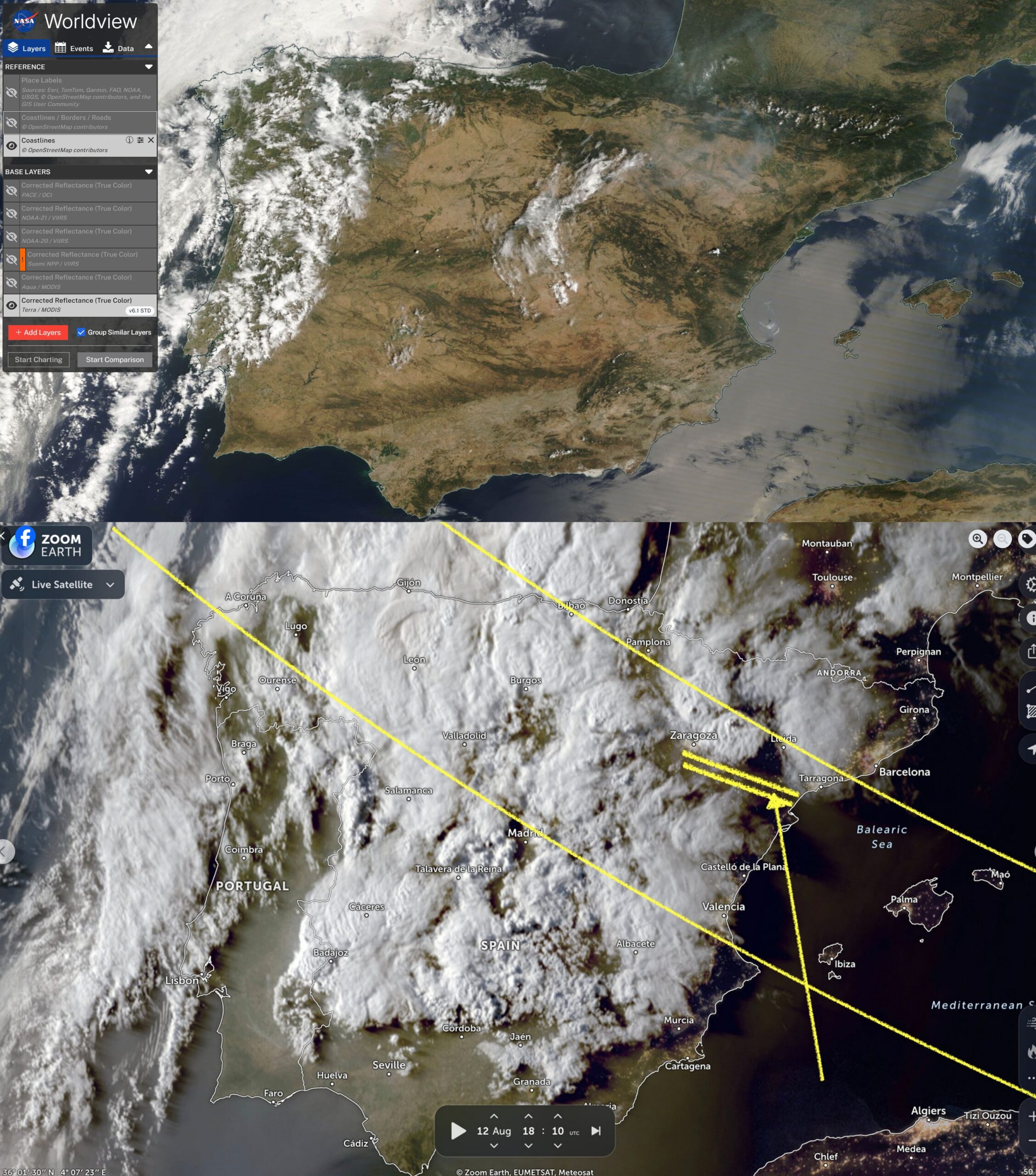
The circumstances are slightly different when the eclipse occurs in the morning, as the probability of vertical cloud development is much smaller than during the afternoon. In the case of a total solar eclipse in Spain and its impact on twilight in the Mediterranean region, deep analyses of satellite imagery aren’t sufficient. I used them only as the statistical data for the places where the eclipse below the horizon can be watched (Pic. 80). I’ve assumed them by the following criteria:
1 – Clear skies
0,75 – Clear skies with a tendency for vertical cloud development during the afternoon hours, presence of cumulus, and other types of patchy clouds at a distance of less than tens of kilometers from the observation venue,
0,5 – Serious sky obstruction by the clouds at a distance smaller than 50km from the observation venue. The clear sky above head, but not clear at the line of sight, intensive cumulus clouds developed over the day
0 – The overcast or partially overcast day with a probability of serious cloud coverage at late afternoon hours. As a full overcast day is extremely rare at this time of the year, various types of cloud presence are common. Intensive thunderstorm clouds are developing in places.
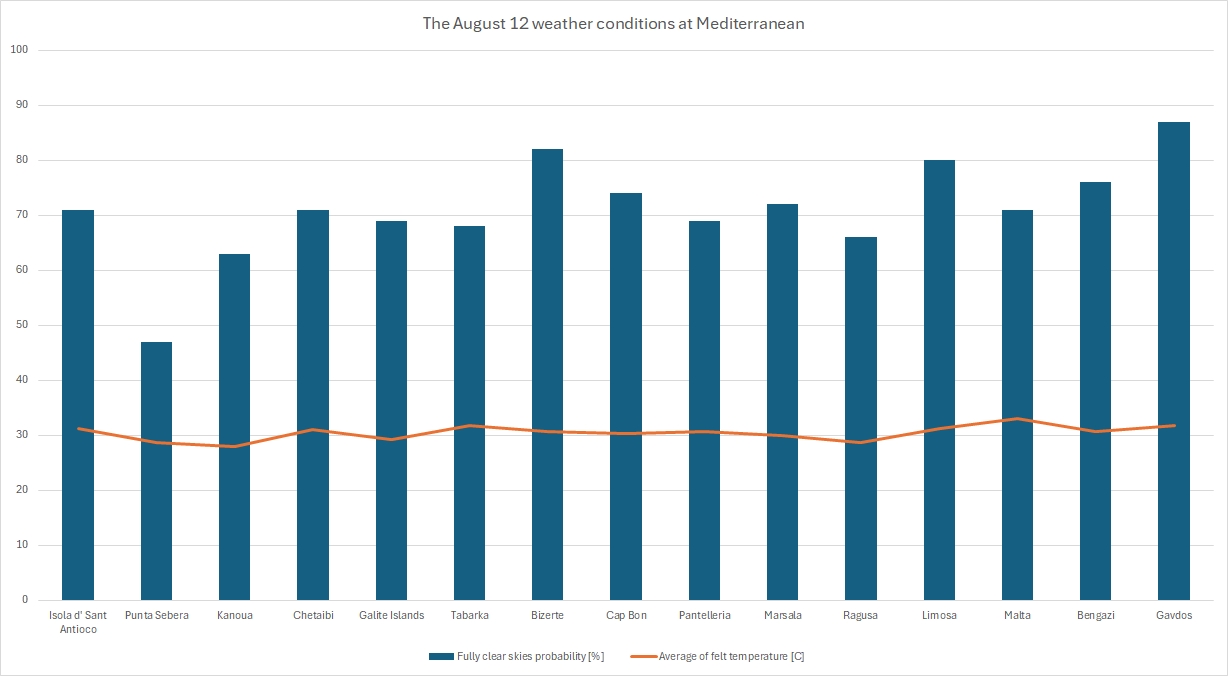
The chart shows that the probability of clear skies tends to increase as we move eastwards. In my estimations, I accounted not only for the pinpointed location but also for the surrounding area, assuming that nearby clouds can cover a significant portion of the sky. The biggest problem is the potential development of thunderstorm clouds as well as significant wildfires or dust storms, which can eventually ruin the observation, as smoke can completely veil the sky (Pic. 81).
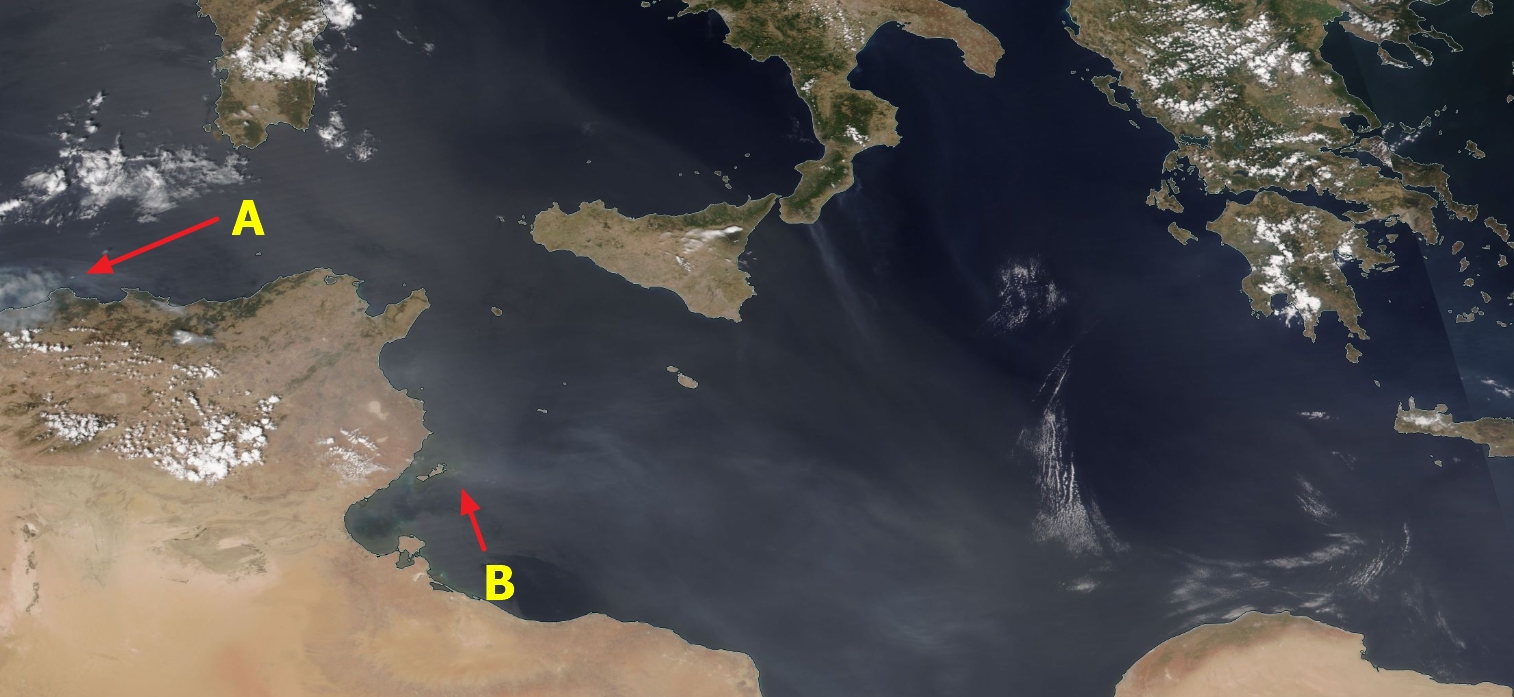
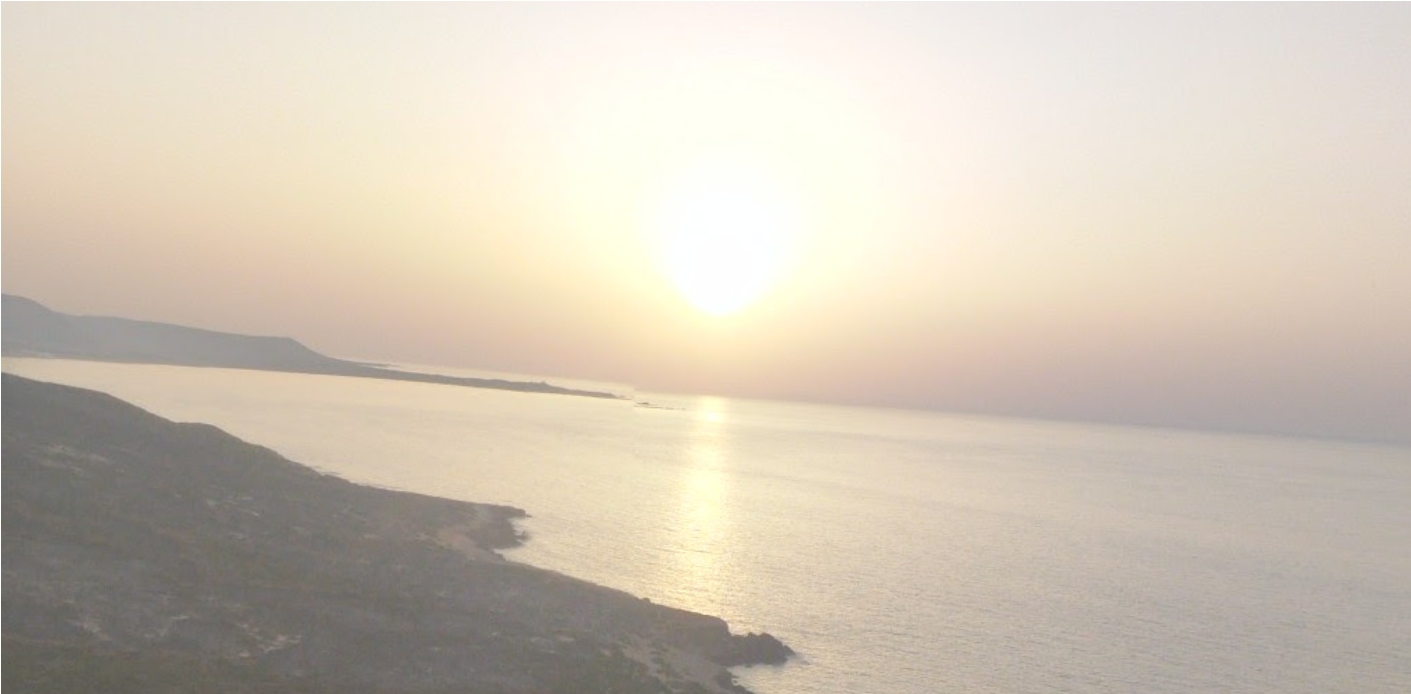
Not to mention, smoke creates favourable conditions for various types of cloud development.
To partially verify the data in the chart above, we can use the Ventusky.com application, which provides daily satellite imagery captured every 3 hours since 2022! (Pic. 80)
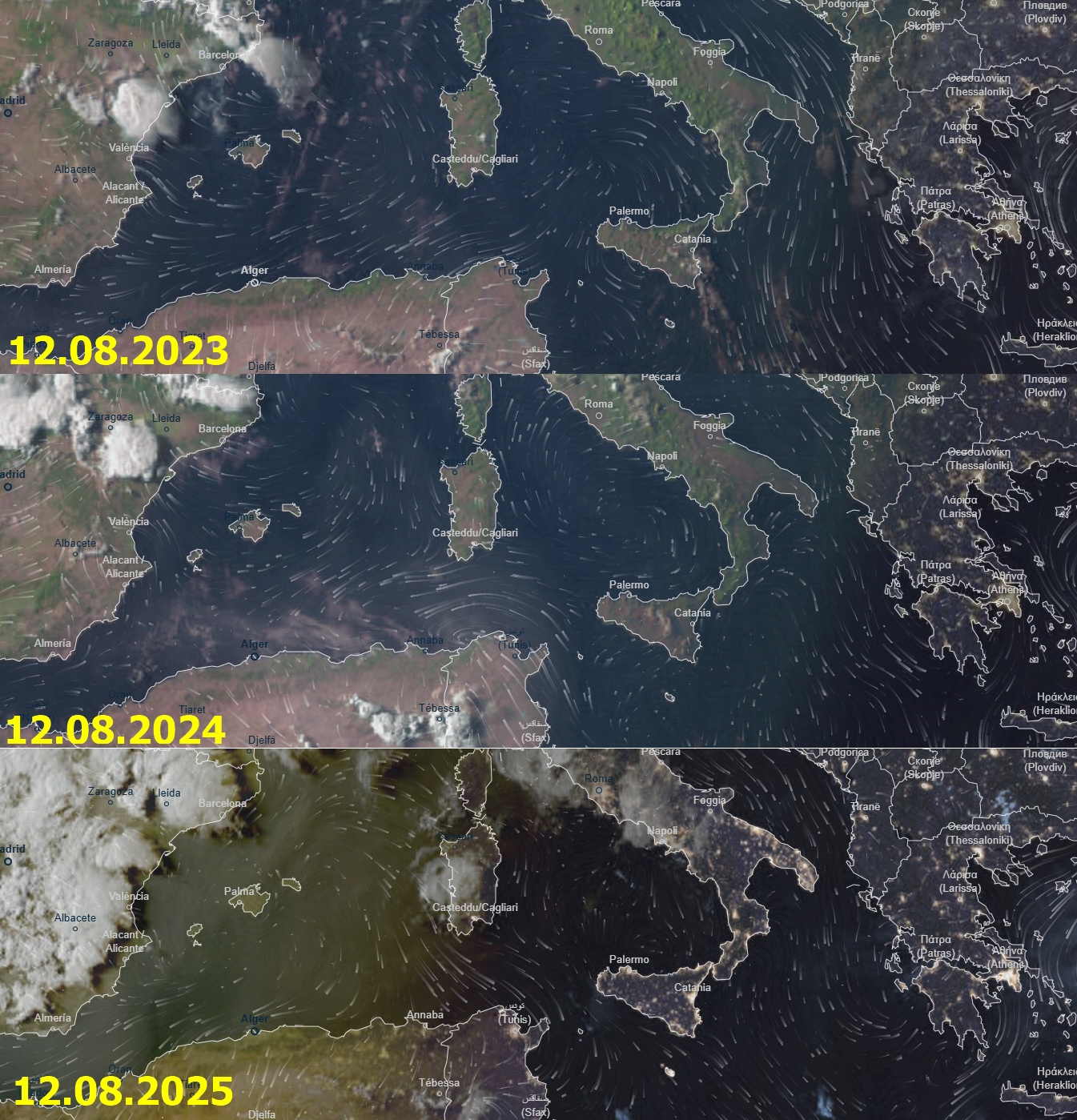
Next, all these places are located within an area almost free of clouds, according to the Eclipse App.
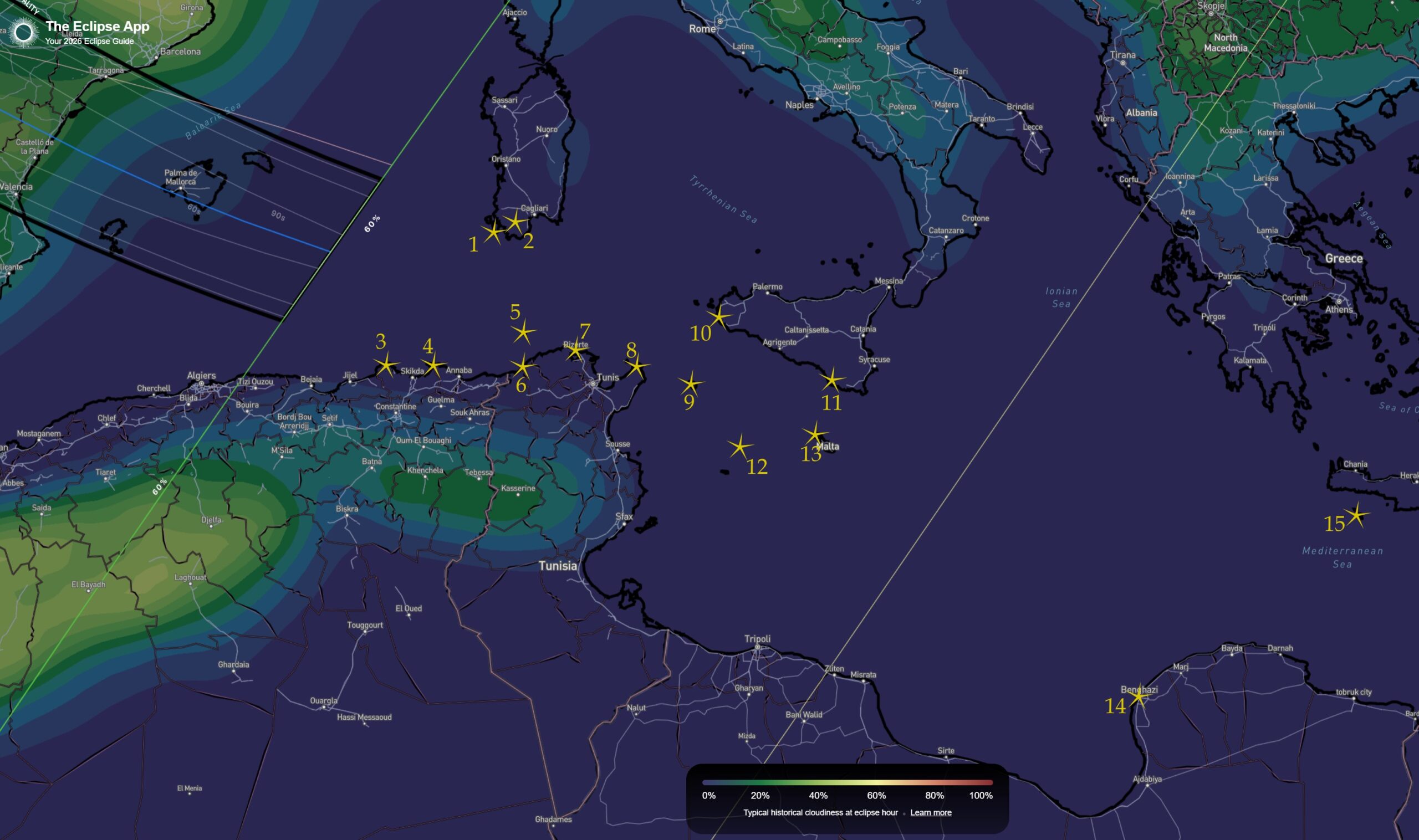
By looking at the results directly from the map above, we can see in detail what the cloud coverage can look like on August 12 between 8 and 9 pm (Pic. 81).
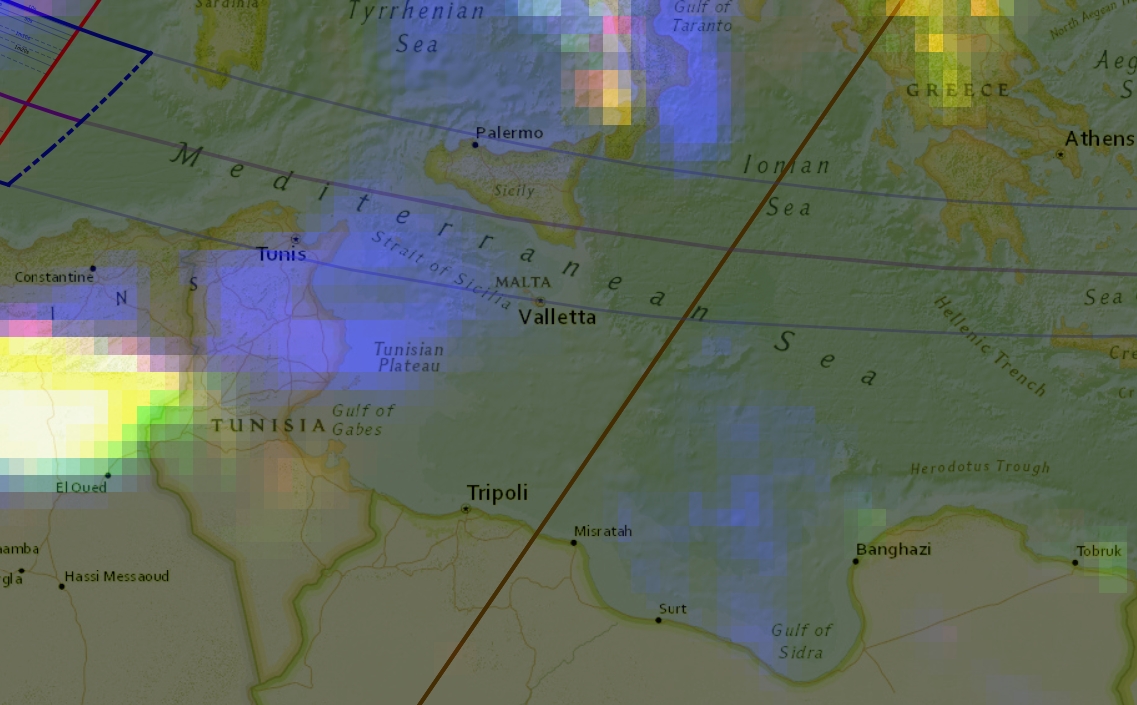
Finally, most of the locations listed on the map above are subject to deep analyses provided by the weatherspark.com service.
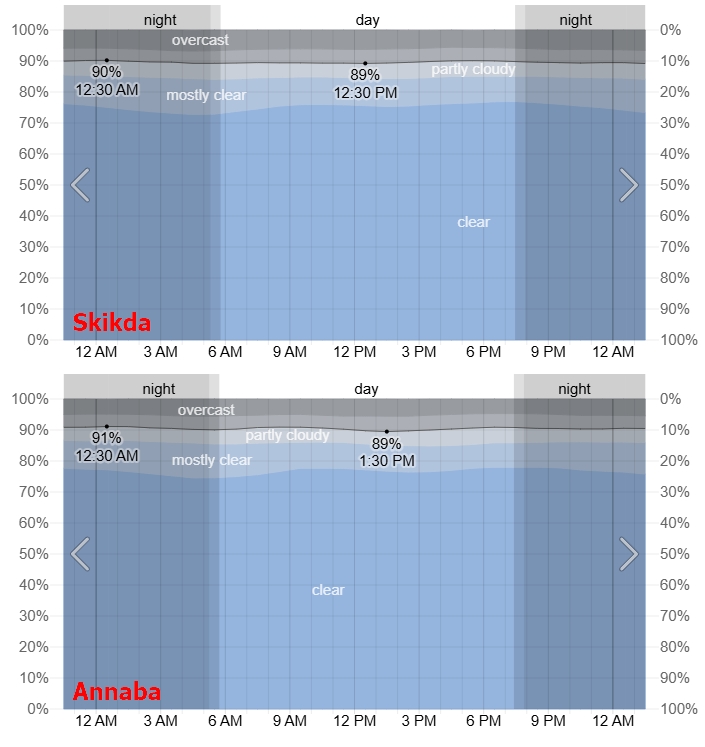
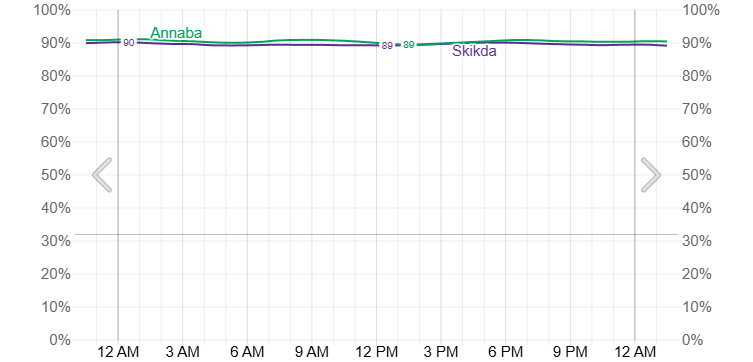
Unfortunately, Weatherspark.com doesn’t support data from the mountainous Algerian coast except for the largest cities nearby. A potential observer must be aware that climbing above 1000 m above sea level can result in much worse weather, as the probability of vertically developed clouds and thunderstorms is quite high. A good hint is to look at the eclipsophile’s average total cloudiness over Spain in August, which occasionally includes northern Algeria. We have a high probability of cloudiness along the coast, where the air rises adiabatically towards the Atlas mountains (Pic. 84).
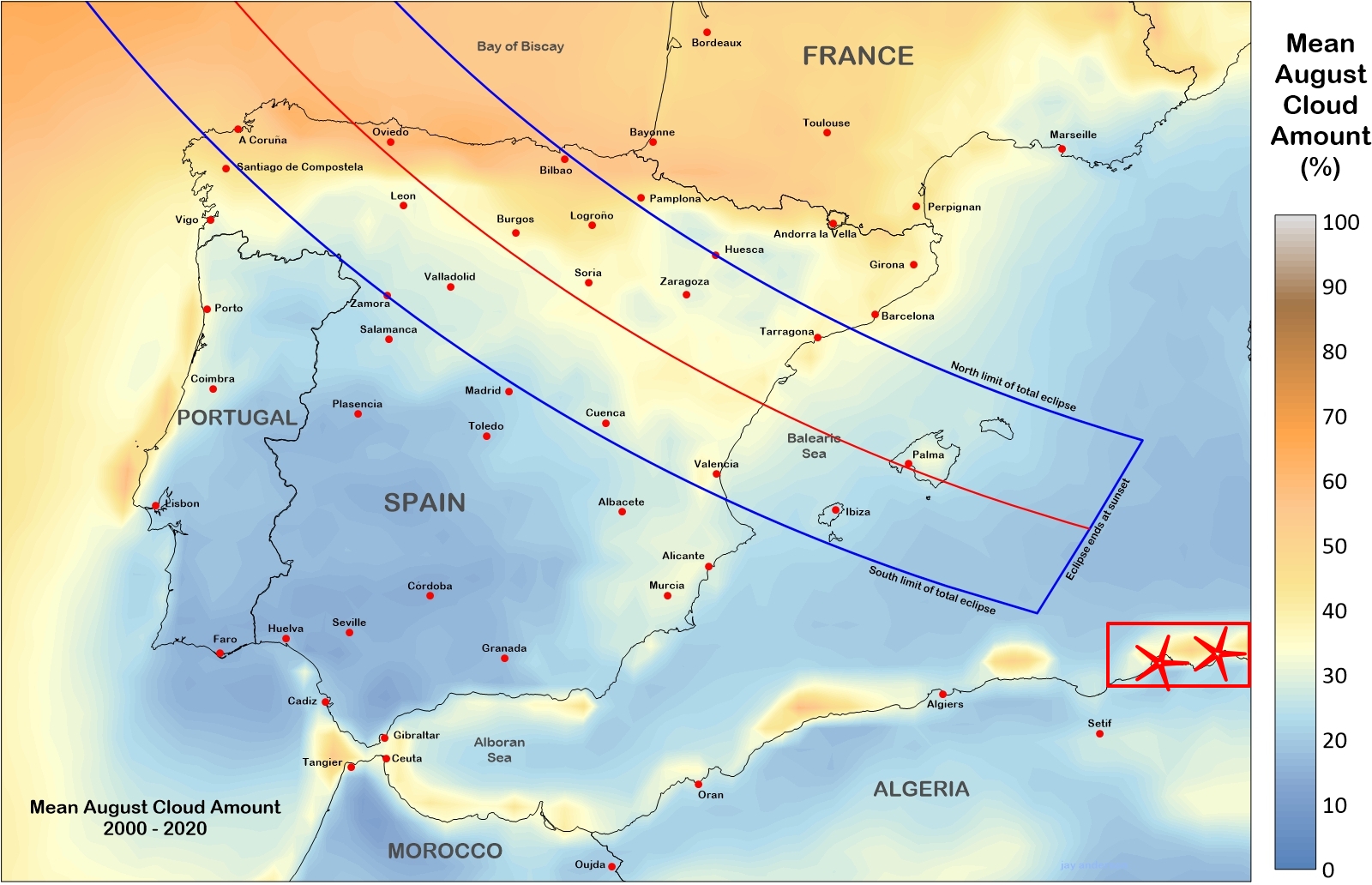
The weather tends to improve as moving eastwards along the southern Mediterranean coast. In Tunisia, the probability of clear skies exceeds 90%, especially at the eastern tail of the Atlas Mountains (Pic. 85-86).
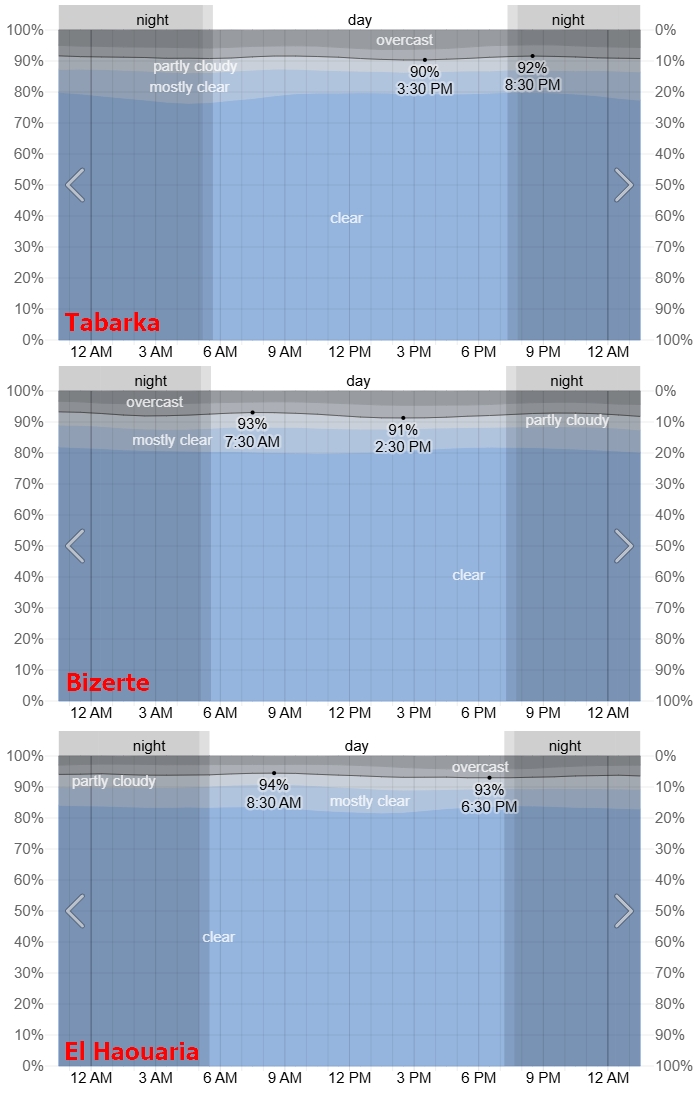
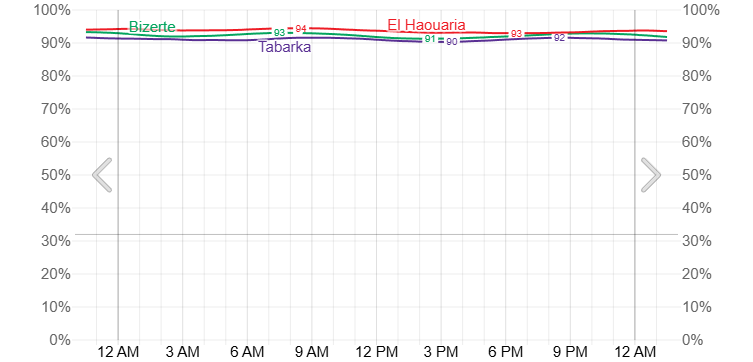
Unlike Tunisia, the western coast of the Mediterranean, at Sardinia, seems to be the most risky for evening thunderstorms. In fact, they disappear as the eclipse progresses, but we must be aware that the event occurs late in the afternoon, when thundery cells develop, often with capillatus clouds, which eventually won’t dissipate as quickly, veiling large sections of the sky. Another thing: even if we assume the thundery clouds will dissipate quickly, this process mostly occurs on the ground, where cooling is much faster than in seawater. Again, the analyses below don’t cover the Punta Sebera surroundings, so two adjacent locations have been picked up (Santadi and Pula).
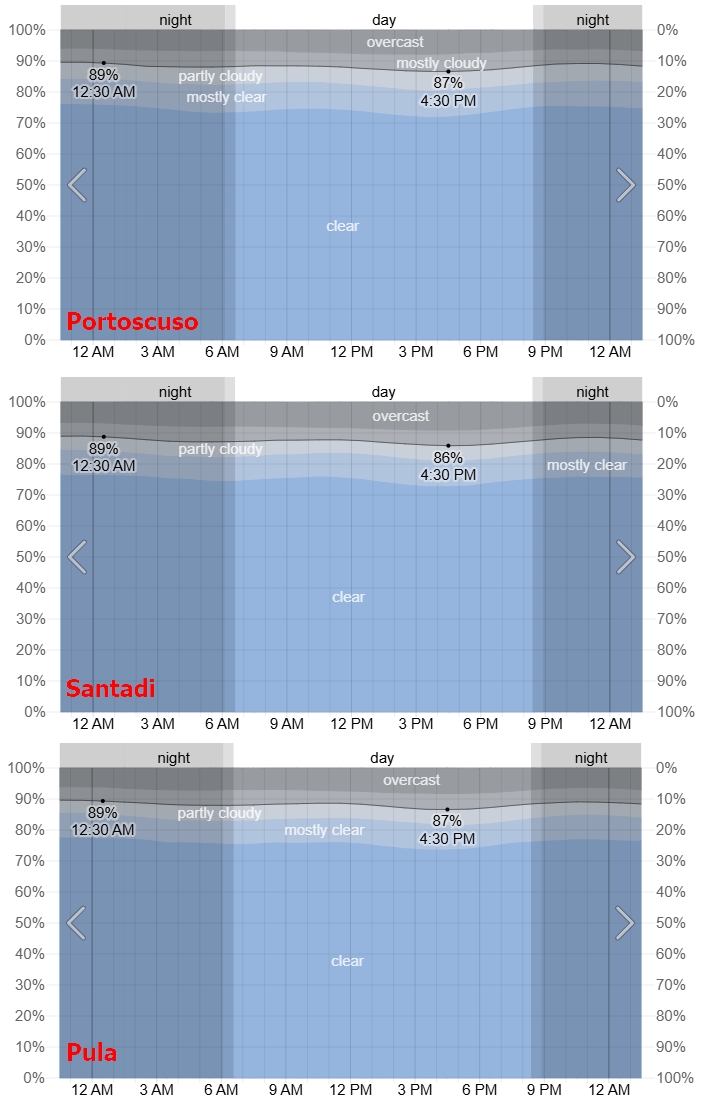
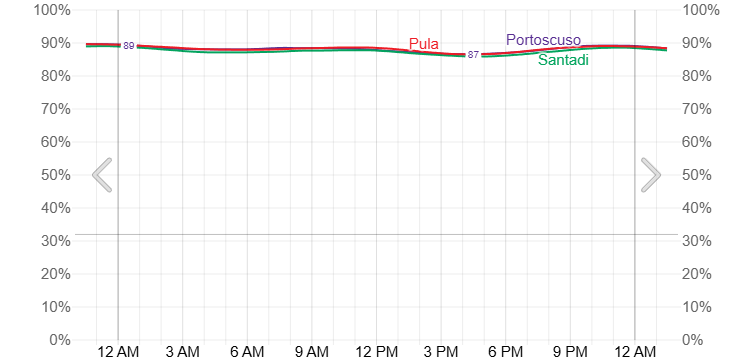
The weather prospects significantly improve in southern Sicily, where the chance of clear skies is fairly high, exceeding seriously 90%. However, a potential observer must be aware of the possibility of vertically developed clouds in the evening. Especially around Ragusa, the probability of clear skies is just 80%.
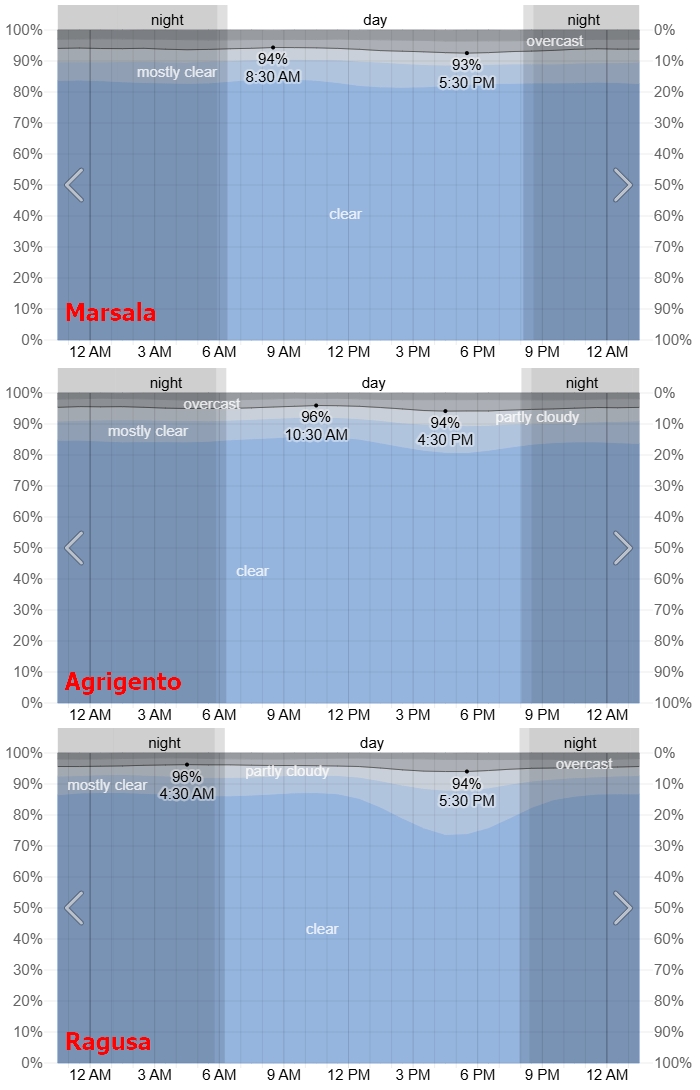
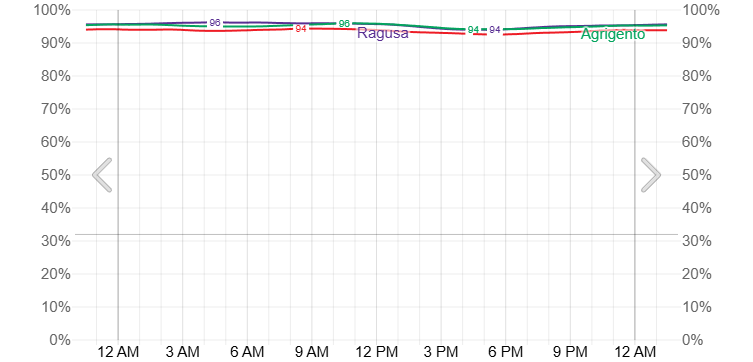
The best weather prospects are for the central Mediterranean section, where, unfortunately, the greatest eclipse effect won’t be observed within the civil twilight zone, except for Pantelleria.
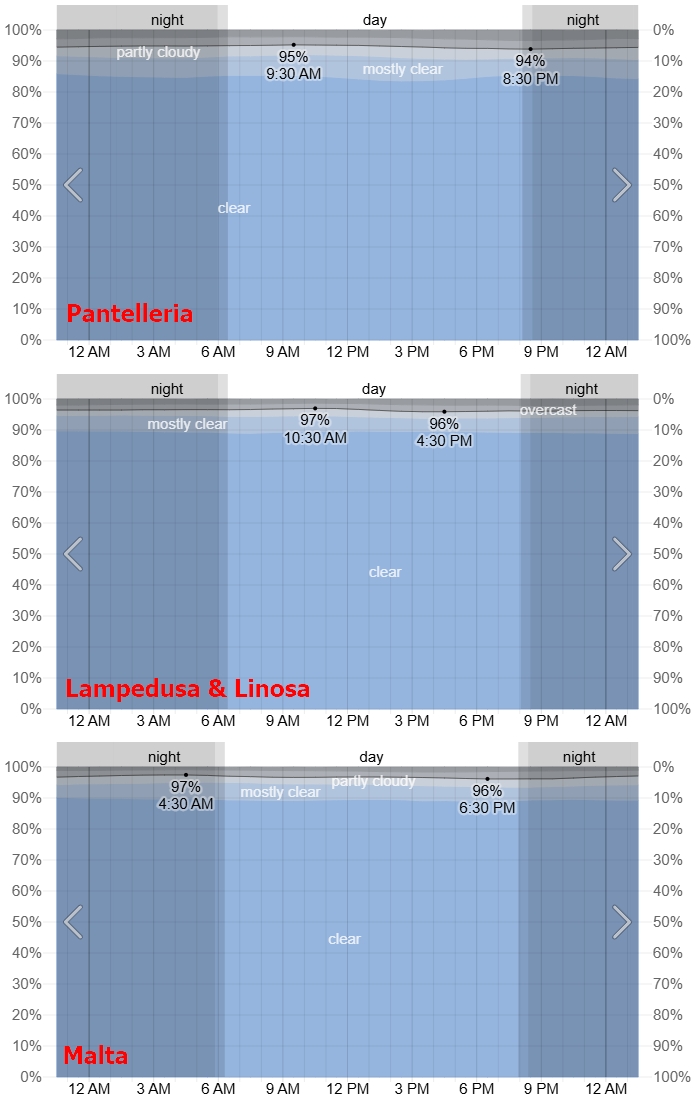
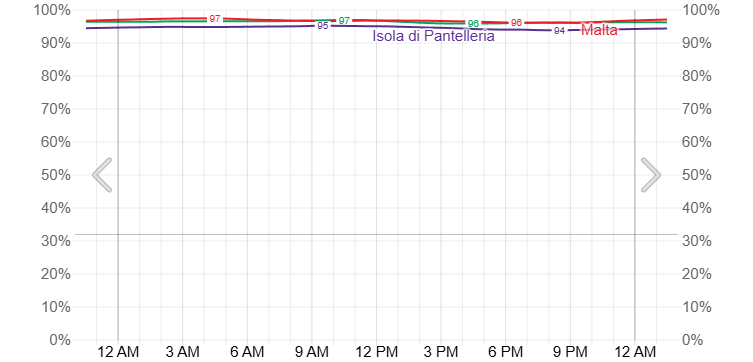
The largest chances of clear weather, almost 100% of the sky free of clouds, apply to the easternmost locations considered, where the eclipse impact can be observed just within the astronomical twilight zone.
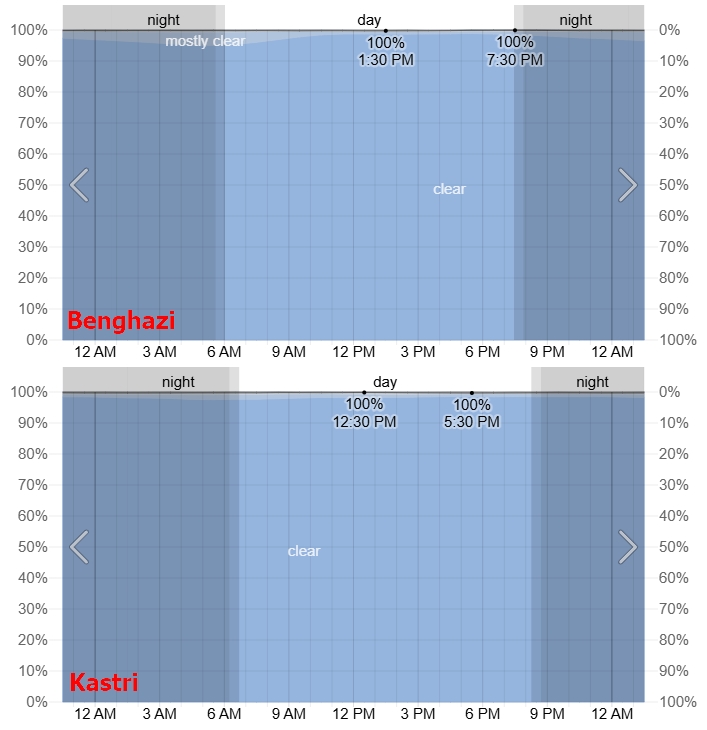
In conclusion, the predictions show the general probability of clear skies, with an understanding of sky visibility under partially cloudy conditions! The colour charts provided suggest that there is an additional 10-15% on average, with the sky being rather clear but not fully clear. It means a lot, especially in situations when the sky is veiled by thin cirrus or cirrostratus clouds, which can disrupt the observation of optical effects or, on the other hand, help with them when the event occurs just after sunset. Another important point is that these analyses mostly refer to the sky above our heads. Most of the charts show an increase in cloudiness in the late afternoon, which directly precedes the observation time between 8 and 9 pm. It does look clearer, however the presence of potential « old » thunderstorm cells or their remnants might deteriorate observation especially at antisolar direction. Conversely, on the opposite side, towards the setting Sun, the presence of especially high-level clouds can help observe the movement of the umbra near the terminator line or even allow the observer to see shadow bands?! Who knows?!
Apart from the standard « cloud coverage » projections, we should be aware of the atmospheric clarity (Pic. 95).
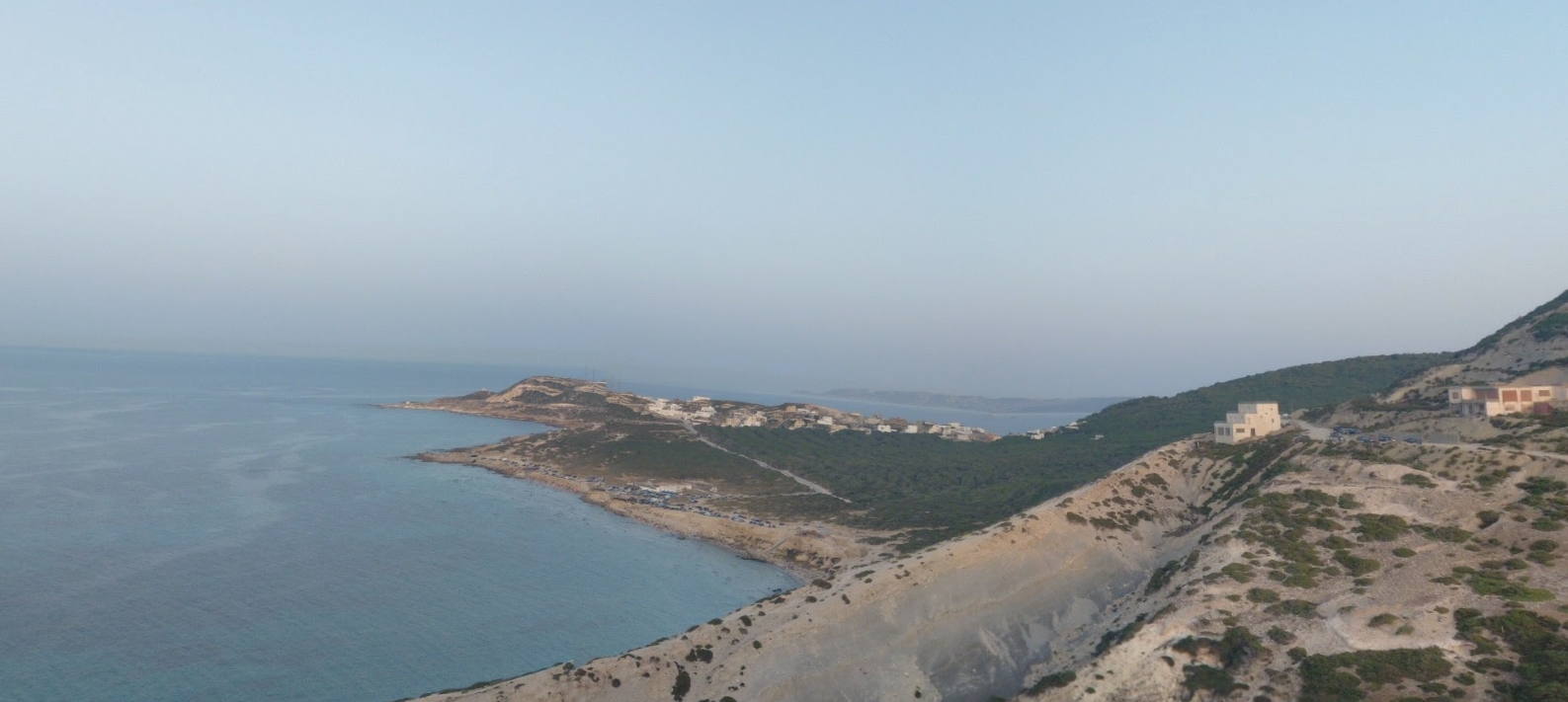
The presence of aerosols, especially lithometeors produced by local wildfires, combined with extremely high humidity along the coast, can significantly alter the appearance of the sky. The humidity level varies predominantly between 70 and 95% across the considered observation sites (Pic. 95).
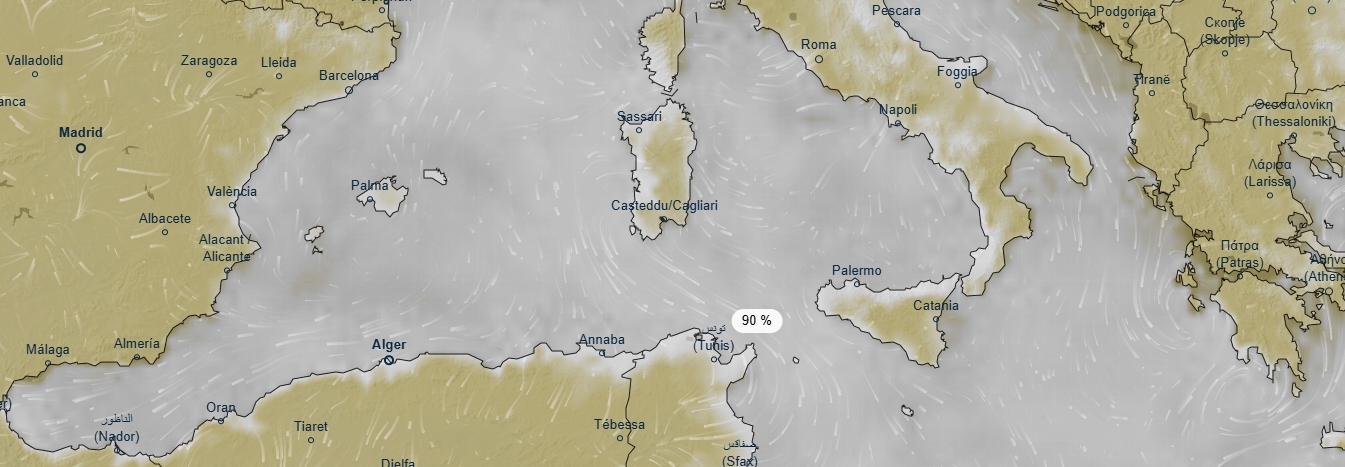
The potential wildfire hazards can be checked in real time on this website. It’s important to do it directly before your observation, along with a wind direction.
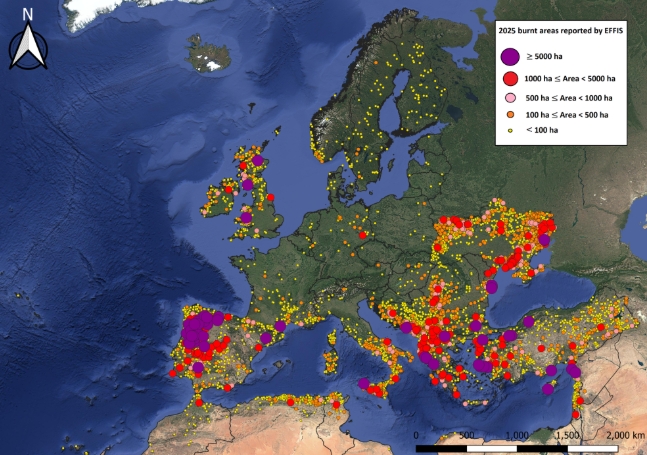
For historical data back to 2000, you can use this website to check where exactly the wildfires occurred on August 12 (Pic. 96).
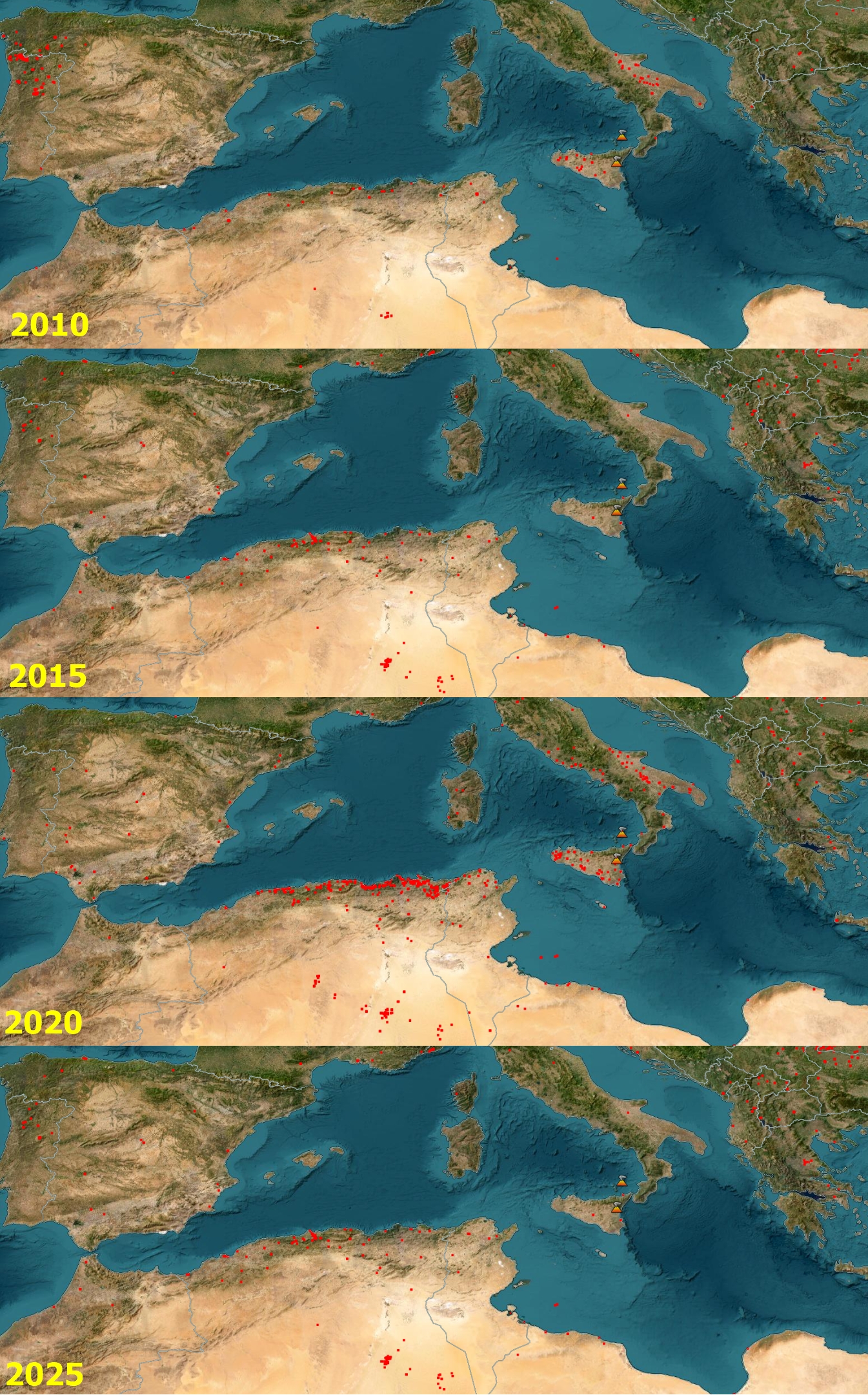
The last thing is the observation conditions themselves. The good weather might not be enough, as observation comfort is essential for focusing and achieving decent results. Unfortunately, the Mediterranean region features rather miserable conditions with an average temperature of around 30 degrees, which, combined with high humidity, can make observers distracted.
Finally, it is important to know a few weather forecast websites that can help you choose a suitable observation site shortly before the eclipse. They’re listed below with all relevant layers to consider:
-> Windy.com (satellite imagery, humidity, aerosols, dust concentration, wind)
-> Ventusky.com (satellite imagery, clouds forecast, wind gusts, air quality)
-> Dust.aemet.es (dust concentration and its movement within hours)
Moreover, it’s good to have the Weather & Radar app on your phone.
14. LIGHT POLLUTION
Light pollution can affect the observation of the solar eclipse’s effect on twilight, especially in the antisolar direction. Because the light begins to disrupt at a solar depression of approximately 9°, the problem has been considered only in the twilight zone. According to the eclipse’s impact on the twilight nomograph, the light-level conditions corresponding to the aforementioned solar depression occur just after sunset, as far as totality is concerned. Second, based on observational experience in Spain and the relevant visualizations presented in Chapter 15, light pollution is considered for locations near the projected extension of the umbral path. It doesn’t mean the effect won’t be visible in other locations; it will simply be less pronounced. Placing yourself at the estimated extension of the totality means at least a minimum period of time, during which the fleeting umbra will be visible exactly at solar direction, which by definition is the brightest in the sky. Analyses of light pollution have been divided into 3 major areas, most favourable for the event’s visibility. They refer not solely to European boundaries but to the entire Mediterranean region.
Mediterranean west – the first area, where the eclipse is to be watched mostly within the civil dusk (Pic. 80).
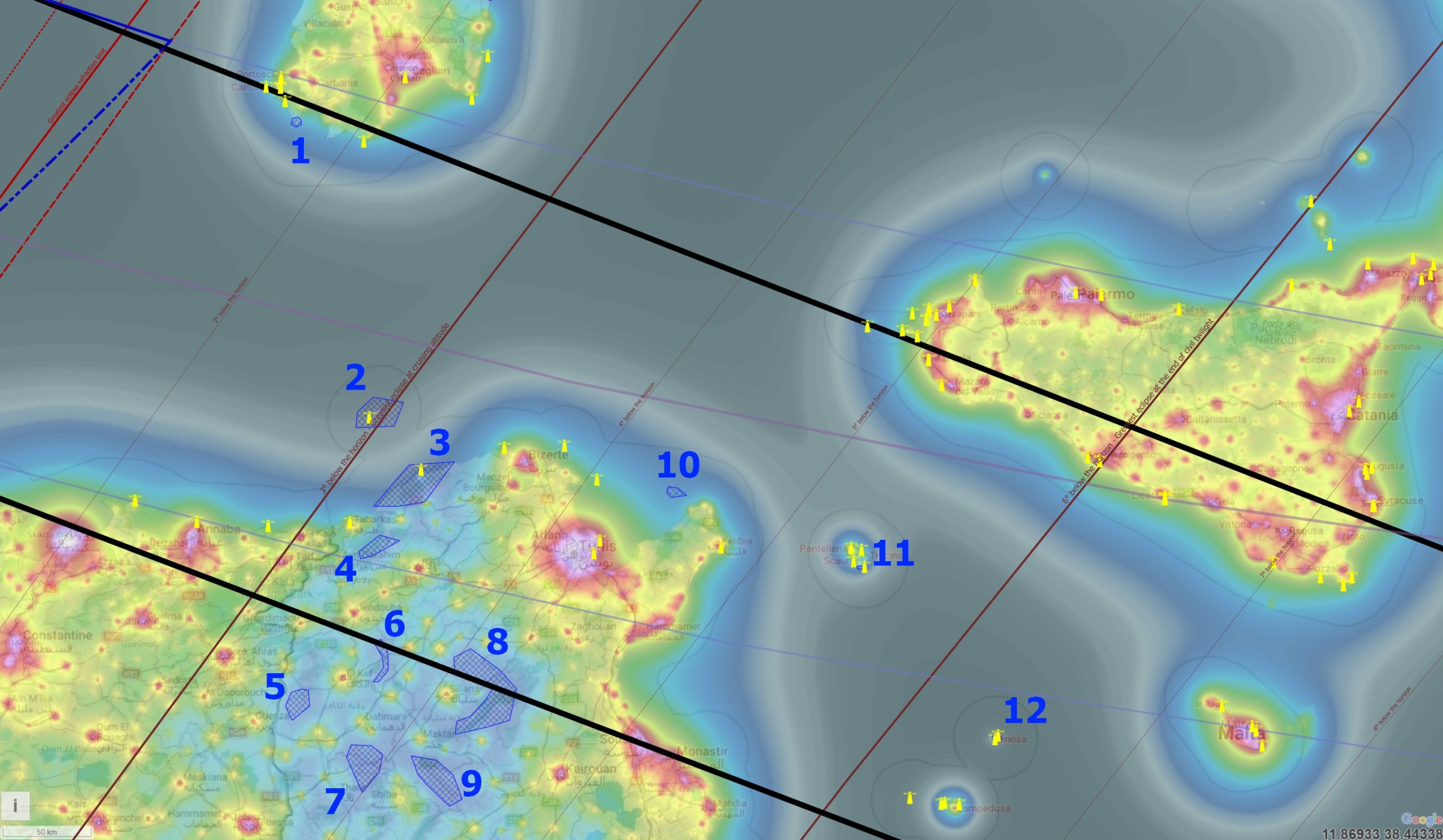
There are 12 areas found in the following region, which are described in detail below:
1 – The Capo Sperone surroundings – precisely the Peonia Rosa village, easily accessible by car. Next, you can take a short walk to the Su Monti de Su Sumafuru summit and enjoy the elevated view. An estimated antitwilight sky quality is Bortle 2, as the observer is located north of the NATO military polygon at Cape Teulada, the southernmost tip of the Sardinian mainland. See Google Street View.
2 – Galite Islands – this intriguing and inhabited archipelago belongs to Tunisia and offers Borelt 1 sky at solar and zenith direction. Unfortunately, due to proximity to one of the largest metropolitan areas – Bizerte, located approximately 80km in a beeline, the sky quality at antisolar direction could be at most Bortle 2. Moreover, the western part of the sky can be occasionally disrupted by the Galiton lighthouse. There are 2 spots to be occupied during the observation: Gran Sommet, the highest, and the Eastern Summit, which rises 360m above sea level. See the on-site view here.
3. The Cap Serrat region – a quite large section of the Mediterranean coast in Tunisia, stretched at a distance of about 30km wth Bortle 2 scale. The best place appears to be around the Sidi Ferjani village, because of the lighthouse at Cap Serrat. The only source of light here is the Lac Zayotine water dam. See an example location here.
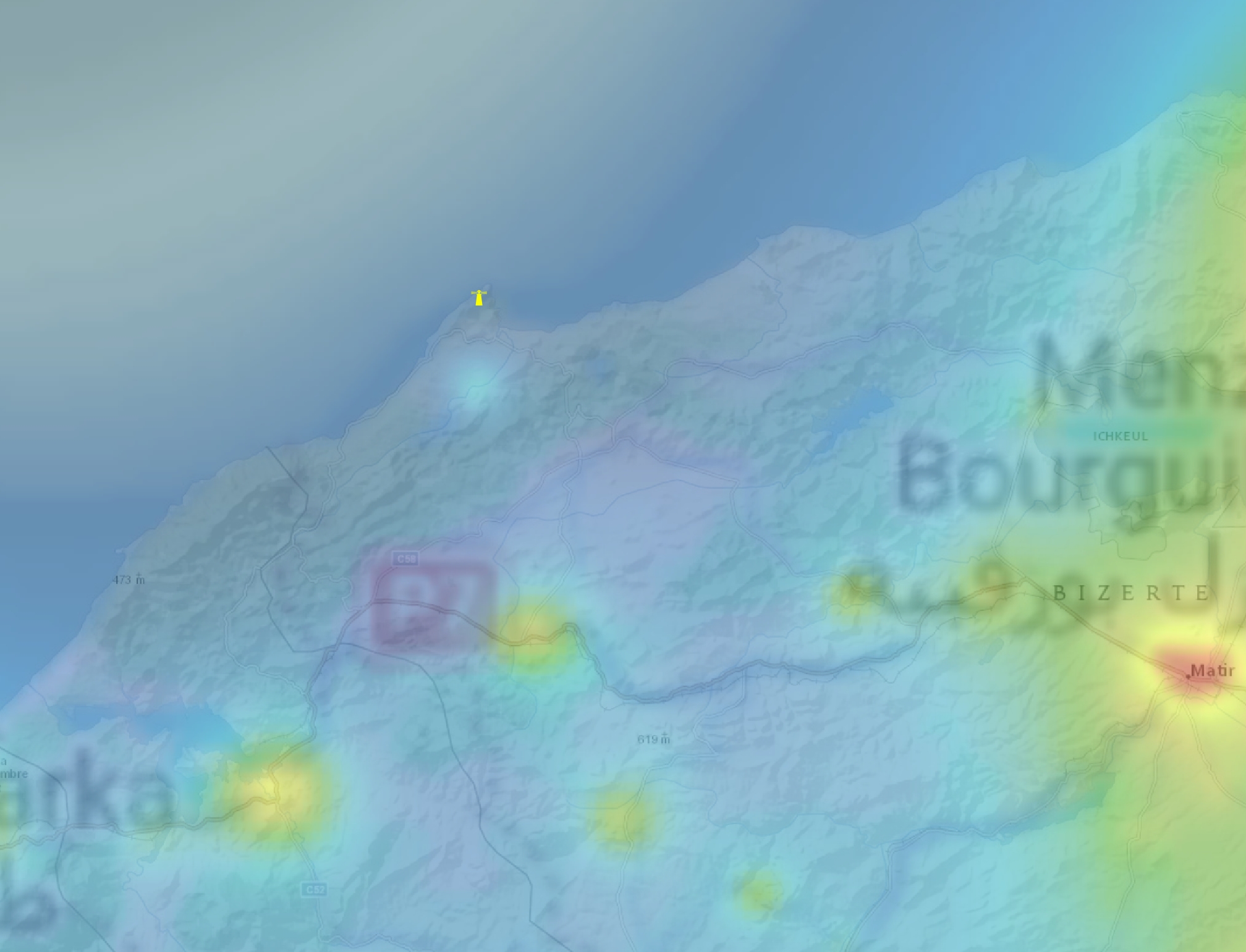
4. Ai Houadidia – precisely the mountainous region south of the village, where the local road zig-zags across the Ain-Draham range. The sky at the antitwilight azimuth looks promising, although the proximity of Beja city (around 30km) results in a Bortle 3 scale.
5. West of Al Kaf – the sparsely inhabited Atlas hills offer a good sky with Bortle 2 scale. However, the average distance to the nearest towns is less than 25km, which can be problematic.
6. Borj El Messaoudi – Another mountainous area in northern Tunisia, where the event should be visible well. It’s easily accessible, i.e. from Tunis. This place is potentially considered for the Eclipser Terminus 2026 project (See chapter 17).
7. Jebel Ballouta – This mountain rises over 1200 m.a.s.l., and a huge part of the ground northwest towards Ain Eddisa and Labar villages is almost free of light pollution with a Bortle 2 sky. A relatively short distance to Siliana town (15km) can make antitwilight observation problematic.
8. Oum El Abouab – the region located near Tunis, it’s around 1,5 hour drive from the capital of Tunisia and is famous for some archeological sites. Sightseeing can be combined with the observation of fleeting umbra in both directions. The bortle 2 sky at zenith doesn’t compensate for the antisolar direction, because the light pollution increases significantly towards the east.
9. South of Maktar – the southernmost region in Tunisia, considered for watching the eclipse event below the horizon. Another great area with bortle 2. You won’t find any settlement nearby, so there is nothing to disrupt the observation. There is over 35km to the nearest town at antisolar direction.
10. Zembra Island – the Zembra National Park area protection with an elevation of almost 400 m.a.s.l., comparable with the Galite Islands. The Bortle 2 sky at zenith is seriously interrupted by the vicinity of Tunis lightglow located just 60km away in the southwest direction, although it shouldn’t disrupt the observation at solar direction, which remains bright enough. In the antisolar direction, the sky turns to Bortle 1 in the background, although the presence of a lighthouse on the adjacent islet of Zembretta can be problematic.
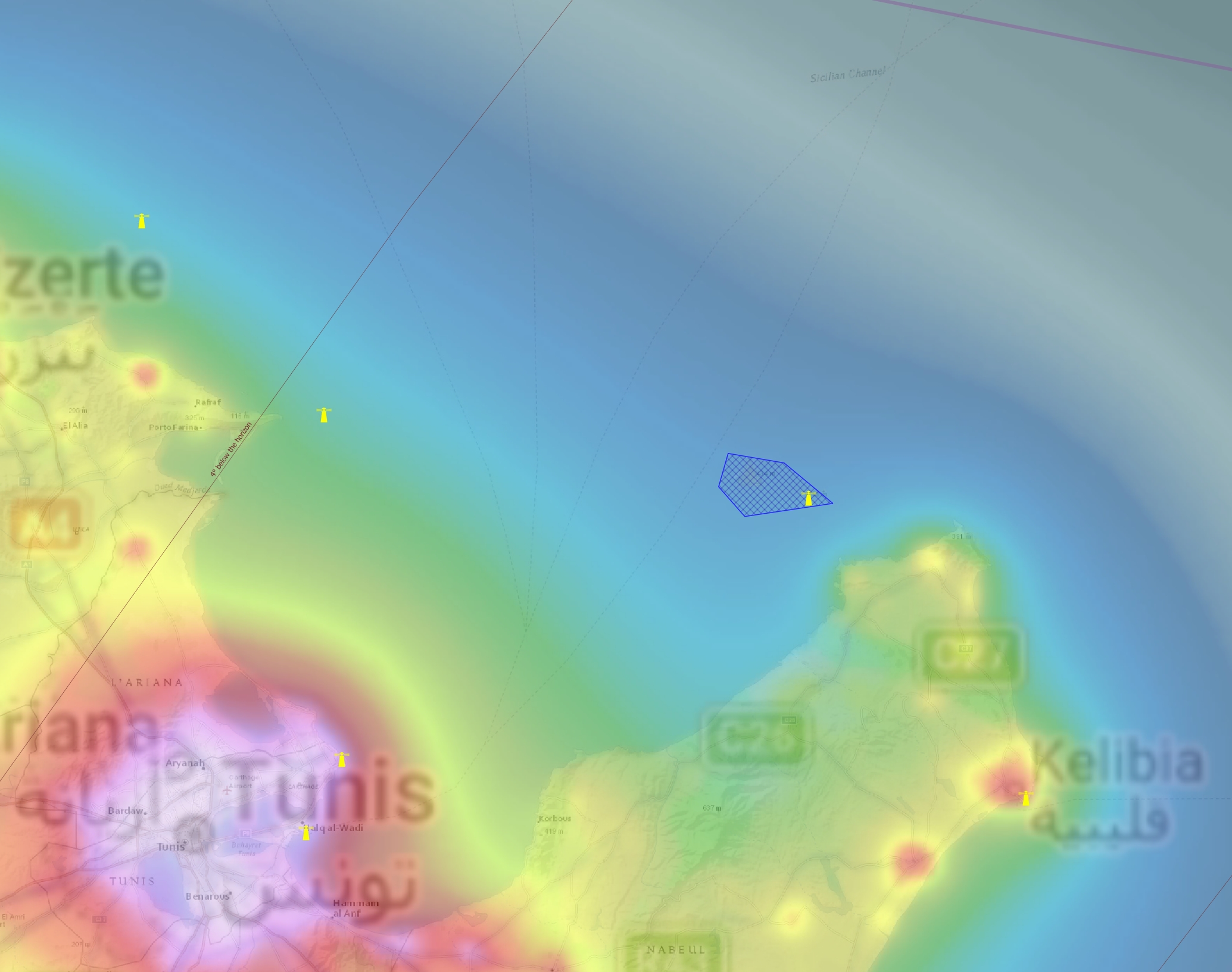
11. Pantelleria – this volcanic island is very intriguing from a geological point of view. Moreover, it’s possible to see even the Etna volcano from there. Given the eclipse, it could be a compelling destination. Unfortunately, the light pollution is serious, and the only place from which clear observation could be performed is the southeast section of the island, which, regrettably, can be disrupted by the lighthouse. Another unfavourable factor is the topography. The western horizon can be totally obstructed by the hills, so the observation venue should be considered carefully! See an example of Google Street View here.
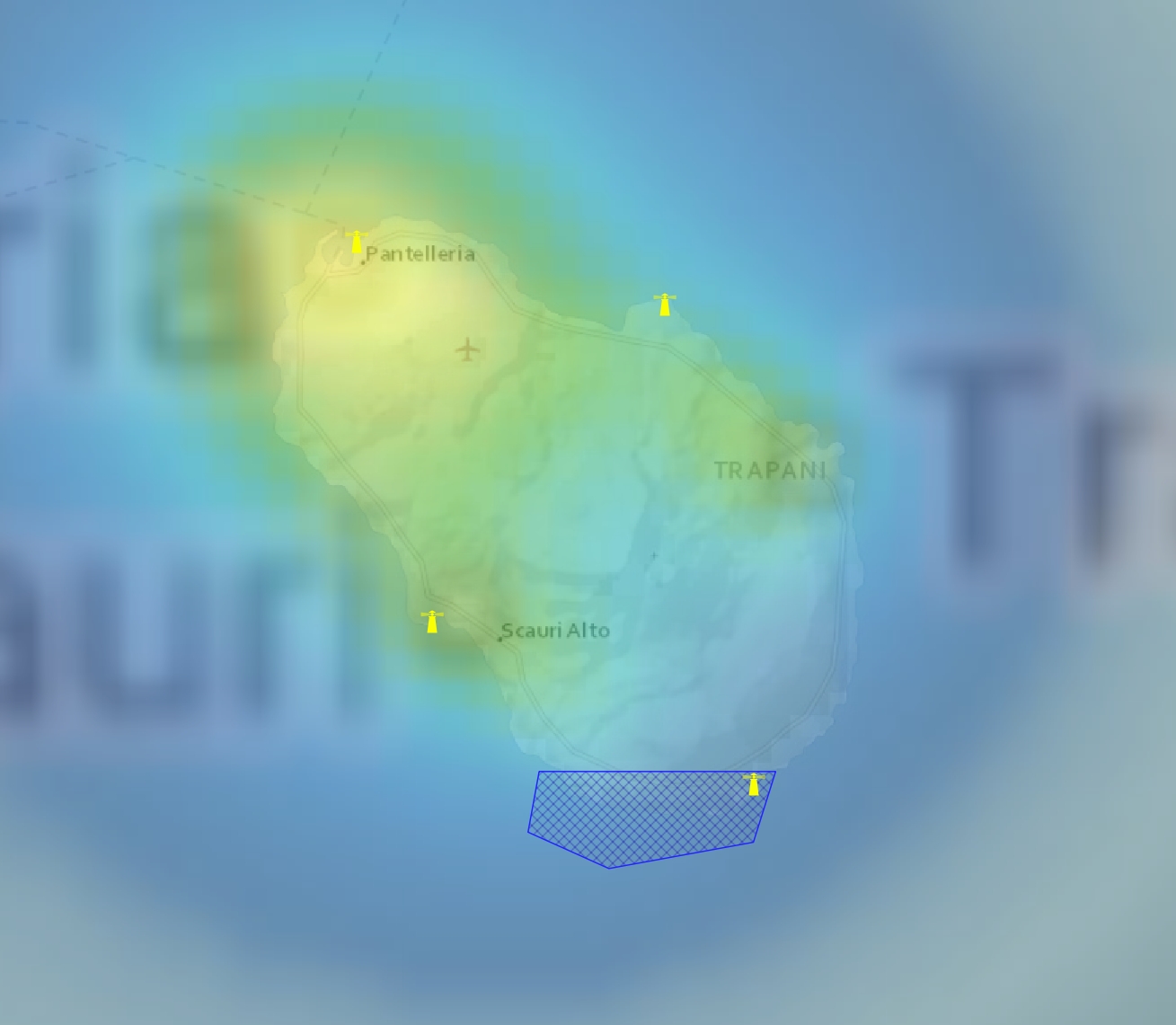
12. Linosa – This small Italian island looks promising because of its low light pollution. Theoretically, the sky at zenith is Bortle 2, but because the area of land is small, we shall assume that the influence of local light can be stronger. The best observation site is in the north, where both solar and antisolar directions are clear. The only problems are lighthouses.
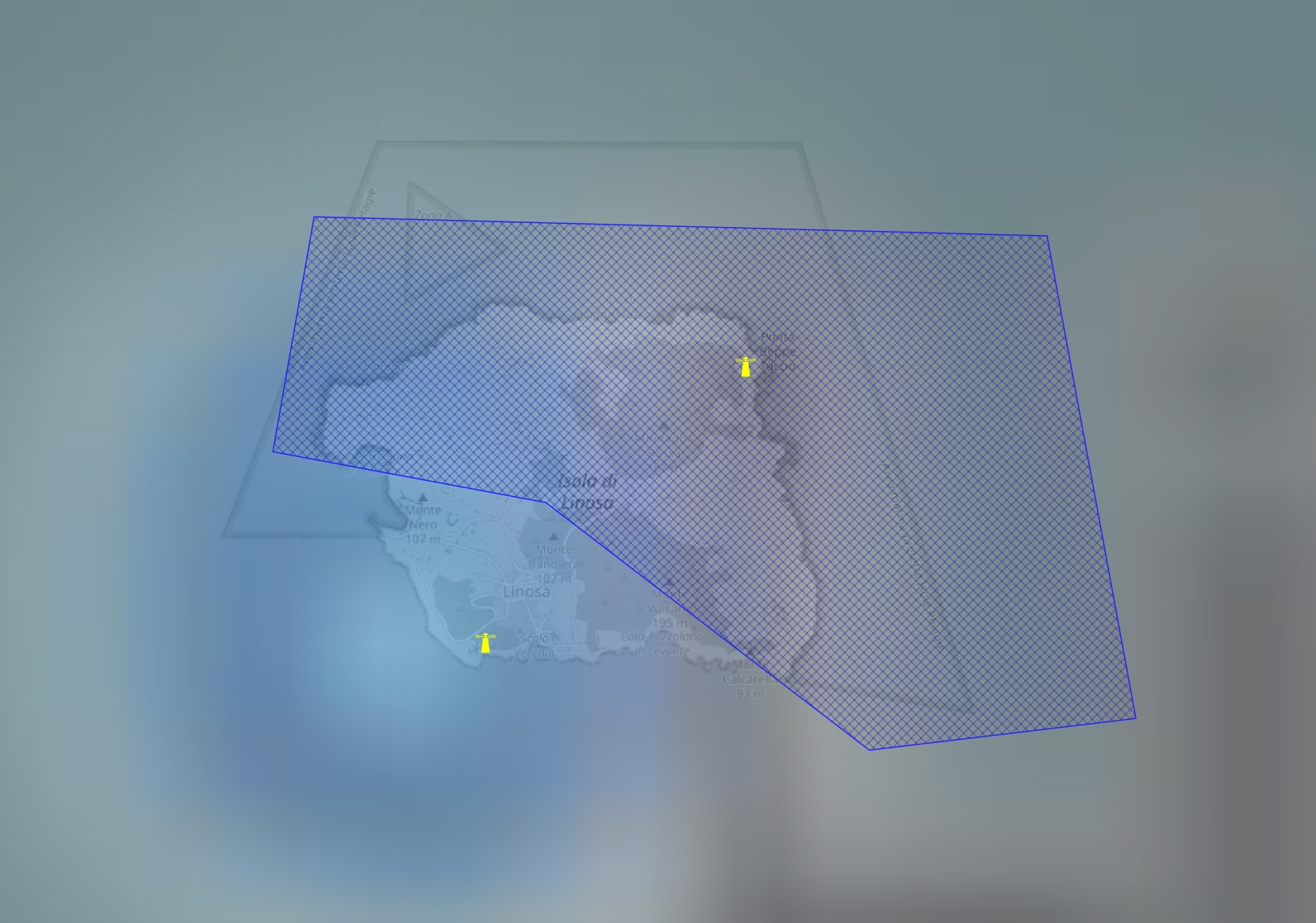
The second area considered lies entirely along the African coast and is referred to as the Mediterranean South for simplicity. Amidst all the regions, it’s the best for observation of the event, which in fact will occur within the astronomical twilight zone.
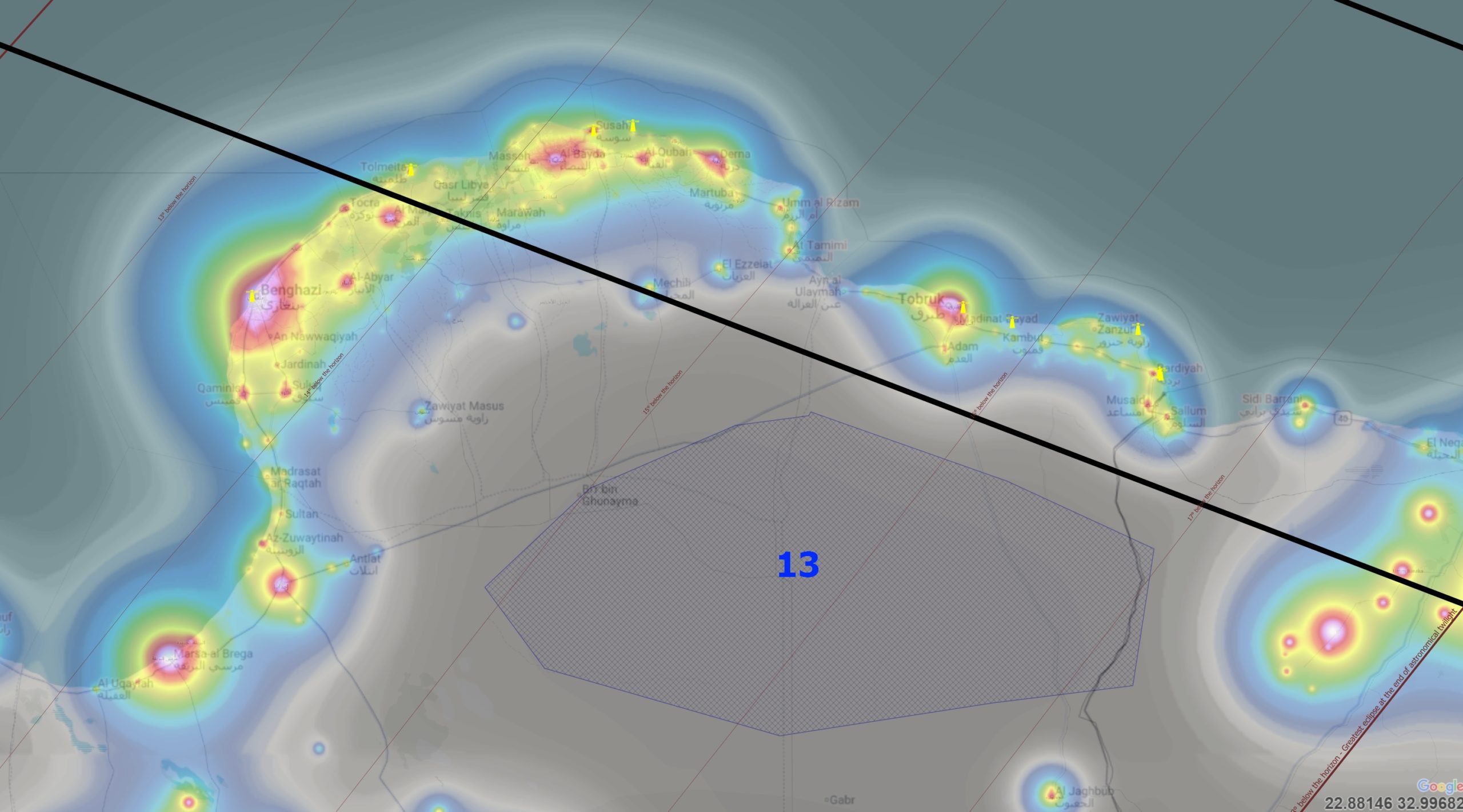
13. North Libya – the best place for watching the 2026 solar eclipse below the horizon event, as the area of Bortle 1 sky is so large, covering a distance of about 400km! Despite the deep position of the Sun, as the event happens at early astronomical twilight, it should be noticeable. The best is to set yourself in the middle of the route between Tobruk and Ajdabiya. At solar direction, some faint glow from Benghazi can be detected at a distance of 225km.
The final area considered is the southernmost part of the Aegean Sea and the eastern Mediterranean Sea, specifically southern Greece. This area lies at the on-the-ground umbral extension zone. Southwestern Crete nearly misses the northern limit of the umbra projection in the space, but because the eclipse event will occur at least 13° below the horizon, it doesn’t matter, as the zenith sky is going to be rather black. In this situation, an observer will see the umbra limitation above the western horizon, being in the vicinity of the lower part of the atmosphere illuminated by the Sun (learn more in this article). Concluding, the effect in Crete should be visible quite well, but the sky should be free of light pollution. The map below indicates potential observation locations for the evening of August 12.
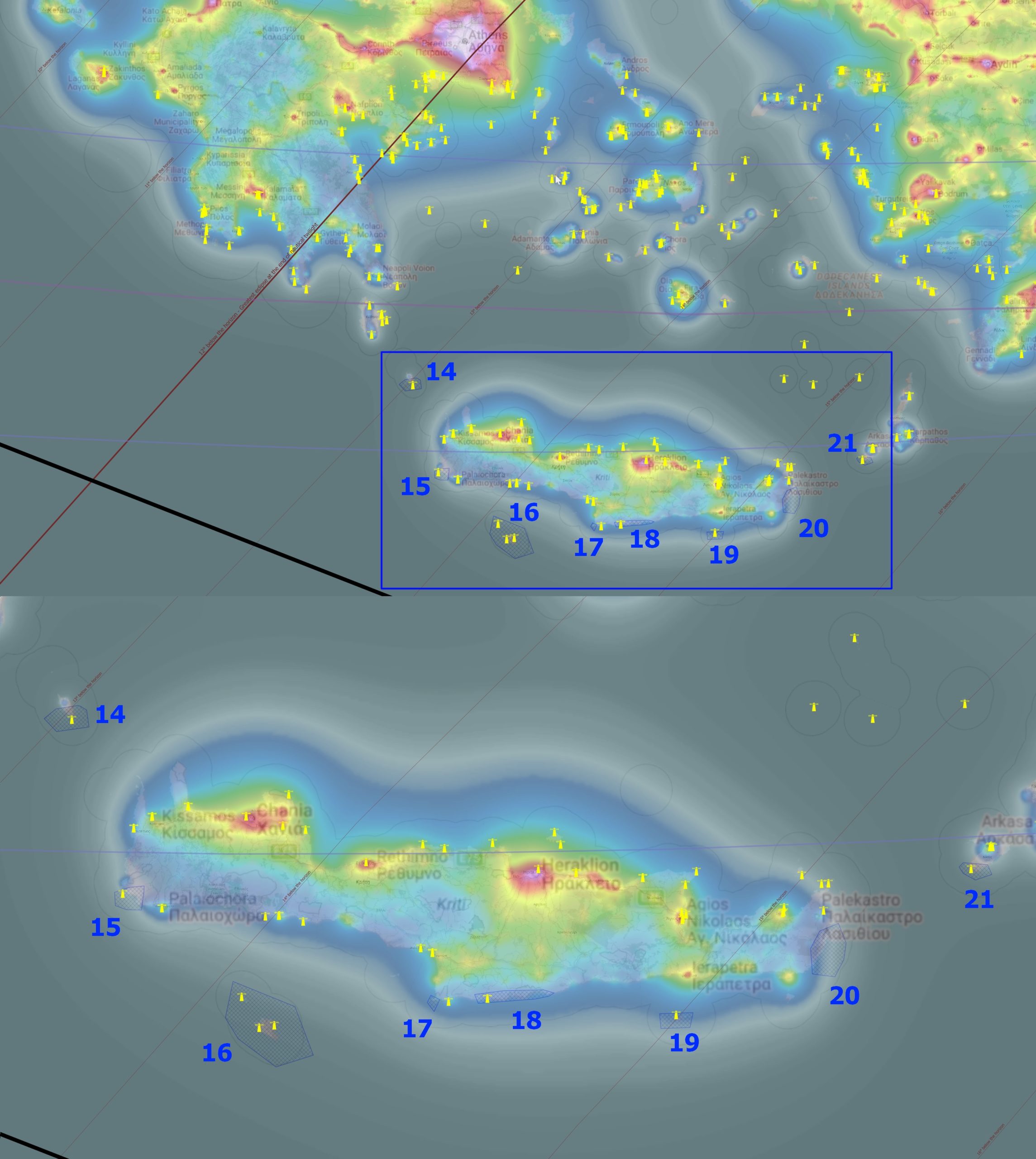
14. Antikithira – This small island could probably be the best place for watching the 2026 eclipse below the horizon event, because of the solar depression of 13°. The northern part of the island has some sky pollution, which affect northern sky. Except for the town, the zenith sky hovers around the Bortle 1 scale. It looks similar for solar direction, but the proximity of Chania (65 km) definitely disrupts the sky at antisolar direction. The best suggested observation point could be the island’s highest point. The worst part is that the island lies well outside the projected umbra extension.
15. Elafonisi – the island accessible by the beach, as well as the entire southwestern « corner » of Crete, has Bortle 1 zenith sky, because light pollution from larger urban areas is blocked by the local mountain ranges. Perfect view at solar direction will be, unfortunately, interrupted by the lighthouse, so it’s advisable to move further north. See the example of Street View here.
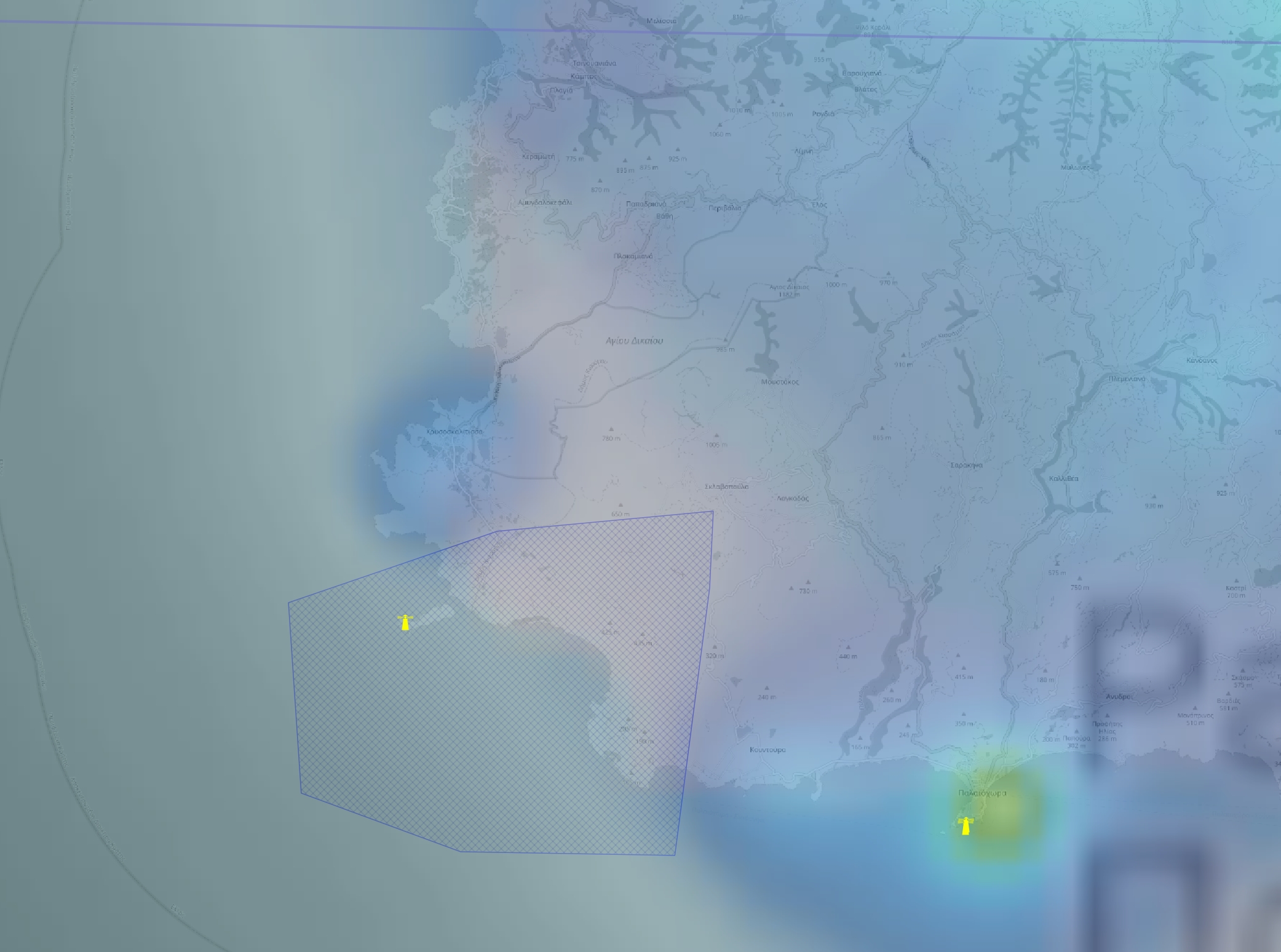
16. Gavdos – the island known as the southernmost point of Europe, lies closest to the projected extension of the umbra and offers one of the clearest skies at once. The Bortle 1 sky is one of the clearest in Europe, but the historic lighthouse being in operation disrupts it. The greatest eclipse will occur 13,5° below the horizon. See the street view example here.
17. The southernmost beach of Crete – accessible only by boat, or alternatively, you can reach the Kefali summit by 4×4 car or by bike/on foot directly from Monastir Odigitrias. The sky is, in fact, Bortle 2 at most, but the lack of lighthouses can seriously facilitate the potential observation.
18. East of Lentas – another perfect area for potential stargazing, because the landscape is epic. Moreover, the sky at antisolar direction is not interrupted by artificial light up to 70km. Because of this, the best approach is to set yourself just above the cliff, as distant mountains can slightly hinder distant light pollution. See the Street View example here.
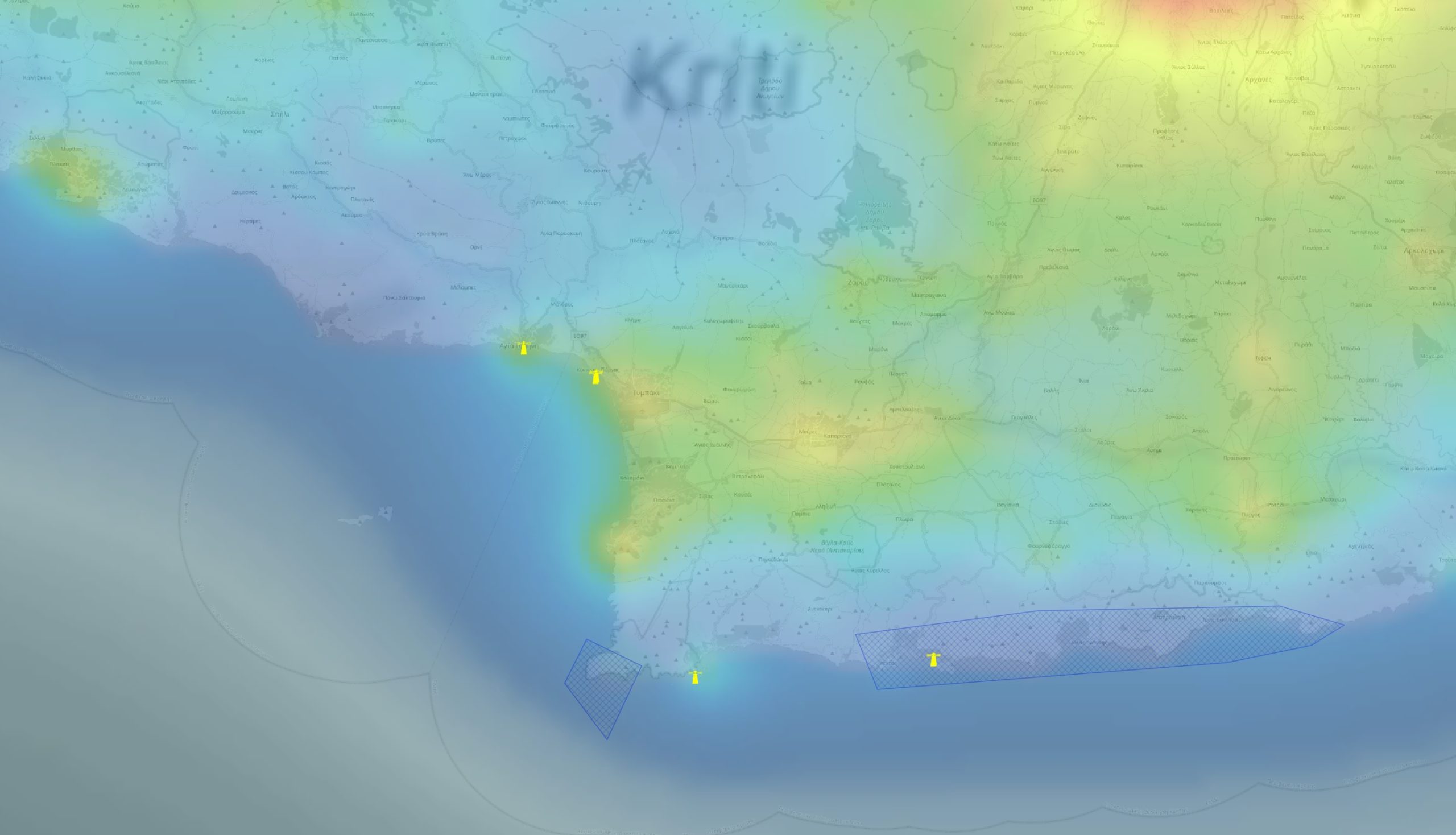
19. Chrisi Island – another recommended place for conducting the observation on August 12, when the Sun will be 14° below the horizon. This flat island has a lighthouse, but the overall sky brightness is estimated at Bortle 2. The biggest problem is the proximity of Ierapetra town, just 15km away, which results in significant disruptions to observation quality, especially in the north direction. In contrast, the west-east directions should be fine. See the Street View example here.
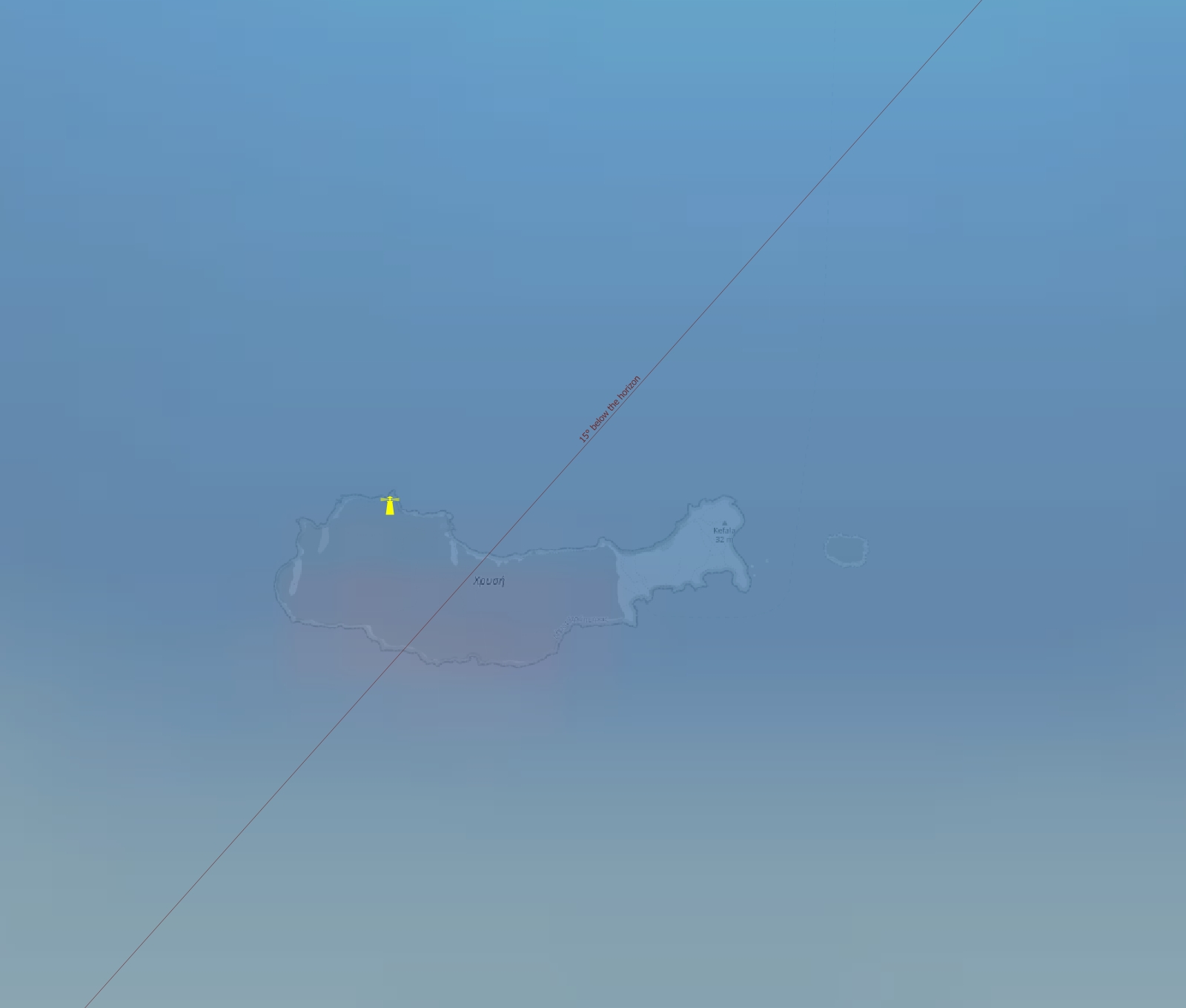
20. Kato Zakros region – the easternmost coast of Crete, which is one of the best on this island for stargazing purposes. There are two factors against the August 12 observation – the deep solar depression at the greatest eclipse, almost 14,5° and the obscuration of the western horizon. Lighthouses aren’t problematic because the area is large and topographically varied. See the Street View example here.
21.Kasos Island – the worst location considered for watching the August 12 event, but another one of the best as far as the clear sky is considered. The greatest eclipse occurs 14,5 degrees below the horizon, and the island lies the furthest from the estimated projection of the umbra extension. The proposed site is in the southwestern part of the island, where the topography allows it to be elevated above 200m above sea level. See the Street View example here.
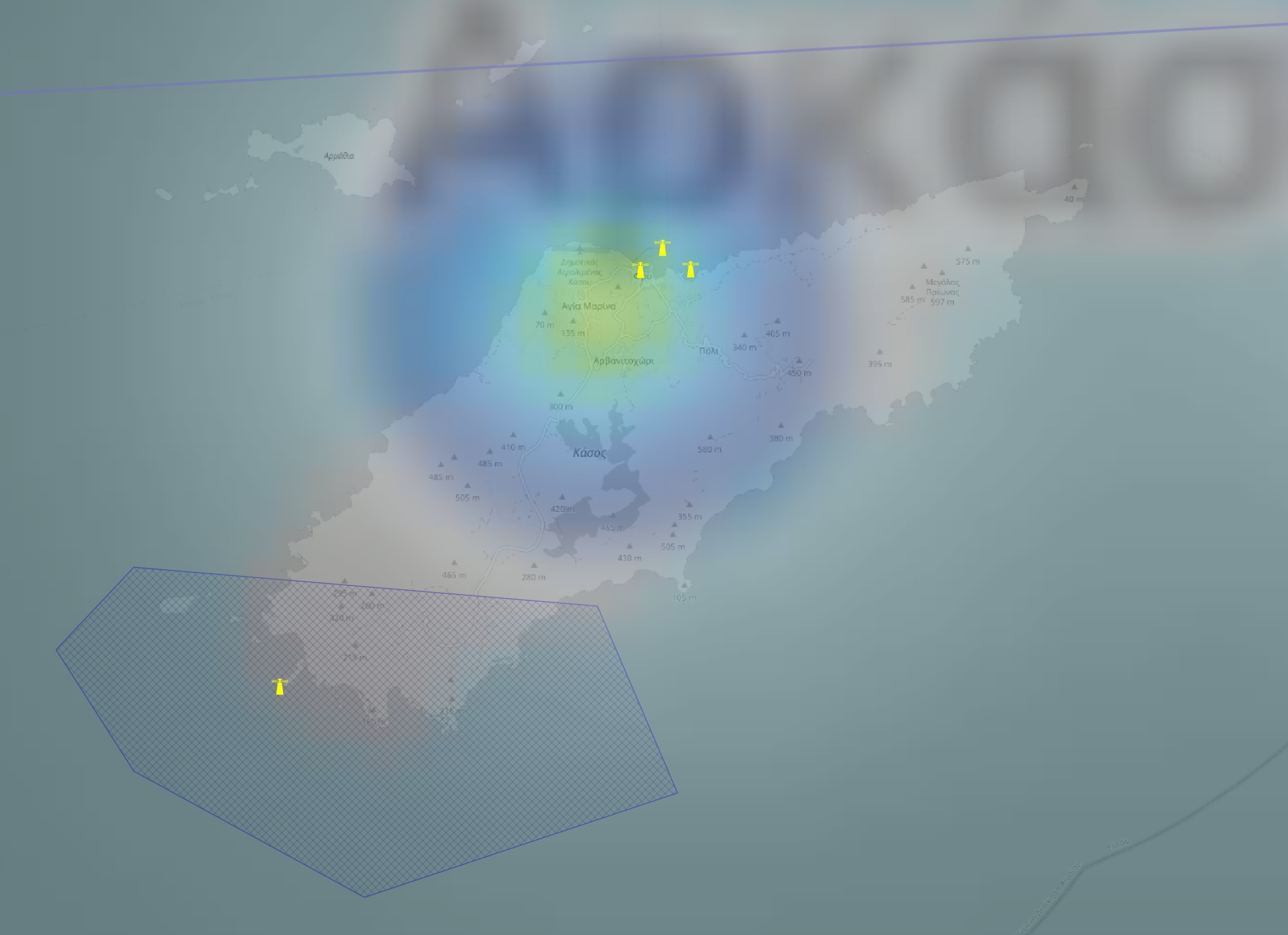
There are still alternative locations to consider for a hypothetical extension of the eclipse path. They will be located more east or north. I brought only one of them from Cyprus.
22. Akama National Forest Park – The northwesternmost tip of Cyprus, which lies close to the on-the-ground eclipse path extension and states the most extreme location, at which only late nautical twilight can be affected by the eclipse. This is at most Bortle 3 sky area.
As a conclusion, all the described places have been listed in the table below, which summarizes the relevant information (Tab. 2) concisely.
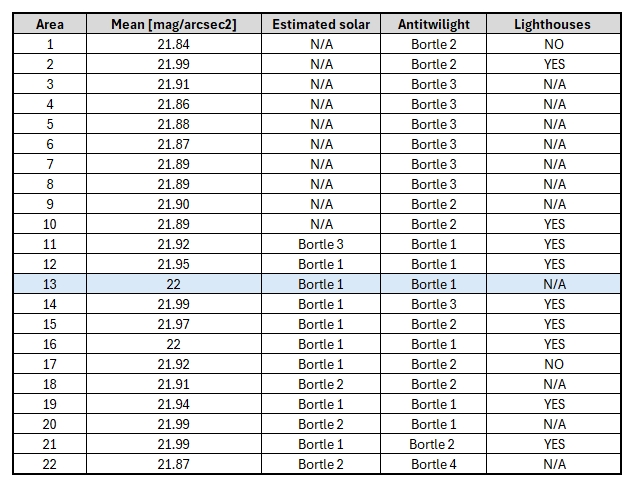
15. OBSERVATION CASE STUDIES
15.1
16. RESOURCES
16.1 Webcams
16.2 Casual flights
16.3 Casual ferries
16.4 Relevant software
17. ECLIPSE TERMINUS PROJECT
This is a groundbreaking project designed to capture the entire scene from an altitude of 32-34 km above the ground. I was fortunate to participate as a speaker at the recent Solar Eclipse Conference (SEC 2025) on June 13-15, 2025, in Leuven. My primary area of study is the impact of solar eclipses on twilight, which, with the exception of a few publications, hasn’t been investigated historically and has not been reported by any electronic devices. My speech was placed in the Eclipse Experiences panel, which I closed. The panel began with a remarkable, pioneering observation of the total solar eclipse of 2012 in Australia, conducted from a stratospheric balloon (Stratospheric flight into Totality – Australia 2012), led by the Romanian astronomer and eclipse chaser Catalin Beldea and his team. I was very excited about the project, especially since the observation covered both stratospheric and ground-based perspectives, providing an excellent example of parallax. The totally eclipsed Sun above shone as a thin crescent from the ground. It will be described on the main page later. After finishing Catalin’s speech, there was a typical question panel, as usual, after every speaker’s performance. I asked about the possibility of viewing the totality from the path’s extension on August 12, 2026, with optional locations of Sardinia, Sicily, or Tunisia. The totality at these locations occurs after sunset, but because of the relatively small solar depression, the event can still be observed from above! The elevated view of the eclipse, as well as its impact on twilight from the ground’s perspective, has fired my imagination since 2015. Catalin concluded that the idea is very good and that we, as astronomers, can pursue it, especially since a similar approach has never been implemented globally. Unfortunately, I am not technically strong and am only moderately proficient in computations, so I am doing my best to support the team on the graphical side.
The core plan of the project is the deployment of the gliding wing into the cone of the total solar eclipse, approximately 600km beyond the ground-based limit of totality. Due to the curvature of the Earth, the eclipse won’t be visible at the location where the stratospheric balloon is launched. From the ground’s perspective, the Sun is about 5° below the horizon, around 25 minutes after sunset or 4° below the horizon, around 20 minutes after sunset, depending on the place of the experiment.
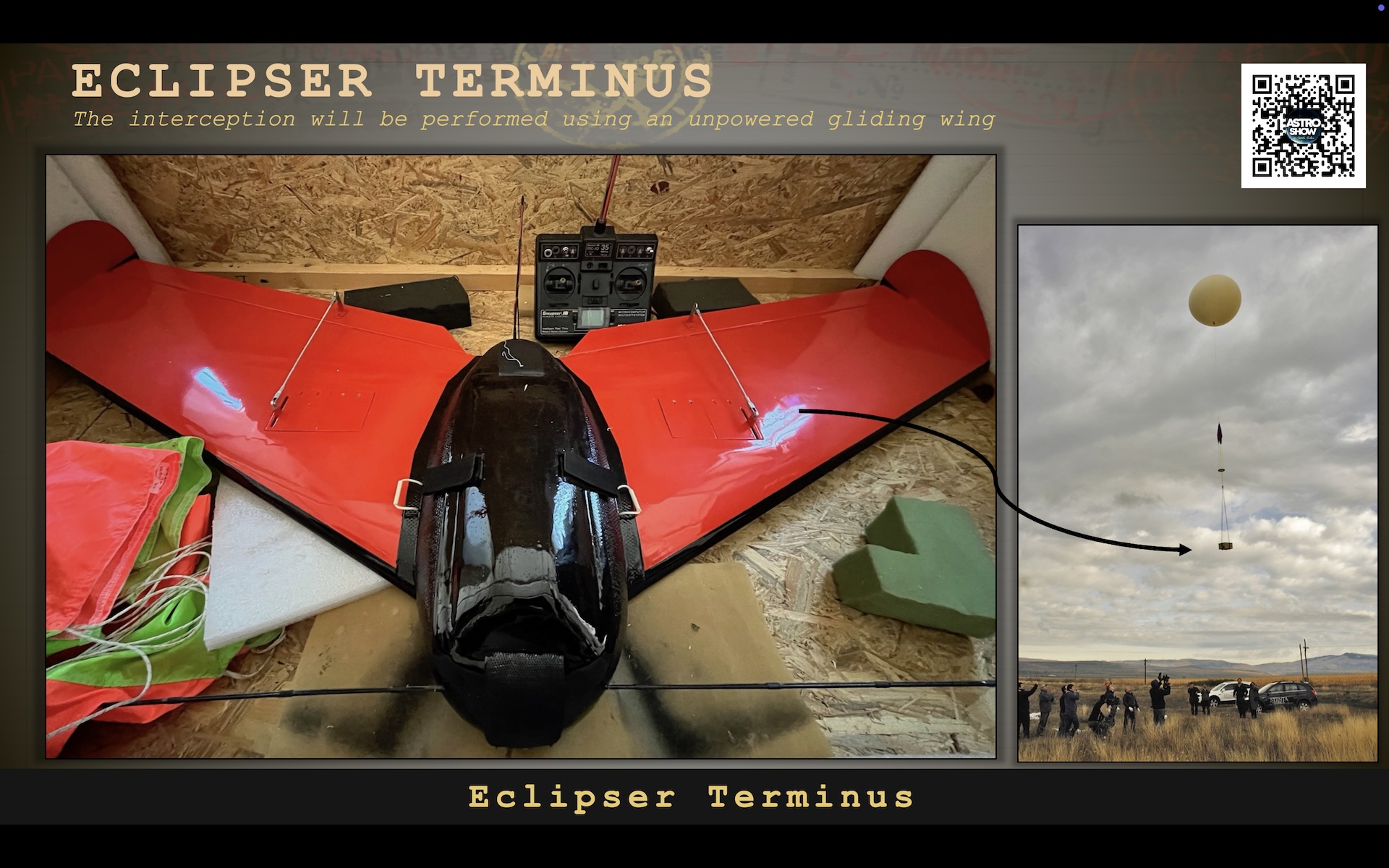
The gliding wing, as presented above, will be aided by the helium balloon.
There are two locations under consideration for launching the project (4.02.2026). The main one is northern Tunisia, about 80km southwest of Tunis, near the southern limit of the extended totality. Thanks to Dan McGlaun, an owner of the former website Eclipse2024.org, we have a quite detailed projection of the umbral cone at the very last moment of its contact with the ground (Pics. 102-105, 107-108), in relation to the space.
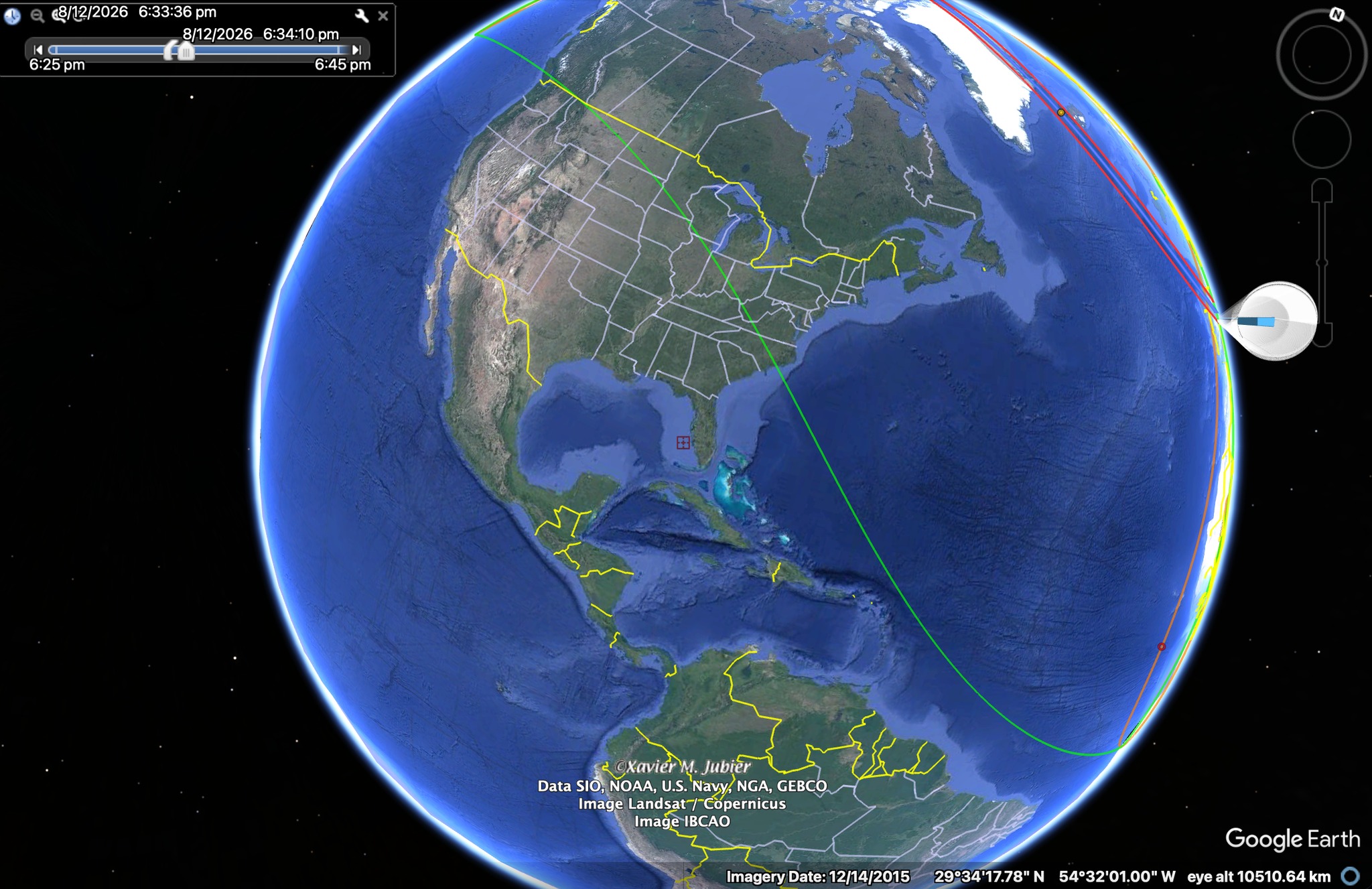
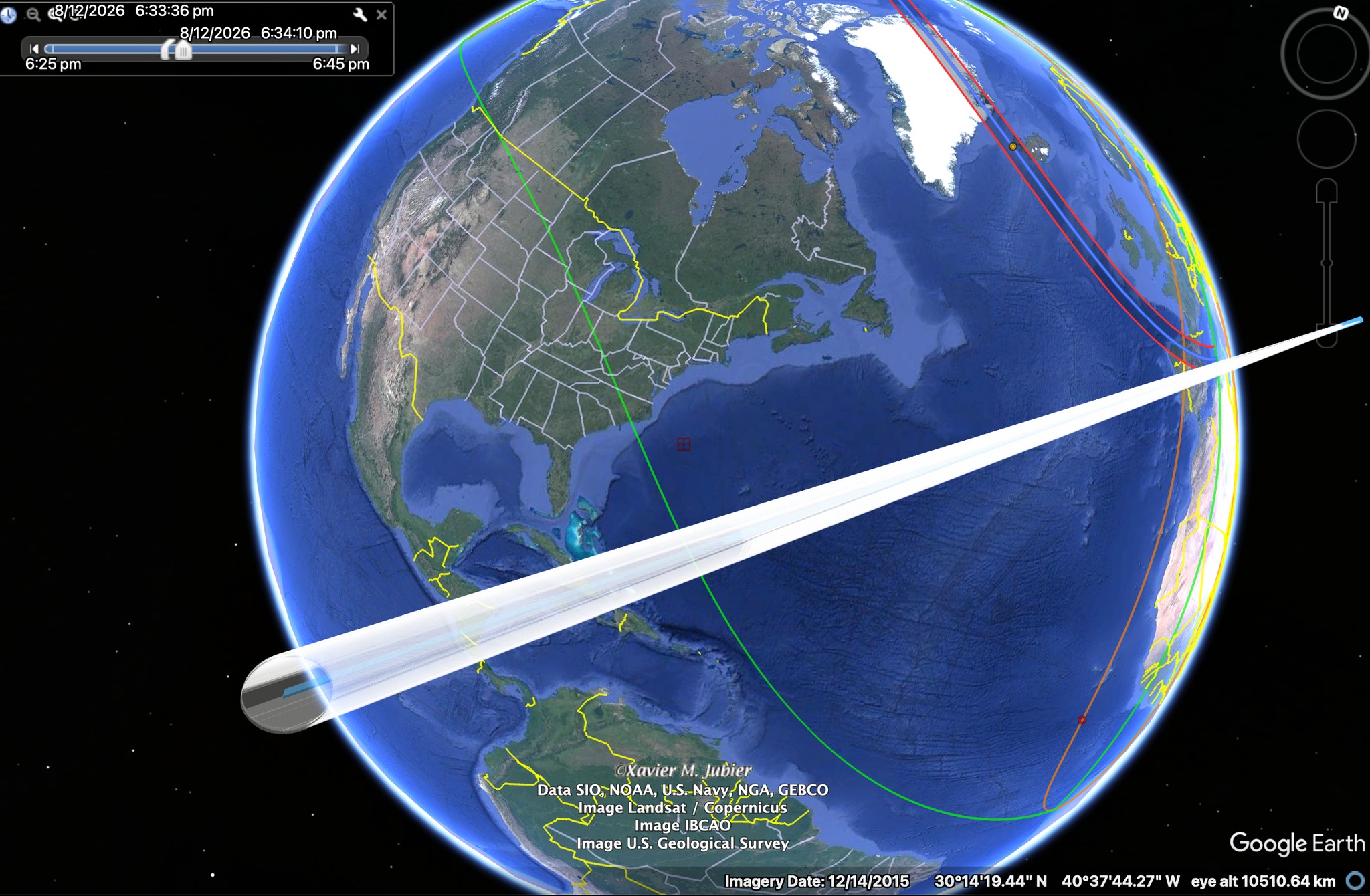
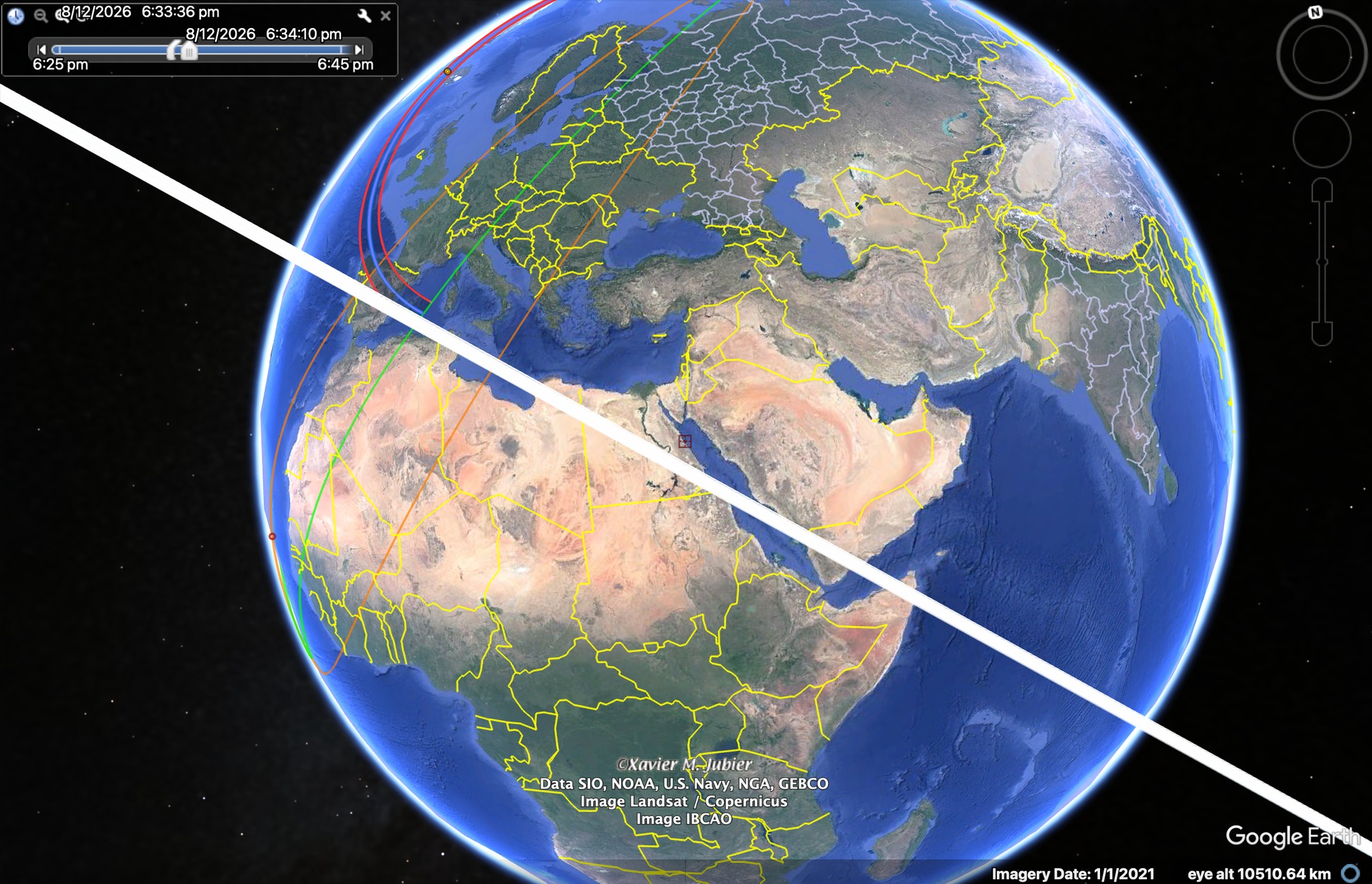
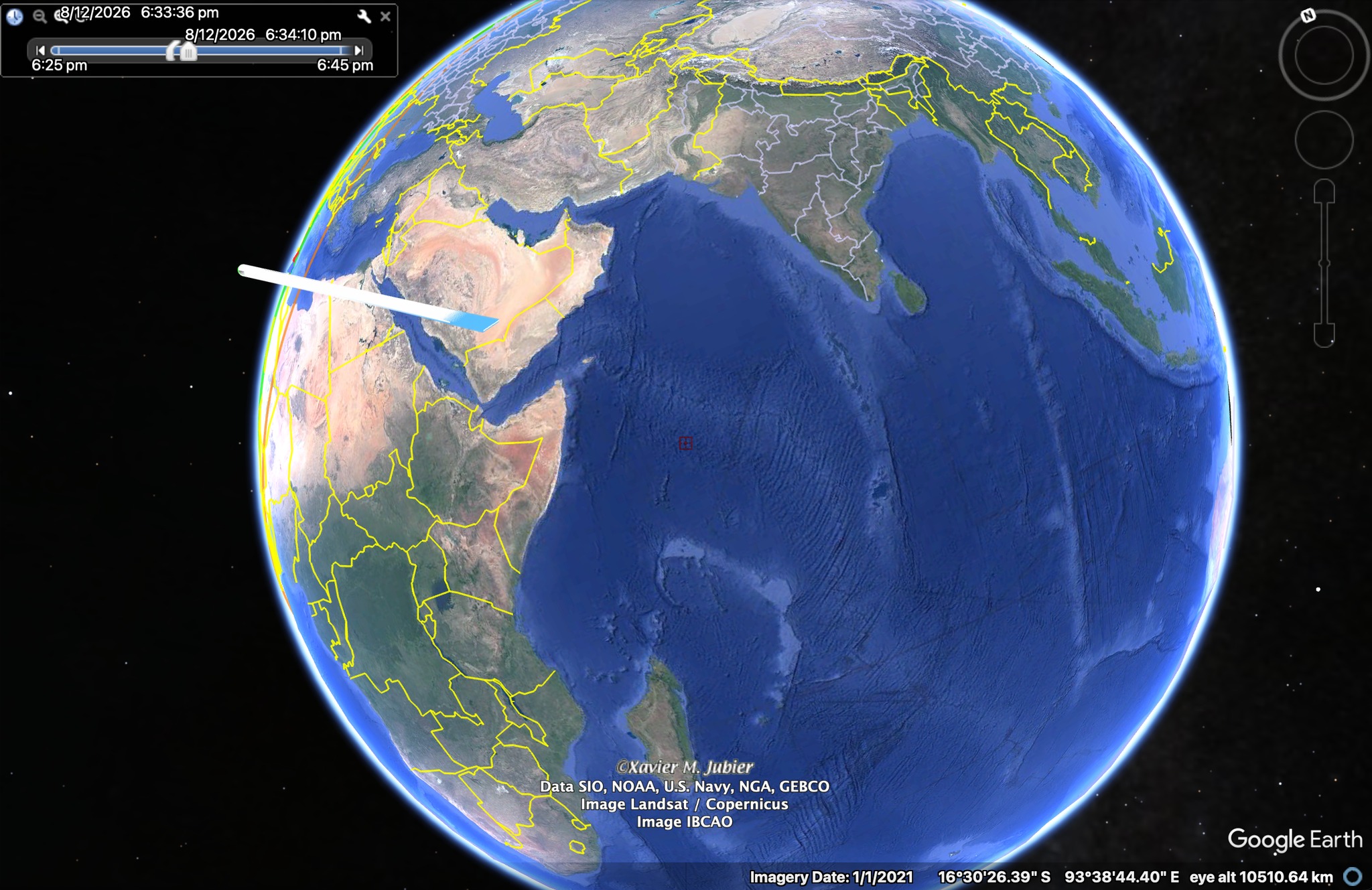
To be clear, all these visualizations correspond strictly to the situation illustrated in the map below (Pic. 106), where the Moon’s shadow is approximately at its last contact with the Earth’s surface.
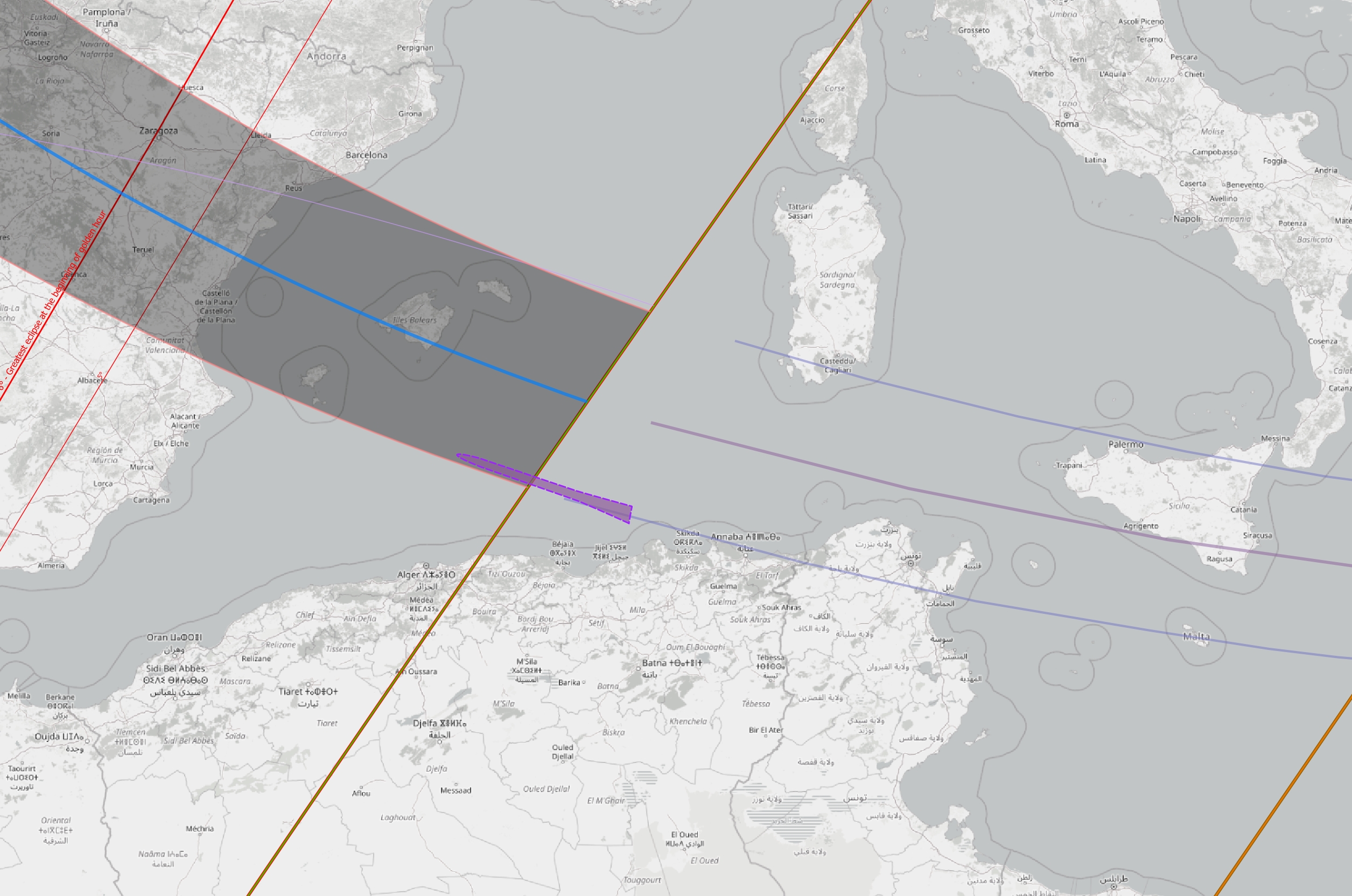
Unlike the Moon’s shadow cone projected onto the ground (map), we can visualize it from space.
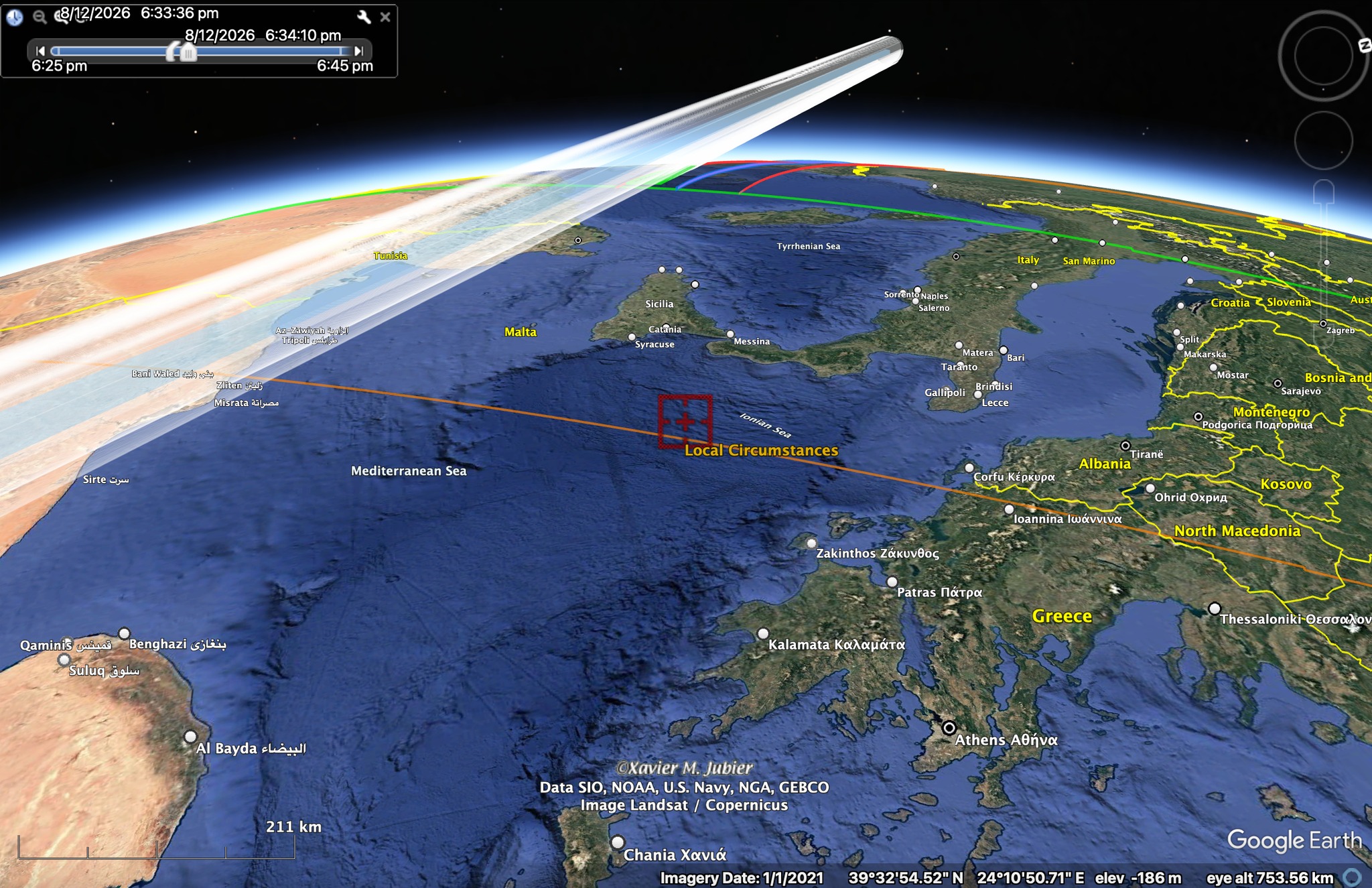
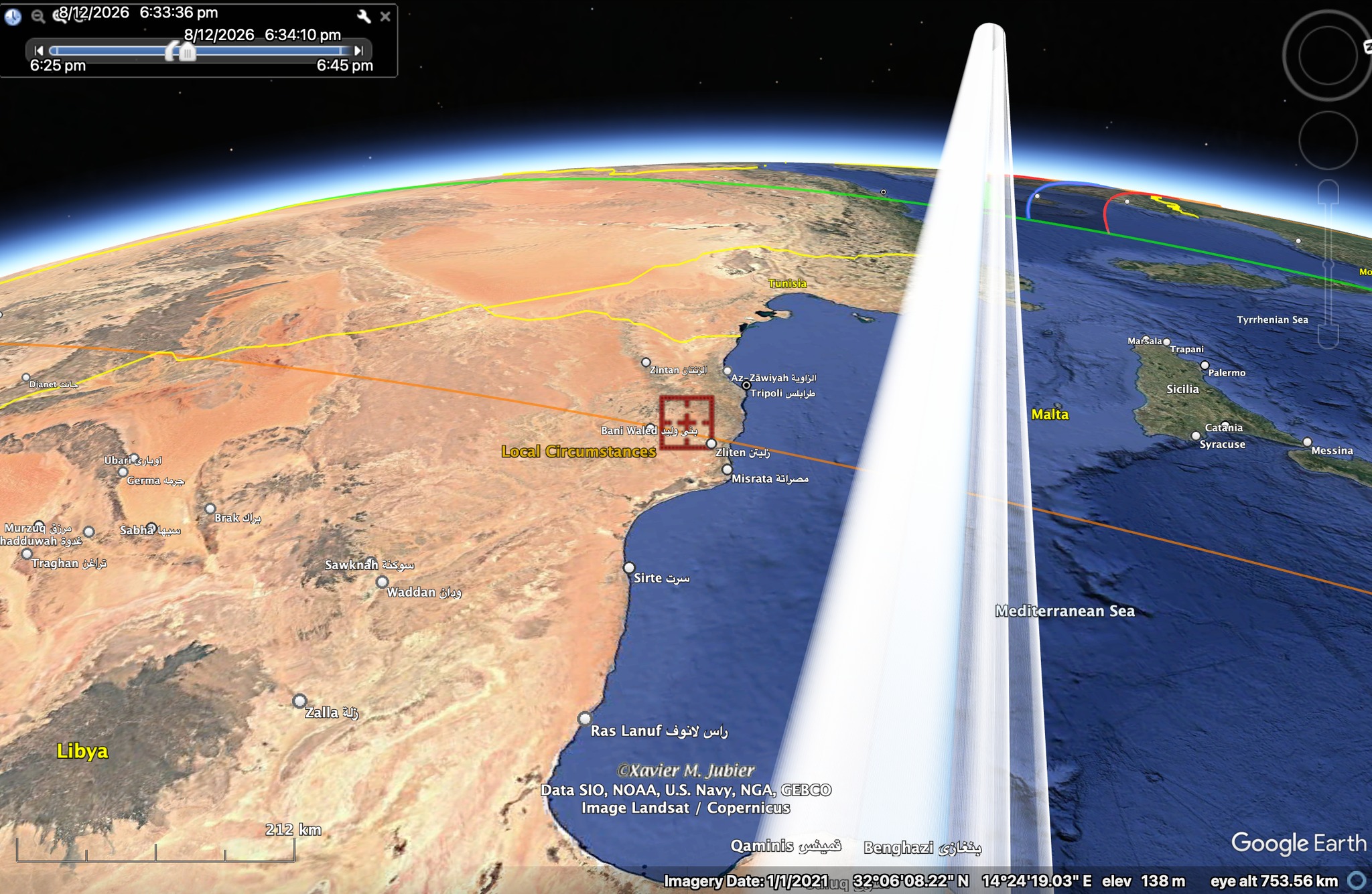
An alternative location for the following project is Sicily, specifically in the Marsala area. Based on Fred Espenak’s and Xavier Jubier’s maps, this place appears to be near the centerline of the path extension (Pic.). 109. It surely does! However, the Earth’s curvature must be seriously taken into account here. By expanding computations of typical solar eclipse maps, we see how all the lines curve northward. It does apply specifically to the Sun’s position below the horizon. Since the Sun after sunset isn’t visible anymore, the only factor we can rely on is the umbral cone and the atmosphere. By looking at the map above, you will understand the Earth as a transparent globe, where the Moon’s shadow overshoots on the opposite side, as discussed in this article. The only way to see it is just behind the terminator line, where the umbra approaches from both sides of the sky at once. We need to consider the terminator line as the most extreme line of the Earth. Beyond this line within the twilight zone, as a result of Earth’s curvature, the locations are placed « deeper » by the solar depression angle. In turn, the lines, which follow typical eclipse maps, refer strictly to the umbral position if the Earth were transparent (See chapter 4). For an observer with a transparent view of the ground, the total solar eclipse in Marsala could be seen at a depression of 5°. strictly. However, because the sunset occurs at an altitude of nearly 30 km, due to parallax, the totality is almost missed! As per Dan McGlaun’s visualizations above (Pic. 107), the umbra behaviour is space-related, not anymore ground-related. Any kilometre above the ground makes a change in the totality extension limits, as initially calculated and visualized by John Irwin below (Pic. 109).
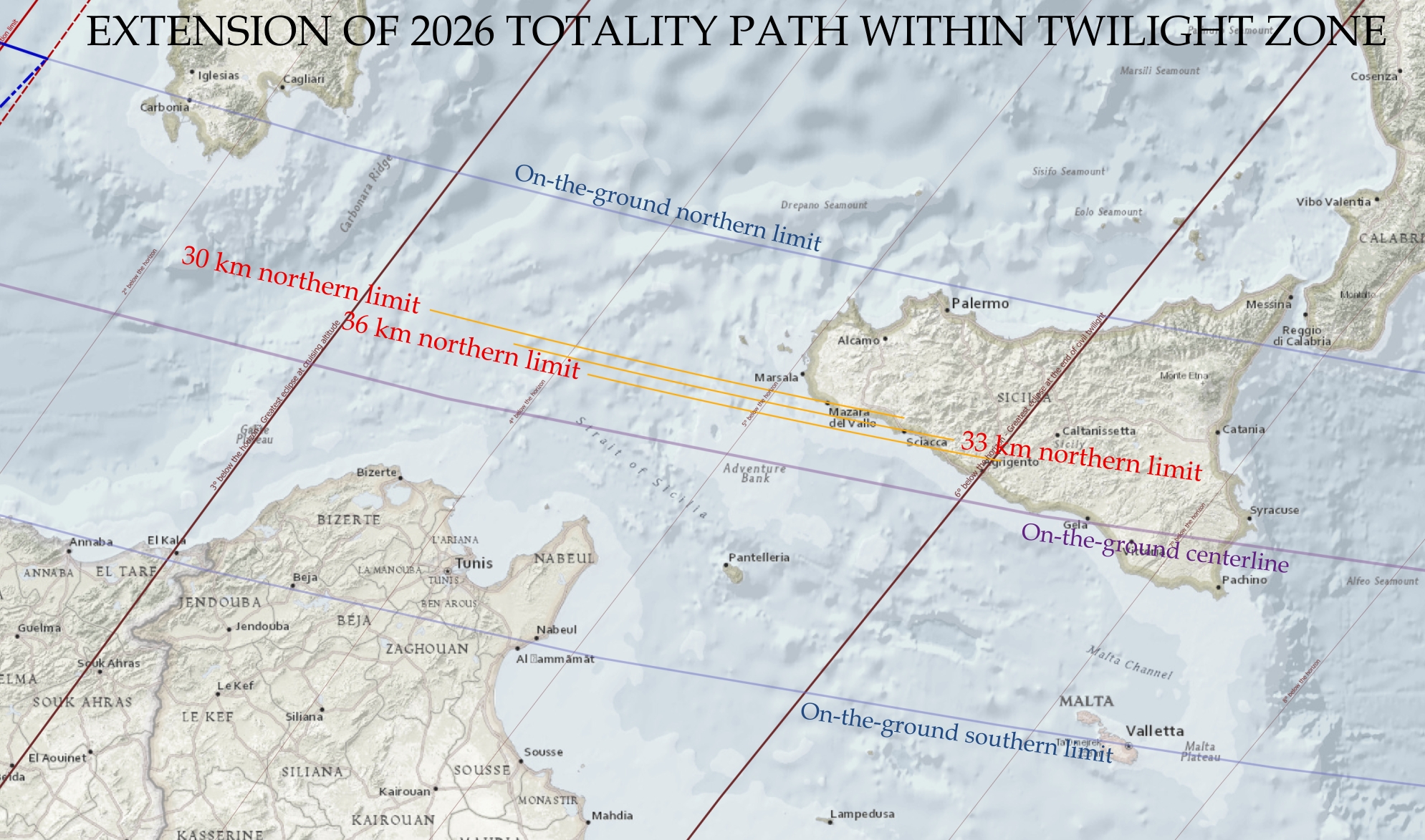
For the altitude of 36 km, we can practically estimate the dark sky at daylight, and the true limitation of the umbra from the perspective of this altitude. Based on the estimates above, the shift in umbra extension is significant and effectively eliminates the possibility of observing it directly from western Sicily. Of course, the umbra will definitely be seen in the sky because of the lack of direct sunlight scattering. However, as mentioned in the chapter 15, the effect won’t be as pronounced as it might appear from a more suitable location. The actual motion of the shadow is shown below (Pic. 110). As discussed in this article, we should view it from a space perspective, as ground-based computations are no longer viable.
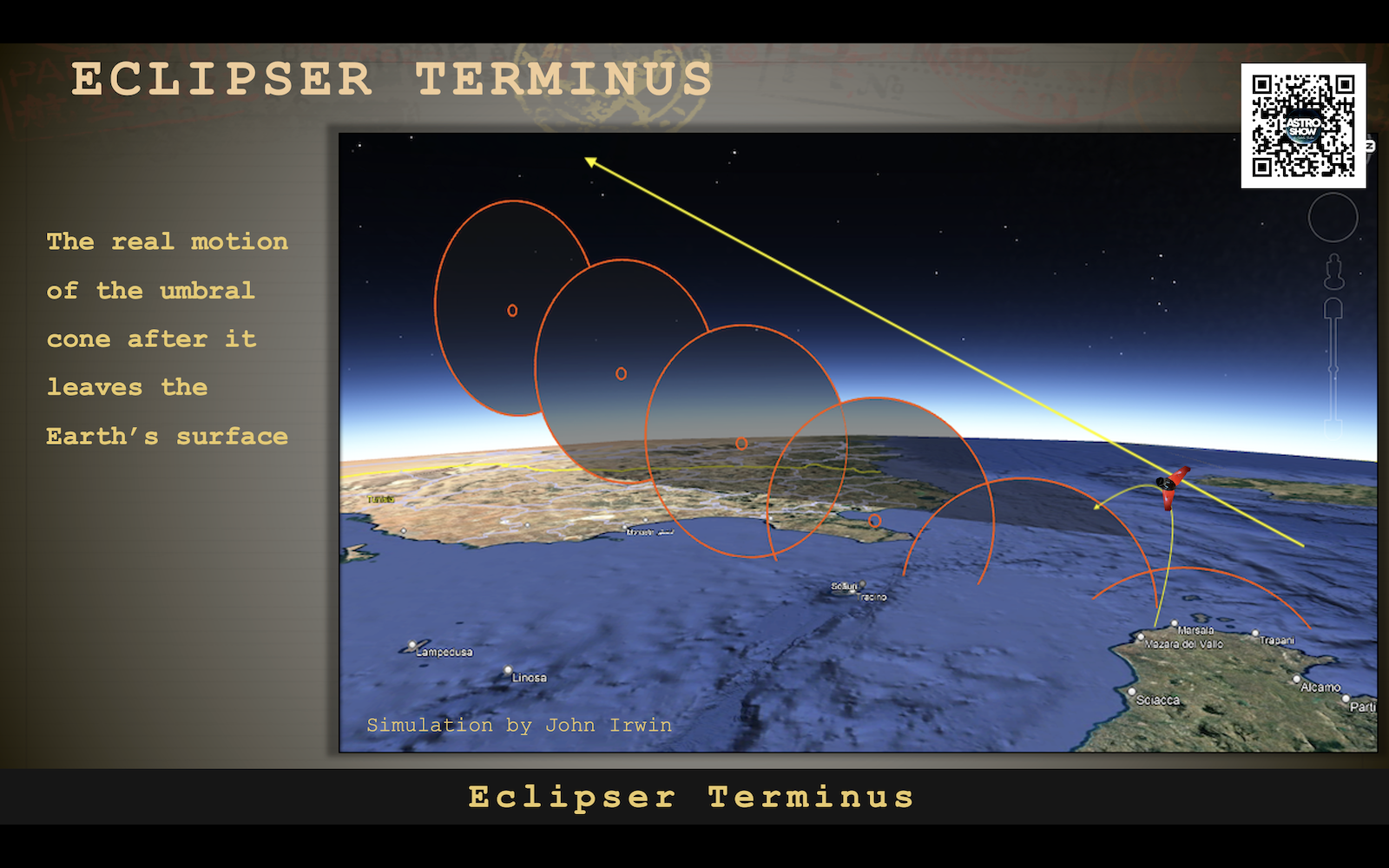
In conclusion, the circumstances for Sicily aren’t favourable enough, despite its geometrically ideal position at the end of the eclipse path.
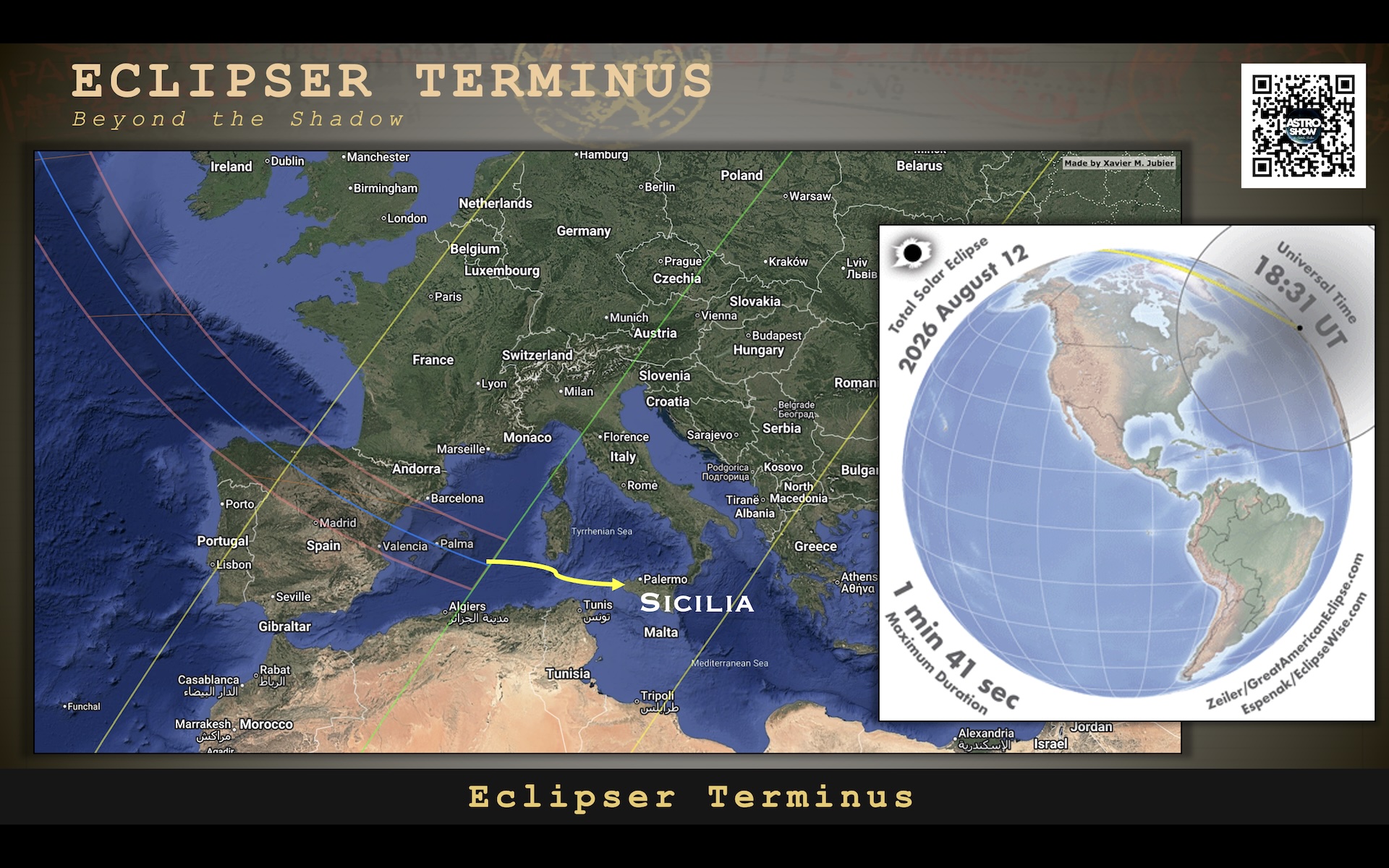
On the other hand, the Eclipser Terminus project isn’t restricted to the ground perspective only. The gliding wing is planned to be sent around 45 km (30-60 km) southwest of the Marsala coast (Pic. 112-113). The basic limitation in this direction is the border of Italian territorial waters within which all the devices have to be recovered from the Sea.
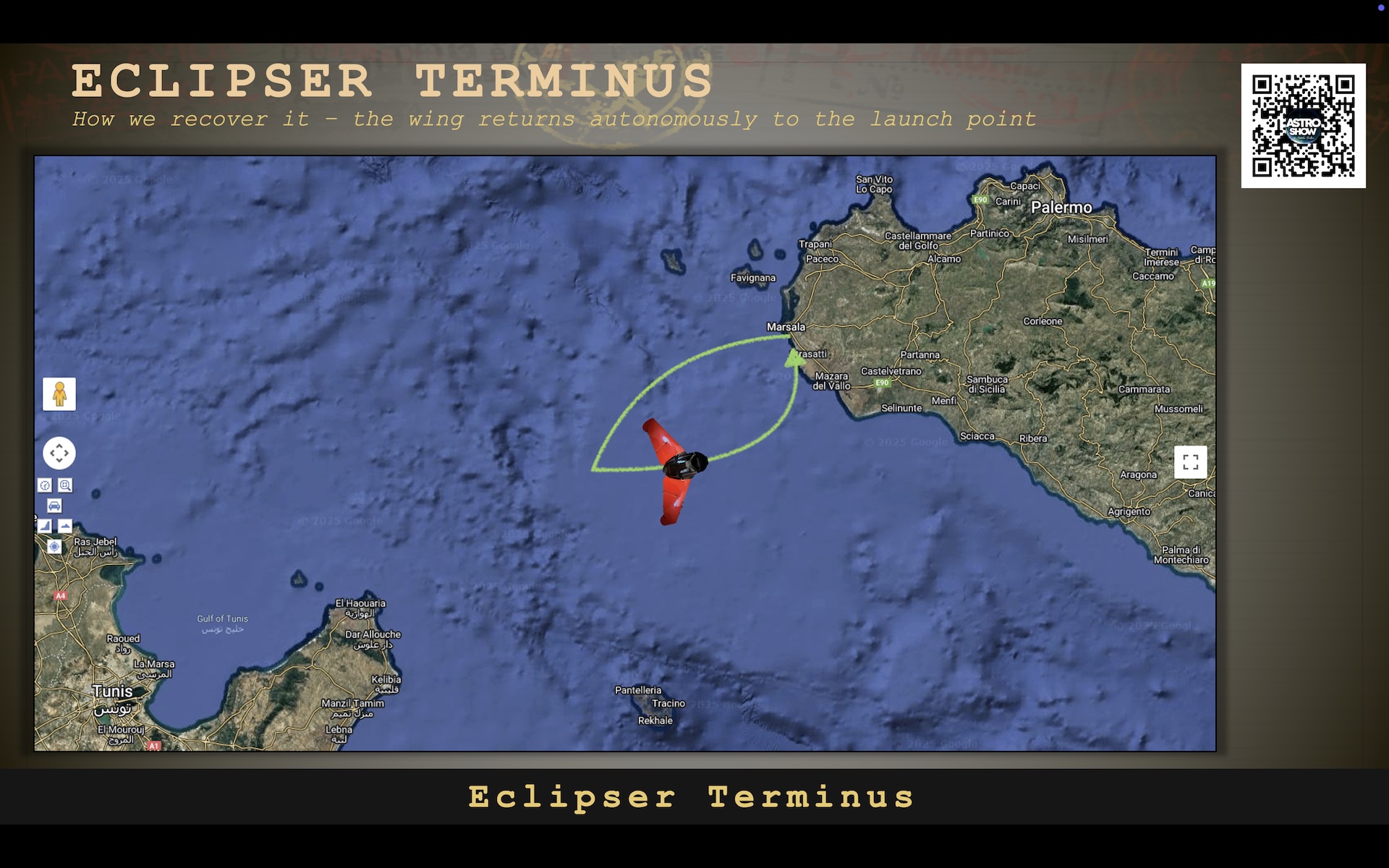
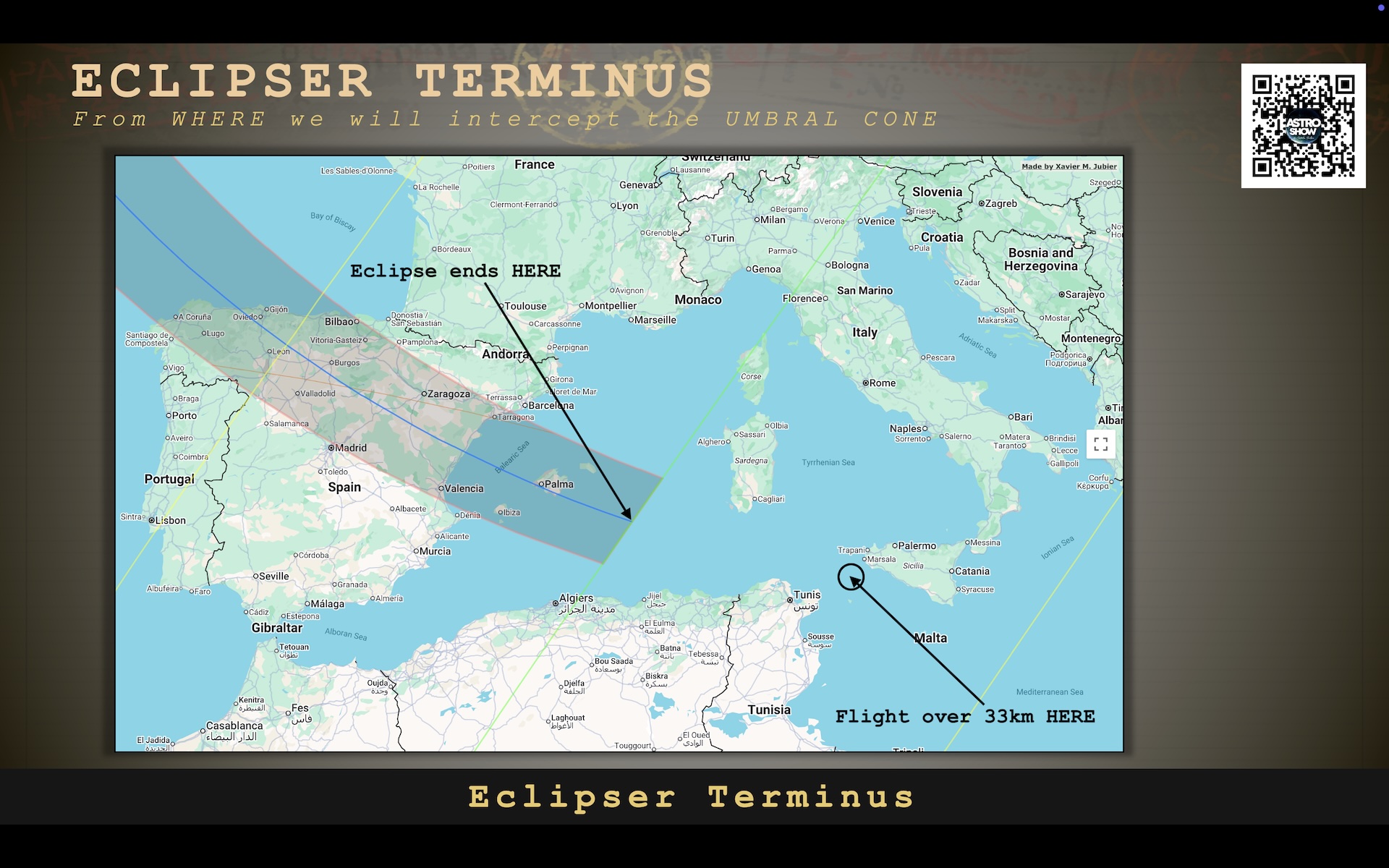
Given the umbra conditions discussed above (Figures 109 and 110), the project has a slim chance of achieving totality from this location (Pic. 113).
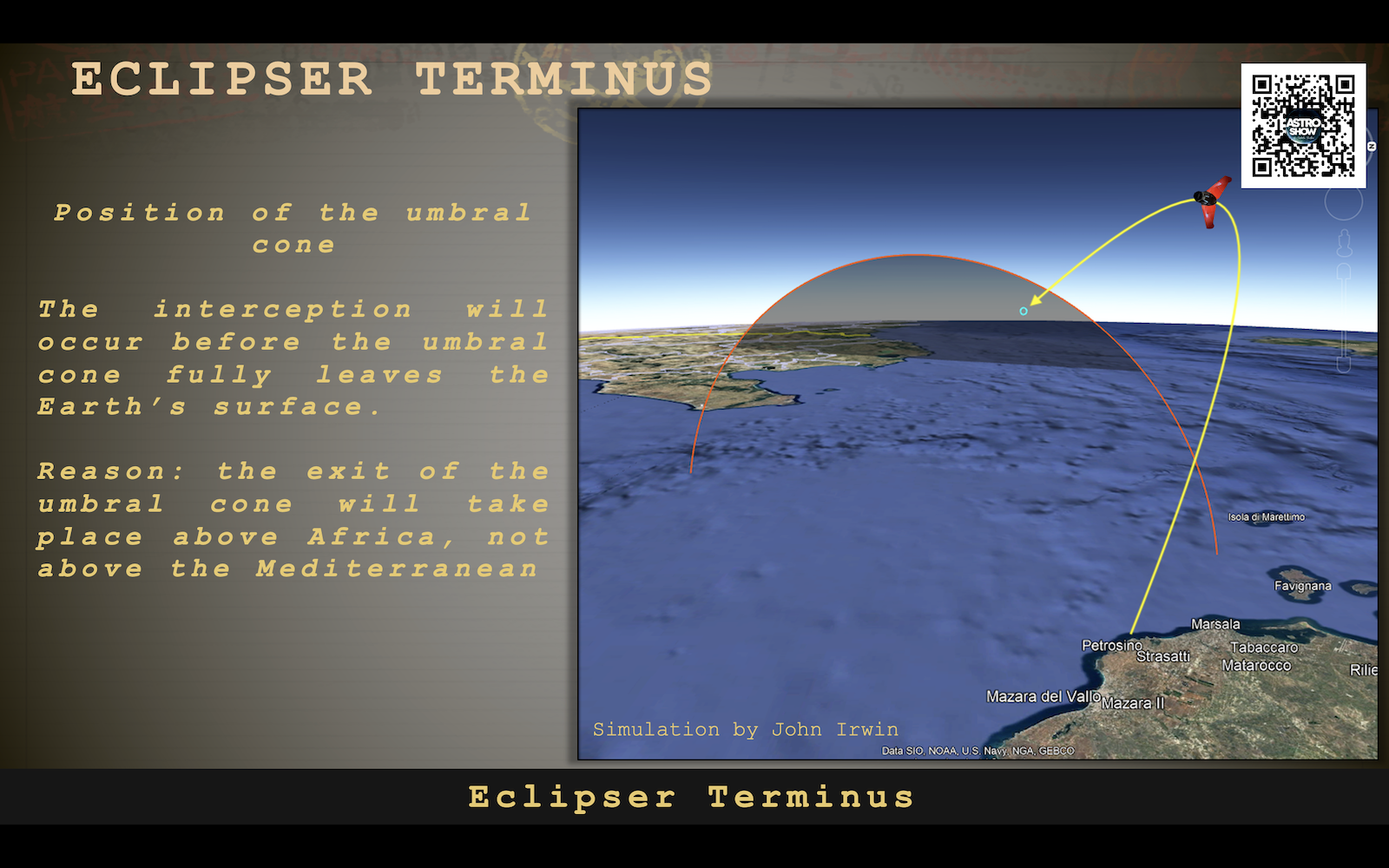
Flying into the stratosphere around 45 km southwest of Sicily guarantees at most 20s of totality with the Sun located approximately 1° above the geometrically dipped horizon (Pic. 115).
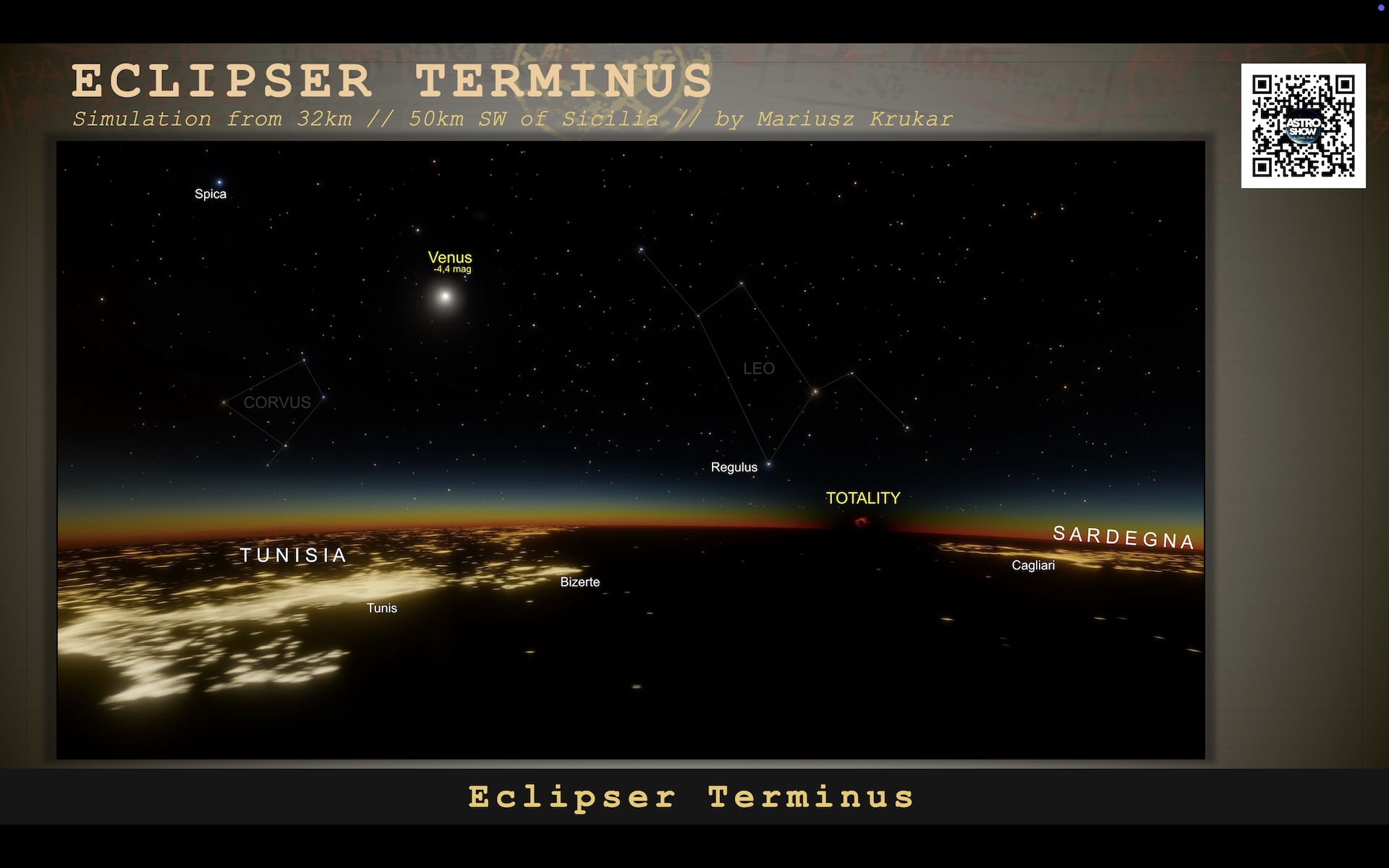
In this situation, to ensure the project’s success, clear weather over the Balearics and a geometric end of the path are necessary. A similar map was projected for ground-based eclipse observers within the path. Since the fully-developed cumulonimbus or high-level clouds (i.e., cirrus) can disrupt the ground observation over 350km away, what happens if the stratospheric balloon records the eclipse from an altitude of 34 km?
Since the Sun will be visible only 1° above the geometrically dipped horizon, we should consider how the geometrically dipped upper boundary of the troposphere, approximately 10 km above the local horizon, is typical for high-level cloud development. The Sun can be at least partially blanketed by the clouds located at a distance of over 600 km away from the observation point. The Space Engine image above shows a sample cloud deck at an altitude of 10 km, which gently veils the horizon sky on the left.
In conclusion, the alternative approach from Sicily may be problematic given the issues raised above, though success remains possible.
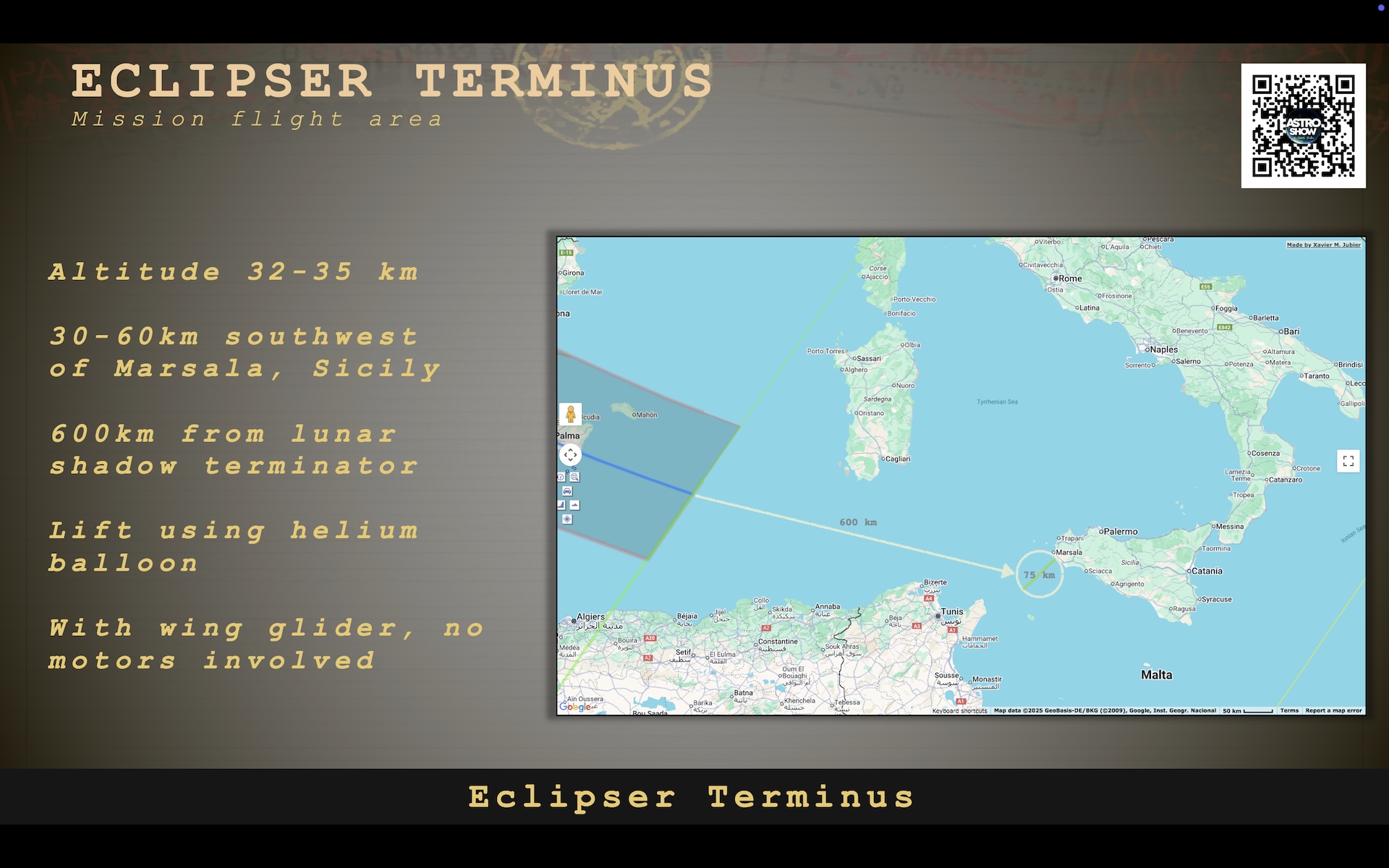
18. OBSERVATION RESULTS
The 2026 total solar eclipse observation results will be presented after August 12, 2026.
19. SUMMARY
The article presents a detailed scientific analysis of the total solar eclipse of 12 August 2026, with its extension below the horizon, including particular emphasis on its geometric configuration, atmospheric interactions, and observational phenomena. This eclipse is specific, as it falls almost under a Type V event, in which totality occurs in one part of the day, predominantly after local noon. The path of totality is situated at higher latitudes, resulting in a comparatively low solar elevation of approximately 26.5 degrees above the horizon. This geometry significantly influences the overall width of the path and the position of the shadow visible in the sky against the eclipse path projected on the ground.
During totality, the temporary obscuration of the solar photosphere enables direct observation of the chromosphere and corona. Thanks to modern visualizations of the lunar limb profile, we can determine the location around the Moon’s limb where the Baily’s beads disappear and reappear at the third contact. On top of that, knowledge of the lunar limb profile helps us determine where the double diamond ring can be observed.
The eclipse at lower altitude has a substantial effect on the sky surface brightness due to reduced direct solar irradiance and the dominance of scattered light. The spectral composition of the sky evolves from typical daylight scattering toward longer wavelengths, producing reddish and eventually bluish-gray tones as totality approaches. They will look very effective in the golden hour and early twilight zones. Notably, the minimum sky brightness does not coincide exactly with the temporal midpoint of totality but occurs slightly thereafter, reflecting asymmetries in atmospheric scattering and the geometry of the lunar shadow. Directional anisotropy in sky brightness becomes pronounced, with brighter sections near the horizon outside the umbral path and darker regions within it.
Several transient optical phenomena arise from diffraction, refraction, and the topography of the lunar limb. Baily’s beads result from sunlight passing through valleys along the Moon’s edge, while the diamond ring effect occurs shortly before or after it, depending on the stage of the eclipse. Shadow bands, consisting of rapidly moving interference patterns caused by atmospheric turbulence, may be observed on plain-coloured surfaces (or clouds). These surfaces can also be useful for capturing the disappearance and reappearance of specular solar reflections, illustrating changes in the light coloration reaching the observer, and, finally, changes in the azimuths of direct illumination. In regions near the path of totality, a “contrast triangle” may form as a result of sunlight reflection on the seawater in contrast with the shadowed sky at the horizon.
During the partial phases, progressive limb darkening of the Sun and the reduction in irradiance lead to gradual changes in the color balance of the sky. Small apertures, including natural gaps in foliage, act as pinhole cameras, projecting crescent-shaped images of the Sun onto nearby surfaces. These effects provide indirect observational evidence of the eclipse’s progression.
The article also highlights rare optical phenomena observed during this event. Due to the period just after a maximum of solar activity, there exists a potential for simultaneous observation of auroral phenomena in high-latitude regions. The presence of noctilucent clouds, which form at mesospheric altitudes, may also coincide with the eclipse under suitable conditions. In certain geographic locations, particularly near sunset in the Mediterranean region, atmospheric dispersion effects such as the green flash may be enhanced by the eclipse. Furthermore, reducing scattered light can increase acontrast between the sky and horizon, potentially extending the distance at which terrestrial objects remain visible.
Finally, the article discusses an experimental observational concept involving a stratospheric balloon platform at altitudes of approximately 30 to 34 kilometers. Such an approach aims to reduce atmospheric interference and extend the observational horizon, thereby enabling unique measurements of various eclipse-induced effects at this altitude. Overall, the study underscores the importance of geometric configuration, atmospheric physics, and observer position in determining the full range of phenomena associated with the 2026 total solar eclipse, which remains the most intriguing astronomical event of the current decade.
20. ACKNOWLEDGMENTS
Stellarium
Photography Ephemeris
Space Engine
Udeuschle
Peakfinder
Catalin Beldea
John Irwin
Dan McGlaun
References:
- Abell G.O., Kearns C.E., 1954, The effect of the solar eclipse of June 30 upon the morning twilight at Palomar Observatory, (in:) Publications of the Astronomical Society of the Pacific, vol. 66, no. 392, p.233
- Geyer EH., Hoffmann M., Volland H., 1994, Influence of a solar eclipse on twilight, (in:) Applied Optics, vol.33 (21), p.4614-4619.
- Guliaev R.A., 1992, On a possible use of total solar eclipse below the horizon for observations of the inner zodiacal light (as applied to the eclipse of 30 June, 1992), (in:) Solar Physics, vol. 138, p.209-211
- Koepke P., 2001, Spectral variation of the solar radiation during an eclipse, (in:) Meteorologische Zeitschrift, vol.10, No 3, 179-186
- Können G.P., Hinz C., 2008, Visibility of stars, halos, and rainbows
during solar eclipses (in:) Applied Optics v. 47 no. 34 - Lee S.H., Lee S., 2012, Illuminance during a solar eclipse with limb darkening: A mathematical model, (in:) Journal of the Korean Astronomical Society v.45, 111-116.
- Meeus J., 1997, Mathematical Astronomy Morsels I, Willmann-Bell
- Meeus J., 2007, Mathematical Astronomy Morsels I, Willmann-Bell
- Richtsmeier S.C., Lynch D.K., Dearborn D.S.P., 2017, Antitwilight I: structure and optics, (in:) Applied Optics, vol. 56, no. 19
- Richtsmeier S.C., Lynch D.K., Dearborn D.S.P., 2017, Antitwilight II: Monte Carlo simulations, (in:) Applied Optics, vol. 56, no. 19
- Saha S., 2020, Ground-based observations of noctilucent cloud
brightness and frequency, Indian Institute of Science Education and Research, Kolkata - Sekhar A., Asher D., Vaubaillon J., 2016, Three-body resonance in meteoroid streams, (in:) Earth and Planetary Astrophysics
- Telepun G., 2023, Eclipse day: How to observe and photograph any total solar eclipse, Ebook
Links:
- https://eclipse.gsfc.nasa.gov/SEsaros/SEsaros126.html
- https://www.solar-eclipse.info/en/saros/detail/126/
- Theskysearchers.com: 12th anniversary of eclipse flight into stratosphere
- https://stevealbers.net/albers/allsky/twilight.html
- https://twanight.org/gallery/lunar-analemma-composite/
- Hpwren.ucsd.edu: Lunar analemma
- Lasco-www.nrl.navy.mil: SOHO solar corona information
- https://www.swpc.noaa.gov/products/goes-solar-ultraviolet-imager-suvi
- https://suntoday.lmsal.com/
- https://www.solarmonitor.org/
- Jsoc1.stanford.edu: Latest images of the Sun
- Astroshop.eu: Flash spectrum and how to create it
- https://www.besselianelements.com/the-flash-spectrum-an-introduction/
- https://skyandtelescope.org/2024-total-solar-eclipse/how-to-see-the-diamond-ring-effect-during-a-total-solar-eclipse/
- https://sciencenotes.org/total-solar-eclipse-diamond-ring-effect-bailys-beads-and-more/
- https://www.timeanddate.com/eclipse/diamond-ring.html
- https://photoephemeris.com/en/articles/searching-for-the-double-diamond-ring/
- https://www.greatamericaneclipse.com/double-diamond-ring
- https://www.reddit.com/r/solareclipse/comments/6v5f9e/natural_pinhole_camera_effecteclipse_thru_tree/
- https://www.besselianelements.com/why-the-chromosphere-is-purple/
- https://www.besselianelements.com/total-eclipses-from-the-edge-coronality-vs-totality/
- https://www.besselianelements.com/eclipse-maps-accuracy/
Wiki: